

U2101 on 2011-2014 Ford Edge: Control Module Configuration Incompatible Causes and Fixes
Code U2101 on a 2011-2014 Ford Edge means a key electronic module, often the ABS module, has been replaced but not programmed. This is a software issue, not a broken part, and requires a dealer or a shop with Ford-specific tools (IDS/FORScan) to reprogram the module. Expect a diagnostic and programming fee of $150-$300.
- U2101 is a software programming issue, not a hardware fault in most cases. It means a module's configuration is wrong for the car.
- On the 2011-2014 Edge, the ABS module is the most common culprit for this code.
- Do not replace the module again if the code appears after a swap. The new module needs to be programmed.
- A fix requires professional tools like Ford IDS or FORScan to perform a 'Programmable Module Installation' (PMI).
- Driving is possible but not recommended as safety systems like ABS and traction control will be disabled.
What's Unique About the 2011-2014 Ford Edge
For the 2011-2014 Ford Edge, factory service information specifically links the U2101 code to the Anti-Lock Brake System (ABS) module. While this code can relate to any module on a Ford, the diagnostic procedures for the Edge often point directly to an ABS module that has been replaced without proper programming or has failed internally. This makes the ABS module the primary suspect on this vehicle when a U2101 code appears, often accompanied by various ABS and traction control warning lights.
Symptoms You May Notice
- ABS warning light is on
- Airbag warning light is on
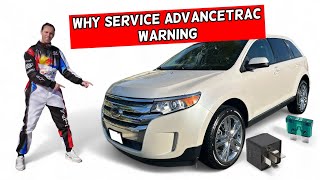
- Traction control or stability control warning light is on ('Service AdvanceTrac' message)
- Inability to clear the code with a basic scan tool
- Advanced Driver Assistance (ADAS) features may not function
- Scan tool reports 'Lost Communication with ABS module' from other modules
- Brake pedal feels soft or goes to the floor after an ABS event
- Replacing the module a second time. The problem is almost never the part itself, but the lack of programming. Swapping in another unprogrammed module will not fix the code.
- Assuming a wiring issue. While a damaged CAN bus wire can cause communication issues, U2101 specifically points to a 'configuration incompatible' error, which is a software-level problem, not a physical connection problem. Communication loss codes (U0121) are a symptom of U2101, not the root cause.
- Believing a used module cannot be programmed. While Ford dealers often state they can only program new modules, specialists and advanced DIYers using tools like FORScan can successfully reprogram used modules.
Most Likely Causes
- ABS Module Replaced Without Programming 🔴 High Probability The ABS module is a known failure point that gets replaced. However, a new or used module must be programmed with the vehicle's specific 'As-Built' data to function. Installing a used module from a donor car, even if the part number is identical, will cause this code if not reprogrammed.
How to confirm: Confirm with the vehicle's service history if the ABS module was recently replaced. A professional scan tool like FORScan or IDS can identify the misconfigured module and its incorrect VIN data.
Typical fix: The ABS module must be reprogrammed using a Ford IDS or FORScan tool to load the correct vehicle configuration data. This is known as a Programmable Module Installation (PMI). This procedure copies the 'As-Built' data from the old module (if available) to the new one or downloads it from Ford's servers using the VIN.
Est. part cost: $0 - Other Control Module Replaced Without Programming (BCM, RCM, etc.) 🟡 Medium Probability This code is common on vehicles that have had collision repairs, where modules from donor cars (especially the Restraints Control Module/RCM) are used without being wiped and reprogrammed.
How to confirm: A high-end scan tool can perform a network test to see which module is not communicating or is improperly configured. The module reporting the U2101 code is the one that needs programming.
Typical fix: The specific module (e.g., Restraints Control Module, Body Control Module) must be identified and reprogrammed with the vehicle's As-Built data using Ford-specific tools.
Est. part cost: $0 - Faulty ABS Module ⚪ Low Probability Internal failure of the module can corrupt its configuration data or cause a complete loss of communication. This can be caused by electrical overloads or corrosion from water intrusion over time. The official Ford diagnostic procedure for U2101 instructs to replace the module if reprogramming fails.
How to confirm: If reprogramming the module fails repeatedly, or if the module cannot be communicated with at all, the module itself is likely defective. This is a diagnosis of exclusion after programming attempts have failed.
Typical fix: Replace the ABS module and perform the necessary programming (PMI) on the new unit. Alternatively, the original module can be sent to a specialist for repair and rebuilding, which often costs less and may not require reprogramming.
Est. part cost: $250-$700
Rare But Worth Checking
- Incorrect Part Installed: A module from a different trim level or model year may have been installed (e.g., a steering column module for a car without adaptive cruise installed in one that has it). The part may physically fit but will be electronically incompatible, triggering U2101. For the Edge, installing an ABS module for a vehicle with Adaptive Cruise Control on one without it (or vice-versa) will cause this code.
- Low Battery Voltage / Power Loss During Programming: A severely discharged battery can cause data corruption in a module, leading to a U2101 code. Similarly, if battery voltage drops significantly while a module is being written to or updated, the process can fail and corrupt the module's configuration.
Diagnosis Steps
- Connect a professional-grade scan tool (Ford IDS, FORScan) capable of reading manufacturer-specific codes from all modules.
- Run a full network scan or self-test on all vehicle modules. Note which module is reporting the U2101 code. On a 2011-2014 Edge, this is often the ABS module.
- Check the service history to see if this module was recently replaced. This is the most common scenario.
- Using the scan tool, attempt to perform the 'Programmable Module Installation' (PMI) or 'Module Configuration' procedure.
- If the original module is available, connect it temporarily to allow the scan tool to 'inhale' or copy its configuration data.
- If the original module is not available, use the scan tool to download the vehicle's original 'As-Built' data from Ford's database (using the VIN) and write it to the module.
- After programming, perform any necessary calibration routines, such as the 'IVD Initialization Sequence' for the ABS module.
- Clear all DTCs and run the network self-test again. If U2101 returns, the module itself may be faulty and unable to accept programming, requiring replacement.
- If the module was not replaced, suspect an internal failure. If programming fails, the module will need to be replaced and the new unit programmed.
Parts You'll Likely Need
- Anti-Lock Brake System (ABS) Module
(OEM #DT4Z-2C215-A (replaces BT4Z-2C215-A), CT4Z-2C405-A)— This is the most likely module to be misconfigured or faulty on a 2011-2014 Edge when code U2101 is present. It is only needed if the original module is internally fried and cannot be reprogrammed. The module is often sold with the hydraulic control unit (HCU). 🎬 Watch: How to replace and program the ABS module
Trusted brands: Motorcraft (OEM), Bosch, Cardone (Remanufactured)
OEM price range: $569 - $1130
Aftermarket price range: $250-$500
Related Codes That Often Appear With This One
- U0121 — Lost Communication With Anti-Lock Brake System (ABS) Control Module. If the ABS module is improperly configured (U2101), other modules on the network will report that they cannot communicate with it.
- U3000 — Control Module. This is a general internal module failure code that can accompany U2101 if the module's internal logic is corrupted, as seen in the Ford Edge service manual diagnostic procedure. 🎬 See a walkthrough of manual As-Built programming for U3002
- U2100 — Initial Configuration Not Complete. This code is very similar to U2101 and often appears with it, indicating the module has not been set up at all. The diagnostic procedure is the same.
Technical Service Bulletins (TSBs) & Recalls
- SSM 47843 - While not for the Edge specifically, this Special Service Message for various 2010-2019 Ford vehicles confirms that DTCs U2100 and U2101 indicate a module has not been properly configured and the fix is to perform a Programmable Module Installation (PMI) or As-Built configuration using the Ford IDS tool.
Platform-Specific Known Issues
- source — An owner on fordedgeforum.com reported an intermittent ABS/Traction Control light issue where the ABS module would become completely non-communicative to scan tools. The problem became permanent after the battery was fully drained and the vehicle was jump-started. This highlights how power fluctuations can trigger or permanently damage a failing module, leading to communication and configuration errors.
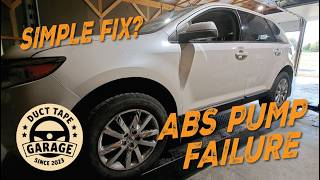
- DIY Replacement and FORScan Programming Success: A YouTube video by 'Duct Tape Garage' documents the entire process of replacing a failed ABS module on a Ford Edge with a used junkyard part. After physically swapping the module and bleeding the brakes, the U2101 code and 'Service AdvanceTrac' message remained. The creator successfully resolved the code by using FORScan software to perform an 'As-Built' configuration
Mechanic-Grade Diagnostic Values
- HS-CAN Bus Network Resistance — expected: Approximately 60 Ohms between CAN_H and CAN_L pins at the OBD-II connector (Pins 6 & 14).. Failure: A reading of 120 Ohms indicates one of the two terminating resistors (often in the PCM or Instrument Cluster) is offline. An open or shorted reading indicates a wiring fault.
- ABS Module Ground Circuit Resistance — expected: Less than 5.0 Ohms.. Failure: Resistance greater than 5.0 Ohms indicates a poor ground connection, which can cause intermittent module operation and communication faults.
- ABS Module Power Supply Voltage (Key On) — expected: Greater than 10 volts.. Failure: Voltage below 10 volts can trigger DTC U3003:16 (Battery Voltage Below Threshold) and may cause configuration corruption leading to U2101.
- CAN Bus Voltage (Key On, Engine Off) — expected: CAN High (Pin 6) should be between 2.5V and 3.5V. CAN Low (Pin 14) should be between 1.5V and 2.5V.. Failure: Voltages outside these ranges, or a short to ground/power on either line, will disrupt network communication.
Hidden / Shadow Codes Worth Checking
- U2101:55: Not Configured. This subtype explicitly means the module is blank and has not been programmed with the vehicle's As-Built data. This is common for new service parts. (see via Ford IDS, FORScan, or other professional-grade scan tools.)
- U2101:57: Invalid/Incompatible Software Component. This indicates the software or calibration file loaded onto the module is not compatible with the vehicle's hardware or other module software. (see via Ford IDS, FORScan, or other professional-grade scan tools.)
- U2101:00: No Sub Type Information. This is a general configuration incompatible error, often seen when a used module from another vehicle is installed. (see via Ford IDS, FORScan, or other professional-grade scan tools.)
Scan Tool Commands That Help
- FORScan / Ford IDS: Programmable Module Installation (PMI) — This is the primary function used to configure a new or used replacement module. It either copies data from the old module or downloads As-Built data from Ford's servers to write to the new part.
- FORScan / Ford IDS: Module Configuration (As-Built format) — This allows for direct editing or loading of the As-Built data for a specific module, like the ABS. It's the core procedure for programming a used module when the original is unavailable.
- FORScan / Ford IDS: IVD Initialization Sequence — This calibration procedure must be run after programming or replacing the ABS module. It calibrates the stability control sensors (Yaw Rate, Lateral Accelerometer) to their zero position. Failure to do this can result in a C1998 code and continued 'Service AdvanceTrac' warnings.
- FORScan: ABS Module Initialization (PATS) — In some cases, particularly with used modules, this function under the PATS (Passive Anti-Theft System) menu is used to make the vehicle recognize the replacement ABS module on the network before As-Built data can be written.
Wiring & Ground Locations
- ABS Module Ground — The main ground circuit for the ABS module is GD121 (BK/YE wire) at Pin 16 of the ABS module connector C135. This circuit typically grounds to the chassis near the left side of the engine compartment.. A poor ground connection can cause low voltage or voltage fluctuations at the module, leading to data corruption, communication loss, and configuration-related fault codes like U2101 and U3003.
- ABS Module Fuses — In the under-hood fuse box (Battery Junction Box), check fuse #5, fuse #43, and fuse #92.. Loss of power from a blown fuse will make the module incommunicable, which can be a precursor or symptom related to U2101. Specifically, these fuses power the ABS pump, module, and valves.
- ABS Module Connector C135 — The main electrical connector attached to the ABS module/HCU assembly in the engine bay.. All power, ground, and CAN bus communication lines run through this connector. Corrosion or backed-out pins here are a primary point of failure to check before condemning the module.
- G104 / G105 / G108 — These are primary engine compartment ground points. G104/G105 are on the left front of the engine compartment, while G108 is on the left rear.. While the ABS module has a dedicated ground wire, that wire ultimately terminates at one of these chassis ground points. Corrosion at these main grounds can cause widespread electrical issues, including module communication problems.
Real Owner Repair Stories
- Ford F150 Forum user (2012 F-150 (similar ABS system and programming)) — ABS and traction system warning lights after module failure.
❌ Tried (didn't work) A professional shop installed a new Ford ABS module but could not program it with their tools., Using the standard release version of FORScan, which could not load the necessary firmware.
✅ What actually fixed it The owner used a Beta version of FORScan, which had the capability to load the firmware onto the new, blank module. After loading the firmware and then the As-Built data, all codes were cleared and the system worked correctly.
OEM Part Supersession History
BT4Z-2C215-A→DT4Z-2C215-A— Standard part revision and update by Ford.
Heads up: The superseding part DT4Z-2C215-A is specified for vehicles without adaptive cruise control, built up to 11/18/2013. Vehicles with adaptive cruise or built after this date may require a different part number.
Model Year Variations Within This Range
- 2011-2013: The ABS module part number DT4Z-2C215-A is specified for models built up to November 18, 2013. Vehicles built in the 2014 model year after this date may use a different module, emphasizing the need to verify the part number for the specific vehicle.
Diagnostic Flowchart
Used vs. New Parts: Buying Guide for This Vehicle
When a used part is the smart pick: A used ABS module is a very common and cost-effective choice for this repair, as the root cause is almost always a software configuration issue (U2101) or a repairable internal electronic fault, not mechanical wear. Since even a new module requires programming, the labor is the same, but the part cost is significantly lower for a used unit.
Donor-vehicle mileage cap: roughly under 150000 miles for the part to have meaningful remaining life.
What to inspect on the donor part:
- Verify the part number from the donor vehicle matches your original module exactly.
- Inspect the electrical connector pins for any signs of corrosion, bending, or damage.
- Check the aluminum housing for any signs of physical impact or cracks.
- If possible, get the VIN of the donor vehicle. This allows you to look up its original 'As-Built' data, which can be helpful as a reference, though you will program your own vehicle's data.
- Buy from a reputable salvage yard with a return policy in case the module is electronically dead.
Aftermarket brands forum-validated for this vehicle:
- Motorcraft (New OEM)
- Cardone (Remanufactured - often a good budget alternative to new OEM)
Brands owners have reported issues with on this vehicle:
- Unknown, no-name brands from online marketplaces without warranties or seller history. The quality control for the electronics in these complex modules is critical.
Real Owner Stories
Aggregated from forums and TSBs cited above. Mileages and costs reflect what owners reported in those sources.
2011 Ford Edge
Symptoms: The ABS and Traction Control lights were on intermittently, and the ABS module would become completely non-communicative to scan tools. The problem became permanent after the battery died and the vehicle had to be jump-started.
What fixed it: The symptoms pointed to a complete internal failure of the ABS module, which would require replacement and programming.
Source hint: fordedgeforum.com - '2011 Edge ABS and Traction Control lights on'
2011-2014 Ford Edge
Symptoms: After replacing a failed ABS module with a used part from a junkyard, the U2101 code and 'Service AdvanceTrac' message would not go away.
What fixed it: The owner used FORScan software to perform an 'As-Built' configuration, which successfully programmed the used module to the vehicle and cleared the code.
Source hint: YouTube video by 'Duct Tape Garage'
Related OBD-II Codes
Frequently Asked Questions
I replaced my ABS module with a used one from a junkyard on my Ford Edge, and now I have a U2101 code and a 'Service AdvanceTrac' light. Is the part bad?
Can I just clear the U2101 code with my basic OBD-II scanner?
My Edge was in an accident and now has an airbag light on along with the U2101 code. Are these related?
What is 'As-Built' data and why do I need it to fix this code?
A mechanic tried reprogramming the ABS module, but the U2101 code came right back. What's next?
Does TSB SSM 47843 apply to my 2011-2014 Ford Edge?
Is this U2101 programming issue also common on the Lincoln MKX?
Helpful Videos

We Have This Part in Stock



The information in this article is provided for general reference and educational purposes only. Vehicle specifications, procedures, and part compatibility can vary by production date, trim level, and region. Always consult your vehicle's factory service manual and verify part numbers before purchasing or performing repairs. Safety-critical components such as airbags, seat belts, and braking systems should be installed by a qualified professional.
- Ford Edge:
- 🎬 Helpful Videos
- 🛍️ Shop This Part
- What's Unique About the 2011-2014 Ford Edge
- Symptoms You May Notice
- Most Likely Causes
- Rare But Worth Checking
- Diagnosis Steps
- Parts You'll Likely Need
- Related Codes That Often Appear With This One
- Technical Service Bulletins (TSBs) & Recalls
- Platform-Specific Known Issues
- Mechanic-Grade Diagnostic Values
- Hidden / Shadow Codes Worth Checking
- Scan Tool Commands That Help
- Wiring & Ground Locations
- Real Owner Repair Stories
- OEM Part Supersession History
- Model Year Variations Within This Range
- Diagnostic Flowchart
- Used vs. New Parts: Buying Guide for This Vehicle
- Real Owner Stories
- 2011 Ford Edge
- 2011-2014 Ford Edge
- Related OBD-II Codes
- Frequently Asked Questions
- 🎟️ Get 5% Off