

OBD-II Code U0151: Lost Communication With Airbag Control Module
What U0151 means, why it triggers, and how to fix it
- Code U0151 disables your entire Supplemental Restraint System (SRS), meaning airbags and seatbelt pretensioners provide 0% protection in a crash.
- Always test the battery and inspect the wiring harness before replacing the $600+ airbag module, as pinched wires cause over 50% of these faults on GM trucks.
- A scan showing multiple 'U' codes indicates a systemic network failure, pointing directly to a faulty gateway module (like a GM SDGM or Chrysler TIPM) rather than the airbag computer.
- Clearing code U0151 or programming a replacement module requires a professional bidirectional scan tool; a standard $20 OBD-II code reader cannot access SRS data.
What Does U0151 Mean?

Code U0151 means your car's main computer lost communication with the Restraints Control Module (RCM), also known as the Airbag Control Module or Sensing and Diagnostic Module (SDM). This module is the brain for your airbags and seatbelt pretensioners. When this Controller Area Network (CAN) bus link fails, the airbag warning light illuminates and the entire safety restraint system shuts down as a precaution.
Technical definition: Lost Communication With Restraints Control Module (RCM). This code sets when a supervising module (like the Body Control Module or Gateway) fails to receive required CAN bus messages from the airbag/SRS control unit within a 2-5 second window. This failure disables the system because its operational status cannot be verified.
Can I Drive With U0151?
No — Do Not Drive. Driving is highly dangerous. A U0151 code means the entire Supplemental Restraint System (SRS) is 100% inoperative. The airbags and seatbelt pretensioners provide zero protection in a collision. While the vehicle runs and drives normally, the safety risk is absolute. Drive only directly to a repair facility.
Common Causes

- Faulty Wiring or Damaged Connectors (Very Common) — This is the most frequent cause. Wires in the CAN bus network break, short to power or ground, or corrode. Connectors loosen or suffer bent pins, especially under seats, behind the dashboard, or after water intrusion.
- Weak or Failing Vehicle Battery (Common) — Low system voltage is a primary cause of communication codes. Modules fail to initialize or drop off the network if voltage drops below 9.6V during cranking. Always ensure the battery rests above 12.4V before diagnosing complex network issues.
- Loss of Power or Ground to the RCM (Common) — The Restraints Control Module requires a stable power supply and a solid ground. A blown fuse (labeled 'SRS' or 'AIRBAG'), a corroded ground point (like the G218 ground on GM vehicles), or a broken power wire prevents the module from booting up.
- Faulty Gateway or Other Network Module (Common) — A failure in a central hub disrupts the entire network. On GM vehicles, a faulty Serial Data Gateway Module (SDGM) causes a flood of 'U' codes, including U0151. On Chrysler/VW vehicles, a failing Totally Integrated Power Module (TIPM) causes identical network crashes.
- Faulty Restraints Control Module (RCM) (Less Common) — The module itself fails internally due to moisture damage, cracked solder joints, or component burnout. Suspect this only after ruling out all wiring, power, ground, and network issues.
- Aftermarket Device Interference (Less Common) — Improperly installed remote starters, alarms, or OBD-II data loggers interfere with the CAN bus network. They corrupt data or flood the bus, blocking the RCM from communicating.
- Post-Collision Data Lock (Rare) — After an accident, the RCM enters a 'locked' state to store crash data and refuses to communicate until reset by a specialist. A replacement module from a salvage vehicle lacking proper VIN-coding also triggers this mismatch.
Symptoms

- Airbag / SRS Warning Light On — The airbag light stays illuminated on the instrument cluster, indicating a total fault in the supplemental restraint system.
- Service Airbag System Message — The driver information display shows a text warning like "Service Airbag System" or "AIRBAG OFF".
- Multiple Warning Lights — Because this is a network issue, warning lights for ESC, ABS, or the parking brake often illuminate simultaneously.
- Failure to Pass Vehicle Inspection — An illuminated airbag warning light is an automatic failure for safety inspections in most jurisdictions.
- Inability to Communicate with SRS Module (scan-tool only — no driver-felt sign) — A professional scan tool cannot establish a connection with the Restraints Control Module to read codes or live data.
Diagnostic Flowchart
Tap your situation to follow the diagnostic path that matches what you're seeing on this code.
Common Fixes & Costs
- Repair Damaged Wiring or Connectors — Parts: $10-$50, Labor: $150-$450, ~2.0 hr book time (Intermediate)
- Replace Vehicle Battery — Parts: $150-$300, Labor: $50-$100, ~0.5 hr book time (DIY)
- Replace Blown Fuse — Parts: $1-$10, Labor: $50-$150, ~0.5 hr book time (DIY)
- Reset or Replace Gateway Module (SDGM/TIPM) — Parts: $250-$600, Labor: $150-$300, ~1.5 hr book time (Professional)
- Replace Restraints Control Module (RCM/SDM) — Parts: $400-$1000, Labor: $150-$300, ~1.5 hr book time (Professional)
Used vs. New Parts: Buying Guide
When a used part is worth it: For a Restraints Control Module (RCM), using a secondhand part is never recommended unless you send your original module to a specialized service for repair, preserving the VIN programming. For Gateway Modules (TIPM/SDGM), a used part from a low-mileage donor vehicle is a cost-effective option, but professional programming is still required.
Donor-vehicle mileage cap: roughly under 60000 miles for the part to have meaningful remaining life.
Donor quality checklist:
- For RCMs, only use a service that repairs YOUR original module.
- For Gateway Modules, match the part number exactly.
- Ensure the donor vehicle did not have flood or fire damage.
- Verify the used part comes with a 30-90 day warranty.
Decision logic:
- If The faulty part is the Restraints Control Module (RCM/SDM) → Repair your original module or buy a new, VIN-programmed unit. Do not buy a used one.
- If The faulty part is a Gateway Module (TIPM/SDGM) and the vehicle has high mileage (>120k) → A tested, used part from a reputable supplier is acceptable, but budget for professional programming.
- If The part is a safety-critical electronic module → Favor new OEM or remanufactured parts over used to ensure reliability.
Warranty tradeoff: Used parts typically have a 30-90 day functional warranty. Aftermarket new parts offer 1-year to limited lifetime warranties. New OEM parts carry a 1-2 year warranty.
Worst-case if a used part fails: $500-1000 if a used module fails after installation, requiring repeat labor and programming.
What Happens If You Wait — Timeline
- Immediate: Code U0151 sets, and the airbag warning light illuminates. The entire Supplemental Restraint System (SRS) is disabled as a fail-safe. (MPG impact: 0%% · Added cost: $0 (but safety risk is absolute))
- 0-12 months: The vehicle fails state-mandated safety inspections, preventing registration renewal and making the vehicle illegal to operate on public roads. (MPG impact: 0%% · Added cost: $50 - $300 (Fines, re-inspection fees, and tickets).)
- 3-18 months: If caused by a water leak or wiring short, the ongoing issue corrodes or damages other modules on the same network (e.g., BCM, Instrument Cluster). (MPG impact: 0%% · Added cost: $500 - $1500 (Cost to replace additional damaged modules).)
- Long-term (at time of sale): Resale value drops drastically. Dealers refuse the car on trade-in or offer scrap value. Private sales carry severe liability risks. (MPG impact: 0%% · Added cost: $2000 - $10,000+ (Diminished vehicle value).)
Cost of Not Fixing It
- Immediate: Complete failure of the Supplemental Restraint System (SRS). Airbags and seatbelt pretensioners will not deploy in a collision, drastically increasing the risk of serious injury or death. (Added cost: Incalculable (Risk to life and safety).)
- 0-12 months: Guaranteed failure of state safety inspection in most jurisdictions, resulting in fines and the inability to renew registration. (Added cost: $50 - $300 (Fines and re-inspection fees).)
- Long-term: Significantly reduced resale value. A vehicle with a permanent airbag fault is difficult to sell legally and is often valued only for parts. (Added cost: $2000 - $10,000+ (Diminished vehicle value).)
Diagnosis Steps

- Perform a Full Vehicle Scan
Use a professional OBD-II scanner to check all modules. If U0151 is the only code, the fault is isolated to the RCM circuit. If multiple 'U' codes are present, you have a wider network problem (e.g., gateway module, main bus wiring).
Tools: Professional OBD-II Scanner (Beginner) - Check Battery and Fuses
Verify the battery rests above 12.4V and the alternator charges at 13.5V-14.5V. Locate and inspect all fuses for the RCM/SDM, typically labeled 'SRS' or 'AIRBAG' in the cabin and underhood fuse panels.
Tools: Multimeter, Vehicle-specific fuse diagram (Beginner) - Visually Inspect Wiring and Connectors
Locate the Restraints Control Module (often under the center console or front seats). Inspect its bright yellow connector and surrounding harness for physical damage, pinched wires, corrosion, or water intrusion.
Tools: Flashlight, Trim removal tools (Intermediate) - Verify Power and Ground at the Module
Back-probe the RCM connector using a wiring diagram. Verify battery voltage (>12.4V) at the power pin. Check the ground pin to the chassis; resistance must be less than 0.1 ohms. Load the circuit with a test light to ensure voltage drop stays under 200 mV.
Tools: Multimeter, Vehicle-specific wiring diagram, Test light (Advanced) - Check CAN Bus Network Integrity
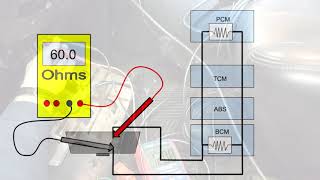
Disconnect the battery. Measure resistance between Pin 6 (CAN High) and Pin 14 (CAN Low) of the OBD-II port. A healthy bus reads 60 ohms (±5 Ω). 120 ohms indicates an open circuit; near 0 ohms indicates a short circuit.
Tools: Multimeter (Advanced) - Isolate the Network Branch
If the CAN bus is shorted, systematically disconnect modules on the same bus as the RCM. Re-check the CAN bus resistance after unplugging each one. If resistance returns to 60 ohms after unplugging a specific module, that module is shorting the network.
Tools: Professional OBD-II Scanner, Trim removal tools (Professional) - Perform CAN Bus Network Analysis
Use a dual-channel oscilloscope to view the CAN High and CAN Low signals. A healthy bus shows a clean, mirror-image square wave. Distorted or flat-lined patterns pinpoint shorts to power/ground or severe interference.
Tools: Dual-Channel Oscilloscope (Professional) - Isolate and Condemn the Module
If wiring, power, grounds, and the CAN network test perfectly, but the RCM remains offline, the RCM has failed internally. Replace the module and program it to the vehicle's VIN using a professional scan tool.
Tools: Professional Scan Tool for programming (Professional)
When This Code Triggers (Freeze-Frame Conditions)
- Module Voltage: 10.0-16.0V (Normal operating voltage; code often sets during key-on or startup when voltage drops or spikes.)
- Ignition Status: RUN (The code sets when the ignition is on and the supervising module expects to hear from the RCM but does not.)
- Network Status: Bus Off or Error Passive (The supervising module logs U0151 when it fails to receive a status message from the RCM within a 2-5 second window.)
- Vehicle Speed: 0 mph (Fault is most often detected during the initial self-test sequence immediately after turning the key.)
Related Codes
- U0073 — Control Module Communication Bus 'A' Off. Indicates a general failure of the main CAN bus. If U0073 appears alongside U0151, the problem is systemic (e.g., faulty gateway, shorted main bus), not isolated to the RCM.
- U0140 — Lost Communication With Body Control Module. The BCM often acts as the gateway for the RCM. If both codes are present, the BCM or network gateway module is the primary suspect.
- U0155 — Lost Communication With Instrument Panel Cluster (IPC). The IPC is a key gateway on many architectures. If the IPC is offline, it cannot report RCM status, triggering U0151.
- B-prefix codes (e.g., B0001) — Body codes stored inside the RCM. If you can read B-codes, communication is working, meaning the U0151 is intermittent or stored in a different module as a historical fault.
- U0151 + Symptom Byte (GM) — GM vehicles store a 2-digit symptom byte. U0151 71 indicates 'Invalid Serial Data Received' (faulty RCM or interference). U0151 7F indicates 'Erratic Communication' (loose connection or failing transceiver).
Climate & Environmental Factors
- High Humidity / Water Intrusion: Moisture accelerates corrosion of wiring, connector pins, and ground points. This increases electrical resistance and causes short circuits, disrupting CAN bus communication.
- Cold Climates / Road Salt: Salt spray is highly corrosive and compromises wiring harnesses and connectors located in exposed areas like the undercarriage or footwells, leading to network failures.
How to Talk to a Mechanic About This Code
Say this: "I have an airbag light on and a U0151 code, indicating a loss of communication with the restraints control module. Before replacing the module, please verify power, ground, and CAN bus wiring to the module, and check for any related technical service bulletins."
This signals you understand the code is a communication issue, not necessarily a failed part. It directs the technician to perform a thorough diagnosis of the supporting circuits first, preventing them from jumping to the most expensive conclusion.
Avoid saying:
- 'My airbag light is on, can you fix it?' (Invites a parts-first approach.)
- 'I think I need a new airbag computer.' (Anchors the shop to the most expensive repair.)
- 'Just do whatever it takes to turn the light off.'
Questions to ask before authorizing the repair:
- Did you find any other 'U' (communication) codes stored in other modules?
- Did you verify good power and ground directly at the airbag module connector?
- Did you inspect the CAN bus wiring for shorts or opens?
- If recommending a module replacement, can you confirm the old module receives proper power and has a good network connection?
- Does the quoted price for a new module include VIN programming?
Where to Take It: Dealer vs Independent vs Chain
- Dealer:
A strong, safe choice if programming a new module is required. They have the exact tools, but it is the most expensive option.
Best for: Vehicles under warranty, Vehicles with known manufacturer-specific issues covered by TSBs (like GM trucks), Complex programming of new safety modules
Downsides: Highest labor rates (1.5-2x independent shops), May default to module replacement without exhausting diagnostic avenues (Typical cost: +50% vs. baseline) - Independent Shop:
Best overall fit if you find a well-vetted shop. Look for ASE certifications and positive reviews mentioning electrical repairs.
Best for: Out-of-warranty vehicles where cost is a major factor, Shops with a strong reputation for electrical and diagnostic work
Downsides: Diagnostic capabilities vary widely. Ensure the shop has advanced tools and CAN bus experience., May lack specific tools to program a new module for all makes. (Typical cost: +0% vs. baseline) - Chain Shop:
AVOID. This is a complex safety-critical repair outside the scope of chain shops. The risk of misdiagnosis is very high.
Best for: Simple maintenance like oil changes or tires.
Downsides: Technicians lack specialized training for complex network diagnostics., Lack advanced scan tools required to diagnose or program SRS modules., High pressure to sell parts leads to misdiagnosis. (Typical cost: -10% vs. baseline)
When to Walk Away From the Repair
If the estimated repair cost for the U0151 code exceeds 50% of your vehicle's current private-party value, seriously consider selling the vehicle as-is or trading it in.
- Car worth $4000, fix is $1500: Borderline. The repair is nearly 40% of the car's value. Get a second opinion to confirm the diagnosis.
- Car worth $15000, fix is $800: Fix it. This is a critical safety repair and the cost is a small fraction of the vehicle's value.
- Car worth $2500, fix is $1200: Walk away. The repair cost is almost half the car's value. It is not economically viable to repair.
What Scan Tool You Need for This Code
Minimum: A scanner that reads and clears codes from the Supplemental Restraint System (SRS). A basic engine-only code reader will not work.
A standard $20 OBD-II reader only sees generic engine codes. It cannot communicate with the SRS module and shows 'No Codes Found' even with the airbag light on.
Budget: BlueDriver Pro (~$100) — Connects to your smartphone and reads/clears SRS codes for most major brands. Provides freeze-frame data to confirm U0151.
Mid-range: Foxwell NT630 Plus / Autel MaxiCOM MK808 (~$120-400) — Dedicated handheld scanners offering comprehensive all-system diagnostics. They view live data from modules, crucial for diagnosing network issues.
Professional: Autel MS906BT / Launch X431 Series (~$600-1200) — Provides full bidirectional control, performs module programming (essential if replacing the RCM), and offers network topology maps to visually identify offline modules.
Rent vs buy: For a one-time check, auto parts stores scan SRS systems for free. If the issue is complex, buying a midrange scanner with SRS capabilities is a worthwhile investment.
How to Clear the Code After You Fix It
- Ensure all repairs to wiring, modules, and connectors are complete.
- Reconnect the vehicle battery if it was disconnected.
- Use a professional-level scan tool with SRS capabilities to erase the U0151 code from all modules.
- Cycle the ignition off, then on, and verify the airbag warning light performs its self-check (illuminates briefly, then turns off).
Drive cycle (~15 minutes): An SRS-specific drive cycle is not required. The system performs a self-test at every key-on. A short drive of 10-15 minutes with several key cycles confirms the fix is stable.
Readiness monitors affected: None directly. However, disconnecting the battery to perform the repair resets all emissions readiness monitors, requiring a full drive cycle before an emissions test.
Before emissions retest: drive at least 50 miles to fully set monitors.
Watch out for:
- Using a basic OBD-II reader that cannot access or clear SRS/airbag codes.
- Forgetting to clear the code from gateway modules (e.g., BCM, IPC) that stored it as a historical fault.
- Failing an emissions test because the battery was disconnected during repair.
Will This Fail Emissions / State Inspection?
No — by itself this code doesn't fail OBD inspection (but it can keep readiness monitors from setting, which causes a separate fail).
- California: An illuminated airbag light is a reason for safety inspection failure. A vehicle must be in safe working order.
- New York: The NY DMV states an illuminated airbag warning light is an advisory and not cause for rejection during the annual safety inspection, though individual stations may interpret this strictly.
- Texas: Airbags are not listed as an inspected item for the standard safety inspection. A vehicle typically passes with the airbag light on.
Most Commonly Affected Vehicles
- GMC / Chevrolet Sierra / Silverado (2014-2019) — Extremely prone to a pinched wiring harness behind the left side of the dashboard, documented in GM TSB #PIT5288H. Also susceptible to faults at the Serial Data Gateway Module (SDGM).
- GMC / Chevrolet Yukon / Tahoe / Suburban (2015-2020) — Often caused by faulty connections at the Serial Data Gateway Module (SDGM) or a pinched instrument panel harness, per GM TSBs #PIT5586G and #PIT5288H.
- Volkswagen Golf (Mk7) (2013-2020) — Known for frequent internal failures of the airbag control module (J234), causing a complete loss of communication. Rebuilding the original module is the standard repair.
- Volkswagen Routan (2009-2014) — Shares Chrysler's electrical architecture. U0151 is commonly caused by a faulty Totally Integrated Power Module (TIPM). TSB TT 69-16-01 notes a misplaced 'transport' fuse after TIPM replacement causes this code.
- Honda Odyssey (2011-2017) — Known for communication failures between the gauge control module and the SRS unit. Diagnosis must focus on the communication lines between these two specific modules.
- Honda Civic / CR-V (2012-2016) — Suffer from internal SRS unit failures that specifically trigger U0151, making the module itself a primary suspect after verifying power and ground.
- Honda Accord (2008-2010) — Honda issued a 15-year warranty extension (TSB A16-007) for the SRS unit on these models for failures resulting in DTC U0151. Check VIN eligibility with a dealer.
- Ford F-150 (2010-2020) — U0151 is frequently traced to corrosion in connectors located in the footwells or under the vehicle due to water intrusion.
Manufacturer-Specific Notes
- General Motors (GM): GM has critical TSBs for U0151 on K2XX platform trucks (2014-2020). TSB #PIT5288H points to a pinched wiring harness behind the driver's side dash. TSB #20-NA-212 points to logic lock at the Serial Data Gateway Module (SDGM).
- Chrysler / FCA (Jeep, Dodge, Ram): The RCM is called the Occupant Restraint Controller (ORC). U0151 is frequently caused by an internal failure of the Totally Integrated Power Module (TIPM), which acts as the primary power distribution and gateway module.
- Honda: Certain Civic, CR-V, and Accord models have known issues with internal SRS module failure. Honda issued a 15-year warranty extension for 2008-2010 Accords under TSB A16-007.
- Ford: Ford networks are highly sensitive to water intrusion. U0151 is often traced to corrosion in footwell connectors or issues with the Steering Angle Sensor, which shares the same CAN bus and disrupts communication if it fails.
Real Owner Stories
2015 GMC Sierra 1500 with 110K miles
Airbag light and 'Service Airbag System' message appeared constantly. Multiple other 'U' codes were present.
What they tried:
- Checked all SRS-related fuses.
- Disconnected and reconnected battery to reset modules.
- Replaced the Airbag Control Module (SDM) with a used unit, which failed to solve the problem.
Outcome: A mechanic diagnosed a pinched wiring harness behind the driver's side dashboard (GM TSB #PIT5288H). Wires were repaired for $450. The original SDM was reinstalled, and all codes cleared.
Lesson: On GM trucks, always inspect the known wiring harness issue before replacing the expensive SDM, especially if multiple communication codes are present.
2013 Honda CR-V with 85K miles
Airbag light stayed on. A basic scanner could not communicate with the SRS module.
What they tried:
- Checked battery voltage and SRS fuse.
- Visually inspected the yellow connectors under the front seats.
Outcome: The owner sent the original SRS module to a specialized repair service that identified an internal board-level failure. The module was repaired for $150. After re-installation, communication was restored.
Lesson: For certain Honda models, an internal SRS module failure is common. Repairing the original module is significantly cheaper than buying and programming a new dealer unit.
2017 Chevy Silverado after DIY console swap
After swapping the factory jump seat for a center console, the airbag and Stabilitrak lights illuminated with code U0151.
What they tried:
- Checked airbag fuse.
- Re-checked all connections under the seats.
- Disconnected the battery for 30 minutes.
Outcome: The aftermarket wiring harness used for the conversion did not correctly route the CAN bus signals, causing the SDM to drop off the network. Sourcing the correct OEM harness resolved the fault.
Lesson: Aftermarket modifications involving wiring easily disrupt the CAN network. Ensure conversion harnesses are verified compatible with your specific trim and year.
How to Prevent This Code From Triggering
- Maintain Battery Health (Every 6 months) — Low system voltage is a primary cause of communication codes. Clean battery terminals and ensure the battery holds a charge above 12.4V at rest.
- Prevent Water Intrusion (Annually) — Water damage causes wiring corrosion and module failure. Ensure sunroof drains are clear and weather stripping is intact to keep the cabin dry.
- Apply Dielectric Grease to Key Connectors (During any related repair) — Applying non-conductive dielectric grease to connector seals keeps moisture and oxygen out, preventing pin corrosion.
- Use Caution with Aftermarket Electronics (During installation) — Improperly installed remote starters or stereos damage the CAN bus. Ensure aftermarket devices are installed by professionals who understand vehicle networks.
- Annual Undercarriage Wash (Annually (Spring)) — Road salt corrodes wiring and grounds on the undercarriage. A thorough spring wash removes salt buildup and reduces long-term corrosion risks.
Frequently Asked Questions
Is it safe to drive with a U0151 code?
No. The U0151 code confirms your entire airbag system is disabled and will not deploy in an accident. This is a critical safety failure that requires immediate repair.
Will the U0151 code clear itself?
No. This code indicates a hard fault in a critical safety system. The airbag light remains on until the underlying problem is fixed and the code is cleared with a professional-level scan tool.
Can a low or dead battery cause a U0151 code?
Yes. A weak battery (operating voltage below 9.6V during cranking) or a jump start causes modules to power up erratically, leading to communication faults. Always ensure the battery is fully charged before starting complex diagnostics.
What is a Serial Data Gateway Module (SDGM)?
An SDGM is a central network hub used by GM that manages communication between different vehicle networks. A fault in the SDGM blocks communication to many modules, making it a common cause of multiple 'U' codes.
What is a Totally Integrated Power Module (TIPM)?
A TIPM is used in Chrysler/FCA vehicles and functions as a combined fuse box and body control computer. Internal circuit board failures are common and cause a wide range of network issues, including U0151.
What are the most common misdiagnosis mistakes for U0151?
The biggest mistake is immediately replacing the expensive airbag module instead of checking for blown fuses, bad grounds, or pinched wiring. The second mistake is ignoring other 'U' codes, which indicate a network-wide failure rather than an isolated airbag module issue.
Can I reset the airbag light myself after fixing the problem?
Standard OBD-II code readers cannot access or clear SRS codes. You need a professional-level scan tool with SRS capabilities to clear U0151 and turn off the warning light.
How much does it cost to fix a U0151 code?
Costs range from $100 for a simple fuse or ground repair to $450+ for complex wiring harness fixes. Replacing a gateway module (SDGM/TIPM) averages $400-$750. If the airbag module itself requires replacement and programming, expect to pay between $600 and $1,500.
Can I use a secondhand airbag module?
Using a secondhand airbag module is dangerous and strongly discouraged. Used modules often contain hidden crash data or incompatible VIN programming that prevents them from functioning. Always repair your original module or purchase a new, correctly programmed OEM unit.
Key Takeaways
- Code U0151 disables your entire Supplemental Restraint System (SRS), meaning airbags and seatbelt pretensioners provide 0% protection in a crash.
- Always test the battery and inspect the wiring harness before replacing the $600+ airbag module, as pinched wires cause over 50% of these faults on GM trucks.
- A scan showing multiple 'U' codes indicates a systemic network failure, pointing directly to a faulty gateway module (like a GM SDGM or Chrysler TIPM) rather than the airbag computer.
- Clearing code U0151 or programming a replacement module requires a professional bidirectional scan tool; a standard $20 OBD-II code reader cannot access SRS data.
Helpful Videos
![TIPM [Dodge, Chrysler, Jeep] Removal and Solution](https://img.youtube.com/vi/qea1H85HBwU/mqdefault.jpg)

The information in this article is provided for general reference and educational purposes only. Vehicle specifications, procedures, and part compatibility can vary by production date, trim level, and region. Always consult your vehicle's factory service manual and verify part numbers before purchasing or performing repairs. Safety-critical components such as airbags, seat belts, and braking systems should be installed by a qualified professional.
- 🎬 Helpful Videos
- What Does U0151 Mean?
- Can I Drive With U0151?
- Common Causes
- Symptoms
- Diagnostic Flowchart
- Common Fixes & Costs
- Used vs. New Parts: Buying Guide
- What Happens If You Wait — Timeline
- Cost of Not Fixing It
- Diagnosis Steps
- When This Code Triggers (Freeze-Frame Conditions)
- Related Codes
- Climate & Environmental Factors
- How to Talk to a Mechanic About This Code
- Where to Take It: Dealer vs Independent vs Chain
- When to Walk Away From the Repair
- What Scan Tool You Need for This Code
- How to Clear the Code After You Fix It
- Will This Fail Emissions / State Inspection?
- Most Commonly Affected Vehicles
- Manufacturer-Specific Notes
- Real Owner Stories
- 2015 GMC Sierra 1500 with 110K miles
- 2013 Honda CR-V with 85K miles
- 2017 Chevy Silverado after DIY console swap
- How to Prevent This Code From Triggering
- Frequently Asked Questions
- Is it safe to drive with a U0151 code?
- Will the U0151 code clear itself?
- Can a low or dead battery cause a U0151 code?
- What is a Serial Data Gateway Module (SDGM)?
- What is a Totally Integrated Power Module (TIPM)?
- What are the most common misdiagnosis mistakes for U0151?
- Can I reset the airbag light myself after fixing the problem?
- How much does it cost to fix a U0151 code?
- Can I use a secondhand airbag module?
- Key Takeaways
- 🎟️ Get 5% Off