

U1010 on 2005-2012 Nissan XTERRA: CAN Communication Failure Causes and Fixes
On a 2005-2012 Nissan XTERRA, code U1010 is a network communication error most often caused by poor ground connections or a failing Intelligent Power Distribution Module (IPDM). Start by cleaning the battery terminals and the main chassis ground under the battery tray. If the issue persists, the IPDM, located in the engine bay, is the next likely culprit and may need replacement, especially if it's the original white-board version.
- Code U1010 is a serious network communication error; do not continue driving.
- Before buying any parts, fully charge your battery and thoroughly clean the main battery and chassis ground connections. This simple step, recommended by Nissan, can fix the issue.
- The IPDM in the engine bay is a highly probable cause. Try swapping the ECM relay with the fog light relay as a quick, free diagnostic test.
- If your Xterra has an automatic transmission, immediately check your transmission fluid for signs of coolant contamination (SMOD). If it's milky or pink, a major repair is needed.
What's Unique About the 2005-2012 Nissan XTERRA
The second-generation XTERRA platform, along with its Frontier and Pathfinder siblings, is particularly susceptible to two major issues that can trigger a U1010 code. First, a well-documented Nissan Technical Service Bulletin (NTB10-066A) points directly to poor ground connections causing communication errors. The primary negative-to-chassis ground is a frequent offender. Second, the Intelligent Power Distribution Module (IPDM), which acts as a central hub for vehicle electronics, is a known failure point, with early models having less reliable white-colored circuit boards that are prone to internal relay failure and water damage. These two issues account for a majority of U1010 cases on this platform.
Diagnostic Flowchart
Tap your situation to follow the diagnostic path that matches what you're seeing on this vehicle.
Symptoms You May Notice
- Engine will not crank or start
- Engine stalls while driving
- Check Engine Light is on
- Transmission shifts harshly or is stuck in one gear (limp mode)
- Multiple warning lights on the dashboard (ABS, VDC, SLIP, Battery)
- Cooling fans running at full speed when the engine is off or key is on
- Erratic electrical behavior (lights flickering, radio issues)
- Scan tool cannot communicate with the ECM or other modules
- Replacing the ECM when the IPDM is the actual cause.
- Replacing the starter motor for a no-crank condition caused by a communication error.
- Replacing individual sensors without first checking the network integrity and power/ground systems.
- Replacing the battery without first cleaning and securing the ground connections.
Most Likely Causes
- Poor Ground Connections or Low Battery Voltage 🔴 High Probability Nissan TSB NTB10-066A specifically identifies excessive resistance in ground connections as a cause for U1000/U1010 codes. The main ground from the battery negative terminal to the body, often located under the battery tray, is a common point of corrosion. Low battery voltage can also cause modules to drop off the network.
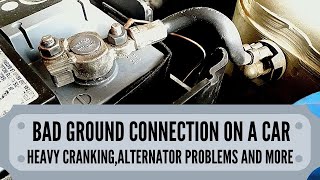
How to confirm: Test the battery to ensure it's above 12.4 volts with the engine off. Visually inspect and physically check the main battery ground cable, especially where it bolts to the chassis. 🎬 See how to diagnose and clean bad ground connections. Also inspect engine block grounds. Look for any signs of corrosion (green or white powder), looseness, or paint interfering with the connection.
Typical fix: Disconnect the battery. Remove, wire brush, and scuff the ground connection points and terminals until they are shiny bare metal. Re-tighten securely. Applying dielectric grease can help prevent future corrosion. Replace the battery if it fails a load test.
Est. part cost: $0-$250 - Failing Intelligent Power Distribution Module (IPDM) 🔴 High Probability The IPDM is a very common failure point on this platform, leading to a wide range of electrical and communication problems. The internal, non-serviceable ECM relay is often the component to fail, and the module is also susceptible to water intrusion.
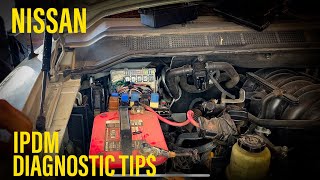
How to confirm: Perform the IPDM self-test (turn ignition on, open driver's door, press and release the door switch 10 times). 🎬 Watch: A quick demonstration of the IPDM self-test procedure. The IPDM should cycle various components like wipers and headlights. A common diagnostic trick is to swap the ECM relay with the identical fog light relay (if equipped and accessible) to see if the problem is resolved.
Typical fix: Replace the IPDM unit. Nissan released an updated, more reliable version with a black-colored case/board to replace the failure-prone original white/clear-cased units. Ensure the part number matches your vehicle's VIN.
Est. part cost: $150-$400 - Failed Transmission Control Module (TCM) due to Coolant Contamination (SMOD) 🟡 Medium Probability On 2005 to early 2010 models with automatic transmissions, a defect in the Calsonic-made radiator can cause the internal transmission cooler to crack. This mixes coolant with transmission fluid, creating the 'Strawberry Milkshake of Death' (SMOD), which destroys the internally-housed TCM and its sensitive electronics.
How to confirm: Check the transmission fluid dipstick. If the fluid is pink, milky, or looks like Pepto-Bismol, you have coolant contamination. Also check the radiator overflow for signs of oily transmission fluid. This issue primarily affects 2005-early 2010 automatic transmission models.
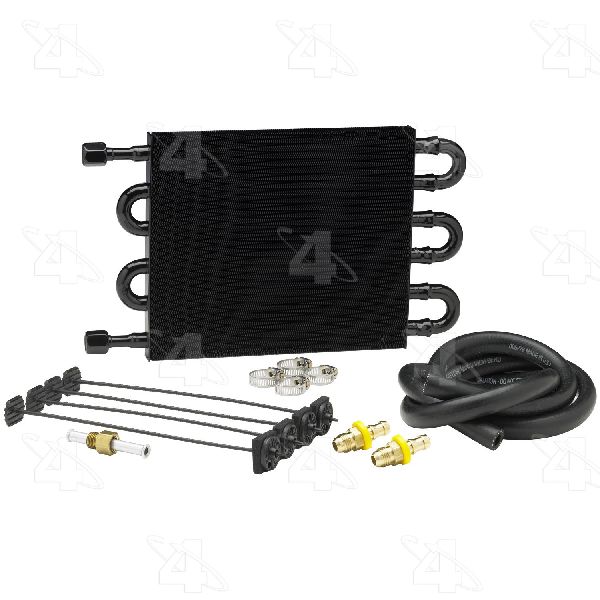
Typical fix: This is a major repair requiring replacement of the radiator, a complete transmission flush, and replacement of the valve body/TCM assembly inside the transmission. Many owners proactively bypass the radiator's cooler or replace the radiator to prevent this failure.
Est. part cost: $800-$2000 - Open or Short in CAN Bus Wiring ⚪ Low Probability
How to confirm: This requires a multimeter and wiring diagram. With the battery disconnected, measure the resistance between the CAN-High and CAN-Low pins at the OBD-II port (pins 6 and 14). A healthy network should read approximately 60 ohms. If it reads 120 ohms, there is a break in the wiring or a faulty terminating module. An open circuit (OL) or a short to ground (0 ohms) indicates a wiring fault.
Typical fix: Locate and repair the damaged section of the wiring harness or replace the corroded connector. Common areas for damage are near the engine or under the vehicle where wires are exposed to heat and debris.
Est. part cost: $5-$100
Rare But Worth Checking
- Failed ABS Actuator / Control Module:
Diagnosis Steps
- Check Battery and Grounds: Ensure the battery has a full charge (12.4V+). Disconnect, clean, and tighten all battery terminals. Pay special attention to the main negative ground connection from the battery to the vehicle body, often found under the battery tray, as it is a known corrosion point.
- Scan for All Codes: Use a quality OBD-II scanner that can read codes from all modules (Engine, Transmission, ABS, BCM), not just the engine computer. Note all 'U' codes, as they point to the network issue.
- Perform IPDM Self-Test: With the ignition on, open the driver's door and press the door jamb switch 10 times within 20 seconds, then turn the ignition off and on again. Observe if the wipers, lights, and horn cycle on and off. A failure to operate or erratic operation points to a faulty IPDM.
- Inspect and Swap ECM Relay: Locate the IPDM in the engine bay. If accessible and your vehicle has identical relays, swap the ECM relay with the fog lamp or another non-critical relay to see if the no-start or communication issue is resolved. This is a free and effective diagnostic step.
- Check for SMOD (2005-2010 Automatics): Carefully inspect the transmission fluid for any signs of pink, milky contamination. Also check the radiator coolant for an oily sheen. If SMOD is suspected, the TCM is likely damaged and the source of the communication loss.
- Check CAN Bus Resistance: If you are comfortable with electronics, disconnect the battery and use a multimeter to measure the resistance between Pin 6 (CAN-H) and Pin 14 (CAN-L) on the OBD-II port. A reading of ~60 Ohms is normal. 120 Ohms indicates a wiring break or a problem with a terminating module.
- Seek Professional Help: If the above steps do not identify the issue, a professional technician with a Nissan-specific scan tool (CONSULT) will be needed to monitor the network live and pinpoint the faulty module or wiring.
Parts You'll Likely Need
- Intelligent Power Distribution Module (IPDM)
(OEM #284B7-EA030, 284B7-ZE03B (Verify with VIN))— This is a very common failure point on the Xterra that directly causes communication codes like U1010. The original white/clear case versions are particularly failure-prone.
Trusted brands: Nissan (OEM)
OEM price range: $250-$400
Aftermarket price range: $150-$300 - Transmission Valve Body with TCM
Related Codes That Often Appear With This One
- U1000 — U1000 is a general CAN communication failure code. U1010 is a more specific version of the same network problem, and they often appear together as they both indicate a CAN bus malfunction.
- U0101 — This code means 'Lost Communication with TCM'. If the TCM has failed (especially due to SMOD), you will likely see U0101 alongside the more general U1010, as the TCM has dropped off the network.
Technical Service Bulletins (TSBs) & Recalls
- General service information for diagnosing CAN communication codes like U1000 and U1010. It advises diagnosing these codes first and provides a framework for analysis.
- Addresses the automatic transmission fluid cooler issue (SMOD) by extending the warranty for affected vehicles. This implicitly acknowledges the radiator defect that leads to TCM failure.
- Provides diagnostic flow for when U1000 is stored in the ABS/VDC control unit, which is often linked to general CAN bus problems that can include a U1010 code.
Platform-Specific Known Issues
- SMOD (Strawberry Milkshake of Death): On automatic models, the radiator's internal transmission cooler is prone to failing, mixing coolant and transmission fluid. This contaminated fluid destroys the Transmission Control Module (TCM), which is located inside the transmission, causing communication and shifting failures.
- Faulty IPDM: The Intelligent Power Distribution Module (IPDM) is a known weak point. The internal ECM relay can fail, causing a no-start condition, and the entire module can fail, leading to widespread communication loss.
Mechanic-Grade Diagnostic Values
- CAN Bus Network Resistance — expected: ~60 Ω. Failure: A reading of ~120 Ω indicates an open circuit or missing terminating resistor. A reading near 0 Ω indicates a short between CAN High and CAN Low wires.
- ECM Power Supply Voltage from IPDM — expected: Within 0.5 volts of battery voltage.. Failure: A significantly lower voltage (e.g., 5-6 volts) at the Mass Airflow Sensor's power supply wire indicates a failing ECM relay inside the IPDM.
Scan Tool Commands That Help
- Nissan CONSULT-II / CONSULT-III Plus: CAN Diagnosis Support Monitor — This is the primary professional diagnostic function for any 'U' code. It polls the entire CAN network and displays a list of all modules, showing which ones are communicating ('OK') and which are not ('NG' - No Good). This instantly tells the technician which module has dropped off the network and is causing the U1010 code.
- Nissan CONSULT-III Plus: Data Monitor — For intermittent communication faults, the Data Monitor can be set up to record network data and trigger a recording when a specific fault (like a DTC) is detected. This helps capture data at the exact moment of failure during a road test.
Wiring & Ground Locations
- CAN Bus at OBD-II Port — The Data Link Connector (OBD-II port) under the driver's side dashboard.. Pins 6 (CAN-H) and 14 (CAN-L) are the primary, most accessible points for testing the entire CAN bus resistance to quickly determine if there is a major network wiring fault like an open or short.
- IPDM E/R — Intelligent Power Distribution Module Engine Room, located in the engine bay near the battery.. This module is the electronic heart of the vehicle, containing the fuses and relays that power most other modules, including the ECM. The internal ECM relay is a primary failure point causing U1010.
- Engine Block Grounds — There are ground straps on both sides of the engine that attach to the exhaust manifolds, often secured by a 10mm bolt for the heat shield.. A poor ground connection between the engine and chassis can create a floating ground for the ECM and other engine-mounted modules, disrupting CAN communication and triggering U-codes.
Real Owner Repair Stories
- Reddit user on r/XTerra (2014 Xterra) — No crank, no start, with a U1010 code present.
❌ Tried (didn't work) Scanning the code.
✅ What actually fixed it The owner discovered that if they physically touched/wiggled the starter relay inside the IPDM, the truck would then start and run normally, strongly indicating a poor connection at the relay or a failing relay within the IPDM. - Reddit user on r/XTerra (2007 Xterra) — Sudden loss of power while driving, chugging, flashing brake and battery lights, followed by a crank-but-no-start condition.
❌ Tried (didn't work) Replacing camshaft position sensors., Replacing crankshaft position sensor., Swapping the ECM relay.
✅ What actually fixed it The owner suspected the original 'white board' IPDM was the cause. Another user with a Nissan Titan confirmed they fixed an identical issue (crank-no-start with fans running full blast) by replacing the IPDM's ECM relay. The evidence points to a failed IPDM. - Reddit user on r/XTerra (2001 Xterra) — Instrument cluster completely died (all gauges to zero) after hitting a large bump or washboard on a dirt road. The issue would blow the 10A fuse for the gauge cluster.
❌ Tried (didn't work) Replacing the alternator (as the fuse also controlled its circuit)., Visually inspecting the cluster's circuit board.
✅ What actually fixed it The issue was intermittent and clearly related to vibration. After replacing a blown fuse, the cluster worked until the next big bump. The final diagnosis was a short-to-ground somewhere in the wiring harness leading to the instrument cluster.
OEM Part Supersession History
Various 'white board' IPDM units→Various 'black case' IPDM units (e.g., 284B6-ZE03B supersedes 284b6ze03a for 2010+ models)— The original IPDMs with white or clear cases were prone to internal circuit and relay failure. Later revisions with black cases are considered more reliable.
Heads up: There were several mid-production changes to the IPDM. The part number is vehicle-specific and must be verified using the VIN to ensure compatibility. Ordering the wrong IPDM can result in a no-start or other electrical failures.
Model Year Variations Within This Range
- 2005-early 2010: These model years with automatic transmissions are susceptible to the radiator defect causing coolant to mix with transmission fluid (SMOD), which destroys the internal TCM and causes communication codes. Later models used a revised radiator design.
- 2009-2012: The 2009 model year received a facelift with revised styling, new HVAC controls, and different standard/optional audio systems, including more prevalent Bluetooth integration. These electrical changes can mean different wiring or connector types behind the dash compared to 2005-2008 models.
- 2011-2012: The 'Off-Road' trim was renamed 'PRO-4X'. This is primarily a name change but is important to know when searching for trim-specific information or parts.
Helpful Videos

Used OEM Parts in Stock


New Aftermarket Parts Available

The information in this article is provided for general reference and educational purposes only. Vehicle specifications, procedures, and part compatibility can vary by production date, trim level, and region. Always consult your vehicle's factory service manual and verify part numbers before purchasing or performing repairs. Safety-critical components such as airbags, seat belts, and braking systems should be installed by a qualified professional.
- Nissan XTERRA:
- 🎬 Helpful Videos
- 🛍️ Shop This Part
- What's Unique About the 2005-2012 Nissan XTERRA
- Diagnostic Flowchart
- Symptoms You May Notice
- Most Likely Causes
- Rare But Worth Checking
- Diagnosis Steps
- Parts You'll Likely Need
- Related Codes That Often Appear With This One
- Technical Service Bulletins (TSBs) & Recalls
- Platform-Specific Known Issues
- Mechanic-Grade Diagnostic Values
- Scan Tool Commands That Help
- Wiring & Ground Locations
- Real Owner Repair Stories
- OEM Part Supersession History
- Model Year Variations Within This Range
- 🎟️ Get 5% Off