

U0121 on 2004-2011 Ford Focus: Lost ABS Communication Causes and Fixes
On a 2004-2010 Ford Focus, code U0121 is most often caused by a failing instrument cluster with bad solder joints, which disrupts network communication. A professional cluster repair service is the most likely fix. If the cluster is working fine, check ABS fuses and wiring next.
- On a 2004-2010 Focus, if you have U0121 plus other U-codes and your gauges are acting erratically, the instrument cluster is almost certainly the problem.
- Do not replace the ABS module without first ruling out the instrument cluster and checking simple things like fuses.
- Driving with this code is a safety risk as your anti-lock brakes and stability control will be disabled.
- A mail-in repair service for your original instrument cluster is the most cost-effective solution for the most common cause of this code.
What's Unique About the 2004-2011 Ford Focus
For the 2004-2010 Ford Focus specifically, this code is very frequently a symptom of a well-documented instrument panel cluster (IPC) failure. The IPC acts as a critical communication gateway in the vehicle's network. Over time, solder joints on the cluster's circuit board crack due to heat and vibration, causing intermittent communication loss between multiple modules, including the ABS. This is a much more common cause than the ABS module itself failing. Repair services explicitly identify this link between the cluster fault and the U0121 code.
Generation note: This range covers the end of the first generation (C170, through 2007 in the US) and the full second generation (C307, 2008-2011). The common instrument cluster failure is a known issue for models from 2004-2010. The 2011 model is the first year of the third generation and is less prone to the specific cluster issue, though other causes like wiring or module faults can still occur.
Symptoms You May Notice
- ABS warning light is on
- Traction Control (TCS/ESP) warning light is on
- Check Engine Light may be on
- Speedometer works erratically or not at all
- Odometer displays dashes [-------] instead of mileage
- Multiple warning lights may flash intermittently
- Vehicle may intermittently fail to start (no-crank condition)
- Engine cuts out while driving
- A strange beeping noise or warning chime without accompanying lights may occur, as noted in NHTSA ODI #11581420.
- Replacing the ABS module when the actual fault is the instrument cluster. This is a common and expensive mistake on the 2004-2010 Focus. If you have erratic gauge behavior, the cluster is the primary suspect.
Most Likely Causes
- Failing Instrument Panel Cluster (IPC) 🔴 High Probability The circuit board solder joints inside the cluster are known to fail from repeated heat cycles and vehicle vibration, disrupting the CAN bus network for which the IPC is a gateway. This is a widely recognized defect for the Mk2 Focus.
How to confirm: Look for accompanying codes like U0155, U1900, U0001, or P1260. Symptoms like erratic gauges, a no-start condition, or multiple warning lights flashing are strong indicators. Tapping on the top of the dashboard may cause the symptoms to appear or disappear temporarily. A forum user on fordownersclub.com reported a slew of U-codes including U0121, U0155, and U1900, which was correctly diagnosed by others as a classic cluster failure.
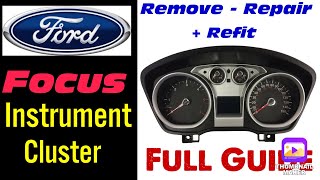
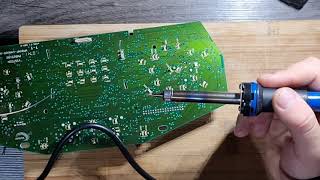
Typical fix: The instrument cluster must be removed and sent to a specialist for the circuit board to be professionally re-soldered and repaired. 🎬 See how to disassemble and resolder your instrument cluster. This avoids reprogramming. A user on the Ford Focus Club forum noted that this is the easiest option as a second-hand cluster is difficult to program due to the integrated PATS immobilizer.
Est. part cost: $100-$300 (£90-£250) for a mail-in repair service. - Blown ABS Fuse(s) 🟡 Medium Probability
How to confirm: Check the fuses for the ABS system in the engine compartment fuse box. There are typically multiple fuses, often a 40A and 30A for the pump and a smaller 5A or 10A fuse for the control module. On 2011+ models, these are often located under a secondary cover within the main fuse box.
Typical fix: Replace the blown fuse. If the fuse blows again immediately, there is a short circuit in the wiring or the ABS module that needs to be diagnosed.
Est. part cost: $1-$5 - Corroded or Damaged Wiring/Connectors 🟡 Medium Probability
How to confirm: Visually inspect the wiring harness and connector at the ABS module for any signs of green corrosion, chafed wires, or physical damage. The ABS module is typically located on the hydraulic control unit under the hood, sometimes under the main fuse box or battery tray. 🎬 Watch: How to find the ABS pump and module location. Also check CAN bus junction connectors, which can be found in the passenger footwell area. A user on a Ford truck forum with the same code found the cause to be a wire in the ABS harness that had rubbed through behind the driver's inner fender. Also check main chassis ground points for corrosion.
Typical fix: Repair the damaged section of wiring or clean/replace the corroded connector. Applying dielectric grease can help prevent future corrosion. Ensure a weatherproof seal to prevent future issues.
Est. part cost: $10-$50 for wiring repair supplies. - Faulty ABS Control Module ⚪ Low Probability
How to confirm: This is typically diagnosed by exclusion. If the instrument cluster is known to be good, all fuses are intact, and power, ground, and CAN bus signals are verified at the ABS module connector with a multimeter, then the module itself is the likely culprit. A user on PassionFord forums confirmed their U0121 and speedo issue was fixed by replacing the ABS module after diagnostics pointed to no communication.
Typical fix: Replace the ABS control module. This requires programming the new module to the vehicle's VIN and configuration using Ford's IDS software or a compatible J2534 tool. The As-Built data from the original module should be transferred or downloaded from Ford's service portal.
Est. part cost: $150-$400 for a remanufactured unit, $500+ for a new OEM unit.
Rare But Worth Checking
- Low Battery Voltage: A weak or failing battery can cause a multitude of random communication codes, including U0121. Before diving into complex diagnostics, ensure the battery has at least 12.4V with the engine off and that the charging system is working correctly (13.8V-14.5V when running). NHTSA ODI #11635359 notes a case where communication errors including U0121-00 were present alongside a bad clockspring and required a new battery.
Diagnosis Steps
- Scan for all DTCs in all modules. If U0155, U1900, or P1260 are present along with U0121 and cluster symptoms (erratic gauges, no-start), the instrument cluster is the most likely cause.
- If only U0121 is present, start with simple checks. Test the battery and charging system to ensure proper voltage (12.4V+ off, 13.8V+ running).
- Locate the engine bay fuse box and inspect all fuses related to the ABS and stability control systems. Check the 40A, 30A, and 5A/10A fuses specifically.
- If fuses are good, locate the ABS module. Visually inspect its electrical connector and nearby wiring for corrosion, moisture, or damage, paying close attention to where the harness may rub against the chassis or inner fender.
- Using a multimeter and a wiring diagram, disconnect the ABS module and check for 12V power and good ground continuity at the connector pins.
- With the battery disconnected and key off, measure the resistance between the CAN-High (Pin 6) and CAN-Low (Pin 14) pins at the OBD-II port. It should be approximately 60 Ohms. A reading of 120 Ohms suggests an open circuit or a missing terminating resistor (often in the cluster or PCM). A reading near 0 Ohms indicates a short between the two CAN wires.
- If power, ground, and the CAN network test okay, the ABS module itself is the most likely remaining point of failure.
Parts You'll Likely Need
- Instrument Cluster Repair Service — This is the most common fix for the 2004-2010 models. The original cluster is repaired, which avoids the need for costly reprogramming.
Trusted brands: ECU Testing, Autotronics, CuSToMod
OEM price range: $800-$1200 for a new cluster.
Aftermarket price range: $100-$300 for a mail-in repair service. - ABS Control Module
(OEM #AS4Z-2C219-A (supercedes 9S4Z-2C215-A for some 2009-2011 models))— This is the fix if the module itself has failed after all other causes (cluster, wiring, fuses) have been ruled out.
Trusted brands: Motorcraft, Bosch, Dorman (reman)
OEM price range: $500-$700.
Aftermarket price range: $150-$400.
Related Codes That Often Appear With This One
- U0155 — Lost Communication with Instrument Panel Cluster (IPC). This code is a strong indicator that the IPC is the root cause of the network failure.
- U1900 — CAN Communication Bus Fault. This is a general network error code that often appears alongside U0121 and U0155 when the instrument cluster fails.
- P1260 — Theft Detected, Vehicle Immobilized. The instrument cluster is part of the PATS (Passive Anti-Theft System). When it fails, it can't communicate with the PCM, which may prevent the engine from starting.
- U0073 — Control Module Communication Bus A Off. Another general CAN bus fault that points to a network-wide communication breakdown, often originating from the cluster.
- U0140 — Lost Communication with Body Control Module. Manufacturer service bulletin TSB 25-2071 notes that U0121 can appear in the gear shift module alongside U0140 and U0155 due to software issues.
Technical Service Bulletins (TSBs) & Recalls
- TSB 18581 / NHTSA ID: #10017884 - 'ERRATIC INSTRUMENT CLUSTER GAUGES AND/OR WARNING INDICATORS - SERVICE TIP' for 2005 Ford Focus.
- TSB 24-2117 - Manufacturer bulletin regarding U0121:87 stored in the trailer module (TRM) when installing certain trailer brake controller kits on Ford vehicles.
- TSB 25-2071 - Manufacturer bulletin noting that U0121 may be stored in the gear shift module (GSM) alongside a "Shift System Fault" message due to software in the GSM.
Platform-Specific Known Issues
- A widespread and well-documented failure of the instrument panel cluster on 2004-2010 models causes CAN bus communication failures, leading to U0121 and other U-codes.
- Ford issued a Technical Service Bulletin (TSB 18581) for 'ERRATIC INSTRUMENT CLUSTER GAUGES AND/OR WARNING INDICATORS' on 2005 models, acknowledging the issue.
Mechanic-Grade Diagnostic Values
- CAN Bus Network Resistance — expected: ~60 Ohms. Failure: A reading of ~120 Ohms indicates an open in the CAN bus circuit or that one of the two terminating resistors (often in the IPC or PCM) is offline. A reading near 0 Ohms indicates a short between the CAN High and CAN Low wires.
- CAN High Voltage (Key On, Engine Off) — expected: ~2.6 Volts. Failure: Significant deviation from 2.6V can indicate a short or open on the CAN High line.
- CAN Low Voltage (Key On, Engine Off) — expected: ~2.3 - 2.4 Volts. Failure: Significant deviation from 2.4V can indicate a short or open on the CAN Low line.
- Voltage between Signal Ground (Pin 5) and Chassis Ground (Pin 4) at DLC — expected: Less than 2 Volts, ideally millivolts.. Failure: Voltage greater than 2V indicates a poor ground connection which can disrupt module communication.
Scan Tool Commands That Help
- Ford IDS (Integrated Diagnostic System): Programmable Module Installation (PMI) — This function is mandatory when replacing the ABS module. It extracts the As-Built data from the old module and installs it onto the new one, ensuring the module is configured for the vehicle's specific VIN and options.
- Ford IDS (Integrated Diagnostic System): Module Reprogramming — Used to update an existing ABS module to the latest software calibration from Ford's servers. This can sometimes fix software-related communication glitches.
- Ford IDS (Integrated Diagnostic System): Self Test / Network Test — This initial test polls all modules on the network to see which ones are present and responding. It can quickly confirm if the ABS module is offline from the perspective of the diagnostic tool.
- Ford IDS or FORScan: ABS Module As-Built Configuration — If the original ABS module is dead and its data cannot be retrieved via PMI, the As-Built data must be manually entered. This data can be obtained from Ford's service website using the vehicle's VIN.
Wiring & Ground Locations
- G1 — Underneath the air cleaner assembly in the engine bay.. This is a primary engine bay ground point. Corrosion or looseness here can cause a variety of module communication and power issues.
- G24 — On the right-hand 'A' pillar, inside the vehicle.. A key interior ground point that can affect modules located inside the cabin, including the Instrument Panel Cluster which is a network gateway.
- G41 / G56 — At the front right side kick panel area, inside the vehicle.. Important interior ground points. The CAN bus network has junction connectors in this area, and a bad ground can introduce noise and communication errors.
- ABS Module Connector — On the ABS hydraulic unit, typically under the hood. On some Focus models, it is located under the engine bay fuse box or battery tray, requiring their removal for access.. This is the primary connection for the ABS module's power, ground, and CAN bus communication. It is a critical point for voltage and resistance testing.
Real Owner Repair Stories
- Ford truck forum user (Ford F-150 (similar CAN bus architecture)) — U0121 code, ABS light on.
❌ Tried (didn't work) Initial diagnostics did not immediately pinpoint the cause.
✅ What actually fixed it A thorough inspection of the wiring harness revealed a wire for the ABS system had rubbed through on the chassis behind the driver's side inner fender. Repairing the broken wire resolved the code. - Owner Report (NHTSA ODI #11330875) — An owner reported that a vehicle had over 25 codes cleared, including U0121, U0100, U0140, and U0155, after being in the shop for 5 days.
- Owner Report (NHTSA ODI #11635359) — An owner experienced load groaning noises from the brakes; a scan revealed communication errors U0121-00, U1012-00, and P062C-00, which were linked to a bad clockspring and a weak battery.
OEM Part Supersession History
4M5T-10849-Ex, 4M5T-10849-Gx (e.g., -ER, -ES, -GR, -GN)→Various, including 7M5T-10849-EB for facelift models.— Revisions and updates throughout the model generation.
Heads up: While many clusters are physically interchangeable between petrol and diesel, and pre-facelift vs. facelift, the internal software (PATS immobilizer) is the main barrier. A direct swap with a used unit will result in a no-start condition unless the immobilizer data is cloned or reprogrammed. Some part numbers correspond to different LCD screen types (small, large, red backlight).9S4Z-2C215-A→AS4Z-2C219-A— Part update/revision by Ford.
Heads up: Applies to some 2009-2011 models. Always verify the correct part number for the specific vehicle's VIN before ordering.
Model Year Variations Within This Range
- 2004-2007 (US Market): These models are based on the older C170 platform. While they can experience the U0121 code, the widespread instrument cluster failure is more famously associated with the 2005-2010 European C307 platform models.
- 2008-2010 (US Market): These models use the C307 (or 'Global C-car') platform and are the most susceptible to the instrument cluster solder joint failure that causes U0121 and a host of other communication codes.
- 2011: The 2011 model year in North America was a transition year. While some may be the last of the second generation, the new third-generation Focus (Mk3) was also introduced. The Mk3 has a different electrical architecture (e.g., Body Control Module plays a larger role) and does not suffer from the same widespread instrument cluster solder joint issue as the Mk2. For a 2011, it is critical to identify which generation the vehicle is before diagnosing.
Diagnostic Flowchart
Other Known Issues on This Vehicle
Issues unrelated to this code that are worth knowing about as an owner of this generation:
- Passenger-Side Hydraulic Motor Mount Failure 🔴 High — Very common on 2008-2011 models. The liquid-filled mount fails, causing excessive engine vibration felt in the cabin and through the steering wheel.
- Faulty Door Latches 🔴 High — Widespread issue affecting 2012-2015 models, leading to doors not latching properly or opening while driving. (Ref: Ford Recall 16S30)
- Duratec Engine Intake Manifold Swirl Flaps 🟠 Medium — On 2.0L Duratec-HE engines (approx. 2005-2007), the plastic swirl flaps in the intake manifold can wear, break, and fall into the engine, potentially causing damage. (Ref: P2004, P2008 codes are common indicators.)
- Lower Engine Mount (Torque Strut) Wear 🟠 Medium — The lower engine mount, or 'dog bone', wears out, causing clunking noises on acceleration/deceleration and contributing to cabin vibrations.
Used vs. New Parts: Buying Guide for This Vehicle
When a used part is the smart pick: A used ABS hydraulic unit (the pump and valve block) can be a cost-effective choice if only the mechanical portion has failed and you are swapping your original electronic control module onto it. However, buying a complete used ABS module (with electronics) is risky due to programming requirements.
Donor-vehicle mileage cap: roughly under 80000 miles for the part to have meaningful remaining life.
What to inspect on the donor part:
- Verify the part number on the used part EXACTLY matches the original.
- Inspect the electrical connector pins for any signs of corrosion, moisture, or damage.
- Choose a part from a vehicle that was not involved in a major front-end collision.
- If possible, get the VIN of the donor car to aid in potential reprogramming needs.
OEM-only on this vehicle (don't cheap out):
- Instrument Cluster: Due to the integrated PATS immobilizer, simply swapping a used cluster will prevent the car from starting. The best options are to have your original unit professionally repaired (retaining its programming) or to buy a new OEM unit and have it programmed by a dealer.
Aftermarket brands forum-validated for this vehicle:
- Dorman (for remanufactured ABS modules)
- Bosch (often the original OEM supplier for brake components)
Brands owners have reported issues with on this vehicle:
- Unknown, no-name electronic modules from online marketplaces, as they often have high failure rates and can be impossible to program correctly.
Real Owner Stories
Aggregated from forums and TSBs cited above. Mileages and costs reflect what owners reported in those sources.
Ford Focus Mk2
Symptoms: Vehicle had a slew of U-codes including U0121, U0155, and U1900.
What fixed it: The issue was diagnosed as a classic instrument cluster failure, which requires removing the cluster and having the circuit board professionally re-soldered.
Source hint: fordownersclub.com user report cited in common_causes
Ford Focus
Symptoms: ABS warning light was on with a U0121 code stored.
What fixed it: The owner found and repaired a wire in the ABS harness that had rubbed through on the chassis behind the driver's inner fender.
Source hint: A user on a Ford truck forum cited in common_causes
Ford Focus
Symptoms: The U0121 code was present and the speedometer was not working.
What fixed it: After diagnostics confirmed no communication and ruled out other causes, replacing the ABS control module fixed the problem.
Source hint: PassionFord forums user report cited in common_causes
Ford Focus (NHTSA ODI #11581420)
Symptoms: An owner reported that the car always makes a strange beeping noise sounding like a warning chime but with no lights. Codes stored included U0121, U0140, U0256, U0452, and U2101.
What fixed it: The owner expressed frustration over manufacturers producing vehicles requiring out-of-pocket repairs for these communication faults.
Related OBD-II Codes
Frequently Asked Questions
My 2005 Focus has multiple warning lights flashing and the gauges are erratic. Does Ford know about this issue?
Why is the instrument cluster failure so common on the 2004-2011 Focus?
I have code U0121 and my speedometer stopped working. How are the ABS system and the speedometer related?
Someone told me to tap on the dashboard above my gauges. Why would that help diagnose a U0121 code?
Should I replace my faulty instrument cluster with a used one to save money?
My Focus won't start and is showing U0121 along with other codes. How can an ABS code cause a no-start?
Do other cars built on the same platform, like the Mazda 3 or Volvo S40, have this same problem?
Helpful Videos
We Have This Part in Stock



The information in this article is provided for general reference and educational purposes only. Vehicle specifications, procedures, and part compatibility can vary by production date, trim level, and region. Always consult your vehicle's factory service manual and verify part numbers before purchasing or performing repairs. Safety-critical components such as airbags, seat belts, and braking systems should be installed by a qualified professional.
- Ford Focus:
- 🎬 Helpful Videos
- 🛍️ Shop This Part
- What's Unique About the 2004-2011 Ford Focus
- Symptoms You May Notice
- Most Likely Causes
- Rare But Worth Checking
- Diagnosis Steps
- Parts You'll Likely Need
- Related Codes That Often Appear With This One
- Technical Service Bulletins (TSBs) & Recalls
- Platform-Specific Known Issues
- Mechanic-Grade Diagnostic Values
- Scan Tool Commands That Help
- Wiring & Ground Locations
- Real Owner Repair Stories
- OEM Part Supersession History
- Model Year Variations Within This Range
- Diagnostic Flowchart
- Other Known Issues on This Vehicle
- Used vs. New Parts: Buying Guide for This Vehicle
- Real Owner Stories
- Ford Focus Mk2
- Ford Focus
- Ford Focus
- Ford Focus (NHTSA ODI #11581420)
- Related OBD-II Codes
- Frequently Asked Questions
- 🎟️ Get 5% Off