

OBD-II Code P1260: Theft Detected, Engine Disabled
The Ultimate 2026 Guide to Diagnosing and Fixing P1260
- Always test a second programmed key first; a damaged transponder chip causes over 40% of P1260 no-start conditions.
- Scan all modules for U-series codes (like U1900); their presence alongside P1260 on a Ford guarantees a failed instrument cluster or CAN bus, not a bad PCM.
- Never replace the Powertrain Control Module (PCM) without first verifying battery voltage exceeds 12.4V and testing the PATS transceiver ring.
- Replacing a module requires a professional scan tool to perform a 'Parameter Reset'; skipping this 10-minute step leaves the vehicle permanently immobilized.
What Does P1260 Mean?

P1260 is a manufacturer-specific code meaning your car's Powertrain Control Module (PCM) activated the engine immobilizer after detecting a security threat. This is highly prevalent on Ford, Lincoln, and Mercury vehicles with a Passive Anti-Theft System (PATS). The system believes an unauthorized start attempt occurred, disabling critical systems like fuel injectors or the starter relay.
Technical definition: The official SAE J2012 definition for P1260 is "Theft Detected - Vehicle Immobilized." This indicates the Powertrain Control Module (PCM) received a signal (or lacks a valid signal) from the anti-theft control module indicating a security breach, prompting the PCM to disable engine operation.
Can I Drive With P1260?
No — Do Not Drive. The vehicle will not start or stalls immediately. This code indicates the anti-theft system actively disabled the engine's fuel or ignition, making the car completely undrivable. Attempting to bypass it without proper diagnosis is futile.
Common Causes

- Damaged or Unprogrammed Ignition Key (Very Common) — The transponder chip inside your key fob is damaged, the key is a non-PATS copy, or you are using a new key that hasn't been programmed. The car's antenna fails to read a valid ID, assumes a theft is in progress, and triggers the immobilizer.
- Faulty PATS Transceiver (Antenna Ring) (Common) — A small antenna ring fits around the ignition cylinder to read the key's transponder chip. If this ring fails, its wiring breaks, or the connector loosens, it cannot communicate with the key. This frequently triggers body codes B1681 or B2103 alongside P1260.
- Failed Instrument Cluster (IPC) (Common) — On many Ford, Lincoln, and Mercury vehicles, the instrument cluster acts as a critical communication gateway for the PATS system. Cracked solder joints on the main connector break the security data link between the key and the PCM, causing a P1260 and U-series communication codes.
- Low Vehicle Battery Voltage or Deep Discharge (Common) — A weak battery (below 12.2V) causes unpredictable electronic glitches. If a battery dies completely, control modules lose their 'Keep Alive Memory' (KAM), forgetting key programming and security parameters, which triggers P1260 on the next start attempt.
- Aftermarket Alarm or Remote Start Malfunction (Less Common) — Improperly installed aftermarket remote start systems frequently cause signal interference. The bypass module used by these systems, which contains a cloned key signal or interrupts PATS wiring, fails and prevents the car from recognizing the legitimate key.
- Wiring Issues or Water Intrusion in Junction Box (Less Common) — Corroded wires between the PATS transceiver, instrument cluster, and PCM interrupt the security signal. On models like the F-150, a leaking windshield allows water to drip onto the Smart Junction Box (SJB), causing widespread electrical chaos and PATS failure.
- Failed Powertrain Control Module (PCM) or Corrupted Software (Less Common) — Mechanics frequently misdiagnose the PCM; true hardware failures are rare. Software corrupts due to voltage spikes (e.g., improper jump-starts), causing it to lose its handshake with the security system. Replace this only after ruling out all other possibilities.
- Incorrect Fuse Box Configuration (Rare) — After collision repair, shops sometimes install incorrect components in the fuse box. Placing fuses into slots designed for relays creates electrical back-feeds, keeping modules powered on and preventing the system from recognizing a key cycle (OFF to ON).
Symptoms

- Engine cranks but will not start — The starter motor turns the engine over, but the PCM disables the fuel injectors and spark, preventing the engine from firing.
- Engine starts then immediately stalls — The engine catches and runs for 1-2 seconds before the immobilizer engages and shuts it down. This is a classic PATS failure symptom.
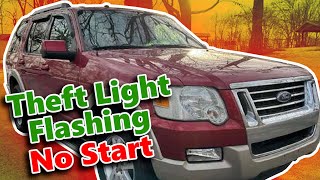
- Flashing or solid anti-theft light — The dashboard security light flashes rapidly or stays illuminated when you turn the key to 'ON'. A normally functioning system shows a solid light for 3 seconds, then turns off. 🎬 Watch: How to identify different Ford PATS system malfunctions
- No-crank condition — In some configurations, the PATS system ties into the starter relay control. When a theft event is detected, the PCM refuses to ground the starter relay, resulting in silence when turning the key.
- Odometer and other displays are blank — A blank odometer display alongside P1260 guarantees the instrument cluster failed and is the root cause of the communication breakdown.
Diagnostic Flowchart
Tap your situation to follow the diagnostic path that matches what you're seeing on this code.
Common Fixes & Costs
- Reprogram or Replace Ignition Key
— Parts: $20-$90, Labor: $80-$200, ~0.5 hr book time
(Professional)
Ford F-150 (2004-2014): OEM 164-R8046 (Alt: H86-PT, H92-PT (Ilco))
Ford Focus (2000-2011): OEM 164-R0463 (Alt: H86-PT, H84-PT (Ilco)) - Replace PATS Transceiver/Antenna Ring
— Parts: $40-$110, Labor: $100-$225, ~1.2 hr book time
(Intermediate)
Ford F-150 (1999-2003): OEM 1L3Z-15607-AB (Alt: Standard Motor Products AT2001)
Ford F-150 (2009-2014): OEM 8G1Z-15607-A (Alt: Standard Motor Products AT2004) - Repair or Replace Instrument Cluster (IPC)
— Parts: $150-$450, Labor: $150-$350, ~2.5 hr book time
(Professional)
Ford F-150 (2004-2008): OEM Varies by trim (VIN matching required) (Alt: Dorman 599-631 (Reman), Tanin Electronix (Repair))
Ford Explorer (2004-2005): OEM Varies by trim (VIN matching required) (Alt: Dorman 599-845 (Reman)) - Replace and Reprogram Powertrain Control Module (PCM)
— Parts: $400-$1000, Labor: $100-$200, ~1.5 hr book time
(Professional)
Ford F-150 (2004-2008): OEM Varies by engine (VIN matching critical) (Alt: Cardone (Reman), FS1 (Reman/Programmed)) - Repair Wiring or Replace Junction Box — Parts: $5-$400, Labor: $200-$600, ~3 hr book time (Advanced)
DIY vs Professional
- Reprogram or Replace Ignition Key — Beginner:
- Replace PATS Transceiver/Antenna Ring — Beginner:
- Repair or Replace Instrument Cluster (IPC) — Beginner:
- Replace and Reprogram Powertrain Control Module (PCM) — Beginner:
- Repair Wiring or Replace Junction Box — Beginner:
Used vs. New Parts: Buying Guide
When a used part is worth it: A used Instrument Cluster (IPC) is cost-effective if purchased from a reputable source that programs it to your VIN before shipping. A mail-in repair of your original cluster is often the best balance of cost and reliability, avoiding all programming issues.
Donor-vehicle mileage cap: roughly under 120000 miles for the part to have meaningful remaining life.
Donor quality checklist:
- Match the part number EXACTLY. Even a slight variation means incompatibility.
- Verify the seller's return policy and warranty (typically 30-90 days for used electronics).
- For mail-in repairs, check for lifetime warranties on the repair work.
- Avoid parts from flood-damaged vehicles, as they are prone to hidden corrosion.
Decision logic:
- If The fix is a simple key or transceiver → Always buy new. The cost savings for used parts are minimal and not worth the risk.
- If The fix is a failed Instrument Cluster or PCM → A mail-in repair of your original module is the safest option to avoid programming headaches.
- If Your original module is destroyed (e.g., collision) and you must use a replacement → A new OEM part is the most reliable but most expensive. A professionally programmed used part is a viable budget alternative.
Warranty tradeoff: Used parts typically offer a 30-90 day functional warranty. Aftermarket new/remanufactured parts often come with a 1-year to lifetime warranty, providing significantly more peace of mind.
Worst-case if a used part fails: $300-$600 if a used electronic module fails after installation, requiring repeat labor for removal, re-installation, and programming.
What Happens If You Wait — Timeline
- First Occurrence (Intermittent): Vehicle fails to start one time, often on a cold morning or after hitting a bump. Theft light flashes. After waiting or a second attempt, it starts normally. P1260 is stored as a history code. (MPG impact: 0%% · Added cost: $0, but the risk of being stranded is now present.)
- 1-4 weeks (Intermittent): The no-start condition becomes more frequent, happening once or twice a week. It becomes a source of stress and unreliability. (MPG impact: 0%% · Added cost: $75-$250 in a potential tow bill if it fails at an inconvenient time.)
- 1-3 months (Frequent): The fault happens on most start attempts. The underlying issue, like cracked solder joints or a failing transceiver, has worsened to near-total failure. The vehicle is effectively unusable. (MPG impact: 0%% · Added cost: $250-$500 in multiple tow bills, diagnostic fees, and alternative transportation.)
- 3+ months (Hard Failure): The vehicle is permanently immobilized and will not start under any condition. The P1260 code is a hard fault that cannot be cleared. It must be towed and repaired. (MPG impact: 0%% · Added cost: $400-$1500+. This includes the tow, the final repair, and potentially the cost of incorrect parts tried along the way.)
Cost of Not Fixing It
- Immediate: Vehicle is completely immobilized and will not start, or starts and immediately stalls. You will be stranded. (Added cost: $75-$250 for a tow to a repair shop.)
- 1-4 Weeks (with intermittent fault): Unpredictable no-start conditions. The car fails to start at random, often triggered by temperature changes, leaving you stranded without warning. (Added cost: Multiple tow bills, lost time, and the cost of alternative transportation.)
- 1+ Month (with intermittent fault): The intermittent electrical fault causing P1260 worsens, leading to a permanent, non-intermittent no-start condition. The risk of being stranded becomes a certainty. (Added cost: Increased diagnostic complexity if multiple systems begin showing symptoms, adding to labor costs.)
Diagnosis Steps
- Observe the Theft Light and Try a Spare Key
Turn the key to ON. If the anti-theft light flashes rapidly, you have a confirmed PATS fault. Immediately try a spare, known-good key. If the car starts, your primary key's transponder chip is dead.
Tools: Spare vehicle key (Beginner) - Scan All Modules for Codes
Use an advanced OBD-II scanner to access all vehicle modules (PCM, IPC, BCM, PATS). U-series codes (e.g., U1900) point to a network communication failure, usually the instrument cluster. B-series codes (e.g., B1681) point to the transceiver antenna. P1260 is the result, not the cause.
Tools: Advanced OBD-II Scanner (e.g., FORScan, Autel) (Intermediate) - Check PATS Diagnostic Flash Codes
On Fords, if the theft light flashes, it pauses and flashes a two-digit code (e.g., flash-pause-flash-flash-flash = Code 13). Code 13 means 'Key code not received', 16 means 'Invalid data from PCM'. Search for your vehicle's specific PATS flash codes for an immediate diagnostic direction.
Tools: Your eyes and ignition key (Beginner) - Check the Vehicle Battery and Fuses
Use a multimeter to confirm the battery has at least 12.4 volts. Low voltage causes module memory loss. Inspect all fuses related to the PCM, Instrument Cluster (IPC), and anti-theft system in both fuse boxes.
Tools: Multimeter, vehicle fuse diagram (Beginner) - Inspect PATS Transceiver and Wiring
Remove the steering column shrouds and visually inspect the PATS antenna ring around the ignition lock cylinder. Check for damage to the ring or wiring harness, and ensure the connector is fully seated.
Tools: Trim removal tools, flashlight (Intermediate) - Verify PCM and Instrument Cluster Power and Ground
Using a wiring diagram, test the power and ground circuits at the PCM and Instrument Cluster connectors. A loss of one of these causes a no-communication scenario and triggers P1260. Do this before condemning an expensive module.
Tools: Multimeter, wiring diagrams (Advanced) - Advanced: Test PATS Transceiver Circuits
With the key ON, check for battery voltage (>10V) on the transceiver power supply pin. Check the ground pin for resistance to chassis ground (<5 ohms). With the key OFF and module disconnected, check resistance between each data line (TX/RX) and ground; it must be very high (>10,000 ohms).
Tools: Multimeter, wiring diagrams, back-probe pins (Advanced) - Pro Tip: Test Module Communication on the CAN Bus
Connect a 2-channel lab scope to Pin 6 (CAN High) and Pin 14 (CAN Low). A healthy CAN bus shows a mirror-image waveform centered around a 2.5V bias. A flat line or voltages shorted to ground/power indicates a wiring or module failure, definitively testing the network P1260 relies on.
Tools: Lab Scope, DLC Breakout Box (Advanced) - Pro Tip: Check for Back-feed at the Fuse Box
If the car doesn't register key cycles (OFF-ON) during programming, probe the instrument cluster and PCM fuses with the key OFF. Unexpected voltage indicates an incorrectly installed component (like a fuse in a relay slot) is back-feeding power, preventing a proper reset.
Tools: Multimeter or test light (Advanced) - Advanced: Check Fuel Pressure (BMW/Jaguar Diesel)
On a BMW or Jaguar diesel, P1260 is fuel-related, not theft. Connect a fuel pressure gauge to the low-pressure service port. With key on, engine off (KOEO), pressure should be 50-75 PSI (3.5-5.2 bar). If low, diagnose the low-pressure fuel pump or sensor.
Tools: Fuel pressure gauge, vehicle-specific service manual (Advanced)
When This Code Triggers (Freeze-Frame Conditions)
- DTC That Caused Freeze Frame: P1260 (The code that triggered the data snapshot.)
- Vehicle Speed: 0 mph (Fault is set during a start attempt, not while driving.)
- Engine RPM: 0 - 250 RPM (Engine is either off (Key On) or at cranking speed when the security check fails.)
- Control Module Voltage: 10.5 - 12.5V (Indicates battery voltage during the start attempt. A low value points to a weak battery as a contributing cause.)
- Engine Coolant Temperature: Varies (e.g., 40-190°F) (Reflects ambient temperature or engine temp from a previous run cycle; helps diagnose temperature-related electronic failures.)
Related Codes
- U1900 / U1262 / U2510 — These are critical CAN bus communication error codes. Seeing any U-code along with P1260 means a module is not communicating. On Fords, this guarantees a failed Instrument Panel Cluster. The problem is the network, not the key or PCM.
- B1681 / B2103 / B1232 — These Body Control Module codes specifically indicate a problem with the PATS transceiver (antenna). Seeing one of these with P1260 strongly suggests the fault is the antenna ring around the ignition or its wiring.
- B1600 / B1601 / B1602 — These codes point directly at the key. B1600 means no key signal was received. B1601 means an incorrect key code was received. B1602 means the data from the key was corrupted. These confirm the issue is the key transponder.
- B2139 / B2141 — These indicate a mismatch between the security identifiers stored in the PCM and the instrument cluster. This happens after a module is replaced without performing the proper 'Parameter Reset' procedure.
- P1000 — This simply means the onboard diagnostic monitors have not completed their self-checks since the memory was cleared. It frequently appears after disconnecting the battery and can be ignored when diagnosing P1260.
Climate & Environmental Factors
- Cold Weather: Cold temperatures are a primary trigger for P1260. Low temps cause microscopic cracks in instrument cluster solder joints to contract, creating an open circuit. Applying heat from a hairdryer to the dashboard is a common temporary workaround that confirms this failure.
- High Humidity / Water Intrusion: High humidity or direct water leaks (e.g., from a leaking windshield) cause corrosion on the pins of the instrument cluster, PCM, or junction box. This disrupts the sensitive communication signals required for the PATS handshake.
- Thermal Cycling: Repeated temperature swings from hot to cold cause expansion and contraction of electronic components. This thermomechanical fatigue is the root cause of solder joint failure inside the instrument cluster.
How to Talk to a Mechanic About This Code
Say this: "My car has a no-start condition and is showing a P1260 'Theft Detected' code. I need a diagnosis of the PATS anti-theft system. Please scan for any related Body (B-series) or Communication (U-series) codes, as I understand the fault could be the key, transceiver, instrument cluster, or wiring, not just the PCM."
This signals you understand P1260 is a system fault, not a single part. It directs the technician to perform a comprehensive diagnosis of the entire security system and prevents them from jumping to an expensive, incorrect PCM replacement.
Avoid saying:
- 'My car won't start, the theft light is on.' (too vague)
- 'Just fix the P1260 code.' (invites part swapping without diagnosis)
- 'I think I need a new computer.' (suggests an expensive repair you may not need)
Questions to ask before authorizing the repair:
- Did you find any other codes, specifically U-codes like U1900 or B-codes like B1681?
- If you are recommending a module replacement (cluster or PCM), did you verify its power and ground circuits are good first?
- Does your estimate include the necessary 'Parameter Reset' or key programming required after the part is installed?
- What is your warranty on this specific repair, including both parts and labor?
Where to Take It: Dealer vs Independent vs Chain
- Dealer:
A safe, but expensive, bet. They have the proprietary Ford IDS scan tool and guaranteed access to the correct programming procedures.
Best for: Vehicles under warranty., Complex jobs requiring module replacement (new PCM or cluster) and programming from scratch., When you have exhausted other options and suspect a rare manufacturer-specific issue.
Downsides: Highest labor rates., Defaults to replacing expensive assemblies rather than performing component-level diagnostics (e.g., replace entire cluster vs. sending for repair). (Typical cost: +50% vs. baseline) - Independent Shop:
Best fit for most owners. A good independent diagnostician solves P1260 effectively and more affordably than a dealer. An automotive locksmith is also a great option if the problem is confirmed to be key-related.
Best for: Most P1260 scenarios on out-of-warranty vehicles., Shops specializing in automotive electronics or a specific brand (e.g., Ford specialists)., Diagnosing common failures like keys, transceivers, and instrument clusters.
Downsides: Quality and equipment vary greatly. Ensure they have advanced, professional-grade scan tools (like Autel, Snap-on, or FORScan) capable of PATS functions. (Typical cost: +0% vs. baseline) - Chain Shop:
AVOID for P1260 diagnosis. While they can read the initial code, they are generally ill-equipped to correctly diagnose and repair the root cause, which involves the entire vehicle security network.
Best for: Simple jobs like battery replacement.
Downsides: Technicians often lack the advanced diagnostic training for complex electrical or network issues., Unlikely to have the specialized scan tools required for module programming and parameter resets., High risk of misdiagnosis and unnecessary parts replacement. (Typical cost: -10% vs. baseline)
When to Walk Away From the Repair
If the total estimated repair cost for the P1260 fault exceeds 50% of your car's current private-party market value, it's time to seriously consider selling or trading it in.
- Car worth $3500, fix is $1200: Borderline. The repair is a significant percentage of the car's value. Get a second opinion before proceeding. If other repairs are also needed, it's likely time to walk away.
- Car worth $10000, fix is $800: Fix it. The repair cost is well within a reasonable threshold to restore a valuable and otherwise functional vehicle.
- Car worth $2000, fix is $1500: Walk away. The repair cost is approaching the car's total value. It is not an economically sound investment.
What Scan Tool You Need for This Code
Minimum: A scanner that reads manufacturer-specific codes from ALL vehicle modules, including the Instrument Panel Cluster (IPC), Body Control Module (BCM), and Powertrain Control Module (PCM).
A basic $20-$50 code reader only shows the P1260 code from the engine computer. It CANNOT see the critical B-series (Body) or U-series (Communication) codes essential for telling you if the problem is the key, the antenna, or the cluster. You will diagnose blind and waste money on the wrong parts.
Budget: BlueDriver Pro Scan Tool (~$100) — Reads and clears codes from all modules (ABS, Airbag, Transmission, BCM, etc.) on Ford/GM/Chrysler/Toyota, the minimum requirement for P1260 diagnosis. It allows you to see the crucial B-codes and U-codes that basic scanners miss.
Mid-range: Foxwell NT510 Elite / NT726 (~$160) — Provides full-system diagnostics to read all relevant codes. More importantly, it offers bi-directional controls to test components and performs some service functions. This is a great tool for a serious DIYer to accurately pinpoint the fault.
Professional: Autel MaxiCOM MK808 / IM508S (~$500) — This level of tool is often required for the FINAL fix. It performs full, all-system diagnostics and provides the critical 'Parameter Reset' function needed to 'marry' a new PCM or Instrument Cluster to the vehicle. It also performs advanced key programming for 'all keys lost' situations.
Rent vs buy: Rentals from auto parts stores are typically basic readers and are NOT sufficient for P1260. For a one-time fix, it is more cost-effective to pay a shop's 1-hour diagnostic fee ($100-$200) than to buy a professional-level scanner. Buy a mid-range or pro scanner only if you plan to do frequent, advanced DIY repairs.
How to Clear the Code After You Fix It
- Fix the root cause (e.g., replace transceiver, program new key, repair cluster).
- Use a professional scan tool to perform a 'Parameter Reset' if a module was replaced.
- Use the scan tool to clear the P1260 and any related B- or U-series codes.
- Cycle the ignition off and on, and attempt to start the vehicle to confirm the fix.
Drive cycle (~30 minutes): A specific drive cycle is not required to clear the P1260 fault itself, but is needed to reset emissions readiness monitors. A typical cycle includes: Cold start, 5 minutes of idling, 15 minutes of mixed city/suburban driving, and 5 minutes of steady highway speed (55-60 mph).
Readiness monitors affected: Comprehensive Component Monitor, Misfire Monitor, Catalyst Monitor, EVAP System Monitor, O2 Sensor Monitor
Before emissions retest: drive at least 50 miles to fully set monitors.
Watch out for:
- Simply clearing the code with a basic scanner will not fix the problem; the code returns immediately on the next start attempt.
- Forgetting to perform a 'Parameter Reset' after replacing a PCM or Instrument Cluster causes the new part to not communicate with the vehicle.
- Failing to have two working keys for a key programming procedure, which is a requirement for many systems.
Will This Fail Emissions / State Inspection?
Yes — this code typically fails an OBD-II emissions inspection.
- California: An active P1260 code causes an automatic failure of the smog check's OBD-II system inspection. All required readiness monitors must be 'Ready', requiring a drive cycle after the repair.
- New York: The NYS DMV emissions inspection includes an OBD-II scan. A stored P1260 fault results in an immediate test failure.
- Texas: In counties requiring emissions testing, an active P-code like P1260 causes the vehicle to fail the OBD-II portion of the inspection.
Most Commonly Affected Vehicles
- Ford F-150 (1999-2014) — Extremely common. Early models (99-03) are prone to PATS transceiver failure. Models from 2004-2008 are notorious for instrument cluster failures causing P1260. Leaking windshields causing shorts in the GEM/SJB are also a known issue.
- Ford Explorer (1998-2010) — Prone to PATS issues triggered by heat or cold. The 2002-2005 models are particularly susceptible to instrument cluster solder joint failure.
- Ford Focus (2000-2011) — Failures often stem from faulty ignition switches, wiring, or instrument cluster communication faults, especially on 2005-2007 models.
- Ford Ranger (2001-2011) — The PATS system is a frequent failure point, typically related to the key transponder or the transceiver antenna ring.
- Ford Escape (2001-2012) — PATS failures are a frequent cause of no-start conditions. The 2008-2012 models experience instrument cluster communication issues similar to other Ford models of the era.
- Ford Mustang (1996-2014) — Instrument cluster communication issues (often with U-codes) are a known cause of P1260, especially on 2005-2009 models.
- Lincoln / Mercury Various Models (1998-2011) — Models like the Town Car, Continental, and Grand Marquis share the Ford PATS architecture and are susceptible to the exact same key, transceiver, cluster, and PCM failures.
- Mazda B-Series, Tribute (1999-2011) — Ford-platform Mazdas use the same PATS system and have the same P1260 meaning.
- BMW 3-Series, 5-Series, X5 (Diesel) (2000-2013) — On diesel models (e.g., M57 engine), P1260 refers to a 'Delivery Fuel Pressure Monitoring' issue, pointing to a low-pressure fuel pump or sensor problem.
- Hyundai / Kia Forte, Elantra, Sonata (2018-2024) — CRITICAL DISTINCTION: On modern Hyundai and Kia vehicles, P1260 is completely unrelated to theft. It points to a 'Steering Angle Sensor (SAS) Circuit-Signal' fault.
Manufacturer-Specific Notes
- Ford / Lincoln / Mercury / Mazda (Ford-based): This is the definitive group for the 'Theft Detected' meaning of P1260. A failed instrument cluster is a uniquely common cause on these vehicles, often more so than the PCM itself.
- Jaguar / Land Rover: While it often indicates an engine immobilizer event, on some diesel models (like the Freelander TD4), P1260 means 'Delivery Fuel Pressure Monitoring', indicating a low-pressure fuel system fault.
- GM (Chevrolet / Buick / Cadillac / GMC): P1260 is NOT a theft code on GM vehicles. It typically points to a 'Fuel Pump Speed Relay Control Circuit' or a 'Throttle Position Sensor' circuit malfunction. Diagnosis should focus on the fuel pump driver module or throttle body.
- Hyundai / Kia: On modern Hyundai and Kia vehicles, P1260 relates to the 'Steering Angle Sensor Circuit-Signal'. Diagnosis should focus on the SAS sensor, its wiring, and calibration within the ABS/ESC system.
- Volkswagen / Audi: On VW and Audi vehicles, P1260 usually indicates an 'Injector 1 Implausible Signal' or 'Intake Manifold Runner Control' fault, pointing to a problem with a specific fuel injector or the intake system.
- BMW: While it indicates 'Theft Detected' on gas models, it is frequently used on diesel engines (M57, M47) to indicate 'Delivery Fuel Pressure Monitoring', pointing to a fault with the low-pressure fuel pump.
Real Owner Stories
2006 Ford Focus with 150K miles - The Cold Morning No-Start
Owner reported the car cranked but would not start only on cold mornings. The theft light flashed rapidly. After the ambient temperature warmed up in the afternoon, the car started and ran perfectly.
Outcome: After applying heat near the ignition switch, the car started immediately, pointing to a thermal-related failure. The owner sent the instrument cluster to a mail-in repair service that re-flowed the solder joints for $180. The problem was permanently solved.
Lesson: If P1260 is intermittent and temperature-dependent (especially cold), it is very likely caused by failing solder joints in the instrument cluster. The hairdryer trick confirms this diagnosis before spending money on parts.
2003 Ford F-150 at 125K miles - The Misdiagnosis Cascade
Vehicle would not start after the battery drained and recharged. The theft light flashed. A locksmith programmed two new keys.
Outcome: The owner suspected a bad PCM. However, forum research indicated the solid theft light and cluster error pointed to a communication failure. The actual problem was a faulty instrument cluster that failed during the battery drain event, preventing the new keys from being recognized by the PCM.
Lesson: Don't immediately blame the PCM. A solid theft light after a key programming attempt, especially with other cluster errors, points to a communication breakdown where the cluster is the middleman.
2008 Lincoln MKZ after Body Shop Repair - The Unusual Root Cause
After collision repairs that included replacing a damaged under-hood fuse box with a used one, the car was a no-crank, no-start with code P1260. The key-in-ignition chime was constantly on, even with the key out.
Outcome: The body shop incorrectly populated the used fuse box, inserting fuses into slots designed for relays. This created a power back-feed that kept the instrument cluster powered on constantly, preventing the PATS system from resetting. Installing the proper relays immediately fixed the issue.
Lesson: If a P1260 appears immediately after a major repair, scrutinize the work that was done. An incorrectly installed component causes complex electronic faults that mimic a module failure.
2010 Ford F-150 with Intermittent No-Crank - The Loose Connection
While driving on a bumpy highway, all dash gauges froze. After parking, the truck would not crank and the anti-theft system engaged.
Outcome: The owner experienced the dash power cutting out again on another bumpy road. The issue was traced to a loose electrical connector for the PATS transceiver. The constant vibration caused an intermittent connection, triggering the anti-theft system. Securing the connector resolved the problem.
Lesson: If the problem is intermittent and seems related to bumps or vibration, the cause is likely a simple loose wire or connector. Always check for secure connections at the PATS transceiver and instrument cluster before replacing parts.
How to Prevent This Code From Triggering
- Maintain a Healthy Battery (Test annually after 3 years) — Low battery voltage (below 12.2V) is a primary cause of electronic module glitches. A healthy battery prevents the random data loss in the PCM or cluster that triggers a false theft event.
- Protect Your Keys (Daily habit) — The transponder chip in the key head is a small glass ampule damaged by drops or impact. Treat your key like a piece of electronics to prevent chip failure, a very common cause of P1260.
- Use Proper Jump-Starting Procedures (As needed) — Improper jump-starting creates voltage spikes well above 16V, permanently damaging sensitive electronics like the PCM and instrument cluster. Always connect positive-to-positive first.
- Address Water Leaks Promptly (Inspect seasonally) — On models like the F-150, a failing windshield seal allows water to drip directly onto the fuse box (SJB). This causes corrosion and electrical chaos, leading to PATS failures.
- Keep a Spare Programmed Key (One-time action) — If you lose your only key or it fails, you must tow the vehicle to a dealer or locksmith. If you have two programmed keys, you can program a third key yourself in minutes, saving significant time and money.
Frequently Asked Questions
Can I just bypass the PATS system to fix P1260?
While technically possible using specific PCM tuning software or physical transponder bypass kits, it is not recommended. It permanently compromises your vehicle's security and is more complex than diagnosing the actual broken component. A simple transceiver or key replacement is the proper fix.
Why did P1260 appear after my battery died or I got a jump-start?
A sudden voltage spike from an improper jump-start or the memory loss from a completely dead battery corrupts the programming in the PCM or instrument cluster. This causes the modules to 'forget' the learned keys. The anti-theft system then triggers on the next start attempt.
Will clearing the P1260 code with a scanner fix the problem?
No. P1260 is a 'hard fault' indicating a persistent security issue. Clearing the code does nothing to resolve the underlying hardware or programming failure, and it returns instantly on the next start attempt.
Can I program a new key myself?
On many older Ford models, if you have two already-programmed keys, you can add a third key yourself using the owner's manual procedure. However, if you only have one or zero working keys, you must hire a professional locksmith or dealer. They use specialized equipment to program new keys into the system.
What does the flashing theft light pattern mean?
On many Ford vehicles, the PATS light flashes a two-digit code to help with diagnosis. For example, code 1-6 indicates 'Invalid data from PCM,' while code 1-3 means 'Key not recognized.' Searching for your vehicle's specific 'PATS flash codes' pinpoints the failure before connecting a scanner.
What is the most common misdiagnosis for P1260?
The most common and expensive mistake is replacing the PCM when the actual fault is a failed instrument cluster. On many Fords, the cluster is a required communication gateway. If you see U-series communication codes (like U1900) alongside P1260, the cluster or its wiring is the culprit.
My theft light is flashing, but the car still starts. What should I do?
This indicates an intermittent fault in the PATS system. The system detects a problem but hasn't failed completely yet. Diagnose it immediately, as you will likely be stranded with a no-start condition very soon.
Key Takeaways
- Always test a second programmed key first; a damaged transponder chip causes over 40% of P1260 no-start conditions.
- Scan all modules for U-series codes (like U1900); their presence alongside P1260 on a Ford guarantees a failed instrument cluster or CAN bus, not a bad PCM.
- Never replace the Powertrain Control Module (PCM) without first verifying battery voltage exceeds 12.4V and testing the PATS transceiver ring.
- Replacing a module requires a professional scan tool to perform a 'Parameter Reset'; skipping this 10-minute step leaves the vehicle permanently immobilized.
Helpful Videos


The information in this article is provided for general reference and educational purposes only. Vehicle specifications, procedures, and part compatibility can vary by production date, trim level, and region. Always consult your vehicle's factory service manual and verify part numbers before purchasing or performing repairs. Safety-critical components such as airbags, seat belts, and braking systems should be installed by a qualified professional.
- 🎬 Helpful Videos
- What Does P1260 Mean?
- Can I Drive With P1260?
- Common Causes
- Symptoms
- Diagnostic Flowchart
- Common Fixes & Costs
- DIY vs Professional
- Used vs. New Parts: Buying Guide
- What Happens If You Wait — Timeline
- Cost of Not Fixing It
- Diagnosis Steps
- When This Code Triggers (Freeze-Frame Conditions)
- Related Codes
- Climate & Environmental Factors
- How to Talk to a Mechanic About This Code
- Where to Take It: Dealer vs Independent vs Chain
- When to Walk Away From the Repair
- What Scan Tool You Need for This Code
- How to Clear the Code After You Fix It
- Will This Fail Emissions / State Inspection?
- Most Commonly Affected Vehicles
- Manufacturer-Specific Notes
- Real Owner Stories
- 2006 Ford Focus with 150K miles - The Cold Morning No-Start
- 2003 Ford F-150 at 125K miles - The Misdiagnosis Cascade
- 2008 Lincoln MKZ after Body Shop Repair - The Unusual Root Cause
- 2010 Ford F-150 with Intermittent No-Crank - The Loose Connection
- How to Prevent This Code From Triggering
- Frequently Asked Questions
- Can I just bypass the PATS system to fix P1260?
- Why did P1260 appear after my battery died or I got a jump-start?
- Will clearing the P1260 code with a scanner fix the problem?
- Can I program a new key myself?
- What does the flashing theft light pattern mean?
- What is the most common misdiagnosis for P1260?
- My theft light is flashing, but the car still starts. What should I do?
- Key Takeaways
- 🎟️ Get 5% Off