

U0101 on 2019-2020 Ram 3500: Lost Communication with TCM Causes and Fixes
On a 2019-2020 Ram 3500, code U0101 means the Transmission Control Module (TCM) has stopped communicating with other vehicle computers. This is often caused by a wiring issue (chafing, poor pin fitment), a software glitch requiring a dealer update, or low battery voltage, rather than a failed transmission. In many cases, multiple modules will log this code simultaneously.
- U0101 on a 2019-2020 Ram 3500 means the Transmission Control Module (TCM) is offline.
- Before suspecting an expensive module failure, thoroughly check the battery, fuses, and all wiring/connectors going to the transmission for damage or corrosion.
- This code may be caused by a software glitch. Check with a Ram dealer to see if any TSBs or software updates apply to your vehicle's VIN.
- Do not continue to drive with this code. The truck can enter a limited-power 'limp mode' or exhibit unsafe shifting behavior.
What's Unique About the 2019-2020 Ram 3500

For the fifth-generation Ram 3500 (especially those with the 6.7L Cummins engine), the U0101 code is specifically cited in multiple Technical Service Bulletins (TSBs) issued by the manufacturer. [Bulletin #1800824, Bulletin #1800724, Bulletin #18-056-22, Bulletin #1805622] These bulletins suggest that the code can appear alongside others (like P226C, P2579), sometimes triggered by conditions like extreme cold, and may be resolved with a PCM software update. [Bulletin #1800824, Bulletin #1800724, Bulletin #18-056-22, Bulletin #1805622] This indicates that on these specific trucks, the cause is not always a physical part failure but can be a software anomaly that the dealer must correct by 'reflashing' the computer. The TSBs often apply to a group of codes, suggesting a single software update can resolve multiple seemingly unrelated issues. [Bulletin #1800824, Bulletin #1800724, Bulletin #18-056-22, Bulletin #1805622]
Diagnostic Flowchart

Tap your situation to follow the diagnostic path that matches what you're seeing on this vehicle.
Symptoms You May Notice

- Check Engine Light is on
- Transmission warning light is illuminated
- Vehicle enters "limp mode," limiting speed and gear selection
- Harsh, erratic, or delayed shifting
- Transmission may not shift out of a specific gear
- Gear position indicator on the dash may be blank or incorrect
- Vehicle may not start, as the PCM cannot confirm the transmission's gear state (e.g., Park/Neutral)
- Multiple other warning lights may appear, such as for ABS or electronic brakes, as other modules lose communication with the TCM
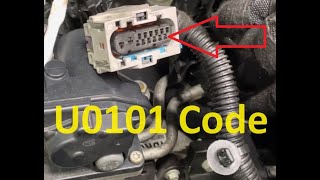
- Scan tool is unable to communicate with the TCM 🎬 Watch: A clear explanation of the U0101 code and fixes.
- Replacing the entire transmission when the fault is purely electrical or software-based.
- Replacing the TCM when the actual problem is a simple wiring break, poor pin fitment in the connector, a corroded ground, or a blown fuse.
Most Likely Causes

- Wiring Harness or Connector Issues 🔴 High Probability Wiring harnesses, especially those near the transmission, are exposed to heat, moisture, and road debris. A very common issue is poor pin fitment or tension at the main TCM connector, causing an intermittent connection from vibration. The plastic locking tabs on the connector can also break, allowing it to back out.
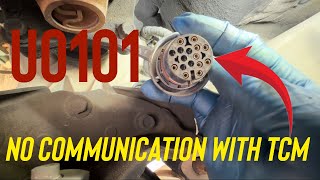
How to confirm: Visually inspect the wiring harness and connectors going to the TCM for any signs of damage, corrosion, or looseness. Specifically check the main connector for broken locking tabs. A technician can perform a 'pin drag' test to check for loose female terminals. Wiggling the connector while monitoring communication status with a scan tool 🎬 See how to diagnose a no communication issue with a scanner. can also identify a poor connection.
Typical fix: Repair the damaged section of the harness or clean the connectors with electrical contact cleaner. If pin fitment is the issue, the specific terminal may need to be replaced or the entire connector pigtail. If the locking tab is broken, the connector should be replaced, though some owners have used zip ties as a temporary fix to hold it securely.
Est. part cost: $20-$300 - Software Anomaly Requiring a 'Reflash' 🟡 Medium Probability Manufacturer TSBs #18-056-22 and others specifically list U0101 in a group of codes that can be resolved by a PCM software update, especially on trucks with the 6.7L Cummins. [Bulletin #18-056-22] This can happen if the TCM loses its programming or if the existing software has known bugs, especially related to cold weather operation. [Bulletin #18-056-22]
How to confirm: This must be confirmed by a Ram dealership or a qualified shop with access to OEM service information (wiTECH) and programming tools. They can check the vehicle's current software calibration against the latest available version referenced in the TSBs. [Bulletin #18-056-22]
Typical fix: The dealer will use a proprietary scan tool to 'reflash' or update the software for the PCM, which corrects the logic that triggers the fault code. [Bulletin #18-056-22]
Est. part cost: $0 (if under warranty/TSB) - $250 - Low Battery Voltage or Poor Ground Connection 🟡 Medium Probability All control modules require a stable voltage (typically above 12.0V) to communicate properly. A weak battery, failing alternator, or corroded ground strap can cause intermittent communication dropouts across the entire network, often setting multiple 'U' codes.
How to confirm: Test the battery voltage with the engine off (should be ~12.6V) and running (should be ~13.7-14.7V). Inspect the main battery terminals and chassis ground connections for tightness and corrosion. Perform a voltage drop test on the ground circuit to ensure a solid connection.
Typical fix: Charge or replace the battery. Clean or replace corroded battery terminals or ground straps.
Est. part cost: $5-$350 - Blown Fuse for the TCM ⚪ Low Probability
How to confirm: Consult the owner's manual or the fuse box cover to locate the fuse(s) for the Transmission Control Module. On 2019+ models, check fuses F21, F22, F33, F57, and F72 in the under-hood fuse box. Visually inspect the fuse and test for power on both sides with a test light or multimeter.
Typical fix: Replace the blown fuse. If the new fuse blows immediately, it indicates a short circuit in the TCM power supply wire that must be diagnosed.
Est. part cost: $1-$5 - Failed Transmission Control Module (TCM) ⚪ Low Probability While less common than wiring or software issues, the TCM itself can fail due to internal circuit board problems. For trucks with the Aisin transmission, the TCM is located inside the cab to the left of the steering column, protecting it from the elements. For 68RFE transmissions, the TCM is often located on the firewall.
How to confirm: This should be the last resort after all wiring, power, ground, and software issues have been ruled out. A professional scan tool will be completely unable to establish any communication with the TCM, even when directly connected, and after confirming the module is receiving proper power and ground.
Typical fix: Replace the Transmission Control Module. The new module will require programming to the vehicle's VIN using dealer-level software.
Est. part cost: $600-$1200
Diagnosis Steps
- Check Battery Health & Grounds: Ensure the battery is fully charged (~12.6V engine off) and the charging system is working (~13.7-14.7V engine on). Inspect and clean all main battery and chassis ground connections.
- Full System Scan: Use a quality OBD-II scanner capable of reading codes from all vehicle modules (ABS, BCM, etc.), not just the engine. Note if other modules also report a U0101 code, which is common. If the scanner cannot communicate with the TCM at all, it points towards a power, ground, or major network failure.
- Check Fuses: Locate and inspect all fuses related to the TCM in the under-hood fuse box (check F21, F22, F33, F57, F72 for 2019+ models). Test them with a multimeter, don't just rely on visual inspection.
- Inspect TCM Connector and Harness: Perform a thorough visual inspection of the main connector at the TCM. Check for broken locking tabs, corrosion, or backed-out pins. Follow the harness as much as possible, looking for chafing, melting, or damage.
- Test Power and Ground at the TCM: Using a multimeter and a wiring diagram, disconnect the TCM connector and confirm that the module is receiving proper battery voltage (greater than 10V) and has a solid ground connection (less than 5 ohms resistance to chassis ground) at its connector pins. A no-start is a strong indicator of a missing power feed to the TCM.
- Check CAN Bus Integrity: With the battery disconnected, measure the resistance between the CAN High and CAN Low pins at the diagnostic port (Pins 6 and 14). It should be approximately 60 ohms. A reading of 120 ohms suggests a break in the circuit or a missing terminating resistor.
- Consult TSBs and a Professional: Check for applicable TSBs like 18-056-22. [Bulletin #18-056-22] If basic checks do not reveal the issue, the next steps involve using an advanced scan tool (wiTECH) to check module communication status and potentially reflashing the PCM/TCM, which requires dealer-level equipment.
Parts You'll Likely Need
- TCM Connector Pigtail — The main connector at the transmission is prone to corrosion, broken locking tabs, and poor pin tension. Replacing the pigtail is often the most reliable repair for a bad connection.
Trusted brands: Mopar, Dorman
OEM price range: $50-$100
Aftermarket price range: $25-$60 - Transmission Control Module (TCM)
(OEM #68467808AA (Note: This is a generic Mopar TCM part number and MUST be verified with a VIN before ordering))— This is the fix if the module itself has failed internally, but only after all wiring, power, ground, and software issues have been ruled out.
Trusted brands: Mopar
OEM price range: $800-$1200
Aftermarket price range: $600-$900
Related Codes That Often Appear With This One
- P226C — Turbocharger Boost Control Slow Response. Often cited in the same TSBs as U0101 (e.g., #18-056-22), suggesting a common software-related trigger, especially in extreme cold. [Bulletin #18-056-22]
- P2579 — Turbocharger Speed Sensor Circuit. Also listed in TSBs with U0101, pointing to a potential software update fix for a group of codes. [Bulletin #18-056-22]
- U02A3 — Lost Communication with Particulate Matter Sensor Module. Another network code listed in the same TSBs, indicating a broader communication event or software issue. [Bulletin #1800724]
- U0401 — Invalid Data Received From ECM/PCM. This code often accompanies U0101 as other modules recognize the data from the powertrain network is incomplete without the TCM's input.
Technical Service Bulletins (TSBs) & Recalls
- 18-056-22: Cites U0101 in a list of potential codes on 2019 Cab Chassis models with the 6.7L Cummins that can be fixed with a PCM software update.
- 18-101-22: Supersedes a previous TSB and again lists U0101 as a code that can be fixed with a PCM software update on 2019 Ram 2500/3500 pickups with the 6.7L Cummins engine.
- 1800824 / 1800724: Older TSB numbers that also reference U0101 in a group of fault codes, reinforcing the software-related nature of the issue on these trucks.
Platform-Specific Known Issues
- Multiple Technical Service Bulletins (TSBs) including #18-056-22, #18-101-22, and others list U0101 as a code that may be resolved with a PCM software update, particularly when it appears with other specific powertrain codes on 6.7L Cummins models.
- A known failure point is the main electrical connector to the transmission/TCM, where broken locking tabs or poor pin fitment can cause intermittent communication loss due to engine vibration.
Mechanic-Grade Diagnostic Values
- CAN Bus Network Resistance — expected: 53.5 to 67 Ohms (ideally ~60 Ohms). Failure: A reading of ~120 Ohms indicates an open in the circuit or a missing terminating resistor. A reading below 53 Ohms indicates a short between the CAN high and low wires.
- TCM Power Supply Voltage — expected: Greater than 10V (ideally battery voltage, ~12.6V). Failure: Low or no voltage indicates an open or short in the power supply circuit, or a blown fuse.
- TCM Ground Circuit Resistance — expected: Less than 5 Ohms. Failure: High resistance indicates a corroded or loose ground connection.
- CAN Bus Voltage (Key On, Engine Off) — expected: CAN High (Pin 6) should be ~2.6V. CAN Low (Pin 14) should be ~2.4V.. Failure: Significant deviation or zero voltage indicates a network problem. If CAN High is lower than CAN Low, the wires may be reversed.
Scan Tool Commands That Help
- wiTECH (Dealer Tool): Network Topology / View All DTCs — This function provides a visual map of all control modules on the network and shows which ones are actively communicating and which are not. It's the first step to confirm if the TCM is the only module offline or if there's a wider network issue.
- wiTECH (Dealer Tool): Reset ECU / Restore Vehicle Configuration — After replacing a TCM, this function is used to program the new module to the truck's VIN and options. It can also be used as a reset procedure after resolving a software glitch or intermittent fault.
Wiring & Ground Locations
- TCM Power Feed Fuses — Under-hood fuse box (formerly TIPM), driver's side of the engine bay.. Multiple fuses supply power to the TCM. Specifically, check F21, F22, F33, F57, and F72, as a failure of any of these can cut power and cause a U0101 code.
- Main Chassis Ground — On the body sheet metal, near the driver's side battery and headlight assembly.. This is a critical ground point for multiple systems. Corrosion or looseness here can cause widespread electrical issues, including module communication failures.
- Engine Block Ground — A large 2/0 gauge cable from the negative battery terminal to the front left of the engine block.. This is the primary ground for the engine and its associated electronics. A poor connection here can affect the PCM and its ability to communicate with other modules like the TCM.
- TCM Connector (C1) — Varies by transmission: On Aisin-equipped trucks, it's often inside the cab to the left of the steering column. On 68RFE trucks, it's typically on the firewall or on the transmission itself.. This is the single point of failure for all TCM power, ground, and communication lines. Poor pin fitment, corrosion, or broken locking tabs on this connector are a very common cause of U0101.
Real Owner Repair Stories
- YouTube channel 'Just Better Diagnostics' (2018 Ram Laramie (similar 5th gen platform)) — No crank, no start condition with U0101 code present. Scan tool could not communicate with the TCM.
❌ Tried (didn't work) Checking the TCM fuse (F57), which was found to be good., Initial voltage check at the TCM connector showed missing power on one of two power feed wires.
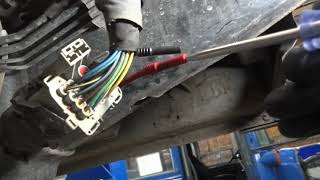
✅ What actually fixed it The root cause was a large, intermediate harness connector (C250) where the locking tabs were broken. This allowed the connector to vibrate loose, creating an open circuit on one of the TCM power wires. Wiggling the connector restored power. The final fix was securing the connector tightly (with a zip tie as a temporary measure) to ensure a solid connection.
OEM Part Supersession History
68475153AD, 68541283AA, 68541292AB, 68582290AA→68446166AA— Part has been updated by the manufacturer. Supersessions often include hardware or software improvements to address known failure points.
Heads up: This part number is for both 6.4L Hemi and 6.7L Cummins engines with Aisin transmissions. Always verify fitment with a VIN before ordering.
Helpful Videos
Used OEM Parts in Stock


New Aftermarket Parts Available


The information in this article is provided for general reference and educational purposes only. Vehicle specifications, procedures, and part compatibility can vary by production date, trim level, and region. Always consult your vehicle's factory service manual and verify part numbers before purchasing or performing repairs. Safety-critical components such as airbags, seat belts, and braking systems should be installed by a qualified professional.
- Ram 3500:
- 🎬 Helpful Videos
- 🛍️ Shop This Part
- What's Unique About the 2019-2020 Ram 3500
- Diagnostic Flowchart
- Symptoms You May Notice
- Most Likely Causes
- Diagnosis Steps
- Parts You'll Likely Need
- Related Codes That Often Appear With This One
- Technical Service Bulletins (TSBs) & Recalls
- Platform-Specific Known Issues
- Mechanic-Grade Diagnostic Values
- Scan Tool Commands That Help
- Wiring & Ground Locations
- Real Owner Repair Stories
- OEM Part Supersession History
- 🎟️ Get 5% Off