

U0101 on 2011-2013 Ford Fiesta: Causes and Fixes for Lost Communication with TCM
On a 2011-2013 Ford Fiesta with the DPS6 automatic transmission, code U0101 almost always points to a failed Transmission Control Module (TCM). This is a widespread, well-documented issue. Before paying for repairs, contact a Ford dealer with your VIN to check for coverage under warranty extension program 14M02, which covers the TCM for 10 years or 150,000 miles. As of May 2023, Ford also offered a one-time replacement for vehicles outside these limits, valid through June 30, 2025, due to the ex
- U0101 on a 2011-2013 Fiesta almost always means the Transmission Control Module (TCM) has failed.
- Before authorizing any repairs, call a Ford dealer with your VIN to check for coverage under the 10-year/150,000-mile warranty extension (Program 14M02).
- Do not drive the vehicle. It is unsafe and could leave you stranded or cause an accident.
- This is not a DIY-friendly repair. The replacement TCM requires special tools for programming.
- Be aware that there have been long-term, nationwide backorders for the replacement TCM part.
What's Unique About the 2011-2013 Ford Fiesta

The 2011-2013 Fiesta uses the DPS6 PowerShift dual-clutch automatic transmission, which is notorious for problems. Unlike a traditional automatic, it uses a dry-clutch system and an externally mounted Transmission Control Module (TCM). This specific TCM is a high-failure part due to internal circuit board issues, like bad solder joints and failing microprocessors, that fail over time from heat and vibration. The problem is so common that Ford issued multiple Technical Service Bulletins (TSBs) and a major warranty extension (14M02) specifically for this module. Therefore, U0101 on this car is overwhelmingly likely to be a failed TCM itself, rather than a simple wiring issue.
Symptoms You May Notice
- Transmission warning light is on
- Check engine light is on
- Vehicle will not start or has an intermittent no-start condition
- Harsh, erratic, or delayed shifting
- Transmission gets stuck in one gear (limp mode)
- Sudden loss of power while driving
- PRNDL gear selector display on the instrument cluster may flash or go blank
- Message center displays 'Hill Start Assist Not Available' or 'Parking Aid Malfunction'
- Replacing the entire transmission when only the externally-mounted TCM has failed.
- Replacing the battery or alternator without first checking for specific TCM-related TSBs or cleaning the TCM ground points.
- Assuming a used TCM from a junkyard will work without professional programming.
Most Likely Causes

- Failed Transmission Control Module (TCM) 🔴 High Probability The TCM used with the DPS6 transmission has a very high failure rate due to internal circuit board defects, specifically cracked solder joints on the processor pins. This is a widely documented factory issue addressed by TSB 16-0129.
How to confirm: A technician will use a scan tool (like Ford's IDS) to check for communication with the TCM. If the module has proper power and ground at its connector but does not respond (or only responds intermittently), it has failed. The presence of codes U0100, U0101, U1013, and/or P0606 together is a strong confirmation.
Typical fix: Replace the Transmission Control Module. The new module must be programmed to the vehicle's VIN and then undergo an adaptive learning procedure. 🎬 Watch: How to perform the transmission reset and learning procedure. Check for warranty coverage under 14M02 first.
Est. part cost: $400-$900 - Wiring Harness or Connector Issues 🟡 Medium Probability The TCM is located on the side of the transmission, under the battery and airbox, where its wiring can be exposed to vibration, heat, and moisture, leading to chafing or corrosion at the connector pins.
How to confirm: Visually inspect the wiring harness and the main connector at the TCM for chafing, corrosion, or loose pins. Use a multimeter to test for stable power, good ground, and continuity on the CAN bus wires at the connector.
Typical fix: Repair the damaged section of the wiring harness or clean/replace the faulty connector. Ensure the harness is properly secured away from sharp edges.
Est. part cost: $20-$150 - Poor TCM Ground Connection ⚪ Low Probability Ford vehicles of this era are known for having ground points on painted chassis surfaces. The main grounds for the transmission are located under the airbox on the driver's side strut tower and chassis rail. Paint can create high resistance, leading to intermittent module communication.
How to confirm: Locate the main battery and transmission grounds under the airbox. Use a multimeter to check for voltage drop between the negative battery terminal and the TCM ground points. A reading above a few millivolts indicates a poor connection.
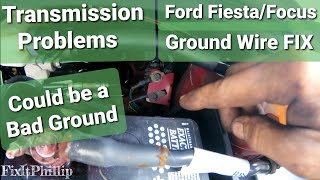
Typical fix: Remove the ground wires, scrape the paint off the chassis contact point to ensure bare metal contact, apply dielectric grease, and re-secure the connections. 🎬 See how to properly clean the transmission ground points.
Est. part cost: $0-$10 - Low Battery Voltage ⚪ Low Probability Control modules require stable voltage to communicate properly. While not specific to the Fiesta, a weak or failing battery can cause a variety of communication codes on any modern vehicle.
How to confirm: Test the battery voltage with a multimeter. It should be above 12.4V with the engine off. Check the charging system output, which should be between 13.5V and 14.5V with the engine running.
Typical fix: Charge or replace the vehicle's battery.
Est. part cost: $150-$250
Rare But Worth Checking
- Faulty Powertrain Control Module (PCM): This is very rare. The PCM is generally reliable. The TCM should always be suspected first.
- Blown Fuse: A blown fuse for the TCM will cause a complete loss of communication. Check the fuse box for any fuses labeled TCM, ECU, or PCM. A blown fuse often indicates a deeper issue, like a short in the wiring.
Diagnosis Steps
- Check with a Ford dealer first. Provide your VIN and ask if your vehicle is covered under the TCM warranty extension program 14M02. This could save you all diagnostic and repair costs. Note the recent extensions through June 30, 2025 for certain cases.
- Perform a full vehicle scan with a high-level scan tool to confirm U0101 and check for other codes in all modules. Note which modules are not communicating. The presence of U0100, P0606, and U1013 is highly indicative of TCM failure.
- Check and charge the battery. Ensure battery voltage is stable and above 12.4V. Clean the battery terminals.
- Inspect the main TCM ground connections under the airbox on the driver's side. Remove them, clean the contact surfaces to bare metal, and re-tighten.
- Locate the TCM on the side of the transmission, underneath the battery tray. Visually inspect its connector and the surrounding wiring harness for any obvious damage, corrosion, or loose pins.
- Using a multimeter and a wiring diagram, verify that the TCM has proper power and ground at its connector pins.
- Test the CAN bus network. With the battery disconnected, check for 60 ohms of resistance across the CAN High and CAN Low wires at the Diagnostic Link Connector (DLC) or the TCM connector.
- If power, ground, and network wiring are all confirmed to be good, the Transmission Control Module (TCM) itself is faulty and requires replacement.
Parts You'll Likely Need
- Transmission Control Module (TCM)
(OEM #AE8Z-7Z369-F)— This is the root cause of code U0101 in the vast majority of cases for this vehicle due to a known manufacturing defect. This part number supersedes previous versions like AE8Z-7Z369-A, B, D, and E.
Trusted brands: Motorcraft
OEM price range: $600-$900
Aftermarket price range: $400-$600 (Remanufactured)
Related Codes That Often Appear With This One
- U0100 — Also means 'Lost Communication with ECM/PCM'. Ford TSBs 16-0129 and 16-0044 list this code alongside U0101 as a primary indicator of TCM failure.
- P0606 — Means 'PCM/ECM Processor Fault'. This code can be triggered when the failing TCM disrupts the entire communication network. TSB 16-0129 specifically includes this code as a symptom of a bad TCM.
- U1013 — Means 'Invalid Internal Control Module Monitoring Data'. This is another network code specifically cited in Ford TSB 16-0129 as pointing to a TCM failure.
Technical Service Bulletins (TSBs) & Recalls
- TSB 16-0129: Addresses intermittent no-start, loss of engagement, or loss of power with DTCs U0100, U0101, P0606, and others, often leading to TCM replacement.
- TSB 16-0044: An earlier version of 16-0129, also pointing to TCM failure for the same set of codes.
- Customer Satisfaction Program 14M02: Extends the warranty on the TCM to 10 years/150,000 miles.
- Customer Satisfaction Program 15B22: A software update to provide earlier warning of a failing TCM.
Platform-Specific Known Issues
- Ford Customer Satisfaction Program 14M02 extended the warranty on the DPS6 Transmission Control Module to 10 years or 150,000 miles (240,000 km). Check with a dealer for coverage.
- Ford issued Technical Service Bulletin (TSB) 16-0129 (and its predecessors 16-0044 and 15-0191) which directly addresses the U0101 code and points to TCM failure as the cause.
- Due to the high failure rate, the replacement TCM (AE8Z-7Z369-F) has been on a significant national backorder for years, with some owners waiting months for the part.
- A May 2023 supplement to 14M02 offered a one-time TCM replacement for vehicles that exceeded the original time/mileage limits, valid until June 30, 2025.
Mechanic-Grade Diagnostic Values
- HS-CAN Bus Network Resistance — expected: Approximately 60 Ω. Failure: A reading of 120 Ω indicates an open in the circuit or a missing terminating resistor. A reading significantly below 60 Ω suggests a short circuit.
- TCM Ground Circuit Resistance — expected: Less than 5 Ω. Failure: Resistance higher than 5 Ω indicates a poor ground connection which can cause intermittent communication failures. Some sources recommend an even lower threshold of < 0.5 Ω.
- TCM Power Supply Voltage (at connector C175T) — expected: 12.0V - 12.6V (Key On, Engine Off). Failure: Voltage below 10V indicates an open or short in the power supply circuit from the fuse box.
Scan Tool Commands That Help
- Ford IDS (Integrated Diagnostic System) or equivalent (e.g., FORScan): Programmable Module Installation (PMI) — This function is required when installing a new TCM. It downloads the vehicle-specific As-Built data to the new module, configuring it for that specific car. If the old module is still communicative, IDS can copy the data from the old module to the new one.
- Ford IDS (Integrated Diagnostic System) or equivalent (e.g., FORScan): TCM Adaptive Learning — This must be performed after TCM replacement. It includes several sub-routines: Transmission Range Sensor, Shift Drum, and Clutch adaptive learning. This procedure calibrates the clutch actuator touchpoints and shift forks. Failure to perform this step will result in harsh shifting, delayed engagement, and other drivability problems.
Wiring & Ground Locations

- TCM Main Connector (C175T) — On the Transmission Control Module itself, which is mounted to the side of the transmission case, underneath the battery and airbox assembly.. This is the single connection point for all power, ground, and CAN bus communication to the TCM. All electrical testing (power, ground, CAN resistance) for the module starts here.
- Main Chassis Grounds — Under the airbox, bolted to the chassis rail and strut tower area on the driver's side. There are typically two 10mm bolts securing multiple ground wires.. These are the primary ground points for the TCM. Corrosion or looseness here is a very common, often-overlooked cause of intermittent U0101 codes. Cleaning these grounds to bare metal is a critical first step before condemning the TCM.
- HS-CAN Bus Wires — Pins 16 (CAN High) and 25 (CAN Low) at the TCM connector C175T. These wires run from the TCM to other modules on the High-Speed CAN network.. These two wires carry all communication data between the TCM and the rest of the vehicle. A short or open on either of these wires will cause a U0101 code.
Real Owner Repair Stories
- YouTube user Big Ben's Cars & Cycles (Ford Focus with DPS6 (same transmission and TCM as Fiesta)) — Various transmission issues and codes.
❌ Tried (didn't work) Assuming the TCM was the only possible cause.
✅ What actually fixed it In several videos, the creator demonstrates that cleaning the two main ground points under the airbox is a critical and often successful fix for intermittent communication and shifting issues. He emphasizes removing the 10mm bolts, cleaning the terminals and chassis surface to bare metal, and re-tightening securely.
OEM Part Supersession History
AE8Z-7Z369-A, AE8Z-7Z369-B, AE8Z-7Z369-C, AE8Z-7Z369-D, AE8Z-7Z369-E→AE8Z-7Z369-F— The original part numbers had high failure rates due to internal manufacturing defects. The 'F' revision is the most current and reliable replacement part offered by Ford.
Heads up: While all are physically interchangeable, installing a newer 'F' module may require a PCM software update to ensure full compatibility. Using a used module from a 2015+ vehicle in a 2011-2014 car may result in harsh shifts without proper programming.
Model Year Variations Within This Range
- 2011-2013: While the fundamental TCM failure issue spans these years, Ford made several running changes to clutch materials and software strategies starting in late 2011. A dealer can check the vehicle's warranty history to see which TSBs or software updates have been applied, which is crucial for determining the next diagnostic steps.
Diagnostic Flowchart

Other Known Issues on This Vehicle
Issues unrelated to this code that are worth knowing about as an owner of this generation:
- Faulty Door Latches 🔴 High — Widespread, affecting 2011-2014 models. Can result in doors not latching or opening while driving. (Ref: Ford Safety Recall 15S16, later expanded and re-issued as 20S30.)
- Clicking/Failed HVAC Blend Door Actuator 🟡 Low — Extremely common across all Fiesta models. Results in a loud clicking sound from the dash on startup and inability to direct airflow. (Ref: No recall, but a very well-documented failure. Many owner and DIY repair guides exist.)
- PowerShift Transmission Clutch/Seal Failure 🔴 High — Separate from the TCM, the transmission itself is prone to clutch shudder, hesitation, and leaking input shaft seals. This was the subject of a major class-action lawsuit. (Ref: Multiple TSBs and warranty extensions exist for clutch and seal repairs, distinct from the TCM program.)
- Starter Motor Failure 🟠 Medium — A common cause for a no-start condition, sometimes misdiagnosed as a TCM issue. Symptoms include a clicking noise when turning the key.
- Suspension Component Wear 🟠 Medium — Reports of premature wear on struts, sway bar links, and bushings are common, leading to clunking noises and poor handling.
Used vs. New Parts: Buying Guide for This Vehicle
When a used part is the smart pick: Due to the extremely high cost and historical backorders of new OEM TCMs, a used part is a very common and often necessary choice for this repair. It is a viable option if you can source a compatible part number and have access to the necessary programming tools or services.
Donor-vehicle mileage cap: roughly under 80000 miles for the part to have meaningful remaining life.
What to inspect on the donor part:
- Verify the part number on the used TCM. Ideally, get a later revision like AE8Z-7Z369-F.
- Ask for the VIN of the donor car to check its history if possible.
- Inspect the connector pins for any corrosion, damage, or signs of fluid intrusion.
- Look for a date code on the module; a newer module is generally preferable. Some have a 'K05' marking indicating a later, more reliable design.
OEM-only on this vehicle (don't cheap out):
- Transmission Control Module (TCM) - While remanufactured units exist, their quality can be inconsistent. A used OEM part or a new OEM part is the most reliable choice. There are no reputable 'new' aftermarket TCMs for this application, only remanufactured ones.
Aftermarket brands forum-validated for this vehicle:
- UpFix (Repair Service): Offers a mail-in repair/refurbishment service for the original TCM.
- PlugNPlayAutoParts (Cloning Service): Offers a mail-in cloning service where they transfer data from your old TCM to a supplied used unit, making it plug-and-play without needing dealer programming.
Brands owners have reported issues with on this vehicle:
- Unbranded, no-name remanufactured TCMs from online marketplaces without a significant warranty or clear return policy.
Real Owner Stories
Aggregated from forums and TSBs cited above. Mileages and costs reflect what owners reported in those sources.
2011 Ford Fiesta
Symptoms: Lost communication with the TCM (U0101). The owner checked the wiring and tried multiple used modules but struggled with programming requirements.
What fixed it: Replacement of the TCM and proper programming of the module.
Source hint: MHH Auto Forum: A thread from 2019 titled 'Ford Fiesta 2011 TCM Lost communication'
2012 Ford Fiesta SE
Symptoms: ABS and Traction Control lights appeared after a clutch job; electrical issues were traced back to ground locations.
What fixed it: Cleaning the ground points located under the air filter.
Source hint: Reddit r/FordFiesta: 'where are the ground locations on a 2012 SE/'
2011-2013 Ford Fiesta
Symptoms: Owners reported U0101 codes and faced long wait times due to parts being on backorder.
What fixed it: Replacement of the Transmission Control Module (TCM).
Source hint: FiestaFaction Forum
Related OBD-II Codes
Frequently Asked Questions
Is there a warranty extension for the TCM on my 2011-2013 Ford Fiesta?
Which TSB addresses the U0101 code and intermittent no-start issues on this vehicle?
My Fiesta's gear display is flashing and it won't start. Could this be a ground issue?
What is the specific replacement part number for the TCM if mine has failed?
Will a software update help prevent a U0101 communication failure?
Can I just swap in a used TCM from a junkyard to fix the U0101 code?
Helpful Videos

We Have This Part in Stock

The information in this article is provided for general reference and educational purposes only. Vehicle specifications, procedures, and part compatibility can vary by production date, trim level, and region. Always consult your vehicle's factory service manual and verify part numbers before purchasing or performing repairs. Safety-critical components such as airbags, seat belts, and braking systems should be installed by a qualified professional.
- Ford Fiesta:
- 🎬 Helpful Videos
- 🛍️ Shop This Part
- What's Unique About the 2011-2013 Ford Fiesta
- Symptoms You May Notice
- Most Likely Causes
- Rare But Worth Checking
- Diagnosis Steps
- Parts You'll Likely Need
- Related Codes That Often Appear With This One
- Technical Service Bulletins (TSBs) & Recalls
- Platform-Specific Known Issues
- Mechanic-Grade Diagnostic Values
- Scan Tool Commands That Help
- Wiring & Ground Locations
- Real Owner Repair Stories
- OEM Part Supersession History
- Model Year Variations Within This Range
- Diagnostic Flowchart
- Other Known Issues on This Vehicle
- Used vs. New Parts: Buying Guide for This Vehicle
- Real Owner Stories
- 2011 Ford Fiesta
- 2012 Ford Fiesta SE
- 2011-2013 Ford Fiesta
- Related OBD-II Codes
- Frequently Asked Questions
- 🎟️ Get 5% Off