

U0100 on 2013-2019 Ford Escape: Lost Communication With PCM Causes and Fixes
U0100 on a 2013-2019 Ford Escape means the main engine computer (PCM) has lost communication. This often causes a no-start or stalling. The most common causes are a weak battery, corroded grounds, loose Mega Fuses, or damaged wiring, particularly the wires controlling the PCM power relay. Always check battery and wiring before suspecting a bad PCM.
- U0100 is a critical code on your Escape, often resulting in a no-start or stalling. Do not drive the vehicle until it is repaired.
- Always start diagnosis by testing the battery and cleaning all main power and ground connections. This is the most common and cheapest fix.
- Before replacing the expensive PCM, thoroughly inspect the wiring harness for damage and test the PCM power relay and its control circuit.
- Diagnosing this code is complex and best left to a professional with experience in automotive network diagnostics.
- A replacement PCM will require programming to your vehicle's specific VIN and options.
What's Unique About the 2013-2019 Ford Escape

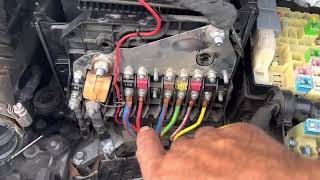
For the third-generation Ford Escape, while common causes like battery and wiring issues are prevalent, there are specific, documented failure points. One is a break in the specific wire that sends a negative (ground) signal from the PCM to activate its own power relay, which can cause a no-start and prevent a scanner from communicating with the PCM. Another owner-documented issue is a loose main fuse in the 'Mega Fuse' block located in front of the battery, 🎬 Watch: How to find and fix a loose Mega Fuse which can vibrate loose and cut power to the ignition system intermittently.
Symptoms You May Notice

- Engine will not start, or cranks but does not fire.
- Engine stalls intermittently while driving.
- Check Engine Light is on (may be intermittent or accompanied by other lights).
- Multiple other warning lights may appear on the dashboard (e.g., ABS, traction control, Service AdvanceTrac).
- Transmission may not shift correctly or may be stuck in one gear (limp mode).
- Scan tool cannot communicate with the PCM.
- Odometer display shows dashes (---) instead of mileage.
- Replacing the PCM without first thoroughly testing the battery, grounds, and wiring. A new PCM will not fix a communication issue caused by a bad wire or low voltage.
Most Likely Causes

- Weak or Failing Battery / Poor Electrical Connection 🔴 High Probability Modern vehicles like the Escape are highly sensitive to voltage. A battery that is weak, has corroded terminals, or loose connections can cause unpredictable voltage drops, disrupting communication between modules.
How to confirm: Test the battery voltage with a multimeter; it should be at least 12.4V-12.6V with the engine off. A load test is the most definitive way to confirm battery health. Clean the battery terminals and check that the main power and ground cables are tight and free of corrosion.
Typical fix: Recharge or replace the battery. Clean or replace battery terminal clamps.
Est. part cost: $150-$300 - Damaged Wiring or Corroded Connectors 🟡 Medium Probability Wiring harnesses, particularly in the engine bay, are susceptible to damage from vibrations, heat, or rodents. Key ground points can corrode over time, creating an open circuit. Specific ground points to inspect on the Escape include G104 (right rear of transmission) and G105/G108/G109 (left rear of engine compartment).
How to confirm: Visually inspect the wiring harness leading to the PCM for any signs of chafing, melting, or breaks. Disconnect the PCM connectors (with the battery disconnected) and check for corroded, bent, or pushed-out pins. Locate and inspect main chassis grounds for tightness and corrosion.
Typical fix: Repair the damaged section of the wire harness. Clean the connector pins with electrical contact cleaner or replace the connector pigtail if corrosion is severe. Clean and tighten ground connections.
Est. part cost: $20-$200 - Faulty PCM Power Relay or Control Circuit 🟡 Medium Probability A documented failure on a 2014 Escape points to a break in the wire that the PCM uses to ground and activate its own power relay (located at position R14 in the engine bay 🎬 See this walkthrough for testing the PCM power relay circuit fuse box). If the relay doesn't turn on, the PCM won't power up and communicate.
How to confirm: Locate the PCM power relay (R14) in the under-hood fuse box. Swap it with a known good relay of the same type. If the problem persists, use a multimeter to check for battery voltage at the relay socket. A wiring diagram is essential to then check for the ground signal from the PCM on the relay's control circuit when the key is turned on.
Typical fix: If the control wire from the PCM is broken, it must be repaired. If the relay itself is faulty, it is a simple replacement.
Est. part cost: $15-$50 - Faulty Powertrain Control Module (PCM) ⚪ Low Probability While PCM failure is not exceptionally common, it can happen due to internal short circuits, voltage spikes, or environmental factors like moisture intrusion.
How to confirm: This is typically diagnosed by exclusion. If the battery, all power/ground connections, the CAN bus network, and all related wiring have been tested and confirmed to be good, the PCM itself is the likely culprit.
Typical fix: Replace the PCM. The new module will need to be programmed to the vehicle's VIN and specific configuration by a dealer or a specialized shop.
Est. part cost: $800-$1500
Rare But Worth Checking
- Loose Mega Fuse Block:
Diagnosis Steps
- Check Battery Health: Start with the simplest cause. Test the battery voltage (should be 12.4V+). A load test is recommended. Inspect terminals for corrosion and ensure they are tight.
- Scan for All Codes: Use a high-quality OBD-II scanner capable of reading codes from all modules (ABS, BCM, etc.), not just the engine. The presence of multiple U-series codes points towards a network-wide issue.
- Inspect Fuses and Relays: Check all fuses related to the PCM in the engine bay and interior fuse panels, specifically fuses 12, 31, 32, and 38 in the engine bay fuse box. Locate the PCM Power Relay (R14 in the engine bay fuse box) and swap it with an identical relay to test.
- Inspect PCM Power and Grounds: Disconnect the battery. Locate the PCM (typically in the engine bay, near the firewall or air filter box on the driver's side). Visually inspect the wiring harness and connectors for damage or corrosion. Check for secure ground connections, paying special attention to G104, G105, G108, and G109, and G200 (under the passenger door sill).
- Test the PCM Power Relay Circuit: Using a wiring diagram, identify the PCM power relay (R14). Check for battery voltage at the relay socket. Test the control circuit wire (often Yellow/Blue at PCM pin 58) that runs from the PCM to the relay; it should provide a ground signal to activate the relay when the ignition is turned on.
- Check CAN Bus Integrity: With an advanced scan tool or multimeter, check the CAN bus network. With the battery disconnected, measure the resistance between the CAN High (Pin 6) and CAN Low (Pin 14) pins at the OBD-II port. It should be approximately 60 ohms. With the key on, voltage should be around 2.5V on each line.
- Check for Loose Mega Fuses: Inspect the main fuse block in front of the battery. With the key on, carefully wiggle the fuses and wiring to see if it causes any electrical change inside the cabin, which could indicate a poor connection.
- Suspect the PCM: If all wiring, power, ground circuits, and network tests are good, the PCM is the most likely point of failure.
Parts You'll Likely Need
- Powertrain Control Module (PCM)
(OEM #CV6Z-12A650-CANP (1.6L), DS7Z-12A650-BSANP (2.0L) - Note: Many variations exist, always verify with VIN.)— This is the part to replace if all wiring, power, and ground circuits have been confirmed to be working correctly. It is the 'brain' of the powertrain.
Trusted brands: Motorcraft
OEM price range: $600-$1200
Aftermarket price range: $400-$800 (Remanufactured) - Battery — A weak or failing battery is a very common cause of communication codes due to unstable voltage.
Trusted brands: Motorcraft, Interstate, DieHard
OEM price range: $200-$300
Aftermarket price range: $150-$250 - PCM Power Relay
(OEM #8T2T-14B192-AA (Commonly used relay, verify part number))— If the PCM does not receive power, it cannot communicate. A faulty relay is a simple but critical failure point in this circuit. Located at R14 in the engine bay fuse box.
Trusted brands: Motorcraft, Standard Motor Products
OEM price range: $20-$40
Aftermarket price range: $10-$25
Related Codes That Often Appear With This One
- U0101 — Lost Communication with TCM. If the TCM is a separate module, this code often appears with U0100 because they are on the same critical network. If the problem is network-wide, multiple U-codes will be present.
- U0121 — Lost Communication with ABS Control Module. This is another key module on the high-speed CAN bus, and its loss often points to a network-wide wiring or power issue.
Platform-Specific Known Issues
- Intermittent No-Start from Loose Mega Fuse: An owner of a 2017 Escape traced a no-start condition to a loose fuse in the 'Mega Fuse' block located under the air intake housing, in front of the battery. Vibrations would cause the fuse to lose contact, cutting power to critical systems. Shaking the fuse block while the key was on caused the vehicle's power to flicker, confirming the issue. The fix was to replace the faulty fuse, which had a poor internal connection.
- Corroded or Loose Main Ground Straps: Poor ground connections are a frequent cause of network communication faults. On the 2013-2019 Escape, it is critical to inspect the main ground points for the PCM and engine harness. Key locations include G104 (at the right rear of the transmission) and a cluster of grounds at the left rear of the engine compartment (G105, G106, G108, G109). These should be removed, cleaned of any paint or corrosion, and securely tightened.
Documented NHTSA Reports
- A manufacturer service bulletin notes that the transmission PRNDL/S gear selector on the instrument cluster may flash when U0100, U0101, U1013 and/or P0606 are present or stored in the PCM (NHTSA ODI #11102327).
- An owner reported that despite a battery testing in good working order, a code reader produced codes for the anti-lock brake system and ECM/PCM, specifically U0151-00 and U0100-00 (NHTSA ODI #11535218).
- NHTSA ODI #11704877 describes a situation where multiple communication fault codes including U0100, U0131, U0140, and U0151 appear when the ignition is on with the engine off, but disappear after the engine is started.
- A manufacturer report mentions diagnostic codes such as P0014, P0303, and U0100 being present alongside mechanical noise and engine roughness (NHTSA ODI #11669147).
- NHTSA ODI #11487894 notes a case where a vehicle produced several codes including P090C, U0100-00, U3003-17, U3003-16, U0101-00, and U0401-00, though the failure could not be duplicated by the dealer.
Mechanic-Grade Diagnostic Values
- HS-CAN Bus Resistance — expected: ~60 Ω (Ohms) between Pin 6 and Pin 14 of the OBD-II port with battery disconnected.. Failure: A reading of ~120 Ω indicates an open in the circuit or a faulty terminating resistor. A reading near 0 Ω indicates a short between the CAN High and CAN Low wires.
- HS-CAN Bus Voltage (Key On, Engine Off) — expected: CAN High (Pin 6) and CAN Low (Pin 14) should both read approximately 2.5V (recessive state).. Failure: During communication, CAN High will toggle to ~3.5V and CAN Low will toggle to ~1.5V (dominant state). A line stuck at 0V or battery voltage indicates a short to ground or power. A real-world test on a 2013 Escape showed 2.75V and 2.24V.
- PCM Ground Circuit Resistance — expected: Less than 0.2 Ω between the PCM ground pins (e.g., 96, 97, 98, 99 on C175B) and a clean chassis ground point.. Failure: High resistance (anything over 0.5 Ω is suspect) indicates a poor ground connection, which can cause the PCM to malfunction.
- PCM Power Relay Control Voltage — expected: The control wire from the PCM to the PCM Power Relay (Pin 58, Yellow/Blue wire on some models) should show ground (near 0V) when the ignition is turned on, activating the relay.. Failure: If this pin does not go to ground with the key on, the relay will not activate, and the PCM will not power up. This points to an internal PCM fault or a break in this specific wire.
Hidden / Shadow Codes Worth Checking
- B10E5:11 / B10E5:15: PCM Wake-Up Control Circuit Short to Ground or Open. This code is stored in the Body Control Module (BCM) and indicates the BCM cannot 'wake up' the PCM when the door is opened or key is turned. This will prevent the PCM from ever coming online, leading other modules to log U0100. (see via A professional scan tool capable of reading Ford-specific BCM codes, such as Ford IDS or FORScan.)
Scan Tool Commands That Help
- Ford IDS (or equivalent): Network Test / Self-Test — This is the first step when diagnosing a U0100. It polls all modules on the network and provides a topology map showing which modules are communicating and which are offline. This quickly identifies if the PCM is the only offline module or if it's a larger network issue.
- Ford IDS (or equivalent): Programmable Module Installation (PMI) — This function is required when replacing the PCM. It reads the 'As-Built' data (vehicle-specific configuration) from the old PCM and writes it to the new one. If the old PCM is dead, this data must be entered manually from Ford's service database using the VIN.
- Ford IDS (or equivalent): PATS Parameter Reset — After replacing and programming a new PCM, the Passive Anti-Theft System (PATS) often needs to be reset to allow the existing keys to be recognized by the new module and start the vehicle.
Wiring & Ground Locations

- PCM Connector C175B, Pin 58 — This is one of the main connectors at the Powertrain Control Module, located in the engine bay on the driver's side, near the air filter housing.. On some models, this specific pin (with a Yellow/Blue wire) sends the ground signal from the PCM to its own power relay. A break in this single wire will prevent the PCM from powering on, causing a no-start and U0100 across the network.
- G200 — Located under the front passenger's door sill plate.. This is a major interior ground point. While not a direct PCM ground, modules inside the cabin that communicate with the PCM use this ground. Corrosion or looseness here can cause intermittent network communication problems.
- PCM Ground Pins (96, 97, 98, 99) — These are specific pins on the C175B connector at the PCM.. These are the main ground inputs for the PCM. A high-resistance reading on any of these pins indicates a faulty ground connection, which is a primary cause of module communication failure. They should be tested for resistance back to a known good chassis ground.
Real Owner Repair Stories
- YouTube user Jonny Rodriguez (2014 Ford Escape 2.0L) — No start, no crank. Scan tool would not communicate with the PCM, showing code U0100.
❌ Tried (didn't work) Checking fuses and main power to the PCM.
✅ What actually fixed it A broken wire for the PCM Power Relay control circuit was found near the PCM connector. Specifically, the Yellow/Blue wire at Pin 58 of the PCM connector, which provides the ground signal to activate the relay, was severed. Repairing this wire restored the PCM's ability to power on and communicate.
Model Year Variations Within This Range
- 2013-2019: The 2017 model year introduced a significant facelift. While the core network architecture is similar, wiring colors, pin locations, and fuse box layouts may have minor differences between the 2013-2016 and 2017-2019 models. Always verify with a wiring diagram specific to the vehicle's model year before performing electrical tests.
Diagnostic Flowchart
Used vs. New Parts: Buying Guide for This Vehicle
When a used part is the smart pick: For a PCM replacement, a used part from a junkyard can be a cost-effective option, potentially saving hundreds of dollars. It is a viable choice if you have access to a Ford IDS scan tool or a high-end aftermarket equivalent (like Autel MaxiSYS) capable of performing the 'Programmable Module Installation' (PMI) procedure.
Donor-vehicle mileage cap: roughly under 120000 miles for the part to have meaningful remaining life.
What to inspect on the donor part:
- Verify the part number on the used PCM matches the original exactly.
- Source the part from a vehicle with the same engine, transmission, and drivetrain (FWD/AWD).
- Inspect the connector pins on the used module for any signs of corrosion, moisture, or physical damage.
- Choose a donor vehicle that was not involved in a flood or front-end collision.
OEM-only on this vehicle (don't cheap out):
- Powertrain Control Module (PCM) - While used OEM is an option, avoid unverified 'rebuilt' or 'reflashed' units from unknown online sellers. A new or remanufactured Motorcraft part, or a properly programmed used OEM unit, are the most reliable choices.
Aftermarket brands forum-validated for this vehicle:
- Cardone (for remanufactured PCMs)
Brands owners have reported issues with on this vehicle:
- Generic, no-name online sellers offering pre-programmed PCMs without requiring a VIN or as-built data transfer.
Real Owner Stories
Aggregated from forums and TSBs cited above. Mileages and costs reflect what owners reported in those sources.
2014 Ford Escape
Symptoms: The vehicle would not start and had a U0100 code for lost communication with the ECM.
What fixed it: A break was found and repaired in the specific wire that the PCM uses to provide a ground signal to its own power relay (R14).
Source hint: YouTube: U0100 code lost communication with ECM. Ford Escape 2014 won't start. Problem in ECM relay line.
2017 Ford Escape
Symptoms: The vehicle had an intermittent no-start condition. Shaking the fuse block in front of the battery while the key was on would cause the vehicle's power to flicker.
What fixed it: A faulty fuse in the 'Mega Fuse' block, which had a poor internal connection, was identified and replaced.
Source hint: YouTube: 2013 - 2017 Ford Escape No Start SOLVED | No BS Tech
2017 Ford Escape Titanium
Symptoms: The owner experienced a recurring, intermittent no-start problem.
What fixed it: The issue was difficult to diagnose; the problem persisted even after a dealership replaced the battery and a relay, indicating a more complex underlying fault.
Source hint: Reddit: r/AskAMechanic - 2017 Ford Escape Titanium won't start
Related OBD-II Codes
Frequently Asked Questions
My 2013-2019 Escape won't start and the odometer just shows dashes. Where should I begin my diagnosis?
Are there specific fuses or relays I should check for a U0100 code on my Ford Escape?
I was told to check the ground connections. Are there any common problem spots on the 2013-2019 Escape?
My scan tool won't connect to the engine computer. Is this part of the U0100 issue?
I have a 2017 Escape with an intermittent no-start. I've already checked the battery and relays. Is there anything else specific to look for?
How likely is it that the PCM itself has failed on my Escape?
Helpful Videos

Used OEM Parts in Stock



New Aftermarket Parts Available



The information in this article is provided for general reference and educational purposes only. Vehicle specifications, procedures, and part compatibility can vary by production date, trim level, and region. Always consult your vehicle's factory service manual and verify part numbers before purchasing or performing repairs. Safety-critical components such as airbags, seat belts, and braking systems should be installed by a qualified professional.
- Ford Escape:
- 🎬 Helpful Videos
- 🛍️ Shop This Part
- What's Unique About the 2013-2019 Ford Escape
- Symptoms You May Notice
- Most Likely Causes
- Rare But Worth Checking
- Diagnosis Steps
- Parts You'll Likely Need
- Related Codes That Often Appear With This One
- Platform-Specific Known Issues
- Documented NHTSA Reports
- Mechanic-Grade Diagnostic Values
- Hidden / Shadow Codes Worth Checking
- Scan Tool Commands That Help
- Wiring & Ground Locations
- Real Owner Repair Stories
- Model Year Variations Within This Range
- Diagnostic Flowchart
- Used vs. New Parts: Buying Guide for This Vehicle
- Real Owner Stories
- 2014 Ford Escape
- 2017 Ford Escape
- 2017 Ford Escape Titanium
- Related OBD-II Codes
- Frequently Asked Questions
- 🎟️ Get 5% Off