

U0002 on 2016-2024 Chevrolet Camaro: High-Speed CAN Bus Performance Causes and Fixes
Code U0002 on a 2016-2024 Camaro indicates a high-speed communication network problem. Before suspecting expensive modules, check for common Camaro issues like a weak battery, water leaks in the trunk causing corrosion at the rear fuse block (per TSB 18-NA-375), or a melted wiring harness on the passenger side if you have aftermarket headers.
- U0002 is a network performance code, not a specific part failure.
- On a 2016-2024 Camaro, immediately suspect physical wiring damage. Check for melted wires near the exhaust (especially with aftermarket headers) and water damage in the trunk.
- Always check the battery and charging system first, as low voltage can mimic more complex network problems.
- Diagnosis is complex and often requires professional tools. Do not replace expensive modules like the ECM or BCM without first proving the wiring and connections are 100% intact.
What's Unique About the 2016-2024 Chevrolet Camaro
For the 6th generation Camaro (2016-2024), this code often points to specific vulnerabilities. One of the most common culprits, especially on modified cars, is the installation of aftermarket exhaust headers, which can melt the nearby wiring harness on the passenger side, causing shorts in the CAN bus wires. Another well-documented issue is water intrusion into the trunk, which can corrode the rear fuse block and its connectors, leading to a host of network and electrical failures. GM has updated TSB 18-NA-375 multiple times to address this water leak issue.
Symptoms You May Notice
- Multiple warning lights on the dashboard (Check Engine, ABS, StabiliTrak, Airbag)
- Gauges on the instrument cluster behaving erratically or dropping to zero
- Loss of power steering assist
- Transmission shifting harshly or getting stuck in gear
- Vehicle entering 'limp mode' with reduced engine power
- No-start or intermittent starting issues
- Radio or infotainment system malfunctioning or displaying a 'Shift to Park' message
- Smell of burnt electronics from the trunk
- Replacing the BCM or ECM without confirming a wiring fault first. These modules are expensive and often not the root cause.
- Clearing the code without fixing the underlying issue. The problem is almost certain to return as it is typically a physical fault.
Most Likely Causes
- Damaged Wiring Harness from Aftermarket Headers 🔴 High Probability The routing of the factory wiring harness on the passenger side runs extremely close to the exhaust manifold. Aftermarket headers often radiate more heat and have larger dimensions, which can easily melt the harness insulation, causing the CAN bus wires to short together or to ground.
How to confirm: Visually inspect the main wiring harness located near the passenger side exhaust manifold/headers, especially under the coolant reservoir area. Look for melted plastic loom, burnt insulation, and exposed copper wires. This has been documented extensively by owners.
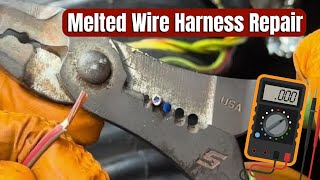
Typical fix: The damaged section of the harness must be repaired. This involves cutting out the burnt wires, splicing in new sections with proper connectors, and re-insulating the harness. 🎬 Watch: Step-by-step guide to fixing a melted wiring harness Some owners report success with this, while others who had dealer repairs note that a full harness replacement (approx. $1500) was required for a permanent fix. The harness must then be rerouted or shielded with high-temperature material (like DEI wrap) to prevent a recurrence.
Est. part cost: $20-$600 - Water Intrusion in Trunk / Rear Fuse Block Corrosion 🟡 Medium Probability GM issued Technical Service Bulletin (TSB) 18-NA-375 for 2016-2024 models regarding water leaks into the trunk. This water pools in the bottom of the trunk tub, submerging and corroding the Rear Body Fuse Block and its connectors, disrupting communication.
How to confirm: Lift the trunk floor liner and inspect the area around the battery and rear fuse block for signs of moisture, standing water, water stains, or blue/green corrosion on the electrical connectors and fuse terminals. TSB 18-NA-375 points to leaks from the decklid weatherstrip, tail lamp seals, rear window seams, or sunroof drains as likely sources.
Typical fix: First, the source of the water leak must be found and fixed. Then, the corroded fuse block, terminals, and wiring must be cleaned or replaced. In severe cases, the entire rear fuse block assembly and its connectors need replacement. Later versions of the TSB recommend drilling a 30mm drain hole in the trunk floor and installing drain plug (GM P/N 39123504) to prevent future water accumulation.
Est. part cost: $50-$500 - Weak or Failing Battery / Alternator 🟡 Medium Probability Modern vehicles are highly sensitive to voltage. A battery that is weak or an alternator that is not charging correctly can cause system voltage to drop below the threshold required by modules, causing them to randomly drop off the communication network and trigger performance codes.
How to confirm: Test the battery voltage with the engine off (should be >12.4V). Then, start the engine and test the alternator output (should be ~13.5-14.5V). A simple load test at an auto parts store is the most definitive way to check battery health.
Typical fix: Replace the weak battery or faulty alternator.
Est. part cost: $150-$600 - Poor Ground Connection ⚪ Low Probability
How to confirm: Inspect and test the main ground connections for the battery, engine block, and chassis. Look for loose, corroded, or broken ground straps. TSB PIC6299B for erratic tachometers also points to checking specific ground locations as a diagnostic step for electrical issues. Perform a voltage drop test on the ground side to check for high resistance.
Typical fix: Clean the grounding points to bare metal and tighten the connections securely. Replace any corroded or broken ground straps.
Est. part cost: $10-$50
Rare But Worth Checking
- Faulty Control Module: While possible, a control module (like the BCM, ECM, or TCM) is less likely to be the cause than a wiring issue. A faulty module can 'scream' on the network, flooding it with bad data and causing other modules to stop communicating. This should only be considered after all wiring and connection issues have been ruled out by a professional.
- Aftermarket Device Interference: Poorly installed aftermarket electronics (remote starters, alarms, OBD-II dongles) can interfere with the CAN bus network. A TSB for other GM vehicles (PI1149A) notes that devices can bring down the MOST bus, a similar network, causing widespread issues.
Diagnosis Steps
- Check Battery Health: Ensure the battery is fully charged and the alternator is functioning correctly. Low voltage is a common cause of network codes.
- Scan All Modules: Use a high-quality OBD-II scanner to read codes from ALL vehicle modules, not just the engine. Note all communication (U-prefix) codes present.
- Inspect for Common Failure Points: Visually inspect the wiring harness near the passenger side exhaust for heat damage. Pull up the trunk liner and inspect the rear fuse block for any signs of water damage or corrosion.
- Check Terminating Resistors: With the battery disconnected, measure the resistance between Pin 6 (CAN High) and Pin 14 (CAN Low) on the OBD-II port. A healthy network should read approximately 60 ohms. A reading of 120 ohms suggests a break in the circuit or a problem with one of the two terminating resistors.
- Isolate the Fault: If a wiring issue isn't obvious, the next step is to disconnect modules one by one from the CAN bus to see if communication is restored. This is an advanced procedure best left to a professional.
- Check for TSBs: Check for any Technical Service Bulletins (TSBs) related to your vehicle's specific VIN and symptoms. TSB 18-NA-375 is a key document for potential water leak issues.
Parts You'll Likely Need
- Wiring Harness Repair Supplies — If the cause is a melted harness, you will need wire, solder, heat shrink, and high-temp loom to perform a durable repair.
Trusted brands: ACDelco, DEI
OEM price range: $20-$50
Aftermarket price range: $10-$30 - Rear Fuse Block / Junction Block
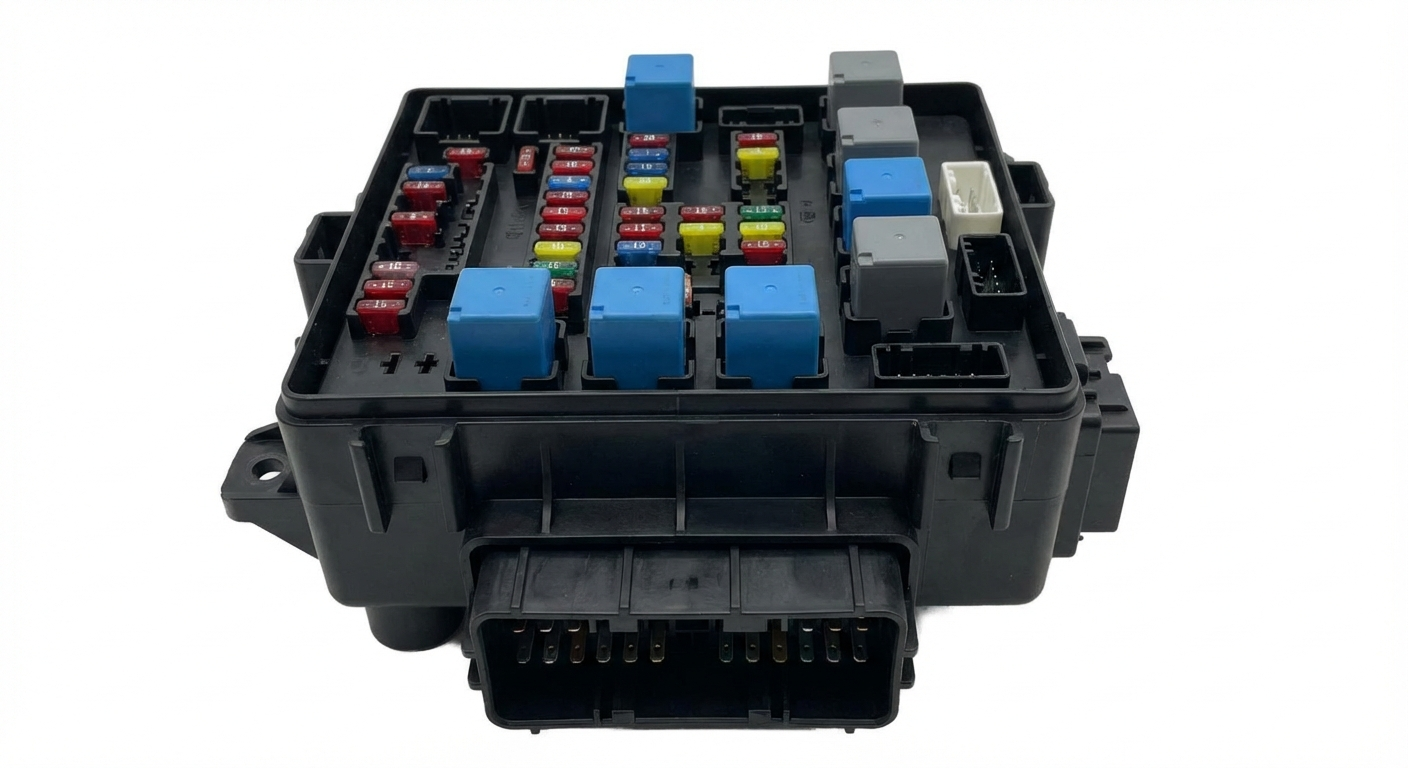
(OEM #84081785 (supersedes 23312008, 84024856))— If water intrusion in the trunk has caused significant corrosion, the entire fuse block may need to be replaced.
Trusted brands: ACDelco (GM Genuine)
OEM price range: $130-$250 - Rear Fuse Block Connectors
(OEM #13594678, 13594679 (for the two large connectors))— Often the corrosion from water damage will destroy the connector housings and pins, requiring them to be replaced along with the fuse block.
Trusted brands: ACDelco (GM Genuine)
OEM price range: $40-$80 - Trunk Drain Plug
(OEM #39123504)— Recommended by GM TSB 18-NA-375 to be installed in a newly drilled hole in the trunk floor to prevent future water accumulation after a leak-related repair.
Trusted brands: ACDelco (GM Genuine)
OEM price range: $5-$15
Related Codes That Often Appear With This One
- U0100 — Lost Communication With ECM/PCM
- U0101 — Lost Communication with TCM
- U0121 — Lost Communication With Anti-Lock Brake System (ABS) Control Module
- P0700 — Transmission Control System (MIL Request) - This is a generic code indicating the TCM has detected a fault.
Technical Service Bulletins (TSBs) & Recalls
- 18-NA-375: Information on Diagnosis of No Start, Smoke/Fire Originating from Trunk, Radio... and/or Various Electrical Issues [due to water intrusion]
- 18-NA-355: 8-Speed Automatic Transmission Torque Converter Clutch Shudder
- 21-NA-245: Shift to Park Message Displayed in Driver Information Center (DIC)
- PIC6299B: Intermittent Erratic Tachometer Operation
Platform-Specific Known Issues
- TSB 18-NA-375 documents a known issue where water can leak into the trunk area and damage electrical components, including the rear fuse block, on 2016-2019 models.
- Numerous owner reports on forums like camaro6.com confirm that aftermarket headers frequently melt the passenger-side wiring harness, leading to CAN bus failures.
Mechanic-Grade Diagnostic Values
- High-Speed CAN Bus Resistance — expected: ~60 Ω. Failure: A reading of ~120 Ω indicates an open circuit or one missing terminating resistor. A reading of 0 Ω indicates the CAN High and CAN Low wires are shorted together. A reading significantly different from 60 Ω (e.g., 45 Ω) could indicate a faulty module or an extra, unintended termination on the bus.
- High-Speed CAN Bus Voltage (Idle/Recessive State) — expected: CAN_H ≈ 2.5 V, CAN_L ≈ 2.5 V. Failure: Significant deviation from 2.5V on either line at idle points to a short to power or ground.
- High-Speed CAN Bus Voltage (Active/Dominant State) — expected: CAN_H ≈ 3.5 V, CAN_L ≈ 1.5 V. Failure: Waveform not reaching these approximate levels or showing excessive noise/ringing indicates a wiring integrity problem, interference, or a faulty module driver.
Scan Tool Commands That Help
- GDS2 (GM Global Diagnostic System 2): Vehicle DTC Information > Display for all ECUs — This is the first step to see which modules are reporting communication loss codes. It helps build a map of the fault.
- GDS2 (GM Global Diagnostic System 2): Data Bus Diagnostic Tool — This specialized function within GDS2 actively polls the bus to determine which modules are present and communicating, helping to quickly identify a module that is offline. It can also monitor bus voltage and message traffic.
- GDS2 (GM Global Diagnostic System 2): Module Diagnostics > [Specific Module] > Control Functions — After identifying a potentially faulty module, a technician can use bidirectional controls to command outputs (like lights, motors) to verify if the module is partially functional or completely dead.
Wiring & Ground Locations
- Rear Body Fuse Block — In the trunk, on the right (passenger) side, near the battery.. This is a major hub for power and data distribution. It is highly susceptible to corrosion from water leaks in the trunk, as documented in TSB 18-NA-375, which can disrupt the CAN bus network.
- X350 — Connector for the fuel tank harness, located above the fuel tank.. While not a primary cause, wiring diagrams show CAN bus lines passing through or near various harness connectors. Damage to any of these, like X350, during other repairs could potentially introduce a network fault.
- G304 (Example) — Interior ground point, often located under seats or near the B-pillar.. Multiple modules share common ground points. A loose or corroded ground like G300 or G304 can cause floating voltages and data errors for any module using it, leading to network performance codes.
- Engine Block Grounds — Multiple points on the rear of the cylinder heads and lower engine block.. The ECM and other engine-related modules rely on clean engine block grounds. These are often disturbed during major engine work (like header installation) and if not properly re-secured, can cause a host of issues including network codes.
Real Owner Repair Stories
- Camaro6 Forums (2020 ZL1 1LE, 6400 miles) — Multiple warning lights (Stabilitrak, ABS, Park Brake), "Service Rear Axle" message, loss of power steering, GPS and other displays losing data. Issues were intermittent.
❌ Tried (didn't work) Dealer replaced the Body Control Module (BCM), but the problem persisted immediately after pickup.
✅ What actually fixed it The owner noted that one of the bolts on the steering rack was hitting the aftermarket headers. While not explicitly stated as the final fix in the thread, this physical interference with a key component (steering rack) connected to the network is a prime suspect for causing intermittent shorts or sensor disruptions that would lead to the reported communication errors and symptoms.
OEM Part Supersession History
23312008, 84024856→84081785— Standard part evolution, likely for manufacturing improvements or minor revisions.
Heads up: 84081785 is listed as the correct replacement for the entire 2016-2024 range.84044726→N/A— This is a different part number for the rear fuse block specifically for 2016-2017 models without the memory package.
Heads up: This highlights that different trim/option packages can have different fuse block part numbers. Always verify the correct part number by VIN.N/A→84180486— Part number listed for 2019-2020 models.
Heads up: The existence of multiple part numbers (84081785, 84044726, 84180486) for the same component across the generation underscores the importance of VIN-matching when ordering a replacement.
Model Year Variations Within This Range
- 2016-2024: TSB 18-NA-375, addressing the trunk water leak, has been revised multiple times, adding model years up to 2024. Later revisions (post-2020) recommend drilling a drain hole as part of the repair, a procedure not mentioned in the initial versions.
- 2016-2017 vs 2019-2020: Different part numbers exist for the rear fuse block depending on model year and options (e.g., with/without memory package), indicating minor internal differences. For example, 84044726 is cited for 2016-17 models, while 84180486 is for 2019-20.
Diagnostic Flowchart
Other Known Issues on This Vehicle
Issues unrelated to this code that are worth knowing about as an owner of this generation:
- 8-Speed (8L45/8L90) Automatic Transmission Shudder 🔴 High — Very common on 2016-2019 models. Can occur at low mileage (under 20k miles). The original factory-fill transmission fluid is hygroscopic and degrades, causing torque converter clutch shudder. (Ref: TSB 18-NA-355)
- Electric Power Steering (EPS) Failure 🔴 High — Affects 2016-2018 models, leading to a sudden loss of power steering assist. A recall was issued for this problem. (Ref: NHTSA Recall 18V586000)
- 'Shift to Park' Message When in Park 🟡 Low — Common across many model years. The Driver Information Center displays a 'Shift to Park' message after the vehicle is already in park, preventing it from shutting off properly. (Ref: TSB 21-NA-245)
- Erratic Tachometer Fluctuation 🟠 Medium — Reported on 2016-2019 models, especially with the LT1 V8 engine. The tachometer needle sweeps erratically without an actual change in engine RPM, often pointing to a ground issue. (Ref: TSB PIC6299B)
Used vs. New Parts: Buying Guide for This Vehicle
When a used part is the smart pick: A used rear fuse block from a junkyard can be a cost-effective option IF you can verify the donor car had no signs of water damage in the trunk. It is a direct-swap component that does not require programming. A used wiring harness pigtail or connector is also a good choice if only a small section of your harness is damaged.
Donor-vehicle mileage cap: roughly under 50000 miles for the part to have meaningful remaining life.
What to inspect on the donor part:
- For a fuse block, inspect the donor vehicle's trunk for any signs of water stains, rust, or musty smells before the part is pulled.
- Examine the fuse block's pins and connectors for any hint of blue or green corrosion.
- For a wiring harness section, ensure the loom is intact, there are no visible burns or melting, and the wires are still flexible, not brittle.
OEM-only on this vehicle (don't cheap out):
- Body Control Module (BCM)
- Engine Control Module (ECM)
Aftermarket brands forum-validated for this vehicle:
- DEI (Design Engineering, Inc.) - For high-temperature heat shielding wrap to protect wiring harnesses from exhaust heat.
Brands owners have reported issues with on this vehicle:
- Unknown/unbranded wiring harness repair kits. Use quality wire and connectors to ensure a durable repair.
Real Owner Stories
Aggregated from forums and TSBs cited above. Mileages and costs reflect what owners reported in those sources.
2016-2024 Chevrolet Camaro
Symptoms: The owner experienced a catastrophic wiring harness failure where the harness was melted by aftermarket headers.
What fixed it: A full replacement of the chassis wiring harness, which required stripping the car's interior.
Cost: $6,000
Source hint: Camaro6 Forum: WARNING headers melting wire harness $6,000 later...
2016-2024 Chevrolet Camaro
Symptoms: The wiring harness was burned by headers, leading to communication faults.
What fixed it: Full harness replacement was performed by the dealer for a permanent fix rather than attempting a splice repair.
Cost: $1,500
Source hint: Camaro6 Forum: Cost to replace chassis wiring harness/burned from header
2016-2024 Chevrolet Camaro
Symptoms: Persistent trunk water leak leading to a dead car, a smell of burnt electronics, and a corroded rear fuse box.
What fixed it: Repairing the source of the water leak and addressing the corroded rear fuse box.
Source hint: Camaro6 Forum: Trunk Water Leak
2016-2024 Chevrolet Camaro
Symptoms: Water in the trunk caused the rear fuse box to corrode, resulting in electrical issues.
What fixed it: The dealer quoted a repair for the corroded rear fuse box caused by water intrusion.
Cost: $900
Source hint: Reddit r/camaro: HELP Water in trunk! Corroded fuse box!
Related OBD-II Codes
Frequently Asked Questions
Does TSB 18-NA-375 apply to my 2016-2024 Chevrolet Camaro?
Can installing aftermarket headers cause the U0002 code on my Camaro?
What is the recommended fix for the trunk water leak mentioned in the TSB?
Why is my Camaro displaying a 'Shift to Park' message along with communication codes?
How much does it cost to fix a wiring harness damaged by exhaust heat?
Could a simple battery issue trigger a U0002 code?
Helpful Videos
We Have This Part in Stock





The information in this article is provided for general reference and educational purposes only. Vehicle specifications, procedures, and part compatibility can vary by production date, trim level, and region. Always consult your vehicle's factory service manual and verify part numbers before purchasing or performing repairs. Safety-critical components such as airbags, seat belts, and braking systems should be installed by a qualified professional.
- Chevrolet Camaro:
- 🎬 Helpful Videos
- 🛍️ Shop This Part
- What's Unique About the 2016-2024 Chevrolet Camaro
- Symptoms You May Notice
- Most Likely Causes
- Rare But Worth Checking
- Diagnosis Steps
- Parts You'll Likely Need
- Related Codes That Often Appear With This One
- Technical Service Bulletins (TSBs) & Recalls
- Platform-Specific Known Issues
- Mechanic-Grade Diagnostic Values
- Scan Tool Commands That Help
- Wiring & Ground Locations
- Real Owner Repair Stories
- OEM Part Supersession History
- Model Year Variations Within This Range
- Diagnostic Flowchart
- Other Known Issues on This Vehicle
- Used vs. New Parts: Buying Guide for This Vehicle
- Real Owner Stories
- 2016-2024 Chevrolet Camaro
- 2016-2024 Chevrolet Camaro
- 2016-2024 Chevrolet Camaro
- 2016-2024 Chevrolet Camaro
- Related OBD-II Codes
- Frequently Asked Questions
- 🎟️ Get 5% Off