

P2802 on 2012-2018 Ford Focus: Transmission Range Sensor 'B' Circuit Low Causes and Fixes
On a 2012-2018 Ford Focus, code P2802 is most often caused by a faulty Transmission Range Sensor (TRS) or corroded wiring connectors. This can cause a no-start condition or erratic shifting. Expect to pay $50-$150 for a new sensor, and always inspect wiring before replacing parts. The OEM part number for the sensor is AE8Z-7F293-A.
- P2802 on a 2012-2018 Focus often causes a no-start condition because the car cannot confirm it is in Park.
- Always inspect wiring and key electrical connectors for corrosion before buying a new Transmission Range Sensor.
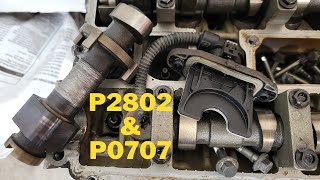
- This code is frequently seen with P0707. If both are present, the Transmission Range Sensor itself is the most likely culprit.
- Due to the complexity of the DPS6 transmission, professional diagnosis is recommended if a simple sensor swap or connector cleaning doesn't resolve the issue.
What's Unique About the 2012-2018 Ford Focus

The 2012-2018 Ford Focus uses the DPS6 PowerShift, a dry dual-clutch automatic transmission with a well-documented history of electrical and mechanical issues. While P2802 points to the range sensor, the root cause is often not the sensor itself. A Ford Technical Service Bulletin (TSB SSM 47790) was issued for related hybrid models (Fusion, C-MAX) highlighting that water intrusion and corrosion in specific wiring harness connectors are a primary cause for this exact code. Technicians often apply this logic to the Focus, as its wiring harnesses can also be vulnerable to moisture, causing shorts that trigger P2802.
Symptoms You May Notice
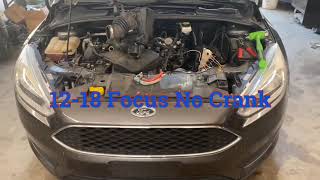
- Vehicle will not start (no crank) 🎬 Watch: Troubleshooting a no-crank condition on your Focus
- Gear selector indicator on the dashboard is blank or incorrect
- "Transmission Malfunction - Service Now" warning light
- Engine stalls or hesitates
- Harsh, jerky, or delayed gear shifts
- Check Engine Light is on
- Inability to shift out of Park
- Replacing the Transmission Range Sensor without first inspecting the wiring and connectors. Corrosion is a very common cause and replacing the sensor will not fix it.
Most Likely Causes

- Faulty Transmission Range Sensor (TRS) 🔴 High Probability The sensor is located on the exterior of the transmission and is subject to heat, vibration, and environmental exposure, leading to internal failure over time.
How to confirm: With a multimeter, backprobe the sensor's connector to check for correct voltage signals as the gear selector is moved. A Ford technician notes you should see ~5V power feed on the white/green wire. If the 'B' circuit signal is stuck low or does not change, the sensor is likely faulty. This code often appears with P0707 ('A' Circuit Low), which strongly points to a failure of the sensor assembly.
Typical fix: Replace the Transmission Range Sensor. The sensor is located on the top/front of the transmission case, often requiring removal of the battery and battery tray for access.
Est. part cost: $50-$180 - Corroded or Damaged Wiring/Connectors 🔴 High Probability While TSB SSM 47790 officially covers other models, it points to a known Ford issue where connectors (like C134, C146, C1651) in the engine bay are vulnerable to water intrusion from clogged cowl or sunroof drains, leading to pin corrosion. This is a very common cause for this code across similar platforms.
How to confirm: Visually inspect the main wiring harness connectors between the transmission and the main vehicle body for any signs of green or white corrosion, moisture, or pushed-out pins. Perform a wiggle test on the harness while monitoring sensor data with a scan tool.
Typical fix: Clean the affected connector pins with an electrical contact cleaner and a small brush. Apply dielectric grease to seal out moisture. If corrosion is severe, the connector pigtail may need to be replaced.
Est. part cost: $10-$75 - Damaged Wiring Harness 🟡 Medium Probability The harness can chafe against the chassis or engine components, or be damaged by rodents, causing a short to ground. A user on Reddit with a 2018 Focus reported that codes P2802 and P0707 were ultimately caused by chewed wires.
How to confirm: Visually inspect the wiring harness running to the transmission range sensor for any signs of physical damage, melting, or breaks. Perform a continuity test with a multimeter to check for a short to ground on the 'B' circuit wire.
Typical fix: Repair the damaged section of the wire using a weatherproof splice and heat shrink tubing.
Est. part cost: $5-$25
Rare But Worth Checking
- Failing Transmission Control Module (TCM): The TCM on the DPS6 transmission is a very common failure point that can cause a wide array of electrical codes. A faulty TCM can fail to send the 5V reference signal to the TRS, or it can internally short, causing P2802. On early models, even disconnecting the battery during other repairs has been anecdotally linked to TCM failure. This should be suspected if the sensor and wiring test good.
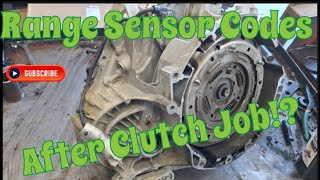
- Faulty Powertrain Control Module (PCM): This is very rare. The PCM should only be considered after the sensor, wiring, and TCM have all been ruled out 🎬 Watch: Why range sensor codes appear after clutch repairs as the cause.
Diagnosis Steps

- Scan for all diagnostic trouble codes. Note if P0707 or any 'U' (communication) codes are present.
- Check for a no-start condition. If the car doesn't crank, the issue is likely preventing the TCM from seeing a 'Park' or 'Neutral' signal.
- Visually inspect the wiring harness and connectors between the firewall and the transmission. Pay close attention to connectors in areas where water might collect, looking for signs of water damage or corrosion.
- If wiring appears intact, test the Transmission Range Sensor (TRS). Disconnect the sensor and check for a 5-volt reference on the white/green wire at the connector. If no voltage is present, the problem is upstream (TCM or wiring).
- If reference voltage is present, use a scan tool to view live data or a multimeter to backprobe the connector. Verify that the 'A' and 'B' circuit signals change state as you move the shifter through each gear.
- If the 'B' circuit signal is stuck low regardless of gear position and power/ground to the sensor are good, the sensor has failed.
- If the sensor and wiring are confirmed to be good, the fault may lie with the Transmission Control Module (TCM), a known high-failure item on these vehicles.
Parts You'll Likely Need

- Transmission Range Sensor
(OEM #AE8Z-7F293-A)— This sensor is the most direct cause of the code if it fails internally. It is also referred to by its Motorcraft service part number, SW6817.
Trusted brands: Motorcraft, Standard Motor Products (SMP)
OEM price range: $100-$180
Aftermarket price range: $50-$120 - Connector Pigtail — If water intrusion has caused severe corrosion, simply cleaning the connector may not be enough. Replacing the connector pigtail ensures a solid connection.
Trusted brands: Motorcraft, Dorman
OEM price range: $40-$70
Aftermarket price range: $20-$40
Related Codes That Often Appear With This One
- P0707 — This code is for 'Transmission Range Sensor 'A' Circuit Low'. Since the 'A' and 'B' circuits are part of the same sensor assembly, seeing both codes together strongly suggests the sensor itself has failed or there is a shared wiring/power issue.
- U0101, U019F, U0284 — These are communication loss codes. On Ford platforms with known water intrusion issues, the corrosion that shorts the TRS wiring can also short adjacent communication wires in the same harness, causing these codes to appear simultaneously. Seeing them with P2802 is a strong indicator of a wiring harness or connector problem.
Technical Service Bulletins (TSBs) & Recalls
- SSM 47790: While officially for 2013-2019 Fusion/MKZ/C-Max Hybrids, this TSB is highly relevant. It notes that water intrusion into specific connectors (C134, C146, C1651, etc.) can cause multiple electrical DTCs, including P2802, and advises inspecting/cleaning them before replacing parts.
Platform-Specific Known Issues
- The 2012-2018 Ford Focus is subject to numerous transmission-related complaints and class-action lawsuits regarding the DPS6 PowerShift transmission. While many issues relate to clutches and the TCM, electrical faults are also common. Ford offered extended warranties (Customer Satisfaction Programs 14M01, 14M02, 15N03) for the TCM and clutch assembly, which extended coverage to 10 years or 150,000 miles for the TCM on certain model years. Owners should check with a dealer to see if their vehicle is covered, as related repairs might be performed simultaneously.
Mechanic-Grade Diagnostic Values
- TRS 5V Reference Voltage — expected: ~5 Volts. Failure: If no voltage is present, the TCM is likely faulty or there is a break in the power wire.
- TRS Ground Circuit Voltage Drop — expected: Less than 0.1 Volts. Failure: A reading higher than 0.1V indicates a poor ground connection, which is a common issue on this platform.
- Scan Tool PID: TR_FREQ — expected: 100 to 150 Hz. Failure: A reading outside this range or that is unstable indicates a fault in the sensor or wiring.
- Scan Tool PID: TR_DC (Duty Cycle) — expected: P: 8.0-25.8%, R: 30.5-39.3%, N: 40.5-52.5%, D: 54.3-71.1%. Failure: The duty cycle percentage does not match the selected gear, or is stuck at a low value.
Scan Tool Commands That Help
- Ford IDS / FORScan: Monitor PIDs: TR_DC and TR_FREQ — This is the primary method for live-testing the Transmission Range Sensor's output. While wiggling the harness, watch these values for any dropouts or erratic changes to identify intermittent wiring faults.
- N/A (Manual Procedure): TCM Reset & Adaptive Learning Procedure — After replacing the TRS, TCM, or repairing wiring, this procedure should be performed to clear learned values and force the TCM to relearn shift points. A common manual method involves a sequence of turning the key on (not starting), shifting to Neutral, turning off, waiting 20 seconds, shifting to Park, turning on, waiting 20 seconds, then starting the engine.
Wiring & Ground Locations

- TRS Connector Pin 3 — At the Transmission Range Sensor connector on top of the transmission.. This pin, on a White with Green tracer wire, is the 5-Volt reference feed from the TCM. A lack of voltage here immediately points to a TCM or wiring issue, not a sensor failure.
- TRS Connector Pin 2 — At the Transmission Range Sensor connector on top of the transmission.. This is the ground circuit for the sensor. Testing between Pin 3 (power) and Pin 2 (ground) should show a solid 5V, confirming the sensor's local power and ground are good.
- Main Chassis Grounds — Under the airbox assembly. There is one main battery ground on the driver's side strut tower and typically two smaller grounds bolted to the chassis below it.. Ford painted the chassis before attaching the ground lugs, leading to poor long-term ground connections. This can cause a host of intermittent electrical issues with the sensitive DPS6 transmission, including range sensor codes. Many owners and technicians fix this by removing the grounds, grinding the paint off the chassis to bare metal, and re-securing them.
- G104 — Listed as being on the left front of the motor compartment.. This is one of the primary ground points for various engine and transmission components. A loose or corroded G104 can cause intermittent electrical faults.
Real Owner Repair Stories
- Reddit user 'cocopropro' in r/MechanicAdvice (2018 Ford Focus Titanium Hatchback) — Would not start, 'Engine Maintenance Required' message, codes P2802 and P0707.
❌ Tried (didn't work) Initial diagnosis pointed towards common TRS or TCM failure.
✅ What actually fixed it Repairing wires that had been chewed through by a rodent. This confirms that physical harness damage is a valid cause. - YouTube channel 'Jonny Rodriguez' (2012 Ford Focus) — No-start / no-crank condition, codes P2802 and P0707, gear selector indicator on dash was blank.
❌ Tried (didn't work) The video implies diagnosis was straightforward.
✅ What actually fixed it Replacing the Transmission Range Sensor (MLPS). After replacement and a relearn procedure, the gear indicator worked correctly and the car started.
"I Checked Everything" — The Actual Cause
- A common scenario for this code on the Focus is that the sensor and wiring harness pass continuity and voltage tests when stationary, but the car still exhibits intermittent faults. The actual cause is often the poor factory grounding design where the main chassis ground lugs are bolted over paint. Vibration and thermal cycles cause the ground integrity to fluctuate, disrupting the sensitive TCM and sensor signals. The fix is to remove the ground lugs under the airbox, grind the paint to bare metal, and re-attach them securely.
OEM Part Supersession History
AE8Z-7F293-A→AE8Z-7F293-A— No supersession found.
Heads up: This part number appears to be consistent across the 2012-2018 model years for the Focus and is also used on the 2011-2019 Fiesta. It is also sold under the Motorcraft service part number SW6817.
Model Year Variations Within This Range
- 2012-2014: When replacing a failed TCM, it is critical to source the correct revision. A former Ford technician advises that for early models like a 2012, a replacement TCM from a 2012-2014 model is acceptable. He specifically recommends looking for a used unit with a shiny sticker marked 'K00' or 'K05' and *without* a Continental brand logo, as these are later, more reliable hardware revisions.
Diagnostic Flowchart
Other Known Issues on This Vehicle
Issues unrelated to this code that are worth knowing about as an owner of this generation:
- DPS6 PowerShift Transmission Failure 🔴 High — Extremely common across all model years. Issues include shuddering, hesitation, delayed shifts, and complete failure of clutches or the Transmission Control Module (TCM). (Ref: Multiple class-action lawsuits and extended warranty programs (e.g., 14M01, 14M02) were issued.)
- Faulty Canister Purge Valve (CPV) 🟠 Medium — Widespread issue causing engine stalling (especially after refueling), rough idle, and difficulty starting. Can deform the fuel tank if left unresolved. (Ref: Ford Safety Recalls 18S32 and 19S22; Customer Satisfaction Program 24N07.)
- Defective Door Latches 🔴 High — Common on 2012-2015 models. A component in the latch can break, preventing the door from closing properly or, in some cases, allowing it to open while driving. (Ref: Ford Safety Recalls 15S16, 16S30, and 20S30.)
- Loss of Power Steering Assist 🔴 High — Affects some models, where the electric power steering rack fails suddenly, resulting in a 'Steering Assist Fault' warning and making the vehicle very difficult to steer.
- Poor Body Grounds 🟡 Low — Some owners report a range of difficult-to-diagnose electrical issues, including transmission shifting problems, caused by poor grounding from the battery to the chassis due to paint on the connection point.
Used vs. New Parts: Buying Guide for This Vehicle
When a used part is the smart pick: A used Transmission Range Sensor (TRS) from a junkyard is a very cost-effective first step if you suspect the sensor is faulty but don't want to spend on a new part for diagnosis. A used Transmission Control Module (TCM) is also a common repair strategy, as new units are expensive and can be hard to source.
Donor-vehicle mileage cap: roughly under 100000 miles for the part to have meaningful remaining life.
What to inspect on the donor part:
- For a TRS, ensure the connector pins are clean, straight, and free of any corrosion.
- For a TCM, prioritize donors from the same model year. For 2012-2014 models, look for the later revision with a shiny sticker ('K00' or 'K05') and no Continental logo.
- Check the donor vehicle's history if possible to avoid parts from flood-damaged or high-impact collision vehicles.
OEM-only on this vehicle (don't cheap out):
- Transmission Control Module (TCM). While a used OEM unit is a viable option, avoid remanufactured or aftermarket TCMs for the DPS6 transmission, as they have a very poor reputation for reliability among owners and specialists.
Aftermarket brands forum-validated for this vehicle:
- Motorcraft (OEM)
- Standard Motor Products (SMP) for the Transmission Range Sensor
Brands owners have reported issues with on this vehicle:
- Unbranded or 'white-box' TCMs sold on auction sites are extremely high-risk.
Real Owner Stories
Aggregated from forums and TSBs cited above. Mileages and costs reflect what owners reported in those sources.
2018 Ford Focus
Symptoms: The vehicle would not start and displayed an "Engine Maintenance Required" message. Diagnostic codes P2802 and P0707 were present.
What fixed it: The cause was found to be rodent damage to the wiring harness, which required repair.
Source hint: Reddit r/MechanicAdvice (2024)
Related OBD-II Codes
Frequently Asked Questions
My 2014 Focus has code P2802 and won't start. Could this be related to the known TCM problems?
I found TSB SSM 47790, but it says it's for the Fusion and C-Max. Is it relevant to my 2016 Focus?
My Focus has both P2802 and P0707 codes. What does that usually mean?
Is replacing the Transmission Range Sensor a common fix for P2802 on this car?
How can I test the Transmission Range Sensor myself before buying a new one?
Helpful Videos

We Have This Part in Stock


The information in this article is provided for general reference and educational purposes only. Vehicle specifications, procedures, and part compatibility can vary by production date, trim level, and region. Always consult your vehicle's factory service manual and verify part numbers before purchasing or performing repairs. Safety-critical components such as airbags, seat belts, and braking systems should be installed by a qualified professional.
- Ford Focus:
- 🎬 Helpful Videos
- 🛍️ Shop This Part
- What's Unique About the 2012-2018 Ford Focus
- Symptoms You May Notice
- Most Likely Causes
- Rare But Worth Checking
- Diagnosis Steps
- Parts You'll Likely Need
- Related Codes That Often Appear With This One
- Technical Service Bulletins (TSBs) & Recalls
- Platform-Specific Known Issues
- Mechanic-Grade Diagnostic Values
- Scan Tool Commands That Help
- Wiring & Ground Locations
- Real Owner Repair Stories
- "I Checked Everything" — The Actual Cause
- OEM Part Supersession History
- Model Year Variations Within This Range
- Diagnostic Flowchart
- Other Known Issues on This Vehicle
- Used vs. New Parts: Buying Guide for This Vehicle
- Real Owner Stories
- 2018 Ford Focus
- Related OBD-II Codes
- Frequently Asked Questions
- 🎟️ Get 5% Off