

P2764 on 2014-2018 Subaru Forester CVT: Torque Converter Solenoid Failure Guide
On a 2014-2018 Forester, code P2764 almost always means the torque converter lock-up solenoid has failed. Subaru dealers replace the entire valve body for $1,500-$2,500+, but replacing just the faulty solenoid is a common, more affordable DIY or independent shop repair.
- P2764 on your Forester almost certainly means the torque converter lock-up solenoid has failed.
- Symptoms include a lit Check Engine Light, flashing AT OIL TEMP light, and jerky driving.
- A Subaru dealer will insist on replacing the entire valve body, costing $1,500-$2,500+.
- A much cheaper fix is to replace only the failed solenoid, which can be done by an independent shop or as an advanced DIY project for a fraction of the cost.
- Do not ignore this code, as it can lead to stalling and further transmission stress.
What's Unique About the 2014-2018 Subaru Forester

This issue is extremely common on Subaru models from this era using the TR580 CVT, including the Forester. While the code points to a single solenoid, Subaru's official repair procedure is to replace the entire valve body assembly, which is very expensive. This has led to a strong aftermarket of individual replacement solenoids and a wealth of community knowledge on performing the more targeted, cost-effective repair. Subaru acknowledged the high failure rate by issuing TSB 16-107-17 and extending the CVT warranty to 10 years or 100,000 miles for certain vehicles, which may cover this specific failure.
Symptoms You May Notice
- Check Engine Light is on
- Flashing 'AT OIL TEMP' light on the dashboard
- Multiple warning lights appearing at once (a 'Christmas tree' effect), often including ABS and Vehicle Dynamics Control lights
- Jerky or harsh shifting, especially during acceleration or deceleration
- Vehicle stalls when coming to a stop or when put into gear
- Car feels sluggish or won't accelerate properly
- Increased fuel consumption
- Transmission goes into 'limp mode', limiting engine RPM
- As noted in NHTSA ODI #11428418, owners may see a combination of a blinking AT Oil Temp light, blinking Cruise Control light, and solid Traction Control and Check Engine lights simultaneously.
- Replacing the entire transmission. The issue is almost always confined to the valve body or a single solenoid, not the entire CVT unit. However, NHTSA ODI #11265402 reports that some dealerships may still claim a whole new transmission is required, asserting that fixing only the torque converter will not resolve the issue.
- Replacing the torque converter. While the code relates to the torque converter's function, the fault is in the controlling solenoid, not the mechanical converter itself.
Most Likely Causes

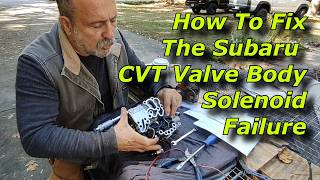
- Failed Torque Converter Lock-Up Duty Solenoid 🔴 High Probability The original lock-up duty solenoids in the TR580 transmission are a well-documented, high-failure item. They often fail by developing an internal short, causing the electrical resistance to drop far below the specified range, which is typically around 12-13 Ohms when cold. 🎬 Watch: How to test and replace the TR580 solenoid
How to confirm: Unplug the main transmission harness connector (a gray connector, often labeled B11, on top of the transmission) and measure the resistance between pin #3 (red and white wire) and chassis ground. A healthy solenoid will read ~12-14 Ohms. A failed solenoid will read significantly lower, often between 2-8 Ohms.
Typical fix: Replace the individual lock-up solenoid. This involves removing the CVT valve body to access the solenoid. While Subaru only sells the full valve body assembly, aftermarket solenoids are widely available from brands like Rostra and Dorman.
Est. part cost: $60-$120 - Failed CVT Valve Body Assembly 🟡 Medium Probability This is the official Subaru-endorsed repair. The failure is almost always the single lock-up solenoid, but the dealer will replace the entire assembly it's attached to, as Subaru does not sell the solenoid individually. NHTSA ODI #11360849 describes a case where a bunch of lights came on at highway speeds, and a scan tool confirmed P2764 and P0700, necessitating a full valve body replacement.
How to confirm: This is typically diagnosed at a dealership after confirming the P2764 code. They will recommend replacing the entire unit rather than a single component.
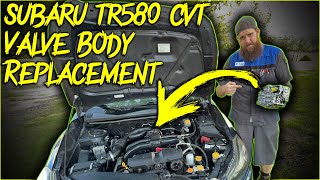
Typical fix: Replace the entire CVT valve body assembly with a new OEM unit. This includes all new solenoids and requires a relearn procedure with a compatible scan tool. 🎬 See this DIY walkthrough for replacing the entire valve body
Est. part cost: $800-$1,200 - Damaged Wiring or Connectors ⚪ Low Probability While much less common than solenoid failure, the wiring harness leading from the TCM to the transmission can be damaged, causing a short or open circuit. NHTSA ODI #11505856 specifically identifies P2764 as a "Torque Converter Clutch Pressure Control Solenoid Control Circuit Low" condition.
How to confirm: Visually inspect the wiring harness for any signs of damage. Perform a continuity test on the wires from the TCM to the transmission connector. If the solenoid resistance test at the transmission connector fails, the wiring is not the issue.
Typical fix: Repair or replace the damaged section of the wiring harness.
Est. part cost: $10-$100
Rare But Worth Checking
- Faulty Transmission Control Module (TCM): Extremely rare for this specific code. This should only be considered after the solenoid has been tested and confirmed to be within spec, and the wiring has been thoroughly checked for faults.
- Internal Transmission Wear: In some instances, such as those described in NHTSA ODI #11422506, technicians may find excessive metal build-up on the magnet in the transmission pan after draining the fluid, which could indicate broader mechanical issues beyond the valve body.
Diagnosis Steps

- Confirm the presence of code P2764 (and likely P0700) using an OBD-II scanner.
- Interview the driver about symptoms. Note the 'Christmas tree' dash lights, especially a flashing AT OIL TEMP light, stalling, or harsh shifting.
- Locate the main transmission electrical harness connector on top of the transmission. It is a gray connector, often referred to as B11. Disconnect it.
- Using a multimeter set to Ohms, measure the resistance between pin #3 (the terminal for the red and white wire) on the transmission side of the connector and a good chassis ground.
- A good, cold solenoid should have a resistance of approximately 12-14 Ohms.
- If the resistance is significantly low (e.g., under 10 Ohms, typically 2-8 Ohms), the lock-up duty solenoid has an internal short and has failed. This confirms the diagnosis.
- If resistance is normal, the problem may be intermittent or, in rare cases, in the wiring or TCM. The solenoid can also fail when hot, so testing a warm transmission may reveal the fault.
- If the solenoid is confirmed bad, the repair is to replace either the individual solenoid (cost-effective) or the entire valve body assembly (dealer method).
- After repair, the transmission fluid must be refilled to the correct level with the proper fluid, and a CVT relearn/calibration procedure should be performed using a compatible scan tool.
Parts You'll Likely Need
- CVT Valve Body Assembly
(OEM #31825AA052 (verify by VIN, may be superseded by 31706AA033/31706AA331 for other models))— This is the complete assembly that includes the faulty solenoid. It is the official, though most expensive, repair recommended by Subaru dealers.
Trusted brands: Subaru (OEM)
OEM price range: $800-$1200
Aftermarket price range: N/A - Torque Converter Lock-Up Solenoid
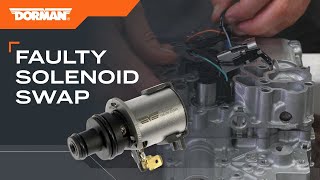
(OEM #Not sold by Subaru; Aftermarket Rostra 52-0580 or Dorman equivalent)— This is the specific component that fails. Replacing only the solenoid is a much more cost-effective repair. It must be sourced from the aftermarket. 🎬 Watch: An affordable aftermarket fix for the lockup solenoid
Trusted brands: Rostra, Dorman
OEM price range: N/A
Aftermarket price range: $60-$120 - Subaru High Torque CVT Fluid (CVTF-II)
(OEM #SOA427V1660 (replaces SOA427V1650))— The correct fluid (green in color) is required when refilling the transmission after the repair. Using incorrect fluid can cause severe damage.
Trusted brands: Subaru (OEM)
OEM price range: $20-$30 per quart
Aftermarket price range: N/A - Transmission Pan Gasket
(OEM #31338AA020 (Verify by VIN))— The gasket should be replaced when the transmission pan is removed to access the valve body.
Trusted brands: Subaru (OEM), Fel-Pro
OEM price range: $10-$20
Aftermarket price range: $5-$15
Related Codes That Often Appear With This One
- P0700 — P0700 is a generic code that simply means the Transmission Control Module (TCM) has stored a fault code. It will almost always be present alongside a specific transmission code like P2764 to illuminate the Check Engine Light.
Technical Service Bulletins (TSBs) & Recalls

- TSB 16-107-17: This TSB specifically addresses CVT valve body and torque converter issues, including diagnostic procedures for codes like P2764. It is the primary document related to the associated warranty extension for the TR580 transmission.
Platform-Specific Known Issues
- Subaru issued Technical Service Bulletin (TSB) 16-107-17, which addresses this specific issue and extended the CVT warranty to 10 years or 100,000 miles for affected vehicles. Owners should contact Subaru of America with their VIN to check for any applicable coverage, even if outside the original warranty period.
- The failure of this solenoid is a well-documented and widespread problem for the TR580 CVT used in the Forester, Impreza, Crosstrek, and other models from the early-to-mid 2010s.
Mechanic-Grade Diagnostic Values
- Lock-Up Duty Solenoid Resistance (Cold) — expected: 12-14.6 Ohms. Failure: Significantly lower resistance, often 2-8 Ohms, indicates an internal short. A very high or open-circuit reading (Mega-Ohms) indicates an internal break in the coil.
- Lock-Up Duty Solenoid Resistance (Hot) — expected: Resistance will increase when hot. A good solenoid might read up to ~25 Ohms.. Failure: If the solenoid tests good when cold, heat it with a heat gun to ~200°F. A faulty solenoid may show an open circuit (infinite resistance) only when hot.
- Valve Body Bolt Torque Specification — expected: 6.5 ft-lbs (80 in-lbs). Failure: N/A
- Transmission Top Cover Bolt Torque Specification — expected: 6 ft-lbs (72 in-lbs). Failure: N/A
Scan Tool Commands That Help
- Subaru Select Monitor (SSM) or compatible aftermarket tool (e.g., OTOFIX, ThinkDiag): Compulsory learning mode / AT Learning — This function is required after replacing the valve body or just the solenoid to reset and recalibrate the transmission's adaptive values. The procedure involves warming the ATF to 40-65°C (104-149°F) and following on-screen prompts with the vehicle lifted. While some owners report success without a relearn, many note that performing it results in noticeably smoother operation.
Wiring & Ground Locations
- TCM (Transmission Control Module) — Underneath the driver's side dashboard, located above the brake pedal. It is a black box.. This is the control unit that sends the signal to the solenoid and detects the fault. Advanced diagnostics may require testing the signal wire (Pin 26 on connector B54) directly at the TCM to rule out a wiring issue between the TCM and the transmission.
- Connector B54 (TCM) — The long, green connector at the back of the TCM under the driver's side dash.. Pin 26 on this connector is the wire for the lock-up duty solenoid. Testing for a short to ground at this pin (with the transmission harness disconnected) can confirm if the wiring harness is compromised.
- Connector B11 / T4 — The main gray electrical connector on top of the transmission case. B11 is the body harness side, and T4 is the transmission side.. This is the primary and easiest access point for testing the solenoid's resistance without removing any major components. The test is performed on the transmission side (T4) between pin #3 and chassis ground.
- Solenoid Internal Ground — The solenoids inside the TR580 are internally grounded to the transmission case.. This simplifies testing, as resistance is measured from the solenoid's power pin directly to the transmission case or any good chassis ground. A fragile ground eyelet for the solenoid harness inside the valve body cover is a common point of breakage during repair.
Real Owner Repair Stories
- Reddit user on r/SubaruForester (2014 Subaru Forester) — Sudden 'Christmas tree' dash with check engine, oil, and traction control lights. Lurching during acceleration.
❌ Tried (didn't work) A repair shop quoted $3,000 for a full valve body replacement.
✅ What actually fixed it The owner performed a DIY repair by replacing only the faulty TCC solenoid with a Dorman part from AutoZone for about $90. The repair took about 8 hours. A key challenge was a fragile ground eyelet for the solenoid that broke during removal and had to be replaced. After the solenoid swap, the codes cleared and the lurching was gone without needing a formal scan tool relearn procedure. - YouTube channel 'Rain City Wrench' (2014 Subaru Impreza (with same TR580 transmission)) — P2764 code present.
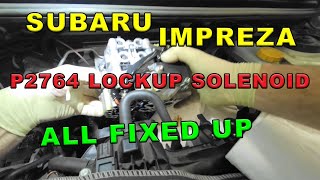
✅ What actually fixed it The technician first tested resistance at the TCM connector, reading 4.5 Ohms (spec is ~13 Ohms). He then tested at the B11 transmission connector and got 7 Ohms, confirming the fault was in the transmission, not the body wiring. After removing the valve body, the bad solenoid was confirmed to have low resistance. He replaced the entire valve body assembly with a new one. The new lock-up solenoid measured a healthy 12.3 Ohms. This fixed the issue.
When the Usual Fixes Don't Work
- While many DIY repairs using aftermarket solenoids (Dorman, Rostra) are successful, some professional technicians report high failure rates with non-OEM parts. One technician noted that aftermarket or rebuilt valve bodies can fail within weeks and strongly recommends using only a new, genuine Subaru valve body assembly for a lasting repair. This suggests that while the individual solenoid swap is a viable cost-saving measure, it may carry a higher risk of premature failure compared to the official OEM full-assembly replacement.
OEM Part Supersession History
31825AA050, 31825AA051, 31825AA052→31706AA030, 31706AA031, 31706AA032, 31706AA033, 31706AA034— Subaru has updated the valve body assembly multiple times. Later versions incorporate design changes like an enhanced valve sleeve to improve durability and prevent issues that cause codes like P2764.
Heads up: While multiple part numbers exist, they are generally interchangeable for the TR580 transmission within this vehicle generation. However, always verify the latest applicable part number with a dealer using the vehicle's VIN.
Diagnostic Flowchart
Other Known Issues on This Vehicle
Issues unrelated to this code that are worth knowing about as an owner of this generation:
- Excessive Oil Consumption 🔴 High — Very common on 2014-2015 2.5L FB25 engines, less so on later years. Was subject to a class-action lawsuit due to faulty piston rings. (Ref: TSB 02-157-14R)
- Failing A/C Compressor Clutch 🟠 Medium — Common across many Subaru models of this era. The clutch air gap can widen, causing intermittent A/C operation, especially when hot. (Ref: TSB 10-84-16R)
- Premature Wheel Bearing Failure 🟠 Medium — Owners report needing to replace front or rear wheel bearings sooner than expected, often starting around 60,000-80,000 miles.
- Cracked Rear Coil Springs 🟠 Medium — Particularly noted on the 2014 model year, rear coil springs can fracture. A recall was issued to address this. (Ref: Recall WTV-84)
- Easily Cracked Windshields 🟡 Low — Many owners report that the original windshields are prone to cracking from minor impacts.
Used vs. New Parts: Buying Guide for This Vehicle
When a used part is the smart pick: A used OEM valve body from a low-mileage donor vehicle can be a cost-effective alternative to a new one, as the failure is typically isolated to a single solenoid that can be replaced. However, buying a complete used assembly is risky as it may have the same inherent solenoid flaw. It is generally not recommended.
Donor-vehicle mileage cap: roughly under 60000 miles for the part to have meaningful remaining life.
What to inspect on the donor part:
- Verify the donor vehicle's mileage and history if possible.
- Before installing a used valve body, test the resistance of the lock-up duty solenoid (and preferably all other solenoids) to ensure they are within the ~12-14 Ohm specification when cold.
- Inspect the unit for any physical damage, corrosion, or signs of sludge.
OEM-only on this vehicle (don't cheap out):
- CVT Fluid (Subaru CVTF-II): Using non-OEM fluid is a major risk and can lead to transmission damage.
- CVT Valve Body Assembly: For maximum reliability and to avoid repeat labor, a new OEM valve body is the most recommended part. Some technicians strongly advise against aftermarket or even remanufactured units due to high failure rates.
Aftermarket brands forum-validated for this vehicle:
- Dorman: Widely cited by DIYers as a successful and affordable option for the individual lock-up solenoid.
- Rostra: Another known aftermarket supplier for individual solenoids.
Brands owners have reported issues with on this vehicle:
- Unbranded/No-name eBay or Amazon valve bodies: Professional technicians report that 'rebuilt' or cheap aftermarket valve body assemblies often use inferior Chinese-made solenoids that fail very quickly, sometimes within weeks.
Real Owner Stories
Aggregated from forums and TSBs cited above. Mileages and costs reflect what owners reported in those sources.
2014 Subaru Crosstrek
Symptoms: Vehicle displayed codes P2764 and P0700. The failed lock-up solenoid's resistance was measured at 2 ohms.
What fixed it: The owner replaced the individual lock-up solenoid. The new part measured a healthy 13.5 ohms.
Source hint: reddit.com/r/subaru: A thread by a 2014 Crosstrek owner titled '2014 Crosstrek LockUp Solenoid Fix'
Subaru Forester
Symptoms: Diagnosed with code P2764, leading to a dealer quote of $2,500 for a full valve body replacement.
What fixed it: A successful DIY replacement of only the failed lock-up solenoid.
Cost: $0-$200
Source hint: subaruforester.org
Documented NHTSA Reports
Subaru Forester
Symptoms: An owner reported that the CVT codes P0700 and P2764 came on, and the dealership stated the vehicle required a whole new transmission (NHTSA ODI #11265402).
Subaru Forester
Symptoms: A driver experienced CVT failure accompanied by check engine lights and an AT Oil Temp warning, with diagnostic trouble codes P0700 and P2764 stored (NHTSA ODI #11505856).
Subaru Impreza (Cross-Model Reference)
Symptoms: A technician noted that P2764 is a "known issue with Subaru CVT engines" and found excessive metal built up on the pan magnet after draining the fluid (NHTSA ODI #11422506).
Related OBD-II Codes
Frequently Asked Questions
Is there a warranty extension for the P2764 code on my 2014-2018 Forester?
The dealership says I need a whole new valve body for over $1,000. Is this necessary?
How can I test the lock-up solenoid myself to confirm it's the cause of P2764?
What are the most common symptoms of this solenoid failure besides the check engine light?
Does this P2764 issue affect other Subarus, like the Crosstrek or Impreza?
After replacing the solenoid or valve body, is any special procedure required?
Helpful Videos
We Have This Part in Stock

The information in this article is provided for general reference and educational purposes only. Vehicle specifications, procedures, and part compatibility can vary by production date, trim level, and region. Always consult your vehicle's factory service manual and verify part numbers before purchasing or performing repairs. Safety-critical components such as airbags, seat belts, and braking systems should be installed by a qualified professional.
- Subaru Forester:
- 🎬 Helpful Videos
- 🛍️ Shop This Part
- What's Unique About the 2014-2018 Subaru Forester
- Symptoms You May Notice
- Most Likely Causes
- Rare But Worth Checking
- Diagnosis Steps
- Parts You'll Likely Need
- Related Codes That Often Appear With This One
- Technical Service Bulletins (TSBs) & Recalls
- Platform-Specific Known Issues
- Mechanic-Grade Diagnostic Values
- Scan Tool Commands That Help
- Wiring & Ground Locations
- Real Owner Repair Stories
- When the Usual Fixes Don't Work
- OEM Part Supersession History
- Diagnostic Flowchart
- Other Known Issues on This Vehicle
- Used vs. New Parts: Buying Guide for This Vehicle
- Real Owner Stories
- 2014 Subaru Crosstrek
- Subaru Forester
- Documented NHTSA Reports
- Subaru Forester
- Subaru Forester
- Subaru Impreza (Cross-Model Reference)
- Related OBD-II Codes
- Frequently Asked Questions
- 🎟️ Get 5% Off