

P2708 on 2020-2023 Ford Transit: 10R80 Transmission Causes and Fixes
On a 2020-2023 Ford Transit, code P2708 is almost always caused by an internal transmission failure related to the CDF clutch drum, as detailed in Ford TSB 24-2254. A bushing inside the drum moves, causing a hydraulic leak. This is not a simple solenoid swap; it requires a major transmission-out repair using an updated part (JL3Z-7H351-B) and costs between $4,500 and $9,000.
- P2708 on a 2020-2023 Transit is a serious code that points to a known mechanical flaw in the 10R80 transmission.
- The most likely cause is a faulty CDF clutch cylinder, as documented in Ford TSB 24-2254.
- This is not a simple DIY repair; it requires transmission removal and disassembly, with total costs often exceeding $5,000.
- Ensure the repair uses the updated CDF drum part number JL3Z-7H351-B to prevent a repeat failure.
What's Unique About the 2020-2023 Ford TRANSIT

The 2020-2023 Ford Transit uses the 10R80 10-speed automatic transmission, which has a well-documented design flaw. For this specific vehicle and code, the problem is rarely the solenoid itself. Instead, Ford has identified that an internal component, the CDF clutch cylinder sleeve, can move axially out of position. This movement uncovers hydraulic fluid passages that are supposed to be sealed, causing a significant pressure leak. The TCM interprets this hydraulic fault as the 'F' solenoid being stuck on, setting code P2708. This known issue is the subject of multiple Technical Service Bulletins (TSBs), making it the most probable cause.
Diagnostic Flowchart

Tap your situation to follow the diagnostic path that matches what you're seeing on this vehicle.
Symptoms You May Notice
- Harsh, erratic, or delayed gear shifts, especially the 1-2 and 3-4 upshifts.
- Delayed engagement when shifting from Park into Drive or Reverse.
- Failure to engage Reverse, sometimes requiring a vehicle restart to resolve temporarily.
- Transmission getting stuck in one gear or feeling like it's in neutral between shifts.
- Illuminated Malfunction Indicator Lamp (Check Engine Light) or Wrench Light.
- Vehicle entering 'limp mode' with reduced power.
- Replacing only the 'F' shift solenoid. While the code points to the solenoid, the root cause on this platform is typically the mechanical failure in the CDF clutch drum causing a hydraulic leak, not an electrically faulty solenoid.
Most Likely Causes

- Internal CDF Clutch Cylinder Failure 🔴 High Probability A known design issue in the 10R80 transmission where a sleeve/bushing inside the CDF clutch cylinder moves ('walks'), exposing hydraulic passages and causing a pressure loss. This is documented in Ford TSB 24-2254.
How to confirm: A technician must perform a specific hydraulic circuit leak test as outlined in TSB 24-2254. This requires specialized tools, including a pressure vacuum transducer kit (Rotunda 164-R9833) and a suitable pressure gauge.
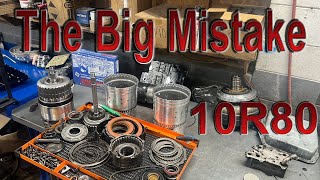
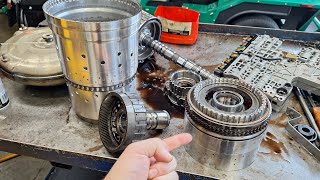
Typical fix: Replace the CDF clutch cylinder assembly with the updated part (OEM # JL3Z-7H351-B), which has a machined lip to prevent the sleeve from moving. 🎬 Watch: A deep dive into the CDF clutch drum design flaw. This requires removing and disassembling the transmission.
Est. part cost: $250-$450 - Failed Main Control Valve Body 🟡 Medium Probability Sticking valves or failed solenoids within the valve body are another known issue with the 10R80 transmission, as noted in TSB 20-2226 and TSB 23-2123 for similar symptoms. Debris from initial break-in or early clutch wear can contaminate the valve body.
How to confirm: After ruling out the CDF clutch cylinder via the TSB-specified leak test, a technician will test the solenoids and inspect the valve body for contamination or wear.
Typical fix: Overhaul or replace the entire main control valve body assembly. 🎬 Watch: How to replace the valve body in a 10R80 transmission. Sometimes only the separator plate needs replacement.
Est. part cost: $600-$1200 - Low or Contaminated Transmission Fluid ⚪ Low Probability While not specific to this platform, low fluid affects hydraulic pressure and can cause shifting issues. On the 10R80, fluid contaminated with clutch material (often from a failing CDF drum) can cause secondary issues like sticking valves in the valve body.
How to confirm: Check the transmission fluid level and condition, following the manufacturer's procedure. The fluid should be clean, red, and free of metallic glitter.
Typical fix: Perform a transmission fluid and filter change using the correct Motorcraft Mercon ULV fluid. This is often done as a first step but rarely solves P2708 if the CDF drum has failed.
Est. part cost: $150-$250
Rare But Worth Checking
- Wiring Harness Damage: Damage to the wiring between the TCM and the transmission can cause a short to power, making the computer think the solenoid is stuck on.
- TCM Software or Hardware Failure: A corrupted software file or internal failure in the Transmission Control Module (TCM) could incorrectly command the solenoid or misinterpret data.
- Missing Input Shaft Plug: A rare but documented failure where a small plug inside the input shaft for the 'F' clutch hydraulic circuit is missing, causing a direct pressure leak. This can be diagnosed with a simple tool like a coat hanger to check for the plug's presence.
Diagnosis Steps
- Verify the Check Engine Light or Wrench Light is on and scan for all DTCs in the PCM and TCM.
- Check the level and condition of the transmission fluid. The fluid should be clean and at the proper level. Any significant metal debris is a sign of internal failure.
- Consult Ford Technical Service Bulletins. Specifically, review TSB 24-2254, which directly addresses P2708 and the CDF clutch cylinder failure for this vehicle.
- Perform the hydraulic circuit leak test as specified in TSB 24-2254. This is the definitive step to confirm the most common cause.
- If the hydraulic test passes, inspect the transmission wiring harness for any signs of damage, corrosion, or loose connections.
- If wiring is good, further diagnosis of the main control valve body and individual solenoids is required, potentially following procedures in TSB 23-2123.
- If the CDF clutch cylinder is found to be faulty, the transmission must be removed for repair and replacement with the updated part.
- While the transmission is out, inspect the input shaft for the rare missing plug issue.
Parts You'll Likely Need

- CDF Clutch Cylinder / Hub Assembly (Updated Design)
(OEM #JL3Z-7H351-B)— This is the component identified in Ford TSB 24-2254 as the primary cause of hydraulic leaks. The updated '-B' version has a machined lip to prevent the internal sleeve from 'walking', providing a permanent fix.
Trusted brands: Motorcraft (Ford OEM)
OEM price range: $250-$450
Aftermarket price range: $200-$350 - Main Control Valve Body Assembly
(OEM #L1MZ-7A100-A)— If the CDF clutch cylinder is not the cause, or if it has sent debris through the system, sticking valves or a failed solenoid within the valve body is the next most likely culprit.
Trusted brands: Motorcraft
OEM price range: $800-$1200
Aftermarket price range: $600-$900 - Automatic Transmission Fluid (Mercon ULV)
(OEM #XT-12-QULV)— Required for any repair that involves opening the transmission or replacing the valve body. A full rebuild requires 10-13 quarts.
Trusted brands: Motorcraft
OEM price range: $15-$25 per quart
Aftermarket price range: $10-$20 per quart
Related Codes That Often Appear With This One
- P0751, P0756, P2700-P2707, etc. — These are all transmission solenoid and clutch performance codes for the 10R80. TSB 24-2254 lists a large group of over 25 codes that are all caused by the same CDF clutch cylinder issue, as the single hydraulic leak can affect multiple clutch circuits.
Technical Service Bulletins (TSBs) & Recalls
- TSB 24-2254: The primary document for this issue. It identifies the root cause as axial movement of the CDF clutch cylinder sleeve in the 10R80 transmission and provides the specific diagnostic leak test procedure.
- TSB 26-2046: A later TSB that also lists P2708 among many other codes related to internal transmission faults caused by the same CDF drum issue. [TSB 26-2046]
- TSB 20-2226: Points to a sticking main control valve body as a cause for harsh engagement on 2020 Transit models.
- TSB 23-2123: Supersedes an earlier TSB and addresses harsh shifts by overhauling the valve body, relevant if the CDF drum is not the primary fault.
Platform-Specific Known Issues
- TSB 24-2254 notes that on 2020-2023 Transits built on or before August 15, 2022, code P2708 may be set due to 'axial movement of the CDF clutch cylinder (7H351) sleeve causing hydraulic circuit leaks.'
- The permanent fix is an updated CDF drum (part number JL3Z-7H351-B) that includes a machined retention lip to prevent the bushing from moving, which Ford began using in later production models.
- TSB 20-2226, for the 2020 Transit specifically, identifies that harsh engagement and related codes can be caused by sticking valves in the main control valve body.
Mechanic-Grade Diagnostic Values
- Shift Solenoid Resistance — expected: 5.0 - 5.4 ohms at 68°F (20°C). Failure: A reading significantly outside this range indicates a faulty solenoid coil.
Scan Tool Commands That Help
- Ford IDS/FDRS or capable aftermarket tool (e.g., FORScan): Clear Transmission Adaptive Tables — This service function is required after any major transmission repair, such as replacing the CDF drum or valve body, to erase the old learned values. It must be followed by the adaptive learning drive cycle.
- Ford IDS/FDRS or capable aftermarket tool (e.g., FORScan): Halt/Stop Use of Transmission Adaptive Learning — Some users and technicians choose to disable the adaptive learning feature to achieve more consistent and predictable shift behavior, especially if they find the learning algorithm creates undesirable shifting characteristics. This is an advanced/off-label use.
- Ford IDS/FDRS: Adaptive Learning Drive Cycle — This is a specific driving procedure that must be performed after clearing the adaptive tables to allow the TCM to relearn clutch fill times and pressure characteristics for smooth shifting.
Wiring & Ground Locations
- Chassis Ground Points — Ford's Body and Equipment Mounting Manual (BEMM) specifies approved ground points, such as the B-Pillar D-Ring mount. For high-current connections, creating a new ground point by drilling a hole and ensuring a clean metal-to-metal contact is recommended.. Poor grounding for the TCM or transmission can cause erratic electrical behavior and phantom codes. Ford specifically advises against connecting high-load grounds directly to the negative battery terminal to avoid bypassing the Battery Management System (BMS).
- Engine Hoist/Lifting Eye — In the engine bay, the engine lifting eye is designated as the proper negative ground point for jump-starting.. While primarily for jump-starting, knowing this official ground point is useful for any engine-bay electrical testing, ensuring a solid connection to the main powertrain ground.
Real Owner Repair Stories
- YouTube video by 'Curmudgeon Transmission' (Ford 10R80 Transmission (vehicle not specified)) — Came in with a 'Shift Element F Stuck Off' code (P2707, related to P2708).
✅ What actually fixed it The technician discovered a plug was missing from one of the four holes on the end of the input shaft. The hole for the 'F' clutch circuit was open, causing a massive hydraulic leak. The fix was to weld the hole shut and grind it flush.
OEM Part Supersession History
HL3Z-7H351-A, JL3Z-7H351-A→JL3Z-7H351-B— The original designs allowed the internal bushing/sleeve to 'walk' out of position. The updated JL3Z-7H351-B part features a machined retention lip to physically prevent the sleeve from moving, permanently fixing the hydraulic leak issue.
Model Year Variations Within This Range
- 2020 - 2022 (and some early 2023): Vehicles built on or before August 15, 2022, are equipped with the original CDF clutch drum design that is prone to the sleeve 'walking' and causing hydraulic leaks, as per TSB 24-2254.
Helpful Videos

Used OEM Parts in Stock

New Aftermarket Parts Available


The information in this article is provided for general reference and educational purposes only. Vehicle specifications, procedures, and part compatibility can vary by production date, trim level, and region. Always consult your vehicle's factory service manual and verify part numbers before purchasing or performing repairs. Safety-critical components such as airbags, seat belts, and braking systems should be installed by a qualified professional.
- Ford TRANSIT:
- 🎬 Helpful Videos
- 🛍️ Shop This Part
- What's Unique About the 2020-2023 Ford TRANSIT
- Diagnostic Flowchart
- Symptoms You May Notice
- Most Likely Causes
- Rare But Worth Checking
- Diagnosis Steps
- Parts You'll Likely Need
- Related Codes That Often Appear With This One
- Technical Service Bulletins (TSBs) & Recalls
- Platform-Specific Known Issues
- Mechanic-Grade Diagnostic Values
- Scan Tool Commands That Help
- Wiring & Ground Locations
- Real Owner Repair Stories
- OEM Part Supersession History
- Model Year Variations Within This Range
- 🎟️ Get 5% Off