

P2702 on 2020-2023 Ford Transit: Causes and Fixes for Transmission Shift Faults
On a 2020-2023 Ford Transit with the 10R80 10-speed transmission, code P2702 almost always indicates a known issue with sticking valves inside the main control valve body or a failing CDF clutch cylinder sleeve. The fix typically involves a dealer-level software procedure to free the valves, or a complete replacement of the valve body assembly or the CDF clutch cylinder.
- P2702 on a 2020-2023 Transit is not a generic code; it points to a specific, well-documented problem with the 10R80 transmission.
- The most likely cause is a faulty main control valve body with sticking valves.
- Do not replace individual solenoids; the repair almost always involves a software procedure or replacing the entire valve body.
- This is not a DIY-friendly repair. It requires dealer-level tools and significant mechanical work.
- Always check for the latest TSBs, as Ford has updated the diagnostic and repair procedures over time.
What's Unique About the 2020-2023 Ford TRANSIT
The 2020-2023 Ford Transit uses the 10R80 10-speed automatic transmission, which is known to have specific, well-documented issues that trigger this code. Ford has released multiple Technical Service Bulletins (TSBs) acknowledging that these transmissions can suffer from sticking valves in the main control valve body or internal hydraulic leaks from a moving CDF clutch cylinder sleeve. Because these are known mechanical and software-related issues, the diagnostic path is very specific to this platform and often requires Ford-specific tools and procedures rather than generic troubleshooting. These issues are not unique to the Transit and affect many other Ford vehicles using the 10R80 transmission.
🎬 Watch: A mechanic explains the four most common 10R80 failures.Diagnostic Flowchart
Tap your situation to follow the diagnostic path that matches what you're seeing on this vehicle.
Symptoms You May Notice
- Harsh, delayed, or erratic gear shifts, sometimes described as a 'violent shift'.
- A jolt, shudder, or 'bump' during gear changes, especially on light acceleration.
- Transmission slipping, where the engine RPMs increase without a corresponding increase in speed.
- A dragging or releasing sensation when slowing to a stop.
- Illuminated Malfunction Indicator Lamp (Check Engine Light) or Wrench Light.
- Vehicle entering 'limp mode', stuck in a single gear.
- Replacing individual shift solenoids. While a single solenoid can fail, the TSBs for this platform strongly indicate the problem is usually the entire valve body assembly or the CDF clutch cylinder, not an individual solenoid. The solenoids and valve body are often calibrated as a matched set.
- Condemning the entire transmission immediately. While some dealers may recommend a full replacement to guarantee the fix and provide a longer warranty, the issue is often repairable by replacing the valve body or CDF drum, which is less expensive than a complete unit.
Most Likely Causes
- Sticking Valves in the Main Control Valve Body 🔴 High Probability This is a widely documented issue for the 10R80 transmission, confirmed by Ford TSB 21-2377. The bulletin suggests that over time, the adaptive calibration can become incompatible with hardware break-in, leading to valve performance issues. Wear or manufacturing debris can cause valves to bind within their bores.
How to confirm: A technician uses a Ford diagnostic scan tool (like FDRS) to perform a 'Transmission Accelerated Main Control Break In' routine. This procedure cycles the solenoids and valves in an attempt to free them. If symptoms persist after the routine, the valve body is deemed faulty.
Typical fix: If the break-in procedure fails, the main control valve body assembly is replaced. After replacement, the new solenoid strategy data that comes with the part must be programmed into the PCM/TCM.
Est. part cost: $450-$850 - Axial Movement of the CDF Clutch Cylinder Sleeve 🔴 High Probability Later TSBs, like 24-2254, identified this as another primary failure point. The sleeve inside the CDF clutch drum can shift out of position, uncovering hydraulic passages and causing a pressure loss to the clutch pack. This is a known design flaw that was addressed in later production.
How to confirm: This requires advanced diagnostics outlined in TSB 24-2254, which involves hydraulic pressure testing at specific ports on the transmission case using a special transducer kit (Rotunda 164-R9833) to verify the internal leak.
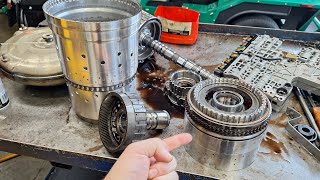
Typical fix: Requires significant internal transmission work to replace the entire CDF clutch cylinder (drum assembly). Aftermarket solutions exist to lock the sleeve in place, preventing future movement. 🎬 Watch: A teardown showing exactly how the CDF drum fails.
Est. part cost: $150-$300 for the part, but labor is extensive. - TCM Software/Calibration Error 🟡 Medium Probability The transmission's adaptive learning strategy can sometimes fail to compensate for normal wear, or the base software may have bugs addressed by updates. This is often the first step in diagnosis before replacing hardware.
How to confirm: Checking for available PCM/TCM software updates with a dealer scan tool is a standard preliminary step in almost all related TSBs.
Typical fix: Reprogramming the Powertrain Control Module (PCM) or Transmission Control Module (TCM) with the latest software calibration, followed by clearing the adaptive tables and performing a drive cycle.
Est. part cost: $0 (if under warranty) - $250 - Low or Contaminated Transmission Fluid ⚪ Low Probability While not specific to this platform, low or dirty fluid can cause hydraulic pressure issues in any automatic transmission. The 10R80 is particularly sensitive and requires Mercon ULV fluid; using the wrong type can cause damage.
How to confirm: Check the transmission fluid level and condition according to the manufacturer's procedure. The fluid should be at the correct level, red in color, and not smell burnt. Any significant metal debris on the pan magnet (beyond fine flakes) indicates a serious internal failure.
Typical fix: Perform a transmission fluid and filter change using only Mercon ULV fluid. If the fluid is low, the source of the leak must be found and repaired.
Est. part cost: $150-$300
Diagnosis Steps
- Verify the code with a professional OBD-II scanner that can also read OEM-specific codes.
- Check the transmission fluid level and condition. Ensure it is clean, at the correct level, and is the specified Mercon ULV type.
- Consult Ford Technical Service Bulletins (TSBs). The most relevant are TSB 21-2377 (Valve Body) and TSB 24-2254 (CDF Clutch Cylinder).
- Using a Ford-specific scan tool (FDRS), check for any available software updates for the PCM/TCM and install them.
- Perform the 'Transmission Accelerated Main Control Break In' routine as described in TSB 21-2377. This procedure must be done with the vehicle on a lift with the wheels off the ground.
- If the break-in routine is successful, clear the adaptive tables, clear the codes, and perform an adaptive learning drive cycle. Advise the customer that shifting may be firm for several days.
- If the break-in routine fails to resolve the symptoms, the main control valve body is the likely culprit and requires replacement.
- If symptoms persist or diagnosis points to a hydraulic leak per TSB 24-2254, follow its specific pressure testing procedures to check for a faulty CDF clutch cylinder. This requires specialized equipment.
- If the CDF clutch cylinder is confirmed to be leaking, the transmission must be partially disassembled to replace the clutch drum assembly.
Parts You'll Likely Need
- Main Control Valve Body
(OEM #L1MZ-7A100-K)— This is the most common point of failure for this code on the 10R80 transmission, due to a known issue with sticking valves. It is the primary repair path outlined in TSB 21-2377.
Trusted brands: Motorcraft
OEM price range: $750-$1100
Aftermarket price range: $400-$600 - CDF Clutch Shell & Cylinder Assembly
(OEM #PC3Z-7B177-A)— This is the second major point of failure, caused by a shifting internal sleeve that creates a hydraulic leak. This part is replaced per TSB 24-2254.
Trusted brands: Motorcraft
OEM price range: $150-$250
Aftermarket price range: $100-$200
Related Codes That Often Appear With This One
- P0751-P0772 — These codes relate to the performance of other shift solenoids (A, B, D, E). They often appear with P2702 because the root cause (valve body, hydraulic leak) affects multiple hydraulic circuits. TSBs list them as a group.
- P0729-P0736 — These codes indicate incorrect gear ratios. They are logged when the TCM detects slip, which is a direct consequence of a friction element not applying correctly, the root issue of P2702.
- P2700-P2705 — This is the full family of codes for Friction Elements A through F. Seeing multiple codes from this range, such as P2702 (Clutch C) and P07F7 (Clutch F), strongly points to a systemic issue like the CDF clutch drum, which houses multiple clutches.
Technical Service Bulletins (TSBs) & Recalls
- TSB 22-2428: Mentions P2702 in a long list of codes related to shifting issues in 2020-2023 Ford Transits, pointing to software updates or valve body issues.
- TSB 24-2254: The most current TSB for this issue. It links P2702 to harsh/delayed shifts and points to hydraulic leaks from a shifted CDF clutch cylinder sleeve. It provides a detailed pressure-testing diagnostic procedure.
- TSB 21-2377: Specifically calls out P2702 and attributes the cause to sticking valves in the main control valve body, outlining a 'Transmission Accelerated Main Control Break In' procedure and subsequent valve body replacement as the fix.
- TSB 26-2046: Lists P2702 among DTCs for powertrain issues on the 2021 model year.
Platform-Specific Known Issues
- Ford has issued multiple Technical Service Bulletins (TSBs) for the 10R80 transmission used in 2020-2023 Transits regarding harsh or delayed shifting accompanied by a group of DTCs including P2702.
- TSB 21-2377 directly attributes the cause to 'sticking valves in the main control valve body' and provides a specific diagnostic procedure (break-in routine) to confirm the fault before replacement.
Mechanic-Grade Diagnostic Values
- Shift Solenoid Resistance — expected: 5.0 - 5.4 ohms at 20°C (68°F). Failure: A reading outside this range indicates a faulty solenoid. However, solenoids are part of the valve body assembly and are typically replaced as a unit.
Scan Tool Commands That Help
- Ford Diagnostic & Repair System (FDRS): Transmission Accelerated Main Control Break In — This is a primary diagnostic step outlined in TSB 22-2428 to attempt to free sticking valves in the main control body before resorting to replacement.
- Ford Diagnostic & Repair System (FDRS): Clear Transmission Adaptive Tables — This must be performed after replacing the valve body or reprogramming the PCM/TCM to force the transmission to relearn shift points and pressures with the new components or software.
- Ford Diagnostic & Repair System (FDRS): Solenoid Body Strategy Programming — This is a mandatory step after replacing the main control valve body. The new valve body comes with a specific 13-digit strategy number that must be programmed into the PCM/TCM for correct operation.
Wiring & Ground Locations
- Main Transmission Vehicle Harness Connector — The main electrical connector on the outside of the transmission case, which connects the internal transmission harness to the vehicle's main wiring and the TCM/PCM.. While internal failures are more common for P2702, damage or corrosion at this connector or its pins can interrupt signals to the shift solenoids, causing erratic behavior and codes. A visual inspection is a valid, though less common, diagnostic step.
Real Owner Repair Stories
- Reddit user on r/f150 (2020 F-150 3.5L with 10R80, 40k miles) — Occasional clunking when shifting.
❌ Tried (didn't work) The user took the truck in for diagnosis primarily to get the complaint on record before the powertrain warranty expired.
✅ What actually fixed it The dealer agreed the shifting was harsh and replaced the CDF drum under warranty per a service bulletin. The owner reported being very happy with the result after getting the truck back. - Reddit user on r/f150 (2018 F-150 EcoBoost, 145k miles) — Crazy shift problems, including floating between gears then slamming into another, and attempting to shift to 1st gear at 80mph.
❌ Tried (didn't work) Transmission relearn procedure., Valve body replacement.
✅ What actually fixed it The user ultimately diagnosed a failed CDF drum, citing the known issue of a slipped internal sleeve. The post serves to inform others about the problem, as the repair was done out of warranty. - Ford F150 Forum user (2021 F-150) — Flaring on the 3-5 upshift, hard downshifts, and difficulty moving forward or in reverse when cold.
❌ Tried (didn't work) A complete transmission rebuild by the dealer to address the CDF drum issue.
✅ What actually fixed it The problem recurred one year and 10,000 miles after the initial rebuild. Another user in the same thread noted their transmission was getting the *updated* CDF drum, as the original replacement part also failed after 30k miles, implying that only the latest part revision permanently solves the problem.
When the Usual Fixes Don't Work
- While the two most common causes are the valve body and the CDF clutch drum, some owners have had these parts replaced only for the problem to persist or return. In one documented case, a user on Reddit with a 2018 F-150 replaced the faulty CDF drum with the updated part, yet the P2702 and P0761 codes returned. After inspecting the new valve body and finding no issues, the cause remained unresolved, suggesting that in rare cases, the issue could lie in the clutch packs themselves, the seals on the input shaft, or a subtle assembly error during the repair.
OEM Part Supersession History
L1MZ-7A100-A, L1MZ-7A100-E→L1MZ-7A100-K— Updates to the valve body assembly to address issues with sticking valves and improve shift quality.
Heads up: L1MZ-7A100-K is the current recommended replacement for earlier versions.HL3Z-7B177-A, HL3Z-7B177-B, HL3Z-7B177-C, HL3Z-7B177-D→PC3Z-7B177-A— The original CDF clutch cylinder design had an internal sleeve that could move, causing hydraulic leaks. The updated part (PC3Z-7B177-A) features a machined lip to prevent this sleeve movement, providing a permanent fix.
Heads up: Vehicles built before approximately August 15, 2022, may have the older, failure-prone CDF drum design. When repairing, it is critical to use the updated PC3Z-7B177-A part.
Model Year Variations Within This Range
- 2020 - Mid-2022: Vehicles built on or before August 15, 2022, are more likely to have the original CDF clutch cylinder design which is prone to internal sleeve movement and hydraulic leaks. Vehicles built after this date are more likely to have the updated part (PC3Z-7B177-A) from the factory.
Helpful Videos


We Have This Part in Stock


The information in this article is provided for general reference and educational purposes only. Vehicle specifications, procedures, and part compatibility can vary by production date, trim level, and region. Always consult your vehicle's factory service manual and verify part numbers before purchasing or performing repairs. Safety-critical components such as airbags, seat belts, and braking systems should be installed by a qualified professional.
- Ford TRANSIT:
- 🎬 Helpful Videos
- 🛍️ Shop This Part
- What's Unique About the 2020-2023 Ford TRANSIT
- Diagnostic Flowchart
- Symptoms You May Notice
- Most Likely Causes
- Diagnosis Steps
- Parts You'll Likely Need
- Related Codes That Often Appear With This One
- Technical Service Bulletins (TSBs) & Recalls
- Platform-Specific Known Issues
- Mechanic-Grade Diagnostic Values
- Scan Tool Commands That Help
- Wiring & Ground Locations
- Real Owner Repair Stories
- When the Usual Fixes Don't Work
- OEM Part Supersession History
- Model Year Variations Within This Range
- 🎟️ Get 5% Off