

P2507 on 2019-2024 Mazda 3: ECM/PCM Power Input Signal Low Causes and Fixes
On a 2019-2024 Mazda 3, P2507 almost always means the 12V battery is weak or failing. Before replacing parts, check that the 'ROOM 15A' fuse is installed, as it's often removed for transport and can set this code without a real fault. A new battery is the most common fix, costing around $200-$400. This issue is also identical on the Mazda CX-30.
- P2507 on a 2019-2024 Mazda 3 is almost always a simple electrical power supply issue.
- Before any other diagnosis, check for the presence and integrity of the 15A 'ROOM' fuse in the engine bay fuse box.
- The most likely actual fault is a weak or dying 12V battery. Have it professionally load-tested.
- Clean and tighten battery terminals and ground connections as a primary, low-cost diagnostic step.
- Do not replace the expensive PCM unless all other simpler causes have been definitively ruled out.
What's Unique About the 2019-2024 Mazda 3
For the fourth-generation (BP) Mazda 3 and its platform-mate, the CX-30, this code has a well-documented, non-malicious cause. Mazda issued a Technical Service Bulletin (TSB 01-003/19) explaining that P2507, often paired with P2610, can be set if the engine is started multiple times with the 'ROOM 15A' fuse removed. This fuse is often pulled by dealerships to put the car in 'transport mode' to prevent battery drain before a sale. The TSB clarifies this is 'normal operation and not a malfunction', meaning the code can be stored as a historical fault with no actual problem present, making it a crucial first check during diagnosis.
Symptoms You May Notice
- Check Engine Light is on
- Vehicle may not start
- Intermittent stalling, especially at idle
- Rough or unstable idle
- i-Stop system may be disabled or show a warning light
- Loss of some electrical functions or accessories
- Warning messages on the dash related to 'Battery Management System Malfunction'
- Replacing the PCM when the actual cause is a weak battery or a missing fuse.
- Replacing the alternator when the battery terminals are simply loose or corroded.
- Ignoring the battery because it is only a few years old; owner reports confirm premature failure is common on this platform.
Most Likely Causes
- Weak or Failing 12V Battery 🔴 High Probability Modern Mazdas with i-Stop (start-stop) technology place high demands on the battery, requiring a specific EFB (Enhanced Flooded Battery) or AGM type. Owner forums are filled with reports of the original Panasonic battery failing in as little as 2-4 years, making it the most common reason for P2507.
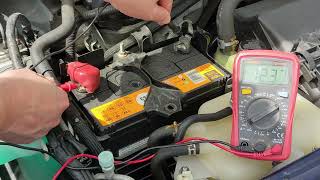
How to confirm: Test the battery with a digital multimeter and a professional load tester. A healthy battery should show at least 12.4V with the engine off and 13.5V-14.5V while running. A load test is critical, 🎬 Watch: How to test your battery and alternator with a multimeter. as a failing battery can show good voltage but collapse under load.
Typical fix: Replace the 12V battery. Ensure the replacement is the correct type (EFB or AGM, typically size Q-85) for vehicles with i-Stop. After replacement, some systems may require a battery monitoring system reset procedure to restore full i-Stop functionality and ensure proper charging.
Est. part cost: $200-$400 - ROOM 15A Fuse Removed for Transport/Service 🔴 High Probability As documented in Mazda TSB 01-003/19, this is a standard Pre-Delivery Inspection (PDI) procedure for new vehicles to prevent battery drain. It can also happen during service, leading to a stored code without a real fault. The TSB notes this is normal and not a malfunction.
How to confirm: Check the fuse box in the engine compartment. 🎬 See this tutorial to find your Mazda 3 fuse boxes. Verify that the 15A fuse labeled 'ROOM' is present and properly seated. If the code is stored along with P2610, this is the most likely cause.
Typical fix: Install a new 15A fuse if missing. Clear the diagnostic trouble codes from the PCM memory. Start the engine to confirm the Check Engine Light does not return.
Est. part cost: $1-$5 - Loose or Corroded Battery Terminals/Grounds 🟡 Medium Probability
How to confirm: Visually inspect the battery terminals for white or greenish corrosion. Attempt to twist the terminals by hand; they should not move. Check the main chassis ground strap (often on the strut tower or under the headlight assembly) for tightness and corrosion.
Typical fix: Disconnect the battery (negative terminal first). Clean the terminals and cable clamps with a wire brush and a baking soda/water solution. Reconnect securely (positive terminal first). Clean any corroded ground points with a wire brush to ensure bare metal contact.
Est. part cost: $5-$15
Rare But Worth Checking
- Faulty Alternator: If the battery tests good but the voltage is low when the engine is running (below 13.2V), the alternator may not be charging properly. This is an uncommon failure on these models.
- Damaged Wiring Harness: A corroded or broken wire in the power supply circuit to the PCM can cause this code. This is more common on older, higher-mileage vehicles or those with rodent damage. One owner of an older Mazda 3 documented a corroded wire under the fuse box as the cause.
- Faulty Powertrain Control Module (PCM): This is extremely rare and should only be considered after all other possibilities (battery, fuses, wiring, grounds) have been exhaustively ruled out. A professional mechanic noted that a PCM is almost never the actual cause despite being a theoretical possibility.
Diagnosis Steps
- Check for Stored TSBs: Ask a dealer or use a professional scan tool to see if TSB 01-003/19 applies. Note that this TSB covers many Mazda models from 2013-2019+.
- Inspect the ROOM 15A Fuse: Open the engine compartment fuse box and confirm the 15A 'ROOM' fuse is installed and not blown. This is the most common non-battery fault.
- Test the Battery: Measure battery voltage with the engine off (should be >12.4V). Start the engine and measure charging voltage (should be 13.5V-14.5V). Perform a professional load test to confirm battery health, as voltage alone is not a sufficient test.
- Inspect Connections: Check battery terminals for corrosion and tightness. Inspect the main chassis ground wire for a clean, tight connection.
- Clear Codes: If a simple issue like a fuse or loose terminal is found and fixed, clear the codes with a scanner and drive the vehicle to see if the code returns.
- Inspect Wiring: If the problem persists, visually inspect the wiring harness leading to the PCM for any signs of damage, corrosion, or loose connections.
- Test Alternator: If charging voltage is low with a known-good battery, have the alternator tested.
- Seek Professional Help: If all other steps fail, a more in-depth diagnosis of the PCM and its circuits may be required.
Parts You'll Likely Need
- 12V Battery (EFB Type)
(OEM #B4Y1-18-520 (Panasonic Q-85 EFB - verify for specific vehicle))— This is the most common cause of low voltage codes. The original battery often lasts 3-5 years before its performance degrades, especially with the i-Stop system.
Trusted brands: Panasonic (OEM), Varta Q-85/115D23L, Yuasa Q-85, DieHard Platinum EFB
OEM price range: $300-$450
Aftermarket price range: $200-$350 - Mini Fuse (15 Amp)
(OEM #99-705-1315 (verify))— Required if the 'ROOM' fuse is missing, which is a common non-fault trigger for this code per Mazda TSBs.
Trusted brands: Bussmann, Littlefuse
OEM price range: $1-$5
Aftermarket price range: $1-$5
Related Codes That Often Appear With This One
- P2610 — P2610 (Instrument Cluster Internal Engine Off Timer Performance Problem) is frequently set alongside P2507 when the ROOM 15A fuse is removed, as documented in Mazda's TSB 01-003/19. Seeing them together strongly points to the fuse issue.
Technical Service Bulletins (TSBs) & Recalls
- 01-003/19 - CHECK ENGINE LIGHT ON WITH DTC P2610 AND P2507. This TSB explains that the codes can be set after starting the engine with the 15A ROOM fuse removed. It applies to the 2019+ Mazda3, 2020+ CX-30, and many other Mazda models. It explicitly states this is 'normal operation and not a malfunction'.
- Bulletin #01-003-21-3776 - Notes that some vehicles may experience the Check Engine Light with DTC P2610 and P2507 stored in memory after an engine start if the 15A room fuse has been removed.
- Bulletin #SA-052-23 - Describes a condition where the PCM stores DTC P2507:00 (PCM Power System: Low Input) which may be accompanied by an engine that will not start unless the key transmitter is placed near the start button, a blank infotainment display, and interior lights that do not illuminate.
- Bulletin #SA-040-24a - Reaffirms that DTC P2507:00 (PCM Power System: Low Input) can be stored alongside communication errors like DTC U0156:00, potentially resulting in a blank infotainment screen and non-functioning interior lights.
Platform-Specific Known Issues
- A known TSB (01-003/19) confirms that P2507 and P2610 can be set simply by starting the engine after the 15A ROOM fuse has been removed for transport or service. This is considered normal operation and is fixed by installing the fuse and clearing the codes.
- Owner Experience: A common story on forums like
mazda3revolution.cominvolves a 2-3 year old Mazda 3 developing a rough idle and this code. The owner takes it to the dealer, who immediately performs a battery load test. The test fails, and a new battery (often replaced under warranty) permanently resolves the issue.
Mechanic-Grade Diagnostic Values
- PCM Keep-Alive (Backup) Voltage — expected: Above 6V. Failure: Voltage drops below 6V for 5 seconds or more.
- Ground Circuit Resistance — expected: < 0.1 Ω. Failure: Resistance greater than 0.1 Ω between a known-good ground point and the negative battery terminal.
- Voltage Drop on Ground Circuit — expected: Below 0.2V. Failure: A reading above 0.2V between the negative battery terminal and the chassis or engine block indicates high resistance.
- Normal Parasitic Draw (after sleep mode) — expected: Under 50mA. Failure: A sustained draw above 50mA after waiting 20-30 minutes indicates a component is not shutting down properly. Note: Some sources indicate that if the vehicle is left unlocked, the draw may stay around 70mA, which is normal for that state.
Scan Tool Commands That Help
- Mazda M-MDS (or equivalent professional scanner): Battery Monitoring System (BMS) / i-Stop Reset — Required after replacing the 12V battery to make the PCM 'relearn' the new battery's state of charge and characteristics. Failing to do this can lead to improper charging, premature battery failure, and persistent 'Battery Management System Malfunction' warnings, even with a new battery.
Wiring & Ground Locations
- PCM Power Input Pins — At the main PCM electrical connector in the engine bay. While specific pin numbers for the 2019+ Mazda 3 are not consistently cited, on similar generation Mazdas they are often labeled 1BA and 1BE. A wiring diagram is required for positive identification.. These are the specific terminals that receive constant backup power from the battery. Testing voltage directly at these pins can confirm if the low voltage issue is at the PCM itself or further upstream in the wiring or power source.
- Main Chassis Ground Points (e.g., G-02, G-03, G-09) — Typically located on the inner fender/strut tower area in the engine compartment, often near the battery tray or under the headlight assembly.. The PCM relies on a solid ground reference to accurately measure voltage. A loose or corroded connection at these primary ground points can create a voltage differential, causing the PCM to incorrectly sense low voltage and trigger P2507.
- Engine/Transmission Ground Straps — Multiple points exist, including straps from the passenger motor mount, on top of the transmission, and on the front of the transmission case.. These grounds ensure the engine block and transmission have a solid connection to the chassis and battery negative. While less direct, a poor engine ground can contribute to overall electrical system instability and voltage issues.
Real Owner Repair Stories
- Reddit user on r/MechanicAdvice (2014 Mazda 3 2.0L (similar architecture)) — Intermittent flashing of brake, key, and traction control lights on the dash, accompanied by dimming headlights, especially when driving in wet/snowy conditions.
❌ Tried (didn't work) Replacing the battery with a new one., Tightening battery terminals.
✅ What actually fixed it The root cause was a corroded main ground point on the passenger side fender brace near the headlight. Cleaning the salt brine corrosion from the bolt, contact surface, and cable end resolved the issue. The problem was confirmed when temporarily running a new ground wire from the affected cable to a clean ground point on the shock tower made the symptoms disappear. - Reddit user on r/mazda3 (2019 Mazda 3 Sedan) — After battery replacement by a local mechanic, a 'charging system malfunctioning' message appeared, followed by a sudden shutdown of all safety systems and the engine while driving on the highway.
❌ Tried (didn't work) Replacing the battery.
✅ What actually fixed it The Mazda dealership determined that the error codes stored from the original battery failure were not cleared after the new battery was installed. A dealer-level reset of the stored codes (and likely the BMS) resolved the problem. This highlights that simply swapping the battery without clearing associated faults can lead to severe drivability issues.
Model Year Variations Within This Range
- 2021+: Turbo models were introduced, and Apple CarPlay/Android Auto became more widely available.
- 2023+: The base 2.0L engine was dropped, and the standard 2.5L naturally aspirated engine received a 5hp increase and improved fuel economy due to tuning and a new cylinder-deactivation system.
- 2024+: A larger 10.25-inch infotainment screen with wireless Apple CarPlay/Android Auto and USB-C ports became available on higher trims.
Diagnostic Flowchart
Other Known Issues on This Vehicle
Issues unrelated to this code that are worth knowing about as an owner of this generation:
- Phantom Braking (Smart Brake Support Malfunction) 🔴 High — Common enough to trigger a recall (NHTSA 19V445000) for 2019-2020 models. Owners report the vehicle braking suddenly with no obstacle present. (Ref: Recall: NHTSA ID 19V445000 / Mazda Recall 3719F)
- Prematurely Leaking Rear Shock Absorbers 🟠 Medium — Frequently reported by owners, sometimes well before 30,000 miles. Oil seepage or leakage is visible on the shock body. (Ref: TSB: 02-001/22 (supersedes earlier versions) provides guidelines for determining leakage vs. normal seepage.)
- Cylinder Deactivation Software Issue 🟠 Medium — A recall was issued for certain 2019 models due to software that could cause a rocker arm to be displaced, leading to engine misfire, power loss, or stalling. (Ref: Recall: NHTSA ID 19V497000 / Mazda Recall 3719F)
- Loose/Detaching Auto-Folding Side Mirrors 🔴 High — A recall was issued for 2020-2022 Mazda3 and CX-30 models where the power folding mirror housing could loosen and potentially detach while driving. (Ref: Recall: NHTSA ID 23V793000)
- Carbon Buildup on Intake Valves 🟡 Low — A common issue for all direct-injection (Skyactiv-G) engines, not just Mazda. Can cause rough idle and reduced power over time, typically after 60,000-80,000 miles.
Used vs. New Parts: Buying Guide for This Vehicle
When a used part is the smart pick: For this code, used parts are generally not recommended for the primary fixes. However, a used wiring harness or engine compartment fuse box from a low-mileage, non-corroded donor vehicle could be a cost-effective solution if a wiring or internal fuse box fault is identified, which is rare.
Donor-vehicle mileage cap: roughly under 50000 miles for the part to have meaningful remaining life.
What to inspect on the donor part:
- For a fuse box or harness, inspect thoroughly for any signs of corrosion, especially green or white powder on pins.
- Check for rodent damage (chewed wires, nests).
- Ensure all connector locking tabs are intact and not brittle.
- Avoid parts from vehicles in regions with heavy road salt use if possible.
OEM-only on this vehicle (don't cheap out):
- 12V Battery: While aftermarket is acceptable, it MUST be the correct type (EFB or AGM) and size (Q-85) to handle the i-Stop system's demands. Using a standard flooded battery will lead to premature failure.
Aftermarket brands forum-validated for this vehicle:
- Varta
- Yuasa
- DieHard (EFB/AGM models)
Brands owners have reported issues with on this vehicle:
- Avoid conventional (non-EFB/AGM) batteries from any brand, as they are not designed for the charge/discharge cycles of a start-stop system.
Real Owner Stories
Aggregated from forums and TSBs cited above. Mileages and costs reflect what owners reported in those sources.
2019 Mazda 3
Symptoms: Rough idle and Check Engine Light with code P2507.
What fixed it: The dealer performed a battery load test which failed. They replaced the battery under warranty, which permanently resolved the issue.
Source hint: mazda3revolution.com
2020 Mazda 3
Symptoms: Check Engine Light on with code P2507, and the i-Stop system was disabled.
What fixed it: The consensus fix among owners was to replace the 12V battery with a new EFB or AGM type battery.
Source hint: Reddit r/mazda3
Related OBD-II Codes
Frequently Asked Questions
My scanner shows both P2507 and P2610 on my 2019 Mazda 3. What should I check first?
Why did my i-Stop system stop working and the 'Battery Management System Malfunction' light come on with P2507?
Can I use a standard lead-acid battery to replace the original one in my Mazda 3 with i-Stop?
I just bought my Mazda 3 and it has this code. Is it a serious problem?
My 2020 Mazda 3 is only 3 years old. Could the battery really be the cause of P2507?
Do I need to perform a special procedure after replacing the battery to fix P2507?
Helpful Videos
We Have This Part in Stock


The information in this article is provided for general reference and educational purposes only. Vehicle specifications, procedures, and part compatibility can vary by production date, trim level, and region. Always consult your vehicle's factory service manual and verify part numbers before purchasing or performing repairs. Safety-critical components such as airbags, seat belts, and braking systems should be installed by a qualified professional.
- Mazda 3:
- 🎬 Helpful Videos
- 🛍️ Shop This Part
- What's Unique About the 2019-2024 Mazda 3
- Symptoms You May Notice
- Most Likely Causes
- Rare But Worth Checking
- Diagnosis Steps
- Parts You'll Likely Need
- Related Codes That Often Appear With This One
- Technical Service Bulletins (TSBs) & Recalls
- Platform-Specific Known Issues
- Mechanic-Grade Diagnostic Values
- Scan Tool Commands That Help
- Wiring & Ground Locations
- Real Owner Repair Stories
- Model Year Variations Within This Range
- Diagnostic Flowchart
- Other Known Issues on This Vehicle
- Used vs. New Parts: Buying Guide for This Vehicle
- Real Owner Stories
- 2019 Mazda 3
- 2020 Mazda 3
- Related OBD-II Codes
- Frequently Asked Questions
- 🎟️ Get 5% Off