

P2463 on 2012-2020 Audi A3 TDI: DPF Soot Accumulation Causes and Fixes
This code means your Diesel Particulate Filter (DPF) is clogged with soot. The most common cause is frequent short trips preventing the DPF from cleaning itself. The fix often involves a forced regeneration with a scan tool, but may require cleaning or replacing a faulty sensor if regeneration fails. In some cases, the DPF itself is damaged and requires replacement.
- P2463 means your DPF is clogged with soot, most likely from too many short trips.
- Before replacing any parts, try to initiate a 'forced regeneration' with a proper scan tool.
- If you own a 2015 model, check if TSB V011509 (software update) applies and has been done.
- If regeneration doesn't work, the most likely part to fail is the DPF differential pressure sensor.
- Never replace the DPF without first finding and fixing the root cause of the clogging.
What's Unique About the 2012-2020 Audi A3
On the Audi A3 TDI with the EA288 engine, this code is very common and often linked to driving habits. These diesel engines need regular highway driving to get the exhaust hot enough (over 600°C / 1112°F) to automatically clean the DPF, a process called passive regeneration. If the car is only used for short city trips, regeneration cycles are frequently interrupted, leading to rapid soot buildup. Additionally, for 2015 models with CRUA/CVCA engines, a known software issue can cause the computer to miscalculate the soot level, falsely triggering this code. Once the warning lights are on, a simple highway drive is usually not enough to clear the fault; a forced regeneration with a diagnostic tool is required.
Symptoms You May Notice
- Check Engine Light is on
- Flashing glow plug warning light
- DPF warning light illuminated on the dashboard
- Vehicle enters 'limp mode' with significant loss of engine power
- Increased fuel consumption
- Engine may struggle to rev up or feel sluggish
- Excessive black smoke from the exhaust (in severe cases, indicating a cracked/failed DPF)
- Engine may run rough
- Replacing the DPF without diagnosing the root cause. A new DPF will simply clog again if the underlying issue (bad sensor, driving habits, software bug, EGR fault) is not resolved.
- Assuming a highway drive will fix the issue once the DPF and glow plug lights are on. At this stage, the ECM has typically locked out passive regeneration and requires a forced regeneration via a scan tool.
Most Likely Causes
- Frequent Short Trips / Interrupted Regeneration Cycles 🔴 High Probability TDI engines require sustained highway speeds (typically 20-30 minutes) for the DPF to reach the 600°C+ temperature needed to burn off soot. City driving cycles often don't meet these conditions, and regeneration may also be inhibited if the fuel tank is less than 1/4 full.
How to confirm: Review driving habits. Check the DPF soot load values using a VCDS or other advanced scan tool. A calculated soot mass over 40-45 grams confirms the clog and will prevent a standing regeneration. A value of 60g is often the maximum reading.
Typical fix: Attempt a 'forced regeneration' using a diagnostic tool like VCDS or Autel. This commands the engine to enter a high-temperature cleaning cycle while driving. If soot load is too high (e.g., >45g), this may fail, and a professional off-car cleaning or DPF replacement is necessary.
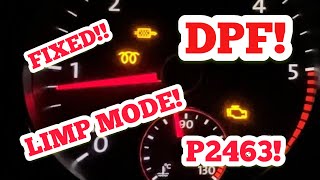
Est. part cost: $0 - Faulty DPF Differential Pressure Sensor (G450) 🎬 Watch this diagnostic walkthrough for DPF pressure sensor faults and soot accumulation codes 🟡 Medium Probability This sensor tells the ECM how clogged the DPF is by measuring pressure before and after the filter. It can fail internally or its connecting hoses can get clogged or melt. A failed sensor sends incorrect data, causing the ECM to either think the DPF is full when it isn't, or fail to trigger a regeneration when needed.
How to confirm: Use a scan tool to monitor the DPF pressure sensor readings at idle and while revving the engine. Unrealistic or static values point to a bad sensor. At idle, a clean DPF should have a very low pressure reading (e.g., under 10-15 hPa/mbar). Check the sensor's voltage on the signal wire; with the key on and engine off, a new sensor should read around 1.0V, while a faulty one might show a much higher or lower voltage. Visually inspect the rubber hoses connected to the sensor for blockages, cracks, or heat damage.
Typical fix: Replace the DPF differential pressure sensor and its hoses. After replacement, the new sensor must be adapted or calibrated to the ECM using a diagnostic tool like VCDS.
Est. part cost: $50-$150 - ECM Software Needs Update (Specifically 2015 Models) 🟡 Medium Probability Volkswagen Group issued TSB V011509 (also known as 2040057) for 2015 TDI models (including those with CRUA and CVCA engines used in the A3) for a software bug that causes a deviation between the calculated and actual soot mass, falsely triggering P2463.
How to confirm: A dealership or a shop with access to OEM service information can check if this TSB applies to your vehicle's VIN and if the update has been performed. This issue often appears alongside code P2458 (Regeneration Duration).
Typical fix: Update the Engine Control Module (ECM) software. The TSB explicitly states not to replace any components until the software update is performed.
Est. part cost: $0 if covered, otherwise shop labor for flashing. - Faulty Throttle Body or EGR System ⚪ Low Probability A malfunctioning throttle body or a stuck EGR valve can disrupt the air-fuel mixture, leading to incomplete combustion and the creation of excess soot, which overwhelms the DPF faster than it can regenerate. Carbon buildup is a common issue in these systems.
How to confirm: Diagnose the throttle body and EGR valve for proper operation using a scan tool to monitor their positions and check for related fault codes. Visual inspection may reveal heavy carbon buildup.
Typical fix: Clean or replace the faulty throttle body or EGR valve.
Est. part cost: $200-$500
Rare But Worth Checking
- Faulty Mass Airflow (MAF) Sensor: A bad MAF sensor can cause incorrect fueling and lead to excess soot. This is often accompanied by other codes, like P0101.
- Cracked or Internally Failed DPF: In rare cases, the filter media inside the DPF can crack or melt due to extreme temperatures from failed regeneration attempts or other engine issues. If this occurs, black soot may be visible at the tailpipe, and the DPF must be replaced.
- Leaking Fuel Injector: A dripping or poorly atomizing fuel injector can lead to incomplete combustion, producing excessive soot that clogs the DPF prematurely.
Diagnosis Steps
- Scan the ECM for all stored fault codes. Note any codes that appear alongside P2463, as they can point to the root cause (e.g., EGR, sensor faults).
- Use a scan tool (like VCDS) to view live data. Check 'soot mass calculated' and 'soot mass measured' in Measuring Value Blocks 108 or 241. A calculated value above 40-45g confirms the clog condition and will likely prevent a standing regeneration.
- Check if TSB V011509 / 2040057 applies to your vehicle (especially 2015 models) and if the software update has been performed.
- If soot levels are between 30g and 40g, attempt a forced regeneration while driving. Follow the scan tool prompts precisely, which typically require driving at a steady speed (30-60 km/h) in a lower gear (4th or 5th) to keep RPMs between 1500-2500 for 15-20 minutes.
- If regeneration fails or the code returns quickly, test the DPF differential pressure sensor (G450). Monitor its readings at idle (should be <15 mbar) and at 2500 RPM (should increase significantly). Check for voltage changes and inspect its hoses for damage.
- If the sensor is good, investigate upstream causes of excess soot, such as the EGR valve, throttle body, and MAF sensor, checking for related codes and proper operation via live data.
- If all sensors and upstream components are working and regeneration fails, the DPF may require professional off-car cleaning. This involves injecting a cleaning fluid directly into the DPF. 🎬 Watch an Audi A3 DPF cleaning process in action
- As a last resort, if cleaning fails or the DPF is found to be cracked internally (often indicated by black soot at the tailpipe), the DPF must be replaced. After replacement, the ECM must be coded to accept the new filter.
Parts You'll Likely Need
- DPF Differential Pressure Sensor
(OEM #076906051B (verify by VIN))— This sensor is a common failure point. It provides the primary data used by the ECM to determine DPF soot load, and a bad sensor will prevent proper regeneration.
Trusted brands: Bosch (OEM supplier, part # 0281006082), Hella, Standard Motor Products
OEM price range: $100-$180
Aftermarket price range: $50-$120 - Diesel Particulate Filter (DPF)
(OEM #8V0254700X (verify by VIN))— This is the final solution if the filter is physically damaged or so clogged that forced regeneration and professional cleaning both fail.
Trusted brands: Walker, Bosal, Eastern Catalytic
OEM price range: $1500-$2200
Aftermarket price range: $600-$1200
Related Codes That Often Appear With This One
- P2002 — This code means 'DPF Efficiency Below Threshold'. It often appears with P2463, indicating the filter is not only clogged but also no longer functioning effectively.
- P2458 — This code means 'DPF Regeneration Duration'. It can be set when regeneration cycles take too long to complete, which is a common symptom leading up to a full P2463 clog. The VW/Audi TSB for the software update also addresses this code.
- P2459 — This code for 'DPF Regeneration Frequency' indicates that the regeneration process is happening too often, which is a precursor to the filter becoming overwhelmed and triggering P2463.
Technical Service Bulletins (TSBs) & Recalls
- V011509 / 2040057: 'Update Programing, MIL ON, Diesel Particulate Filter (DPF) Faults P2458, P2463 Stored in ECM Fault Memory' - Addresses incorrect soot mass calculation on 2015 TDI models with CRUA/CVCA engines.
Platform-Specific Known Issues
- A software update is required for many 2015 models to correct the ECM's soot calculation logic, as detailed in TSB V011509 / 2040057. Failure to perform this update before replacing parts can lead to a repeat failure.
- On vehicles that have had the 'Dieselgate' emissions fix performed, some owners report more frequent DPF issues. The fix altered regeneration strategies, which can, in some cases, lead to premature DPF failure.
Mechanic-Grade Diagnostic Values
- DPF Differential Pressure (G450) at Idle — expected: < 10 hPa (mbar) on a clean filter for Euro 6 engines.. Failure: A reading significantly higher than 15-20 hPa at idle, or a static value that doesn't change with RPM, indicates a clogged filter or faulty sensor.
- DPF Differential Pressure (G450) at ~2500 RPM — expected: Pressure should rise significantly, e.g., to 30-50+ hPa (mbar), depending on load.. Failure: Little to no increase in pressure suggests a leak in the sensor hoses or a failed sensor. An extremely high reading confirms a blockage.
- DPF Soot Load (Calculated vs. Measured) — expected: Values should be relatively close. Calculated load should be below 30g for normal operation.. Failure: A calculated soot load over 45g will typically prevent any form of regeneration and requires DPF replacement or professional cleaning. A large discrepancy between calculated and measured values can point to a sensor or software issue.
- G450 Sensor Signal Voltage (Key On, Engine Off) — expected: A new, properly functioning sensor should read approximately 1.0V.. Failure: A significantly different voltage, such as 0.3V or 5.7V as seen in a diagnostic video, points to an internal sensor failure.
Scan Tool Commands That Help
- VCDS: Service Regeneration while Driving — Used to clear a moderately clogged DPF when soot load is too high for passive regeneration but below the ~45g limit. Go to [01 - Engine] -> [Adaptation - 10] -> Select 'Service regeneration of particulate filter while driving' and change the value to 1. Requires specific driving conditions (e.g., 1500-2500 RPM for 15-20 mins).
- VCDS: Emergency Regeneration at Standstill — For soot loads between 30g and 40g. Go to [01 - Engine] -> [Security Access - 16] -> Enter code 27971. Then go to [Basic Settings - 04] and select the standing regeneration option. The engine will run at an elevated RPM for up to 40 minutes.
- VCDS: Adaptation of Exhaust Gas Differential Pressure Sensor (G450) — This is mandatory after replacing the G450 sensor. For UDS protocol engines, go to [01 - Engine] -> [Basic Settings - 04] -> Select 'Adaptation of exhaust gas differential pressure sensor'. For older CAN protocol engines, use [Coding II - 11] and enter login code 30605. Failure to adapt the new sensor will result in incorrect DPF soot calculations.
- VCDS: Adaptation of Carbon Mass (DPF Replacement) — This must be performed after installing a new DPF to reset the learned ash and soot values. Go to [01 - Engine] -> [Security Access - 16] -> [Adaptation - 10] -> Select 'Particle filter initialization' or 'Adaptation of ash mass' and save a new value of 1.
Wiring & Ground Locations
- G450 Sensor Connector — On the EA288 engine, the G450 sensor is typically in a foil pouch located just behind the oil filler cap.. This is the primary sensor for the P2463 code. Checking for a 5V supply, good ground, and a changing signal voltage at this connector is a key diagnostic step.
- Engine Compartment Ground Connections — Wiring diagrams for the A3 (8V) show multiple critical ground points in the engine compartment wiring harness, specifically identifiers 131, 209, and 419. Another key ground is on the left A-pillar (identifier 639).. A poor ground connection for the engine control module or its sensors can cause erratic voltage readings, leading to false codes like P2463. Verifying these grounds are clean and tight is crucial if sensor readings are illogical.
Real Owner Repair Stories
- Ross-Tech Forums (Audi A4 B7 (similar DPF system principles)) — Heavy smoke (blue/black), P2002 and limp mode.
❌ Tried (didn't work) Replacing the G450 sensor with an aftermarket equivalent (BOSCH 0 281 006 005)., Performing the G450 adaptation procedure in VCDS., Cleaning the EGR valve.
✅ What actually fixed it The owner discovered via the official parts catalog that the replacement sensor was the wrong part number for the vehicle. Installing the correct OEM part number (076906051A for that specific vehicle) resolved the smoking issue, though the P2002 code persisted, indicating other potential issues or the need for a proper adaptation reset. - YouTube - O'Rileys Autos (Audi A3 with P2463) — DPF light, glow plug light, engine light, limp mode, soot load at 60g.
❌ Tried (didn't work) The owner's short driving habits (1 mile to work) were the root cause, and highway driving was no longer sufficient to clear the fault.
✅ What actually fixed it A professional on-car DPF chemical cleaning was performed. The technician injected cleaning fluid directly into the DPF via the pressure sensor hose while the engine was running. After the cleaning, the soot values were reset with a scan tool, and a test drive confirmed the pressure values returned to normal (dropping to ~7 mbar at idle). However, this process revealed a secondary fault with the EGR valve, which then also required replacement.
OEM Part Supersession History
03G-906-051-A / 076-906-051-A→076-906-051-B— Change in sensor calibration and internal design.
Heads up: The 'A' and 'B' versions are not interchangeable. Using the wrong sensor for the vehicle's model year will lead to incorrect pressure readings and persistent DPF fault codes, even if the part is new and adapted.
Model Year Variations Within This Range
- 2015: A specific ECM software bug affects some 2015 models with CRUA/CVCA engines, causing miscalculation of soot mass and triggering P2463. A TSB was issued to update the software as the primary fix.
- Pre-2010 vs. Post-2010 (applies to wider VAG family): The DPF pressure sensor (G450) part number and calibration changed. Early models used part number ending in 'A', while later models use one ending in 'B'. They are not cross-compatible.
Diagnostic Flowchart
Other Known Issues on This Vehicle
Issues unrelated to this code that are worth knowing about as an owner of this generation:
- Clogged Heater Core 🔴 High — Very common, especially on cars with G13 coolant. Often occurs around 60,000-100,000 miles. Results in no heat in the cabin. (Ref: No official TSB, but a widely known issue. The cause is often attributed to a silica bag inside the coolant expansion tank rupturing and releasing desiccant beads that clog the heater core matrix.)
- Timing Belt & Water Pump Failure 🔴 High — The official interval was extended by VW/Audi to as long as 140,000 miles, but many specialists and owners recommend replacement much earlier, around 60,000-80,000 miles or 5 years, to prevent catastrophic engine failure. Water pumps on the EA288 are also a known failure point, prone to leaks or internal seizure.
- Leaking/Failing Water Pump/Thermostat Housing 🟠 Medium — The EA288 engine uses a complex, switchable water pump integrated into a plastic thermostat housing. These units are known to develop slow coolant leaks from warped plastic or failed seals over time.
- EGR Cooler Leaks/Failure 🟠 Medium — The EGR cooler can become clogged with carbon or develop internal cracks, leading to coolant loss, overheating, or loss of power.
- Haldex (AWD) Service Requirement 🟡 Low — On Quattro models, the Haldex all-wheel-drive coupling requires regular fluid and filter changes (typically every 30,000-40,000 miles). Neglecting this service can lead to pump failure and loss of AWD. Some models can also develop humming/vibrations related to the coupling, addressed by TSB 2059057. (Ref: TSB 2059057)
Used vs. New Parts: Buying Guide for This Vehicle
When a used part is the smart pick: A used DPF Differential Pressure Sensor (G450) can be a cost-effective option if sourced from a reputable dismantler with a known low-mileage donor vehicle. Other related sensors (like exhaust gas temperature sensors) are also generally safe to buy used. A used throttle body or EGR valve can also be viable, but inspect for heavy carbon buildup.
Donor-vehicle mileage cap: roughly under 60000 miles for the part to have meaningful remaining life.
What to inspect on the donor part:
- For a DPF: Inspect the filter face for any signs of melting, cracking, or black 'soot-through' spots which indicate internal failure. Avoid any DPF with oily residue, as this suggests a failed turbo on the donor car which may have contaminated the filter.
- For a G450 Sensor: Ensure the plastic housing and hose nipples are not cracked or brittle. Check that the electrical connector pins are clean and free of corrosion.
- Verify the part number on the used component exactly matches the one required for your vehicle's VIN.
OEM-only on this vehicle (don't cheap out):
- Diesel Particulate Filter (DPF): While expensive, an OEM DPF is the safest bet. Many aftermarket DPFs use a lower-quality substrate with less precious metal coating, leading to rapid clogging, failure to regenerate properly, and the P2463 code returning within a few months.
- DPF Differential Pressure Sensor (G450): Given the critical calibration differences between part numbers, using an OEM or OEM-supplier (like Bosch) part is strongly recommended to avoid persistent diagnostic headaches.
Aftermarket brands forum-validated for this vehicle:
- Sensors: Bosch (often the original OEM supplier), Hella.
- DPF: Walker and Bosal are generally considered higher-quality aftermarket options, but OEM is still preferred for longevity.
Brands owners have reported issues with on this vehicle:
- Unbranded, 'no-name' DPFs and sensors from online marketplaces. These are frequently cited on forums as failing quickly and not meeting the required performance specifications, making the initial savings a false economy.
Real Owner Stories
Aggregated from forums and TSBs cited above. Mileages and costs reflect what owners reported in those sources.
2015 Audi A3 (implied via CRUA engine platform mate) — 114000 miles
Symptoms: P2463 code for DPF restriction and soot accumulation.
What fixed it: The dealer performed a forced regeneration and an ECM software update related to TSB V011509.
Source hint: TDIClub Forum - P2463 on CRUA engine
2020 Audi A3 (implied via EA288 engine platform mate) — ~45000 miles
Symptoms: Engine and glow plug light on; soot level reached 40g and forced regeneration would not work with multiple diagnostic tools.
What fixed it: The high soot load locked out the regeneration process, necessitating professional cleaning or sensor diagnosis.
Source hint: VW T6 Transporter Forum - P2463 Force regen not working
Audi A3 2.0 TDI 184 (CUPA engine)
Symptoms: P2463 code would not reset even after the DPF was professionally cleaned.
What fixed it: The issue was identified as a faulty differential pressure sensor (G450) causing the ECU to still perceive the filter as blocked.
Source hint: SEATCupra.net - P2463 won't reset after DPF clean
Related OBD-II Codes
Frequently Asked Questions
Does TSB V011509 apply to my 2015 Audi A3 TDI?
Can I perform a forced regeneration if my soot mass is over 45 grams?
Why is my Audi A3 entering 'limp mode' with the P2463 code?
Could a faulty G450 sensor be causing my DPF issues?
Does the 'Dieselgate' emissions fix affect DPF reliability on the A3?
What should I check before replacing the DPF on my 2015 A3?
Helpful Videos

We Have This Part in Stock

The information in this article is provided for general reference and educational purposes only. Vehicle specifications, procedures, and part compatibility can vary by production date, trim level, and region. Always consult your vehicle's factory service manual and verify part numbers before purchasing or performing repairs. Safety-critical components such as airbags, seat belts, and braking systems should be installed by a qualified professional.
- Audi A3:
- 🎬 Helpful Videos
- 🛍️ Shop This Part
- What's Unique About the 2012-2020 Audi A3
- Symptoms You May Notice
- Most Likely Causes
- Rare But Worth Checking
- Diagnosis Steps
- Parts You'll Likely Need
- Related Codes That Often Appear With This One
- Technical Service Bulletins (TSBs) & Recalls
- Platform-Specific Known Issues
- Mechanic-Grade Diagnostic Values
- Scan Tool Commands That Help
- Wiring & Ground Locations
- Real Owner Repair Stories
- OEM Part Supersession History
- Model Year Variations Within This Range
- Diagnostic Flowchart
- Other Known Issues on This Vehicle
- Used vs. New Parts: Buying Guide for This Vehicle
- Real Owner Stories
- 2015 Audi A3 (implied via CRUA engine platform mate) — 114000 miles
- 2020 Audi A3 (implied via EA288 engine platform mate) — ~45000 miles
- Audi A3 2.0 TDI 184 (CUPA engine)
- Related OBD-II Codes
- Frequently Asked Questions
- 🎟️ Get 5% Off