

P2201 on 2015-2019 Ford Transit 3.2L: NOx Sensor Causes and Fixes
On a 2015-2019 Transit 3.2L, code P2201 is almost always a failed upstream (front) NOx sensor. Before buying parts, check if your van is covered by Ford's Customer Satisfaction Program 21N02 for a free replacement, which expires 12 months after recall 21E01 is done or Dec 31, 2024, whichever is first. If not covered, a new Motorcraft sensor (Part No. CK4Z-9D378-D or NOX-10) costs around $250-$400.
- First, check with a Ford dealer if your VIN is covered by Customer Satisfaction Program 21N02 for a free sensor replacement.
- The most likely cause is a failed upstream (front) NOx sensor, located before the catalytic converter.
- Do not use aftermarket chemical cleaners in the EGR or intake system, as Ford has warned this can damage the NOx sensor.
- If you replace the sensor yourself, you may need a scan tool to perform a reset procedure to clear the code permanently.
- Ignoring this code can lead to reduced engine power and more costly damage to the emissions system.
What's Unique About the 2015-2019 Ford Transit

For the 3.2L Power Stroke in the Transit, this code is so common that Ford issued a Customer Satisfaction Program (21N02) to address it. An earlier emissions recall (21E01) involved a software update that made the system's monitoring more sensitive, which then revealed pre-existing NOx sensor faults, triggering the P2201 code. Ford also specifically warns via Special Service Message (SSM 49065) that using aftermarket EGR system cleaners can cause 'sodium poisoning' of the NOx sensor, leading to permanent damage and this code.
Symptoms You May Notice
- Check Engine Light is on
- Dashboard message regarding 'Emissions System Fault' or 'AdBlue System Fault'
- Reduced engine power or 'limp mode'
- Vehicle will fail an emissions test
- Excessive smoke from the exhaust
- Engine non-start in some conditions
- Replacing the downstream (Bank 1, Sensor 2) NOx sensor when the code is for Sensor 1.
- Replacing the NOx sensor without first checking for applicable TSBs, recalls, or the 21N02 warranty extension program which might provide a free repair.
- Assuming the sensor is bad without inspecting the wiring harness and connectors for damage first.
- Replacing the sensor but failing to use a scan tool to reset the NOx sensor adaptations, causing the code to return.
Most Likely Causes

- Faulty Upstream (Front) NOx Sensor 🔴 High Probability A sensitive PCM calibration after recall 21E01 makes these sensors more likely to report faults. Ford acknowledged the high failure rate with a warranty extension program (21N02). The sensor itself is also prone to internal failure from heat and contamination. Manufacturer Bulletin #SSM 46066 notes that diesel-equipped Transits may exhibit P2201 specifically in the powertrain control module (PCM) and directs technicians to specific online repair procedures for this component.
How to confirm: After checking for TSBs and wiring issues, this is the most likely component failure. A professional scan tool (like FORScan) can monitor the sensor's live data; a sensor with no reading, a fixed, unchanging value, or erratic readings is faulty. Visually inspect the sensor probe for heavy soot or contamination.
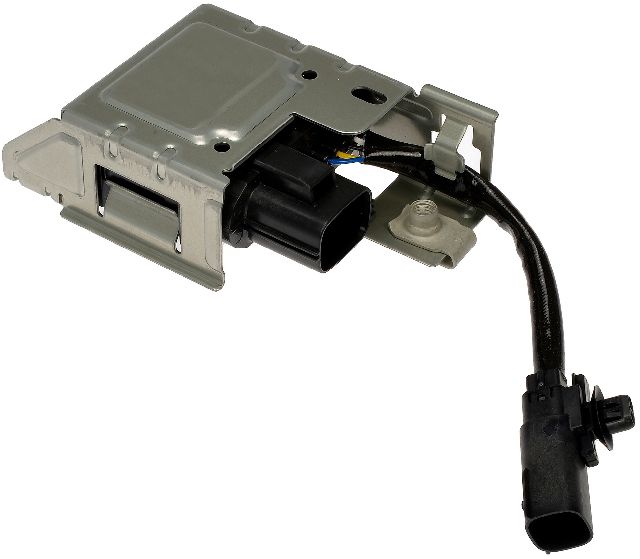
Typical fix: Replace the Bank 1 Sensor 1 NOx sensor and its attached module. Check for eligibility under Ford's Customer Satisfaction Program 21N02 first. After replacement, the PCM's NOx sensor adaptive values must be reset using a capable scan tool.
Est. part cost: $250-$400 - Outdated or Corrupted PCM Software 🟡 Medium Probability Emissions recall 21E01 involved a mandatory PCM reprogram. Issues can arise if this was not performed, or if the update revealed a pre-existing sensor fault that now triggers the P2201 code, which is the intended function of the update.
How to confirm: A Ford dealer or a shop with a Ford-specific scan tool (IDS) or FORScan can check the current software calibration version against the latest available updates and confirm if recall 21E01 has been completed.
Typical fix: Reprogram the Powertrain Control Module (PCM) to the latest software version as per recall 21E01. If the code appears after the update, the cause is almost certainly the sensor itself, which may then be covered by program 21N02.
Est. part cost: $0 - Damaged Wiring or Connectors ⚪ Low Probability The NOx sensor module is mounted to the frame rail under the vehicle, making its wiring harness and connector vulnerable to moisture, corrosion, and road debris. The harness section near the hot exhaust pipe can also melt or become brittle.
How to confirm: Visually inspect the entire wiring harness for the upstream NOx sensor, from the sensor itself to the control module on the frame rail. Look for breaks, corrosion, melting, or loose pins in the connectors. Check for 12V power and a solid ground at the module connector.
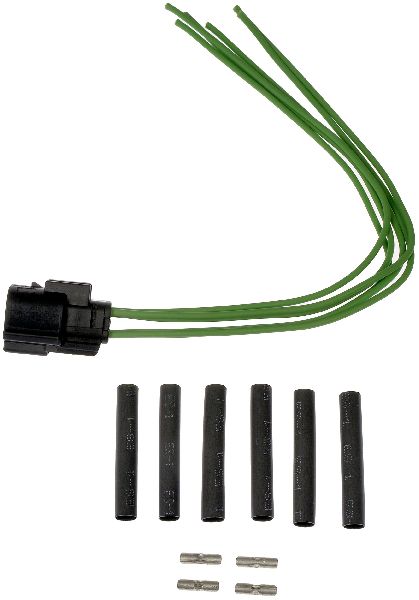
Typical fix: Repair the damaged section of the wiring harness or replace the connector.
Est. part cost: $20-$100
Rare But Worth Checking
- Use of Aftermarket EGR/Intake Cleaning Chemicals: Ford issued specific service messages (SSM 49065, SSM 47641) warning that aftermarket chemical cleaners can cause 'sodium poisoning' of the NOx sensor, leading to failure and codes P2201, P20EE, P229F, and others. Ford states this can cause permanent damage and may void the emissions warranty.
- Internal Fuse Box Fault: In at least one documented case, the code was caused by a lack of 12V power to the NOx sensor module due to an internal fault in the battery junction box (fuse box), not a problem with the sensor or wiring itself. The fuse (likely F14, 15A) was good, but the box failed to supply power to the circuit.
- Failed Diesel Particulate Filter (DPF): A failing or cracked DPF can allow excessive soot to pass through and contaminate the downstream exhaust components, including the NOx sensors. In one diagnostic case, a P22FB (a related NOx sensor performance code) was present alongside a P2002 (DPF efficiency code), and the root cause was a physically damaged DPF, which in turn required a new NOx sensor.
Diagnosis Steps
- Check for Ford Customer Satisfaction Program 21N02: Before any diagnosis, contact a Ford dealer with your VIN to see if you are eligible for a one-time free replacement of the front NOx sensor. This applies only if recall 21E01 has been completed and expires 12 months after the recall was performed or on Dec 31, 2024, whichever comes first.
- Scan for Other Codes: Check for any other related trouble codes that could provide more context, such as P229F, P20EE, or wiring-related codes.
- Inspect Wiring and Connectors: Perform a thorough visual inspection of the upstream NOx sensor's wiring harness and its module on the frame rail. Look for any signs of melting, chafing, corrosion, or physical damage, paying close attention to the connector.
- Check for Power and Ground: Using a multimeter, verify that the NOx sensor module connector is receiving 12V power from the battery junction box and has a solid ground connection to the chassis.
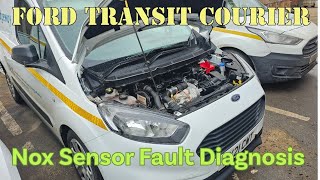
- Analyze Sensor Data (Requires Scan Tool): 🎬 Watch: A professional walkthrough of NOx sensor fault diagnosis. Use a diagnostic scan tool like FORScan to monitor the live data from 'NOx11' (Bank 1, Sensor 1). A healthy sensor will show changing NOx ppm values based on engine load. A sensor that is stuck, shows no reading, or has erratic values is likely faulty.
- Check for Exhaust Leaks: Inspect the exhaust system for any leaks between the engine and the NOx sensor. Soot trails near gaskets or welds are a clear sign of a leak that can skew sensor readings.
- Replace the Upstream NOx Sensor: If all other checks pass and the vehicle is not covered by a warranty program, replace the upstream (Bank 1, Sensor 1) NOx sensor. The sensor typically requires a 22mm or 7/8" oxygen sensor socket for removal.
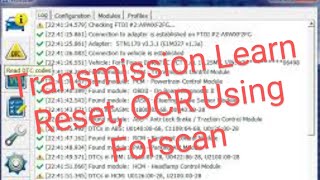
- Reset and Relearn: After replacing the sensor, 🎬 See how to use FORScan to reset system adaptations. use a capable scan tool (like FORScan or Ford's IDS) to clear the codes and perform the 'Reset all adaptations' or specific NOx sensor reset procedure. This step is critical to ensure the PCM recognizes the new component correctly.
Parts You'll Likely Need

- Upstream NOx Sensor
(OEM #CK4Z-9D378-D (also listed as Motorcraft NOX-10 or CK4Z-5J213-B))— This is the component that fails most frequently, triggering the P2201 code, often due to a combination of normal wear and sensitive PCM software as acknowledged by Ford's service programs.
Trusted brands: Motorcraft, Bosch, NTK, Dorman
OEM price range: $250-$400
Aftermarket price range: $150-$250
Related Codes That Often Appear With This One
- P229F — This code points to a fault with the downstream NOx sensor (Bank 1, Sensor 2). It's common for system-wide issues like software problems or chemical contamination to flag faults for both sensors.
- P20EE — This code means 'SCR NOx Catalyst Efficiency Below Threshold'. A faulty upstream NOx sensor (P2201) provides bad data to the PCM, causing it to misjudge the catalyst's performance and set a P20EE code. Ford also created a warranty extension (21N06) for this code if it appears after the 21E01 recall.
- P246D — This code relates to the Diesel Particulate Filter (DPF) pressure sensor. A Transit owner on a Reddit forum reported having both P2201 and P246D, suggesting a wider issue within the exhaust aftertreatment system that could involve a clogged DPF or a faulty pressure sensor.
- P207F — This code indicates an issue with Reductant (DEF) Quality. Ford's SSM 49065 explicitly lists this code alongside P2201 as a possible result of chemical contamination from aftermarket intake cleaners.
Technical Service Bulletins (TSBs) & Recalls
- Bulletin #21N02 - Customer Satisfaction Program: Extends the warranty for the front NOx sensor to cover a one-time replacement for DTC P2201 after recall 21E01 is performed. Expires Dec 31, 2024.
- 21E01 - Emissions Recall: Involves a PCM reprogram that makes the onboard diagnostic system more sensitive to NOx system faults, often revealing a pre-existing but previously undetected fault.
- Bulletin #SSM 49065: Notes that vehicles may exhibit an illuminated MIL with DTC P2201 as a result of using aftermarket cleaning liquids or tools for the EGR cooler or intake.
- Bulletin #SSM 47641: Warns that P2201 and other emissions codes may be triggered by aftermarket cleaning tools or liquids used on the intake or EGR system.
- Bulletin #SSM 46066: Specifically identifies that diesel-equipped Transits may exhibit DTC P2201 in the powertrain control module.
Platform-Specific Known Issues
- Ford Customer Satisfaction Program 21N02 extends the warranty for the front NOx sensor for vehicles that have had emissions recall 21E01 performed. This program covers a one-time replacement if DTC P2201 is present. The extension lasts for 12 months from the date of the 21E01 reprogram or until December 31, 2024, whichever comes first.
Mechanic-Grade Diagnostic Values
- NOx Sensor Module Power Supply Voltage — expected: Approximately 12V (Battery Voltage) with Key On, Engine Off (KOEO).. Failure: A voltage significantly below battery voltage (e.g., 7.5V) or no voltage indicates a fault in the wiring or the battery junction box.
- NOx Sensor Module Ground Circuit Resistance — expected: < 1.0 Ω.. Failure: High resistance indicates a corroded or loose ground connection, likely at the frame rail.
- NOx Sensor Module CAN Bus Voltages — expected: CAN High and CAN Low lines should have a combined total of approximately 5V (e.g., CAN-H at ~3.6V and CAN-L at ~1.4V). Some systems show ~2.5V on each line.. Failure: Voltages that are stuck high, low, or do not total ~5V indicate a short, open, or module communication failure.
- NOx Sensor Heater Cold Resistance — expected: 1.5 - 8 Ω between heater pins on a disconnected sensor.. Failure: An open circuit (infinite resistance) or a direct short (0 Ω) indicates a failed heater element within the sensor.
- NOx Sensor Supply Voltage (Module Internal Fault) — expected: Module should operate between 8.5V and 16.5V.. Failure: A related code, P220A, will set if the supply voltage to the module goes outside this range.
Scan Tool Commands That Help

- FORScan / Ford IDS: Reset all adaptations / Reset of the NOx sensor learned values — This is a mandatory step after replacing a NOx sensor to make the PCM recognize the new component and clear learned values from the old, faulty sensor. Failure to do this will often cause the P2201 code to return.
- FORScan / Ford IDS: Particulate filter learned values reset — If the P2201 code was accompanied by DPF-related codes (like P2002 or P246D) or if the DPF was disturbed or replaced during the repair, this reset is necessary.
- FORScan / Ford IDS: Static regeneration routine — If diagnosis reveals high soot loading in the DPF that may have contributed to sensor contamination or other codes, a forced or static regeneration can be commanded to clean the DPF after the primary fault is repaired.
Wiring & Ground Locations

- NOx Sensor Module Connector — Mounted to the frame rail, under the vehicle, near the exhaust system.. This is the central connection point for the sensor. It receives power, ground, and communicates via CAN bus. It is highly vulnerable to water intrusion and corrosion. Pin 1 is Power (+12V), Pin 4 is Ground, Pin 2 is CAN High, and Pin 3 is CAN Low.
- G400 (or similar) — A chassis ground point on the frame rail, near where the NOx sensor modules are mounted.. This is the primary ground point for the NOx sensor module. A loose or corroded connection here will cause high resistance, leading to erratic sensor operation and triggering P2201.
- Fuse F14 (15A) — In the Battery Junction Box (underhood fuse box).. This fuse supplies the 12V power to the NOx sensor modules. While the fuse itself may be good, the fuse box can fail internally and not provide power to the circuit, which is a known edge-case failure.
Real Owner Repair Stories
- YouTube diagnostic video (Adam Auto) (Ford Transit Courier (similar architecture)) — Check engine light with lost communication codes for both NOx sensors.
❌ Tried (didn't work) Initial assumption was faulty sensors or modules.
✅ What actually fixed it The technician found no 12V power at the NOx module connector despite the fuse (F14, 15A) being intact. The root cause was an internal failure within the battery junction box (fuse box) which was not supplying power to the fuse's output terminal. The final repair involved rewiring the power supply to the module. - Ford Transit Forum user (Ford Transit 2.2L Euro-5 (similar architecture)) — 'Adblue malfunction' message on the dash.
❌ Tried (didn't work) Diagnosing the specific downstream sensor as the fault.
✅ What actually fixed it The owner solved the problem by replacing the faulty downstream NOx sensor with a new, genuine Ford *upstream* NOx sensor. The only apparent difference was the cable length. This suggests some level of interchangeability between the sensors, at least on this specific platform.
"I Checked Everything" — The Actual Cause
- A common diagnostic dead-end occurs when the NOx sensor and its direct wiring harness check out fine. In a documented case, the root cause was a lack of 12V power *to* the entire circuit, originating from an internal fault in the underhood fuse box (Battery Junction Box). A technician may check that the fuse is good and has power, but fail to verify that power is actually leaving the fuse box on that circuit, leading to a misdiagnosis of a bad sensor module.
Diagnostic Flowchart
Used vs. New Parts: Buying Guide for This Vehicle
When a used part is the smart pick: A used OEM (Motorcraft) NOx sensor from a low-mileage wrecked vehicle can be a cost-effective option, as demonstrated by owner experiences. Given the high cost of a new OEM sensor, a used part can save hundreds of dollars, but carries the risk of a shorter lifespan.
Donor-vehicle mileage cap: roughly under 60000 miles for the part to have meaningful remaining life.
What to inspect on the donor part:
- Ask for the VIN of the donor vehicle to verify mileage and check for a history of emission system problems.
- Visually inspect the sensor probe for excessive black soot (indicating a potentially faulty DPF on the donor) or white crystalline deposits (indicating DEF contamination).
- Inspect the connector pins for any signs of corrosion, water damage, or bent pins.
- Ensure the wiring harness between the sensor and the module is free of cuts, melting, or abrasion.
OEM-only on this vehicle (don't cheap out):
- NOx Sensor: While aftermarket options from brands like Bosch or Dorman exist, the sensitive nature of the Ford PCM software (especially after the 21E01 recall) makes using an OEM Motorcraft sensor the most reliable way to ensure compatibility and prevent the code from returning.
Aftermarket brands forum-validated for this vehicle:
- Bosch (often the original equipment manufacturer)
- NTK
Brands owners have reported issues with on this vehicle:
- Unbranded, no-name sensors from online marketplaces are highly likely to be poorly calibrated and fail quickly, often causing the code to return immediately after the adaptation reset.
Real Owner Stories
Aggregated from forums and TSBs cited above. Mileages and costs reflect what owners reported in those sources.
2015 Ford Transit 350 3.2L — 172000 miles
Symptoms: Check engine light with codes P2201 and P246D appearing intermittently every 200 miles, along with an occasional smell of exhaust in the cab.
What fixed it: The owner was still seeking a solution. A commenter suggested the upstream NOx sensor was the likely culprit, as the owner confirmed the downstream sensor had already been replaced without fixing the issue.
Source hint: Reddit r/Diesel
2015-2019 Ford Transit 3.2L
Symptoms: The Check Engine Light came on with code P2201 just a week after the 21E01 emissions recall was performed.
What fixed it: The dealer replaced the front NOx sensor at no charge under the Customer Satisfaction Program 21N02.
Source hint: fordtransitusaforum.com
Related OBD-II Codes
Frequently Asked Questions
I heard there's a warranty extension for the NOx sensor on my Ford Transit. How do I know if I'm covered?
My Check Engine Light with code P2201 appeared right after the dealer performed the 21E01 recall. Is this related?
What's the very first step I should take if my 2016 Transit 3.2L shows a P2201 code?
Which NOx sensor causes the P2201 code, the front (upstream) or rear (downstream)?
If I replace the NOx sensor myself, can I just clear the code and be done?
What is the typical cost for a new front NOx sensor if it's not covered by the 21N02 program?
Helpful Videos
We Have This Part in Stock


The information in this article is provided for general reference and educational purposes only. Vehicle specifications, procedures, and part compatibility can vary by production date, trim level, and region. Always consult your vehicle's factory service manual and verify part numbers before purchasing or performing repairs. Safety-critical components such as airbags, seat belts, and braking systems should be installed by a qualified professional.
- Ford Transit:
- 🎬 Helpful Videos
- 🛍️ Shop This Part
- What's Unique About the 2015-2019 Ford Transit
- Symptoms You May Notice
- Most Likely Causes
- Rare But Worth Checking
- Diagnosis Steps
- Parts You'll Likely Need
- Related Codes That Often Appear With This One
- Technical Service Bulletins (TSBs) & Recalls
- Platform-Specific Known Issues
- Mechanic-Grade Diagnostic Values
- Scan Tool Commands That Help
- Wiring & Ground Locations
- Real Owner Repair Stories
- "I Checked Everything" — The Actual Cause
- Diagnostic Flowchart
- Used vs. New Parts: Buying Guide for This Vehicle
- Real Owner Stories
- 2015 Ford Transit 350 3.2L — 172000 miles
- 2015-2019 Ford Transit 3.2L
- Related OBD-II Codes
- Frequently Asked Questions
- 🎟️ Get 5% Off