

P2138 on 2015-2018 Volkswagen Jetta 1.4T: Throttle & Pedal Sensor Fault Causes and Fixes
On a 2016-2018 VW Jetta 1.4T, code P2138 is most often caused by a failing throttle body. The internal sensors or return spring fail, requiring replacement of the whole unit. Expect to pay $150-$300 for an aftermarket part or $400+ for OEM. A throttle body adaptation via a scan tool is required after the repair.
- P2138 on a 1.4T Jetta almost always points to a problem with the throttle body.
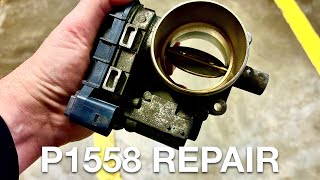
- Before buying parts, inspect the throttle body by removing the intake hose. Check for heavy carbon buildup and test if the throttle plate snaps shut when pushed open.
- If the throttle plate is sluggish or loose, the entire throttle body needs to be replaced. Cleaning will not fix a mechanical failure.
- After cleaning or replacing the throttle body, you MUST perform a throttle body alignment/adaptation with a VW-specific scan tool for the car to run correctly.
- Do not drive the vehicle with this fault; the sudden loss of power is a significant safety hazard.
What's Unique About the 2015-2018 Volkswagen Jetta

For the 1.4T EA211 engine in this Jetta generation, the P2138 code points more frequently to a problem with the throttle body assembly itself rather than the accelerator pedal. Owners and technicians often report failures of the throttle body's internal return spring or integrated position sensors, even at relatively low mileage. While a dirty throttle body can cause this, complete mechanical or electronic failure of the unit is a very common root cause on this specific powertrain, a sentiment echoed in owner forums for vehicles with the same engine.
Generation note: The 2015-2018 Jetta belongs to the A6 (or Mk6) generation, specifically the facelifted 'Mk6.5' models. However, the 1.4T EA211 engine was first introduced to the Jetta in the 2016 model year, replacing the older 2.0L and 1.8T engines in some trims. This guide is most applicable to 2016-2018 models with the 1.4T engine.
Symptoms You May Notice
- Check Engine Light is on
- EPC (Electronic Power Control) light is on
- Vehicle enters 'limp mode' with severely limited engine power and acceleration
- Poor or no throttle response
- Engine may idle erratically or stall
- Hesitation or sudden loss of power while driving
- Jerky or erratic throttle response
- Replacing the accelerator pedal sensor when the fault is actually a bad throttle body. On this platform, the throttle body is the more common failure point for this code.
- Replacing parts without performing the required throttle body adaptation/relearn procedure with a proper scan tool, leading to the code returning immediately.
Most Likely Causes

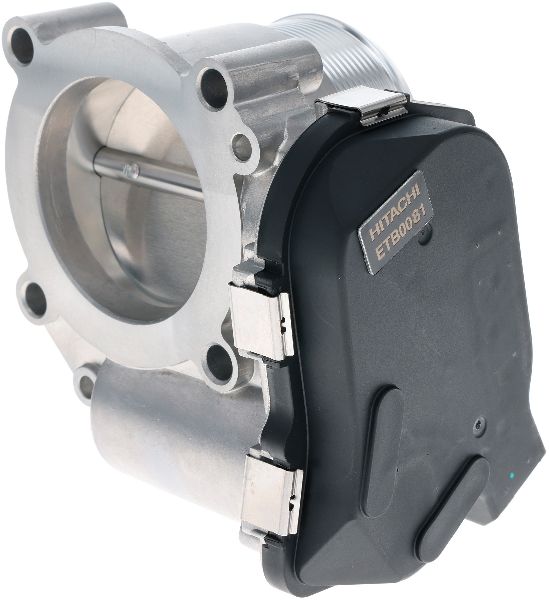
- Faulty Throttle Body Assembly 🔴 High Probability The internal return spring can break or the integrated electronic sensors can fail. This is a documented common failure point on the EA211 engine family. The throttle body is an electrical-mechanical part that wears over time.
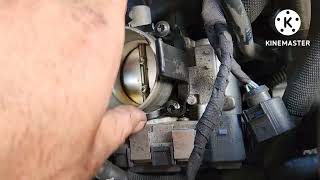
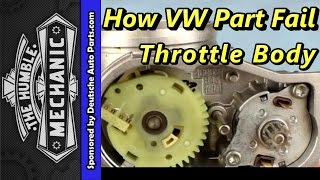
How to confirm: With the engine off, remove the intake hose from the throttle body. Gently push the throttle plate open with your finger. It should offer smooth resistance and snap back shut firmly when released. If it feels loose, gritty, or doesn't snap back, the unit has failed internally. A professional scan tool can also graph the voltage from the two internal sensors (TPS1/G187 and TPS2/G188); if one is erratic or doesn't move smoothly as the plate is opened, the unit is bad. 🎬 Watch: See a live demo of a failing throttle body.
Typical fix: The entire throttle body assembly must be replaced. The position sensors are integrated and not sold separately. A throttle body adaptation (also called a basic setting relearn) must be performed with a capable scan tool (like VCDS or OBDeleven) after replacement. Failure to perform the adaptation can result in a persistent error code or poor performance.
Est. part cost: $150-$500 - Dirty Throttle Body 🟡 Medium Probability Direct injection engines like the 1.4T can accumulate carbon and oil deposits from the PCV system in the intake tract, including the throttle body. This buildup can cause the throttle plate to stick, preventing it from closing properly and causing the sensors to report a discrepancy.
How to confirm: Visually inspect the throttle plate and bore for black, sticky carbon buildup. A significant coating, especially around the edges of the plate, can restrict movement.
Typical fix: Clean the throttle body thoroughly with a dedicated throttle body cleaner and a soft, lint-free cloth. Do not spray cleaner directly into the electronic components. It is best to remove the throttle body for cleaning. Perform a throttle body alignment/reset with a scan tool after cleaning.
Est. part cost: $10-$20 - Faulty Accelerator Pedal Position (APP) Sensor ⚪ Low Probability
How to confirm: This is typically diagnosed by exclusion. If the throttle body and wiring are confirmed to be good, the pedal sensor is the next likely cause. A scan tool that can graph the live data from both pedal sensors (APP1/G79 and APP2/G185) can show erratic or non-correlating readings as the pedal is pressed. Voltages should rise smoothly.
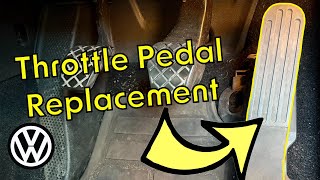
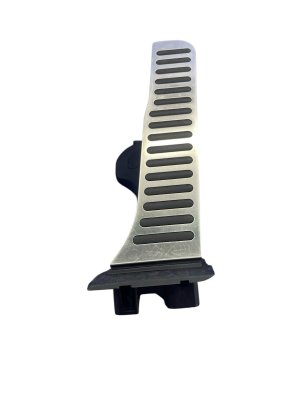
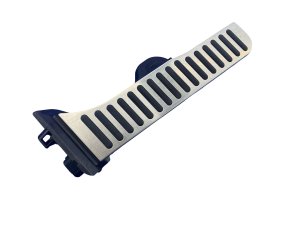
Typical fix: The APP sensor is integrated into the accelerator pedal assembly. The entire pedal unit must be replaced. 🎬 See this walkthrough for replacing the accelerator pedal assembly.
Est. part cost: $100-$250 - Wiring or Connector Issue ⚪ Low Probability Wiring harnesses in the engine bay are subject to heat and vibration. Rodent damage is also a possibility.
How to confirm: Visually inspect the wiring harness and connectors going to both the throttle body and the accelerator pedal. Look for any signs of damage, corrosion, chafing, or loose pins. Perform continuity and resistance checks on the sensor wires from the component connector to the ECM.
Typical fix: Repair the damaged section of the wiring harness or clean/replace the faulty connector.
Est. part cost: $5-$50
Rare But Worth Checking
- Failing Engine Control Module (ECM): This is very rare. All other possibilities, especially the throttle body and its wiring, should be exhaustively ruled out before considering the ECM as the cause. An ECM failure could also be the result of an internal software issue that may be resolved with a software update from the dealer.
- Low Battery Voltage: On some VW models, if the battery voltage drops below a certain threshold (e.g., 11.5 volts) or the battery is disconnected, the throttle body's basic settings can be lost, potentially triggering this code. Ensuring the battery and charging system are healthy is a good preliminary step.
Diagnosis Steps

- Read all fault codes with an OBD-II scanner capable of reading VW-specific codes. Confirm P2138 is present and note any other codes.
- Using the scan tool, view live data for the Accelerator Pedal Position sensors (APP1, APP2) and Throttle Position sensors (TPS1, TPS2).
- With the engine off, key on, slowly press the accelerator pedal to the floor. The APP sensor voltages should rise smoothly and correlate with each other.
- Turn the vehicle off. Remove the plastic engine cover and the intake air duct connected to the throttle body.
- Inspect the throttle body connector and wiring for any visible damage, corrosion, or loose pins.
- Manually test the throttle plate's spring action. Push it open with a finger; it should be smooth, offer resistance, and spring back shut instantly. If it's weak, slow, or stuck, the throttle body is bad.
- If the spring feels okay, inspect the throttle bore and plate for heavy carbon buildup. If dirty, remove the throttle body and clean it thoroughly using throttle body cleaner and a rag.
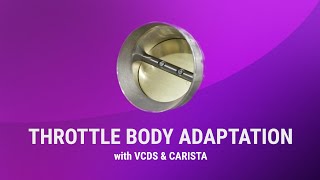
- If a new throttle body is installed or the original is cleaned, reinstall it and the intake duct. Using a capable scan tool (like VCDS or OBDeleven), perform a 'Throttle Body Alignment' (TBA) or 'Basic Settings' procedure in Group 060. 🎬 Watch: How to perform the throttle body adaptation procedure.
- Clear the codes and test drive the vehicle. If the code and symptoms return, further diagnosis of the wiring harness or accelerator pedal is needed.
Parts You'll Likely Need

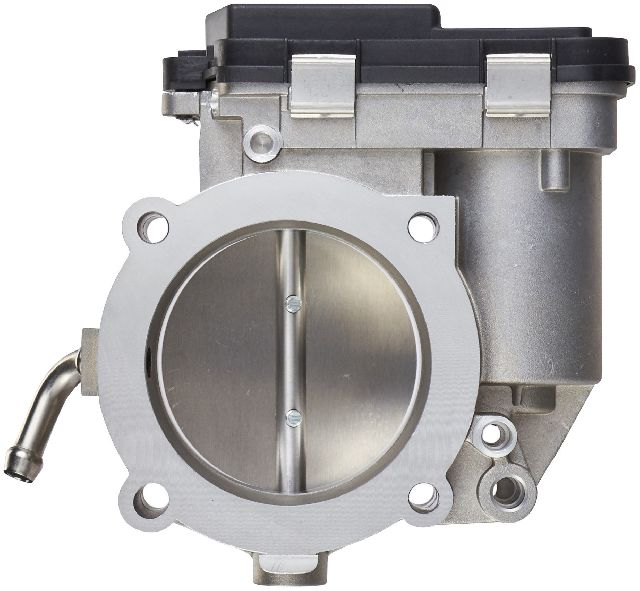
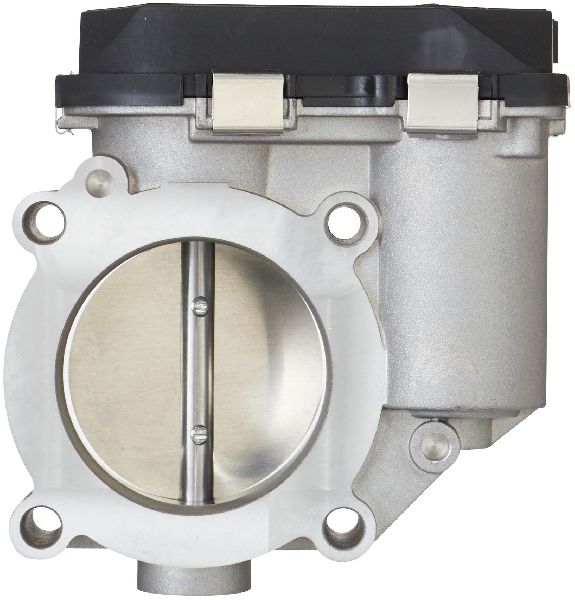
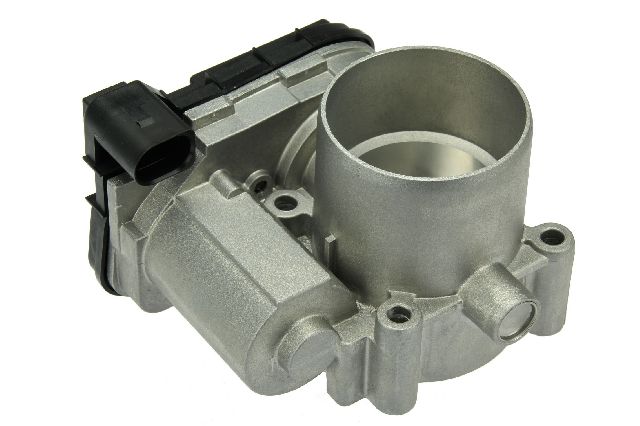
- Throttle Body Assembly
(OEM #04E133062B)— This is the most common cause of P2138 on the 1.4T engine due to internal mechanical or electronic failure. This part number is shared across other VW, Audi, Seat, and Skoda models with the same engine.
Trusted brands: Bosch, VDO, Continental, Borsehung
OEM price range: $400-$550
Aftermarket price range: $150-$300 - Accelerator Pedal Assembly
(OEM #1K1721503AN)— If the throttle body and wiring are confirmed good, a faulty pedal sensor is the next most likely component.
Trusted brands: Bosch, Vemo
OEM price range: $150-$250
Aftermarket price range: $80-$150
Related Codes That Often Appear With This One
- P0121 — This code specifically relates to 'Throttle/Pedal Position Sensor 'A' Circuit Performance' and can be triggered along with P2138 when the ECM sees an issue with the throttle body.
- P0221 — This code relates to 'Throttle/Pedal Position Sensor 'B' Circuit Performance' and often appears with P2138 as the computer cross-checks multiple sensor signals.
- P0171 — If the throttle plate is sticking open or closed due to carbon buildup, it can cause an incorrect air-fuel mixture, a 'System Too Lean' code.
Technical Service Bulletins (TSBs) & Recalls
- VW TSB 20G054: Mentioned in one repair database as a relevant TSB for throttle sensor calibration updates, which could potentially address software-related causes of P2138.
Platform-Specific Known Issues
- Owner Experience with Recurring P2138: One owner of a VW Golf with the same 1.4T engine reported a recurring P2138 code despite having the throttle body, accelerator pedal, and even the ECU replaced under warranty, indicating that in rare cases, the issue can be a persistent electrical gremlin that is difficult to trace.
Mechanic-Grade Diagnostic Values
- Throttle Position Sensors (G187 & G188) Live Data — expected: Using VCDS Measuring Block Group 062: Sensor 1 (G187) should read low at rest (e.g., 3-15%) and rise smoothly. Sensor 2 (G188) should read high at rest (e.g., 85-97%) and fall smoothly. The two values should roughly add up to 100% at all times.. Failure: Values are erratic, jump, freeze, or do not move in opposite directions when the throttle is manually opened (engine off).
- Accelerator Pedal Position Sensors (G79 & G185) Live Data — expected: Using VCDS Measuring Block Group 030: G79 should read ~0.67V to ~4.10V. G185 should read ~0.25V to ~2.14V. Both should increase smoothly as the pedal is depressed.. Failure: Voltage readings are jumpy, drop to zero, or do not increase/decrease incrementally as the pedal is pressed and released.
- Throttle Body Connector Voltage Supply — expected: With the ignition on and connector unplugged, there should be approximately 5V between terminals 2 and 6 of the harness connector.. Failure: Voltage is significantly lower than 5V or absent, indicating a wiring issue or problem with the ECM's 5V reference circuit.
Scan Tool Commands That Help
- VCDS (VAG-COM): [01-Engine] -> [Basic Settings - 04] -> Group 060 -> [Go!] — This is the Throttle Body Adaptation (TBA) procedure. It MUST be performed after cleaning or replacing the throttle body to allow the ECU to relearn the closed, open, and idle positions. Failure to do this will often cause the P2138 code to return or result in an unstable idle.
- VCDS (VAG-COM): [01-Engine] -> [Adv. Meas. Values] — To simultaneously graph the outputs of the accelerator pedal sensors (G79, G185) and throttle body sensors (G187, G188) to visually check for dropouts or glitches that might not be obvious when looking at numbers alone.
Wiring & Ground Locations
- Engine Block Ground Stud — On the top of the engine, often near the valve cover. Two ground wires for the ignition coils are secured here with 10mm nuts.. While primarily for the ignition system, a poor engine ground can introduce electrical noise and voltage drops that can affect various sensors, including the throttle body. Ensuring this connection is clean and tight is a crucial basic step.
- Main Chassis Ground Point — On the firewall/bulkhead, behind the battery. Look for a stud with multiple brown wires attached.. This is a primary ground point for many components in the engine bay. Corrosion or looseness here can cause a wide range of difficult-to-diagnose electrical issues, including sensor correlation faults.
- Throttle Body Connector (J338) — A 6-pin connector directly on the throttle body assembly.. This is the primary connection point for all power, ground, and signal wires for the throttle body. Pins to check are Pin 2 (Sensor 2 Signal), Pin 4 (Sensor 1 Signal), Pin 5 (5V Reference), and Pin 6 (Sensor Ground).
- Accelerator Pedal Connector (G79/G185) — A 6-pin connector attached to the top of the accelerator pedal assembly, accessible from the driver's footwell.. This connector carries the signal from both pedal position sensors to the ECM. A loose connection or corroded pin here is a common point of failure.
Real Owner Repair Stories
- Reddit r/AskMechanics user post (VW Golf 1.4T (same EA211 engine), less than 8,000 miles) — Recurring EPC and Check Engine lights, P2138 code, limited RPMs, near-stalling on shifts, forward collision warning light also on.
❌ Tried (didn't work) Throttle body replaced (under warranty), Accelerator pedal replaced (under warranty), ECU replaced (under warranty)
✅ What actually fixed it The user's post was a request for help after multiple failed repair attempts by the dealer. The final resolution was not posted, but the story is valuable as it shows that for a small number of cases, the root cause can be an elusive electrical issue beyond the three most common components. - YouTube video by 'Stupid Bloke' (VW Golf Mk6 2.0 TDI (different engine, but same fault code and pedal component)) — P2138 code, vehicle goes into limp mode with flashing coil light on the dash.
❌ Tried (didn't work) Cleaning the throttle body seemed to fix it temporarily, but the fault returned.
✅ What actually fixed it The accelerator pedal was faulty. Live data on a scan tool showed the pedal position signal dropping to zero intermittently as it was slowly depressed. Replacing the accelerator pedal assembly provided a smooth, consistent signal and resolved the issue.
OEM Part Supersession History
04E133062→04E133062B, 04E133062C, 04E133062D— Standard revisions for manufacturing process improvements or minor design updates.
Heads up: All revisions (B, C, D) are generally considered interchangeable for this application. However, it is always best to install the latest available revision (e.g., 'D') when replacing the part.
Model Year Variations Within This Range
- 2015: The 2015 model year Jetta did not come with the 1.4T EA211 engine in North America. This P2138 guide is primarily for the 2016-2018 model years which featured this engine.
Diagnostic Flowchart
Other Known Issues on This Vehicle
Issues unrelated to this code that are worth knowing about as an owner of this generation:
- Water Pump & Thermostat Housing Failure 🔴 High — Very common. Can fail as early as 40,000 miles but is frequently seen between 60,000-100,000 miles. The plastic housing becomes brittle and cracks, causing coolant leaks. (Ref: Subject of extended warranty programs and class-action lawsuits for some VW models, though not always specifically for the Jetta 1.4T.)
- Intake Valve Carbon Buildup 🟠 Medium — A known consequence of Direct Injection (GDI) engines. Buildup becomes significant enough to affect performance or cause misfires typically around 60,000-100,000 miles. Requires manual cleaning (walnut blasting).
- Timing Belt Replacement 🔴 High — The EA211 uses a timing belt, not a chain. While VW gives long intervals (up to 120k miles or more), many technicians and owners recommend replacement sooner, around 80,000-100,000 miles or 6-8 years, as a preventative measure to avoid catastrophic engine failure.
- Turbocharger Wastegate Actuator Rattle/Failure 🟠 Medium — The actuator arm or its pivot point can wear or seize, causing a rattling noise, underboost/overboost conditions, and triggering an EPC light with codes like P2263.
Used vs. New Parts: Buying Guide for This Vehicle
When a used part is the smart pick: For the accelerator pedal assembly, a used part from a low-mileage, late-model donor car can be a cost-effective option as it is a less frequent failure item compared to the throttle body. For the throttle body itself, a used part is NOT recommended.
Donor-vehicle mileage cap: roughly under 50000 miles for the part to have meaningful remaining life.
What to inspect on the donor part:
- Verify the part number on the used component matches the original or a known superseded part number.
- For a pedal assembly, ensure the connector pins are clean, straight, and free of corrosion.
- Ask for the VIN of the donor car to verify mileage and check for accident history (avoid parts from flood or front-end collision vehicles).
OEM-only on this vehicle (don't cheap out):
- Throttle Body Assembly: Given that this is a very common failure point on the 1.4T engine, installing a used part carries a high risk of premature failure. A new OEM (VDO, Bosch) or high-quality aftermarket part is strongly recommended for reliability.
Aftermarket brands forum-validated for this vehicle:
- Bosch
- VDO / Continental
Brands owners have reported issues with on this vehicle:
- Unbranded, 'no-name' parts from online marketplaces. While tempting due to low cost, they have a high reported failure rate and may not calibrate correctly during the throttle body adaptation procedure.
Real Owner Stories
Aggregated from forums and TSBs cited above. Mileages and costs reflect what owners reported in those sources.
2016 Volkswagen Jetta 1.4T
Symptoms: EPC light is on.
What fixed it: The owner sought advice on Reddit regarding the EPC light, which is commonly associated with throttle body or sensor correlation issues.
Source hint: Reddit r/AskMechanics: A thread about a 2016 Jetta 1.4T with an EPC lig
Volkswagen Golf 1.4T
Symptoms: Recurring P2138 code and electrical issues.
What fixed it: In this specific case, the issue persisted as an electrical gremlin even after the throttle body, accelerator pedal, and ECU were replaced under warranty.
Source hint: vehicle_specific_issues: Owner Experience with Recurring P2138
Related OBD-II Codes
Frequently Asked Questions
Is there a TSB for throttle sensor issues on my 2015-2018 Jetta 1.4T?
Can I just clean the throttle body on my EA211 engine to fix the EPC light?
Do I need special tools like VCDS to fix P2138 on my Jetta?
Why does my Jetta 1.4T lose power and show an EPC light while driving?
Can I buy just the sensor for the accelerator pedal if it fails?
Is the throttle body on the Jetta 1.4T known for mechanical failure?
Helpful Videos
Used OEM Parts in Stock



New Aftermarket Parts Available



The information in this article is provided for general reference and educational purposes only. Vehicle specifications, procedures, and part compatibility can vary by production date, trim level, and region. Always consult your vehicle's factory service manual and verify part numbers before purchasing or performing repairs. Safety-critical components such as airbags, seat belts, and braking systems should be installed by a qualified professional.
- Volkswagen Jetta:
- 🎬 Helpful Videos
- 🛍️ Shop This Part
- What's Unique About the 2015-2018 Volkswagen Jetta
- Symptoms You May Notice
- Most Likely Causes
- Rare But Worth Checking
- Diagnosis Steps
- Parts You'll Likely Need
- Related Codes That Often Appear With This One
- Technical Service Bulletins (TSBs) & Recalls
- Platform-Specific Known Issues
- Mechanic-Grade Diagnostic Values
- Scan Tool Commands That Help
- Wiring & Ground Locations
- Real Owner Repair Stories
- OEM Part Supersession History
- Model Year Variations Within This Range
- Diagnostic Flowchart
- Other Known Issues on This Vehicle
- Used vs. New Parts: Buying Guide for This Vehicle
- Real Owner Stories
- 2016 Volkswagen Jetta 1.4T
- Volkswagen Golf 1.4T
- Related OBD-II Codes
- Frequently Asked Questions
- 🎟️ Get 5% Off