

P2112 on 2009-2019 Ford Flex: Throttle Body Stuck Closed Causes and Fixes
On a 2009-2019 Ford Flex, code P2112 almost always means the electronic throttle body has failed due to a well-documented internal electronic fault. This triggers a dangerous low-power 'limp mode.' The only reliable fix is to replace the entire throttle body assembly, which costs around $100-$280 for the part and is a common DIY repair that takes less than 30 minutes.
- P2112 on a Ford Flex is a critical code that will put the vehicle into a dangerous, low-power 'limp mode', making it unsafe to drive.
- The cause is almost certainly a failed electronic throttle body due to a known manufacturing defect.
- Do not waste time or money cleaning the throttle body; the failure is internal and electronic, requiring a full replacement of the assembly.
- The repair is straightforward for a DIYer with basic tools and can be completed in under an hour.
- After replacement, be sure to reset the Keep Alive Memory (KAM) by disconnecting the battery to ensure the computer relearns the new part correctly.
What's Unique About the 2009-2019 Ford Flex
The 3.5L Cyclone V6 used in the Flex and many other Fords of this era has a widespread and well-documented history of premature electronic throttle body (ETB) failure. The issue stems from contamination on the internal motor contacts, leading to intermittent electrical connectivity and failure. The problem was so common that Ford issued Customer Satisfaction Program 13N03, extending the warranty on the throttle body for 10 years or 150,000 miles, and multiple Technical Service Bulletins (TSBs). While the warranty program has expired for most vehicles, it confirms that this is a known manufacturing defect, not a random failure.
Generation note: The Ford Flex was produced in a single generation (2009-2019), with a major facelift for the 2013 model year. However, the underlying 3.5L V6 engine and the electronic throttle body issue are common across the entire production run. TSBs have been issued covering various years within this range.
Symptoms You May Notice
- Sudden and severe loss of engine power (Limp Mode)
- Vehicle will not accelerate, only idle
- Illuminated Malfunction Indicator Lamp (Check Engine Light)
- Illuminated Powertrain Malfunction Indicator (Wrench Light)
- Unresponsive or sluggish accelerator pedal
- Engine may stall or run rough
- Additional dashboard warnings like "hill start assist not available", as noted in NHTSA complaint #11436665.
- Condition may temporarily clear after turning the vehicle off and on, but will return.
- Replacing the Accelerator Pedal Position (APP) Sensor. P2112 specifically indicates a failure at the throttle body itself, not an incorrect signal from the pedal.
- Cleaning the throttle body. The failure is internal and electronic due to contaminated contacts, not mechanical binding from carbon buildup. Cleaning will not resolve the limp mode issue on this platform.
- Using a low-quality aftermarket throttle body. Some forum users have reported that the P2112 code returned shortly after replacing the original part with a cheap aftermarket unit, suggesting potential quality control issues.
Most Likely Causes
- Failed Electronic Throttle Body (ETB) 🔴 High Probability A known manufacturing defect where internal motor contacts become contaminated, causing an internal electronic failure. This was acknowledged by Ford through Customer Satisfaction Program 13N03 and multiple TSBs.
How to confirm: Given the extremely high probability, if code P2112 is present with limp mode symptoms, the throttle body is the culprit. A scan tool can confirm by showing a discrepancy between the 'Commanded Throttle Angle' and 'Actual Throttle Position' PIDs. A real-world example from a Ford F150 Forum describes an owner experiencing sudden power loss, scanning P2112, and completely fixing the issue with a 15-minute throttle body replacement.
Typical fix: Replace the entire electronic throttle body assembly and gasket. Cleaning the old unit is not an effective fix for this internal electronic failure.
Est. part cost: $100-$280 - Damaged Wiring or Connector ⚪ Low Probability
How to confirm: Visually inspect the wiring harness and 6-pin electrical connector at the throttle body for any signs of damage, corrosion, loose pins, or chafing. One owner complaint (NHTSA ODI #11324912) found damaged wiring was the cause.
Typical fix: Repair or replace the damaged section of the wiring harness or the connector pigtail.
Est. part cost: $20-$150 - Water or Ice in Intake Manifold ⚪ Low Probability
How to confirm: Per Ford TSB #SSM 50597, this is a possibility. After removing the throttle body, inspect the intake manifold behind it for any signs of water, ice, or other obstruction that could prevent the throttle plate from opening.
Typical fix: Remove the obstruction and the throttle body. Dry the intake manifold thoroughly.
Est. part cost: $0
Rare But Worth Checking
- Powertrain Control Module (PCM) Failure: This is extremely rare. The PCM should only be considered as a potential cause after the throttle body and wiring have been definitively ruled out.
Diagnosis Steps
- Confirm the presence of code P2112 using an OBD-II scanner. Note any other codes present, such as P2111 or P2104.
- Given the known issues, expect to replace the throttle body. However, it is wise to first perform a quick visual inspection.
- Inspect the wiring harness and electrical connector at the throttle body. Look for any obvious signs of damage, corrosion, or loose connections.
- If wiring appears intact, the most logical and time-effective step is to replace the electronic throttle body assembly with a new gasket.
- After installing the new throttle body, perform a throttle body relearn procedure. The most common method is to reset the Keep Alive Memory (KAM) by disconnecting the negative battery terminal for at least 15 minutes. An alternative method involves turning the key to 'ON' (engine off), slowly pressing the accelerator to the floor, releasing it quickly, and then starting the engine.
- Allow the engine to idle for a few minutes to complete the relearn process.
- Clear all codes with the scanner and perform a thorough test drive to ensure the issue is resolved.
Parts You'll Likely Need
- Electronic Throttle Body Assembly
(OEM #7T4Z-9E926-FA)— This is the component that almost always fails internally, causing the P2112 code and limp mode. Replacement is the only reliable fix. This part number is cited in TSB 10-21-6. It may be superseded by other numbers like 7T4Z-9E926-EA.
Trusted brands: Motorcraft, Bosch, Hitachi, Dorman
OEM price range: $200-$280
Aftermarket price range: $100-$180
Related Codes That Often Appear With This One
- P2111 — Stands for 'Throttle Actuator Control System - Stuck Open'. It is often listed in the same TSBs as P2112 and points to the same failing component, the electronic throttle body.
- P2119 — Stands for 'Throttle Actuator Control Throttle Body Range/Performance'. This code is also mentioned alongside P2111 and P2112 in Ford TSBs related to throttle body failures.
- P2104 — Stands for 'Throttle Actuator Control System - Forced Idle'. This is an informational code indicating the PCM has put the vehicle into limp mode as a direct result of a throttle fault like P2112.
Technical Service Bulletins (TSBs) & Recalls
- TSB 16-0139: Wrench Lamp Illuminated With DTCs P2111, P2112 and/or P2119.
- TSB 10-21-6: DTC P2111 OR P2112, OR LOWER THAN DESIRED ENGINE IDLE SPEED, ENGINE IDLE SPEED FLUCTUATES.
- SSM 50597: Mentions P2111, P2112, and/or P2119 may be due to water or ice buildup in the intake manifold.
Platform-Specific Known Issues
- Ford Customer Satisfaction Program 13N03: This was an extended warranty (10 years/150,000 miles) covering the electronic throttle body due to high failure rates from internal contamination. The program confirms the cause is 'intermittent electrical connectivity' and has now expired for all eligible vehicles but serves as an official acknowledgment of the defect.
- TSB 16-0139: Issued for 2015-2016 Flex models (and many other Fords) built on or before May 31, 2016, for codes P2111, P2112, and/or P2119, recommending throttle body replacement.
- TSB 10-21-6: Issued for 2010-2011 Flex models (and others) with the 3.5L non-EcoBoost engine, addressing codes P2111 and P2112 by recommending throttle body replacement.
Mechanic-Grade Diagnostic Values
- Throttle Actuator Control (TAC) Motor Resistance — expected: 2 to 25 Ohms. Failure: A reading of OL (Over Limit/open circuit) or a value significantly outside the expected range indicates a failed internal motor.
- Throttle Position Sensor (TPS) Reference Voltage (VREF) — expected: ~5.0 Volts at the designated pin on the throttle body connector (Key On, Engine Off).. Failure: Low or no voltage points to a wiring issue or a problem with the PCM's 5V reference circuit, not the throttle body itself.
- Ford-Specific P2112 Trigger Condition — expected: The actual throttle plate angle should be within 6 degrees of the commanded angle.. Failure: Code P2112 sets when the actual angle is more than 6 degrees lower than the commanded angle.
Scan Tool Commands That Help
- Ford IDS (Integrated Diagnostic System): Datalogger with Trigger/Capture Event — To record all relevant PID data (commanded vs. actual throttle position, sensor voltages) at the exact moment the P2112 fault is triggered. This helps definitively confirm the throttle body is the source of the failure by capturing the glitch as it happens.
- Ford IDS (Integrated Diagnostic System): PCM Reset / Clear Keep Alive Memory (KAM) — This function should be performed after installing a new throttle body to clear the old adaptive learning values from the PCM and initiate the relearn process.
Wiring & Ground Locations
- Electronic Throttle Control (ETC) Connector (C134) — On the top front of the engine, plugged directly into the electronic throttle body assembly.. This 6-pin connector is the single point of failure for all power and data signals to the throttle body. Corrosion, backed-out pins, or harness damage here will directly cause P2112.
- G101 — On the left front of the engine compartment.. This is a primary ground for the Powertrain Control Module (PCM). A poor connection here can cause erratic PCM behavior and various seemingly unrelated codes, including throttle control faults.
- G104 — Located on the transmission assembly.. Provides a ground path for various engine and transmission components. A faulty ground here can introduce electrical noise that may affect sensor readings related to the throttle control system.
- Powertrain Control Module (PCM) — Located in the rear of the engine compartment, near the firewall.. The PCM controls the throttle body. Its main connector, C175B, contains the circuits for the throttle actuator control motor.
Real Owner Repair Stories
- Ford F150 Forum (2016 Ford F-150 3.5L EcoBoost, 48,000 miles) — Sudden loss of power (limp mode), would only idle forward, check engine light on, code P2112.
✅ What actually fixed it Replaced the entire throttle body assembly and gasket with a new dealer part for $78. The repair took 15 minutes and resolved the issue. - ScannerDanner Forum (2006 Ford Explorer 4.0L) — After replacing a starter and reconnecting the battery, the engine would start and stall repeatedly. Codes P2104 and P2112 were present and could not be erased. The PCM intentionally disabled all throttle control.
❌ Tried (didn't work) Initial thought was a faulty Throttle Position Sensor.
✅ What actually fixed it The throttle plate was sticking shut due to carbon buildup. After the battery was disconnected, the PCM lost its learned throttle stop points and detected the sticking during its key-on self-test. A thorough cleaning of the throttle body resolved the codes and restored throttle function.
OEM Part Supersession History
7T4Z-9E926-EA→7T4Z-9E926-FA— Part revision/update by manufacturer.
Heads up: 7T4Z-9E926-FA is the backward-compatible replacement for -EA.7T4Z-9E926-FA→AT4Z-9E926-B— Part revision/update for later model years.
Heads up: AT4Z-9E926-B is listed for 2013-2015 Flex models, while 7T4Z-9E926-FA is listed for 2009-2012. Physical fit may be the same, but electronics could differ. Verify by VIN.
Model Year Variations Within This Range
- 2009-2012: These earlier models primarily use throttle body part number 7T4Z-9E926-FA.
- 2013-2019: Following the 2013 facelift, the specified throttle body part number often changes to AT4Z-9E926-B or similar. While the core failure is the same, using the correct part number for the specific model year is crucial.
Diagnostic Flowchart
Other Known Issues on This Vehicle
Issues unrelated to this code that are worth knowing about as an owner of this generation:
- Internal Water Pump Failure 🔴 High — A major design flaw where the timing-chain-driven water pump fails and leaks coolant directly into the engine oil, potentially causing catastrophic engine failure. Onset can be anywhere from 60,000 to 150,000+ miles.
- Power Transfer Unit (PTU) Overheating/Failure (AWD Models) 🔴 High — The PTU fluid can overheat and break down, especially under load, leading to seal failure, fluid loss, and eventual gear failure. Symptoms include a grinding/whining noise, shuddering, or a smell like propane.
- Door Latch Failure 🟠 Medium — Ford issued recalls for door latch failures that could result in doors not closing properly or opening while driving. This was part of a massive recall affecting many Ford models. (Ref: Multiple recalls, including 16S30 and 20S30.)
- Timing Chain Wear (Primarily EcoBoost) 🟠 Medium — While more prevalent on the EcoBoost version, the base 3.5L can also experience timing chain stretch over time, often signaled by a rattling noise on cold starts.
Used vs. New Parts: Buying Guide for This Vehicle
When a used part is the smart pick: A used throttle body is a high-risk choice for this repair. The failure is due to an internal design flaw (contact contamination) and is not related to simple wear and tear. A used part from a junkyard has a high probability of either being faulty already or failing soon after installation.
Donor-vehicle mileage cap: roughly under 20000 miles for the part to have meaningful remaining life.
What to inspect on the donor part:
- Verify the part number on the used unit matches the required OEM number for your vehicle's VIN.
- Inspect the electrical connector pins for any signs of corrosion, bending, or damage.
- If possible, check for a manufacturing date on the part; a newer part is marginally better but still carries risk.
- Avoid parts from vehicles with high mileage or evidence of sitting for long periods in harsh weather.
OEM-only on this vehicle (don't cheap out):
- Electronic Throttle Body
Aftermarket brands forum-validated for this vehicle:
- Motorcraft (OEM)
- Bosch
- Hitachi
Brands owners have reported issues with on this vehicle:
- Unbranded or generic 'white box' parts. Forum discussions suggest some low-cost aftermarket units (e.g., from O'Reilly's) have failed shortly after installation, causing the P2112 code to return. While brands like Dorman are often a viable alternative, for this specific critical failure, sticking to OEM or a top-tier OEM supplier is the most reliable option.
Real Owner Stories
Aggregated from forums and TSBs cited above. Mileages and costs reflect what owners reported in those sources.
2016 Ford F-150 3.5L V6 (Platform Mate)
Symptoms: Sudden and severe loss of engine power (Limp Mode) while driving.
What fixed it: Replaced the electronic throttle body assembly and gasket.
Cost: $78-$78
Source hint: Ford F150 Forum: Throttle Body Failure Code P2112
2015 Ford Flex 3.5L V6
Symptoms: Vehicle entered limp mode with an illuminated Wrench Light and Check Engine Light; additional 'hill start assist not available' warning appeared.
What fixed it: Replacement of the electronic throttle body as per TSB 16-0139 recommendations.
Source hint: NHTSA complaint #11436665
2010 Ford Flex 3.5L V6
Symptoms: Engine idle speed fluctuates or is lower than desired, accompanied by P2112.
What fixed it: Replacement of the throttle body assembly.
Source hint: TSB 10-21-6
2016 Ford F-150 3.5L V6 (Platform Mate)
Symptoms: P2112 code returned immediately after replacing the throttle body with a new part.
What fixed it: The owner discovered the aftermarket part from O'Reillys was faulty; the context emphasizes using quality OEM or reputable components.
Source hint: Ford F150 Forum: P2112 Code - New Throttle Body Same Code is Back
Related OBD-II Codes
Frequently Asked Questions
I have a 2015 Ford Flex with a wrench light and code P2112; is there a TSB for this?
Is the throttle body failure on my 2012 Ford Flex covered under a special warranty?
Can I just clean the throttle body on my 3.5L Cyclone V6 to fix the P2112 'stuck closed' error?
My Flex is showing 'hill start assist not available' along with the P2112 code. Are these related?
Does TSB 10-21-6 apply to the EcoBoost version of the Ford Flex?
What should I check if I replace the throttle body but P2112 returns on my Flex?
Helpful Videos

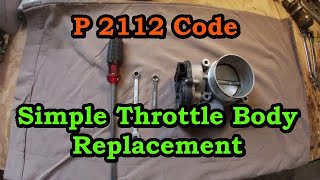

Used OEM Parts in Stock


New Aftermarket Parts Available

The information in this article is provided for general reference and educational purposes only. Vehicle specifications, procedures, and part compatibility can vary by production date, trim level, and region. Always consult your vehicle's factory service manual and verify part numbers before purchasing or performing repairs. Safety-critical components such as airbags, seat belts, and braking systems should be installed by a qualified professional.
- Ford Flex:
- 🎬 Helpful Videos
- 🛍️ Shop This Part
- What's Unique About the 2009-2019 Ford Flex
- Symptoms You May Notice
- Most Likely Causes
- Rare But Worth Checking
- Diagnosis Steps
- Parts You'll Likely Need
- Related Codes That Often Appear With This One
- Technical Service Bulletins (TSBs) & Recalls
- Platform-Specific Known Issues
- Mechanic-Grade Diagnostic Values
- Scan Tool Commands That Help
- Wiring & Ground Locations
- Real Owner Repair Stories
- OEM Part Supersession History
- Model Year Variations Within This Range
- Diagnostic Flowchart
- Other Known Issues on This Vehicle
- Used vs. New Parts: Buying Guide for This Vehicle
- Real Owner Stories
- 2016 Ford F-150 3.5L V6 (Platform Mate)
- 2015 Ford Flex 3.5L V6
- 2010 Ford Flex 3.5L V6
- 2016 Ford F-150 3.5L V6 (Platform Mate)
- Related OBD-II Codes
- Frequently Asked Questions
- 🎟️ Get 5% Off