

OBD-II Code P2104: Throttle Actuator Control System - Forced Idle
What P2104 means, why it triggers, and how to fix it
- Code P2104 forces your engine into an idle-only 'limp mode' because the computer detected a critical failure in the electronic throttle control system.
- Driving is impossible with an active P2104 code because the accelerator pedal is completely disabled, requiring an immediate tow.
- P2104 is a secondary safety code; you must diagnose the accompanying primary codes (like P2112 or P2135) to find the actual failed component.
- Replacing the throttle body requires a mandatory electronic 'relearn' procedure using a scan tool, otherwise the P2104 code returns instantly.
What Does P2104 Mean?

P2104 means the Powertrain Control Module (PCM) detected a critical failure in the electronic throttle control system. As a safety measure, it forces the engine to run at idle speed, completely disabling the accelerator pedal. P2104 is not the primary problem; it is a protective fail-safe triggered by another underlying fault.
Technical definition: The official SAE/OBD-II definition is 'Throttle Actuator Control System - Forced Idle.' The PCM intentionally overrides driver inputs and holds the engine at idle due to a malfunction in the electronic throttle control system. This fail-safe prevents unintended acceleration.
Can I Drive With P2104?
No — Do Not Drive. This code forces your car into an idle-only 'limp mode' with zero throttle response. Driving is impossible because you cannot accelerate to merge with traffic or climb hills. Tow the vehicle to a repair shop immediately.
Common Causes

- Faulty Electronic Throttle Body (Very Common) — The entire throttle body unit fails due to internal electronic failure of the actuator motor or position sensors. This is the most frequent hardware cause.
- Dirty or Obstructed Throttle Body (Common) — Carbon and grime buildup around the throttle plate causes it to bind. When the PCM commands movement and the plate sticks, it interprets this as a system failure, setting P2111 or P2112 followed by P2104.
- Faulty Accelerator Pedal Position (APP) Sensor (Common) — The sensor connected to the gas pedal sends erratic signals that don't match its redundant internal sensors, triggering limp mode as a safety precaution.
- Wiring or Connector Issues (Common) — The wiring harness between the throttle body, pedal sensor, and PCM becomes damaged, corroded, or loose. This interrupts critical signals, leading to abnormal voltage patterns.
- PCM Memory Loss (Battery Disconnect) (Less Common) — Disconnecting the battery erases learned throttle stop points. If the throttle plate sticks slightly during the PCM's re-learning self-test at key-on, it triggers P2104.
- Low System Voltage (Rare) — A weak battery or failing alternator starves the electronic throttle control system of power. Low voltage (below 12V) causes erratic behavior and triggers forced idle mode.
- Faults in Other Systems (ABS, VSC) (Rare) — On some vehicles, a critical failure in the Anti-lock Braking System (ABS) or Vehicle Stability Control (VSC) causes the PCM to enter a global fail-safe mode, logging P2104.
- Powertrain Control Module (PCM) Failure (Very Rare) — The vehicle's main computer fails due to software glitches or internal hardware damage. This is the last component to suspect after ruling out all other possibilities.
Symptoms

- Engine is stuck at idle speed — The engine runs but ignores the gas pedal, locking RPMs between 1200 and 1600.
- Zero throttle response — Pressing the accelerator pedal produces zero change in engine speed.
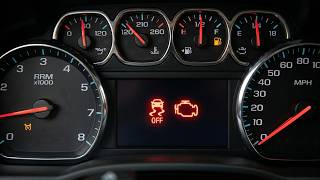
- Check Engine Light is on — A solid or flashing Check Engine Light illuminates on the dashboard.
- Reduced Engine Power or 'Limp Mode' light — Vehicles display a wrench icon or 'Reduced Engine Power' message on the instrument cluster.
- ABS or Traction Control Light is on — The fault triggering P2104 also illuminates warning lights for the ABS or stability control systems.
Diagnostic Flowchart

Tap your situation to follow the diagnostic path that matches what you're seeing on this code.
Common Fixes & Costs
- Cleaning the Throttle Body — Parts: $10-$20, Labor: $75-$150, ~0.8 hr book time (DIY)
- Replacing the Electronic Throttle Body Assembly — Parts: $150-$450, Labor: $100-$200, ~1.2 hr book time (Intermediate)
- Replacing the Accelerator Pedal Position Sensor — Parts: $50-$150, Labor: $50-$100, ~0.8 hr book time (DIY)
- Repairing Damaged Wiring or Connectors — Parts: $10-$50, Labor: $150-$400, ~2.5 hr book time (Professional)
- PCM/ECM Reprogramming or Replacement — Parts: $600-$1200 (for module), Labor: $150-$300, ~1.5 hr book time (Professional)
DIY vs Professional
- Cleaning the Throttle Body — Beginner:
- Replacing the Accelerator Pedal Position Sensor — Beginner:
- Replacing the Electronic Throttle Body Assembly — Beginner:
- Repairing Damaged Wiring or Connectors — Beginner:
- PCM/ECM Reprogramming or Replacement — Beginner:
Used vs. New Parts: Buying Guide
When a used part is worth it: Buying a used electronic throttle body is highly risky. It only makes sense for older vehicles on a strict budget if you can source the part from a low-mileage donor vehicle scrapped for non-engine reasons.
Donor-vehicle mileage cap: roughly under 60000 miles for the part to have meaningful remaining life.
Donor quality checklist:
- Verify the donor vehicle's mileage and reason for being salvaged (e.g., collision damage is better than engine failure).
- Match the part number exactly, as even slight variations cause compatibility issues with the PCM.
- Inspect for physical damage, corrosion on connectors, and excessive carbon buildup on the throttle plate.
- Ask about the warranty; reputable sellers offer at least a 30-90 day warranty.
Decision logic:
- If The part is for a Ford, GM, or other make with known high failure rates for this component → Buy new. A used part is likely to have the same inherent design flaw or be near the end of its service life.
- If Vehicle is less than 10 years old and under 100K miles → Buy a new OEM or high-quality aftermarket part. The added cost is justified by the longer warranty and reliability.
- If Budget is the primary concern and the vehicle is high-mileage → A used part from a trusted source is a viable option, but accept the risk of a shorter lifespan.
Warranty tradeoff: Used parts typically come with a 30-90 day warranty covering only the part. New aftermarket parts offer a 1-year to limited-lifetime warranty. New OEM parts offer a 1-2 year warranty.
Worst-case if a used part fails: $250-$650 if the used part fails after the warranty period, requiring you to pay for another part and installation labor.
What Happens If You Wait — Timeline
- 6-12 months before P2104: Early stage of an underlying fault. A dirty throttle body causes a minor hesitation off-idle. A failing APP sensor causes inconsistent cruise control behavior. (MPG impact: 0-2%% · Added cost: $0)
- 1-6 months before P2104: Symptoms become noticeable. A dirty throttle body causes a rough idle, especially with the A/C on. A failing APP sensor causes jerky acceleration or a dead spot in the pedal. The Check Engine Light flashes intermittently with codes like P2112 or P2135. (MPG impact: 3-8%% · Added cost: $50-$150 in wasted fuel and diagnostic frustration.)
- 1-4 weeks before P2104: The underlying fault becomes persistent. The throttle plate sticks regularly, or the APP sensor signal is frequently erratic. The PCM triggers a temporary 'Reduced Engine Power' mode (P2110) that resets after restarting the engine. (MPG impact: 5-15%% · Added cost: $100-$300 (Cost of ignoring a persistent CEL and drivability issue).)
- The moment of failure: The PCM's tolerance is exceeded. It logs code P2104, cuts all power to the throttle actuator motor, and forces the engine into a strict idle-only mode. The accelerator pedal becomes completely unresponsive. (MPG impact: N/A (Vehicle is undrivable)% · Added cost: $75-$200 (Towing cost) + the cost of the primary repair ($100-$650).)
Cost of Not Fixing It
- Immediate: The vehicle is completely undrivable. The car locks into 'Forced Idle' mode with zero throttle response, requiring an immediate tow. (Added cost: $75-$200 (towing))
- N/A - Short Term: Attempting to repeatedly clear the code to drive short distances is unsafe and ineffective. The underlying fault instantly re-triggers limp mode. (Added cost: 0)
- N/A - Long Term: Long-term neglect is impossible because P2104 disables acceleration entirely. The underlying sensor or motor failure never resolves itself and requires physical repair. (Added cost: 0)
Diagnosis Steps
- Scan for All Trouble Codes & Analyze Freeze Frame Data
Use an OBD-II scanner to read all stored codes. P2104 is a secondary code triggered by a primary fault. Look for codes related to the throttle body (P2111, P2112), pedal sensor (P2135), or actuator motor (P2100). Analyze the freeze frame data to see sensor readings at the exact moment the fault occurred before clearing anything.
Tools: OBD-II Scanner (Beginner) - Check for Technical Service Bulletins (TSBs)
Check for TSBs related to P2104 for your specific vehicle. Manufacturers frequently release software updates or revised diagnostic procedures for common throttle body problems, saving significant time and money.
Tools: Online access to TSBs or dealership information (Intermediate) - Visually Inspect the Wiring Harness
Check the wiring harness going to the throttle body and accelerator pedal. Look for signs of damage, corrosion, loose connectors, or cracked insulation. Ensure the floor mat is not pushed against the gas pedal.
Tools: Flashlight (Beginner) - Inspect and Clean the Throttle Body
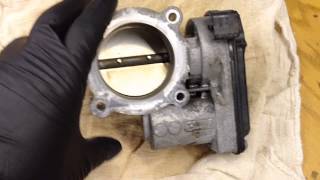
Remove the air intake hose. Look for heavy carbon buildup around the throttle plate. With the key off, gently push the plate open to check for a sticky or binding feeling. Clean it carefully with dedicated throttle body cleaner and a soft cloth. 🎬 Watch: How to clean an electronic throttle body safely.
Tools: Screwdriver/ratchet set, throttle body cleaner, rags (Intermediate) - Test the Accelerator Pedal Position (APP) Sensor
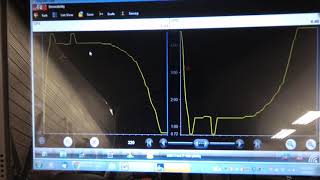
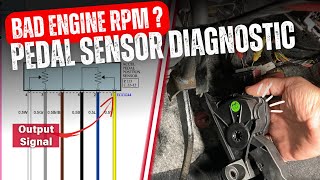
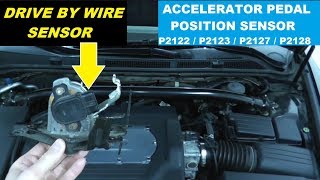
Monitor the voltage readings from APP Sensor 1 and APP Sensor 2 using a scan tool with live data. As you press the pedal, signals must change smoothly (e.g., 0.5V to 4.5V) with no dropouts or spikes. Any glitch indicates a faulty APP sensor. 🎬 See this guide on testing and replacing the pedal sensor.
Tools: Advanced OBD-II Scanner with Live Data (Intermediate) - Test the Throttle Actuator Motor
Command the throttle plate to open and close using a bidirectional scan tool. If the scanner sends the command but the plate doesn't move, the throttle body assembly is faulty and requires replacement.
Tools: Bidirectional Scan Tool (Advanced) - Check Power and Ground at the Throttle Body
Identify the power and ground wires at the throttle body connector using a wiring diagram. With the key on, verify the power supply wire has battery voltage (~12V). Check the resistance between the ground wire and the battery's negative terminal; it must be less than 0.5 Ohms. A high resistance ground is a common failure point.
Tools: Multimeter, vehicle-specific wiring diagram (Advanced) - Test the Powertrain Control Module (PCM)
Perform this final step only when all other components and wiring test good. Testing a PCM requires specialized equipment to verify internal logic and driver circuits. Take the vehicle to a professional.
Tools: Specialized diagnostic equipment, oscilloscope (Professional)
When This Code Triggers (Freeze-Frame Conditions)
- Engine Coolant Temp: 180-210°F (Fully warmed up, during normal operation.)
- RPM: 1200-2500 RPM (Often triggers during steady-state cruise or light acceleration, not typically at idle or heavy throttle.)
- Engine Load: 20-50% (The fault often surfaces under moderate engine load when the system expects a precise correlation between pedal input and throttle response.)
- Vehicle Speed: 25-60 mph (Frequently occurs during city or highway driving as opposed to initial startup.)
Related Codes
- P2135 — 'Throttle/Pedal Position Sensor/Switch A/B Voltage Correlation.' This is the most common cause of P2104. The redundant sensors in the pedal or throttle body disagree. Graph live data to spot voltage dropouts.
- P2112 — 'Throttle Actuator Control System - Stuck Closed.' The PCM commanded the throttle plate to open, but it remained closed due to carbon buildup or motor failure. This confirms a physical problem with the throttle body.
- P2111 — 'Throttle Actuator Control System - Stuck Open.' The PCM commanded the throttle plate to close, but it remained open. The PCM cuts power to prevent a runaway vehicle. Check for physical obstructions in the throttle bore.
- P2110 — 'Throttle Actuator Control System - Forced Limited RPM.' P2110 forces a limited RPM (e.g., 1500 RPM) but allows slight movement, whereas P2104 is a stricter safety mode that forces a complete idle-only state.
Climate & Environmental Factors
- Cold Weather: Extreme cold freezes moisture inside the throttle body and hardens carbon buildup, causing the throttle plate to stick. Cold weather exacerbates existing mechanical faults rather than acting as the primary cause.
- Humidity / Moisture: Water intrusion causes corrosion on wiring connectors for the throttle body, APP sensor, and PCM. This increases electrical resistance, disrupts signals, and directly triggers the fault.
How to Talk to a Mechanic About This Code
Say this: "My car has a P2104 'Forced Idle' code and zero throttle response. Please diagnose the root cause by checking for primary codes like P2135 or P2112 and reviewing the freeze frame data before clearing anything."
This proves you understand P2104 is a secondary 'safe mode' code. It forces the technician to perform a proper diagnosis instead of blindly replacing the expensive throttle body.
Avoid saying:
- 'My car won't go, just fix it.'
- 'My check engine light is on, can you look at it?' (This is too vague and invites a high, non-specific diagnostic fee).
- 'I think I need a new throttle body.' (Don't diagnose it for them; you might pay for a part you don't need).
Questions to ask before authorizing the repair:
- What was the primary fault code that caused the P2104?
- Can you show me the live data graph from the accelerator pedal sensor to prove it's faulty?
- Did you test the power and ground wires at the throttle body connector before condemning the part?
- If the throttle body needs to be replaced, does the quoted price include the mandatory throttle relearn procedure?
Where to Take It: Dealer vs Independent vs Chain
- Dealer:
Best for: Vehicles still under powertrain or emissions warranty., Vehicles with known manufacturer-specific TSBs for P2104 (e.g., certain Ford, GM models)., Complex diagnoses that require PCM software updates.
Downsides: Highest labor rates, typically 1.5x to 2x an independent shop., Dealerships frequently default to replacing the entire throttle body assembly when a $100 cleaning or wiring repair would suffice. (Typical cost: +50% vs. baseline) - Independent Shop:
Best fit for most cases. A qualified independent shop effectively diagnoses and repairs P2104 without the dealer price premium.
Best for: Out-of-warranty vehicles where cost is a major factor., Diagnosing common causes like a faulty APP sensor, dirty throttle body, or wiring issues.
Downsides: Diagnostic skill varies widely. Verify the shop uses bidirectional scan tools capable of reading live data and performing throttle relearn procedures., Vet the shop's reputation through online reviews and ask if they are ASE certified. (Typical cost: +0% vs. baseline) - Chain Shop:
Use with caution. Acceptable for a simple, pre-diagnosed part replacement, but AVOID for initial diagnosis of a P2104 code, as misdiagnosis is highly likely.
Best for: Simple part swaps like an accelerator pedal sensor if you have already diagnosed the issue yourself.
Downsides: Technician skill varies dramatically., Chain shops lack the bidirectional scanners required to differentiate between a failed throttle body and a simple wiring short., High pressure to sell parts leads to replacing the throttle body unnecessarily. (Typical cost: -10% vs. baseline)
When to Walk Away From the Repair
If the estimated repair cost for the P2104 fault exceeds 40-50% of your car's private-party value (from a source like Kelley Blue Book), seriously consider selling the car as-is or trading it in.
- Car worth $4000, fix is $700: Fix it. The repair cost is well below the 40% threshold.
- Car worth $3000, fix is $1500: Walk away. The repair cost is 50% of the car's value. It's not economically sensible to proceed.
What Scan Tool You Need for This Code

Minimum: A scanner capable of reading codes, clearing codes, and displaying live data graphs for the Accelerator Pedal Position (APP) and Throttle Position (TP) sensors.
A basic $20 code reader only shows 'P2104', leaving you at a dead end. Live sensor data is mandatory to determine if the pedal sensor is glitching, the throttle is stuck, or the wiring is shorted.
Budget: BlueDriver Pro Scan Tool (~$99) — Connects to your smartphone and provides detailed code reports, freeze frame data, and customizable live data graphing for the APP and TP sensors. This is enough for a skilled DIYer to diagnose a faulty pedal or confirm a non-responsive throttle body.
Mid-range: XTOOL A30M (Anyscan) or D5S (~$150) — Adds crucial bidirectional control and throttle relearn functions. This allows you to command the throttle plate to open and close, directly testing the motor. It also performs the mandatory relearn procedure after a new throttle body is installed.
Professional: Autel MaxiCOM MK808 / MK808Z (~$389-500) — Offers full OE-level diagnostics, extensive bidirectional controls, and guided functions. It performs advanced tests on the electronic throttle control system, easily executes relearn procedures, and provides a robust interface for professional-level diagnosis.
Rent vs buy: Rent from a parts store like AutoZone for a basic code read, but it likely won't have the live data or bidirectional features needed for a full P2104 diagnosis. Buying a tool like the BlueDriver or XTOOL A30M is a smart investment that pays for itself after one use.
How to Clear the Code After You Fix It
- Perform the required repair (e.g., replace throttle body).
- Reconnect the battery if it was disconnected.
- Use an OBD-II scan tool to clear all diagnostic trouble codes.
- Perform the vehicle-specific 'Idle Relearn' or 'Throttle Body Relearn' procedure as per the service manual.
- Complete a full drive cycle to allow readiness monitors to run.
Drive cycle (~20 minutes): A general drive cycle includes a cold start, a few minutes of idling, a period of mixed city driving (stop-and-go), followed by 5-10 minutes of steady highway speed (55-65 mph), and then allowing the vehicle to cool down.
Readiness monitors affected: Comprehensive Component Monitor, Misfire Monitor, Fuel System Monitor
Before emissions retest: drive at least 50 miles to fully set monitors.
Watch out for:
- Forgetting to perform the mandatory 'Throttle Relearn' procedure after replacing the throttle body causes the code to return instantly.
- Clearing the codes without fixing the underlying mechanical or electrical fault provides only a temporary fix.
- Taking the vehicle for an emissions test before the OBD-II readiness monitors complete their self-checks results in a 'Not Ready' failure.
Will This Fail Emissions / State Inspection?
Yes — this code typically fails an OBD-II emissions inspection.
- California: An active P2104 code and illuminated Check Engine Light cause an automatic smog check failure. All OBD-II readiness monitors must read 'Ready', which requires repairing the fault and completing a full drive cycle.
- New York: Any illuminated Check Engine Light results in an automatic failure of the NYS emissions inspection. After repair, the vehicle must complete a drive cycle to reset readiness monitors.
- Texas: In counties requiring emissions testing, an active P2104 code causes an automatic failure. If the battery was disconnected, the vehicle fails due to 'Not Ready' monitors.
Most Commonly Affected Vehicles
- Ford Edge, Fusion, Explorer, F-150 (2007-2016) — Extremely common due to throttle body failure. Ford issued Customer Satisfaction Program 13N03. Disconnecting the battery frequently triggers P2104 upon reconnection if the throttle body is dirty.
- Chevrolet / GMC Silverado, Tahoe, Suburban, Equinox (2007-2014) — Commonly affected by throttle position sensor failures, leading to 'Reduced Engine Power' messages and P2104. Checking terminal connections at the throttle body is a key diagnostic step.
- Hyundai / Kia Sonata, Genesis, Optima (2009-2015) — Issues arise from the throttle position sensor, the accelerator pedal position sensor, or the throttle body itself.
- Subaru Outback, Forester, Impreza (2005-2014) — Appears frequently on Subaru models, often related to a failing throttle body assembly or wiring issues.
- Nissan Altima, Sentra, Rogue (2007-2013) — Prone to electronic throttle control system problems, often traced back to the throttle body motor.
- BMW 3-Series (e.g., 328i), X3, X5 (2007-2013) — Often caused by a failing accelerator pedal position sensor or the throttle valve actuator itself.
- Dodge/Jeep/Chrysler Ram 1500, Grand Cherokee, Charger (2007-2023) — Susceptible to this code from a variety of causes, with the throttle body being the most frequent failure point.
- Honda Accord, Civic, CR-V (2008-2015) — Often traced to a faulty APP sensor or a throttle body that requires cleaning or replacement.
Manufacturer-Specific Notes
- Ford: Ford vehicles almost always pair P2104 with P2111 or P2112, pointing directly to a failing throttle body. Ford's Customer Satisfaction Program 13N03 extended throttle body warranties to 10 years/150,000 miles. Replacing a dead battery frequently triggers P2104 if a dirty throttle body fails the key-on relearn test.
- General Motors (GM): GM vehicles display a 'Reduced Engine Power' message, usually caused by the throttle position sensor. GM Special Coverage Adjustment 11273A extended this sensor's warranty to 10 years/120,000 miles for 2008-2011 V8 models.
- Toyota: Toyota models trigger P2104 due to faults in unrelated systems like ABS or VSC, forcing a global fail-safe mode. Dealerships often resolve this with a PCM software update to fix overly sensitive fault triggers.
- Honda: Honda P2104 codes frequently link to a failing Accelerator Pedal Position (APP) sensor. Always test the APP sensor's voltage output for a smooth, linear response before replacing the expensive throttle body.
Real Owner Stories
2006 Ford Explorer, 100K+ miles - P2104 after battery disconnect
A 2006 Ford Explorer was towed in for a no-crank, diagnosed as a bad starter. After replacing the starter and reconnecting the battery, the truck started but immediately stalled or ran with zero throttle response, setting codes P2104 and P2112.
What they tried:
- Initially suspected a faulty Throttle Position Sensor (TPS) because the codes would not clear.
- Realized that disconnecting the battery erased the PCM's learned memory for the throttle stop points.
Outcome: The root cause was a dirty throttle body. Carbon buildup caused the throttle plate to stick slightly during the PCM's key-on self-test, failing the test. Cleaning the throttle body completely resolved the issue.
Lesson: On many Ford models, if P2104 appears immediately after a battery replacement, the primary suspect is a dirty throttle body failing the PCM's relearn self-test, not a new electronic failure.
2005 Ford F-150, 72K miles - Misdiagnosis leads to parts swapping
The truck entered 'Engine Failsafe Mode' and set P2104 and P2112 (Stuck Closed). The owner wanted to try the cheapest fixes first.
What they tried:
- Cleaned the throttle body.
- Replaced the Throttle Position Sensor (TPS) for $40.
- Considered replacing the entire throttle body assembly after initial steps failed.
Outcome: Forum members advised that at 72K miles, the internal motor of the electronic throttle body was the likely failure point. They stressed checking the wiring harness for chafing before replacing expensive parts.
Lesson: While cleaning or replacing just the sensor is a cheap first step, the internal motor of the entire throttle body assembly is the true failure point on many vehicles over 70,000 miles. Always inspect wiring before buying parts.
2011 Ford Fusion Sport - Successful DIY Throttle Body Replacement
The car set P2104 and P2112 codes, indicating a throttle body issue. The owner decided to replace the entire throttle body assembly as a DIY job.
What they tried:
- Disconnected the battery and removed the intake hose.
- Unplugged the throttle body connector and removed the four mounting bolts.
- Installed a new throttle body and gasket.
- Performed a manual relearn procedure: reconnected the battery, started the car with accessories off, idled for a minute, turned on the A/C, and idled for another minute before driving.
Outcome: The replacement and relearn procedure successfully fixed the codes and restored normal operation.
Lesson: Replacing the throttle body is a manageable DIY task, but success critically depends on performing the correct relearn procedure immediately after installation.
2008 Ford F-350 Fire Truck - Unusual Cause from Environment
A V-10 powered fire truck used off-road set P2104 and P2112 after a battery replacement. The truck would not rev above 1,000 RPM.
What they tried:
- Checked all fuses.
- Replaced the accelerator pedal assembly.
- Replaced the throttle position sensor.
- Took the truck to a dealer when the problem persisted.
Outcome: The dealer diagnosed a failed throttle body. Excessive soot and ash from fires ingested by the air intake damaged the throttle body butterfly mechanism. The fix required a new throttle body and modifying the air intake system.
Lesson: Extreme environmental conditions cause physical failures. If a vehicle operates in a very dirty or dusty environment, consider external contamination as the root cause.
How to Prevent This Code From Triggering
- Clean the throttle body periodically. (Every 50,000 to 75,000 miles, or when replacing the air filter.) — Prevents carbon buildup from sticking the throttle plate, which is the primary trigger for P2112 and the resulting P2104 limp mode.
- Inspect and apply dielectric grease to key connectors. (Once every few years, or during other maintenance.) — Applying dielectric grease to the throttle body and APP sensor connectors prevents moisture intrusion and corrosion, stopping signal disruptions.
- Monitor battery health and system voltage. (Annually.) — The electronic throttle control system requires stable voltage. A weak battery or failing alternator causes erratic behavior, triggering a protective forced idle mode.
- Address rough idling or hesitation early. (As symptoms appear.) — A rough idle or hesitation is an early sign of a dirty throttle body or failing sensor. Fixing these minor symptoms prevents the PCM from triggering a full P2104 limp mode event.
Frequently Asked Questions
I replaced the throttle body, but the P2104 code came back immediately. Why?
After replacing an electronic throttle body, you must perform a 'Throttle Relearn' procedure. If you skip this step, the PCM uses calibration data from the old part. It sees the new throttle body as out of range and immediately re-triggers forced idle mode.
What is the most common misdiagnosis mistake for P2104?
The most common mistake is clearing the codes before properly diagnosing the problem. P2104 is a secondary code; you must identify the primary code that caused it. Checking the freeze frame data before clearing codes reveals what the sensors were reading at the moment of failure.
Can I just clear the P2104 code to fix my car?
No. Clearing it temporarily restores throttle response for a few seconds, but the code immediately returns because the underlying hardware problem still exists.
Is it dangerous to drive with a P2104 code?
Yes. You cannot accelerate to merge with traffic, climb hills, or escape dangerous situations, making it completely unsafe for public roads.
Will cleaning the throttle body always fix a P2104 code?
Cleaning only works if the root cause is a sticking throttle plate due to carbon buildup. If the code is caused by a failed sensor, wiring fault, or bad motor, cleaning will not solve the problem.
Can a vacuum leak cause a P2104 code?
No, a vacuum leak does not directly cause a P2104 code, as this code is specific to the electronic throttle control system's integrity. However, a disconnected charge air cooler duct on a turbocharged engine causes a similar loss of power.
My car showed code P2104 right after I replaced the battery. What happened?
When you disconnect the battery, the PCM loses its learned throttle plate position. If the throttle body has carbon buildup, the plate sticks during the power-up self-test, instantly triggering P2104 and P2112. Cleaning the throttle body resolves this.
Key Takeaways
- Code P2104 forces your engine into an idle-only 'limp mode' because the computer detected a critical failure in the electronic throttle control system.
- Driving is impossible with an active P2104 code because the accelerator pedal is completely disabled, requiring an immediate tow.
- P2104 is a secondary safety code; you must diagnose the accompanying primary codes (like P2112 or P2135) to find the actual failed component.
- Replacing the throttle body requires a mandatory electronic 'relearn' procedure using a scan tool, otherwise the P2104 code returns instantly.
Helpful Videos

The information in this article is provided for general reference and educational purposes only. Vehicle specifications, procedures, and part compatibility can vary by production date, trim level, and region. Always consult your vehicle's factory service manual and verify part numbers before purchasing or performing repairs. Safety-critical components such as airbags, seat belts, and braking systems should be installed by a qualified professional.
- 🎬 Helpful Videos
- What Does P2104 Mean?
- Can I Drive With P2104?
- Common Causes
- Symptoms
- Diagnostic Flowchart
- Common Fixes & Costs
- DIY vs Professional
- Used vs. New Parts: Buying Guide
- What Happens If You Wait — Timeline
- Cost of Not Fixing It
- Diagnosis Steps
- When This Code Triggers (Freeze-Frame Conditions)
- Related Codes
- Climate & Environmental Factors
- How to Talk to a Mechanic About This Code
- Where to Take It: Dealer vs Independent vs Chain
- When to Walk Away From the Repair
- What Scan Tool You Need for This Code
- How to Clear the Code After You Fix It
- Will This Fail Emissions / State Inspection?
- Most Commonly Affected Vehicles
- Manufacturer-Specific Notes
- Real Owner Stories
- 2006 Ford Explorer, 100K+ miles - P2104 after battery disconnect
- 2005 Ford F-150, 72K miles - Misdiagnosis leads to parts swapping
- 2011 Ford Fusion Sport - Successful DIY Throttle Body Replacement
- 2008 Ford F-350 Fire Truck - Unusual Cause from Environment
- How to Prevent This Code From Triggering
- Frequently Asked Questions
- I replaced the throttle body, but the P2104 code came back immediately. Why?
- What is the most common misdiagnosis mistake for P2104?
- Can I just clear the P2104 code to fix my car?
- Is it dangerous to drive with a P2104 code?
- Will cleaning the throttle body always fix a P2104 code?
- Can a vacuum leak cause a P2104 code?
- My car showed code P2104 right after I replaced the battery. What happened?
- Key Takeaways
- 🎟️ Get 5% Off