

P2101 on 2011-2019 Ford Explorer 3.5L: Throttle Actuator Control Causes and Fixes
On a 2011-2019 Ford Explorer with the 3.5L engine, code P2101 almost always means the electronic throttle body has failed internally. This is a very common and well-documented failure for this platform. The fix is to replace the entire throttle body assembly. Expect to pay $100-$200 for an aftermarket part or $250+ for an OEM Motorcraft part. This is a common DIY repair that takes less than an hour.
- P2101 on a 2011-2019 Explorer almost always points to a failed electronic throttle body.
- Symptoms are sudden and severe: the wrench light comes on and the vehicle enters 'limp mode' with drastically reduced power.
- This is a well-known defect acknowledged by Ford; cleaning the throttle body will not fix the internal electronic failure.
- The fix is to replace the entire throttle body assembly, which is a DIY-friendly job for many, followed by a KAM reset/relearn procedure.
- Always check for related codes like P2111 and P2112, which further confirm the diagnosis.
What's Unique About the 2011-2019 Ford Explorer

The 3.5L V6 engine used in the fifth-generation Explorer and many other Ford models from this era is known for a high rate of electronic throttle body (ETB) failures. This isn't just a matter of carbon buildup; it's a well-documented internal electronic fault, often due to contamination of the internal motor contacts which increases electrical resistance. Ford acknowledged the problem with Customer Satisfaction Program 16B32 and TSB 16-0139, which covered ETB replacement on millions of vehicles, including the 2016 Explorer. While those programs have expired, they confirm that a sudden limp mode with code P2101 is a characteristic failure for this specific platform.
Symptoms You May Notice

- Sudden and significant loss of engine power (Limp Mode / Fail-Safe Mode).
- Wrench icon illuminated on the dashboard.
- Check Engine Light is on.
- Poor or no throttle response; pressing the gas pedal does little or nothing.
- Jerky or uneven acceleration before the failure.
- Engine may stall or have a rough, unstable idle.
- AdvanceTrac service warning may appear on the dash. 🎬 Watch: Understanding common causes and symptoms of limp mode.
- Replacing the Accelerator Pedal Position (APP) Sensor. P2101 specifically points to a fault in the throttle actuator motor circuit, not the pedal sensor. While pedal sensor failure can cause similar symptoms, it will typically set different trouble codes.
- Only cleaning the throttle body. While cleaning a sticking throttle plate can resolve some minor idle or response issues caused by carbon, it will not fix the internal electronic failure that is the common cause of P2101 on these Ford vehicles.
Most Likely Causes

- Failed Electronic Throttle Body (ETB) Assembly 🔴 High Probability The original equipment electronic throttle bodies on this engine family have a high rate of internal electronic failure. Ford's own documents state the cause is contamination developing on the internal motor contacts, leading to increased electrical resistance. This was the subject of Ford's Customer Satisfaction Program 16B32.
How to confirm: After confirming the code P2101 is present (often with P2111 or P2112), and inspecting the wiring/connector for obvious damage, the most practical diagnostic step is to replace the throttle body. Due to the extremely high failure rate of this part on this platform, it is the most likely culprit. Visual inspection may show excess oil buildup inside the throttle body, which Ford attributes to the contamination issue.
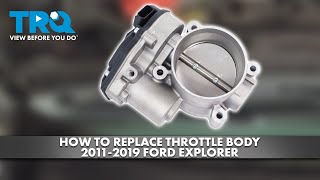
Typical fix: Replace the entire electronic throttle body assembly with a new part. After replacement, perform a Keep Alive Memory (KAM) reset 🎬 Watch: Full walkthrough for replacing the throttle body on your Explorer. and throttle relearn procedure. This is a straightforward DIY job for many owners.
Est. part cost: $100-$350 - Wiring Harness or Connector Issue ⚪ Low Probability While less common than ETB failure, wiring can become damaged from engine heat, vibration, or improper servicing. The connector pins can also corrode.
How to confirm: Visually inspect the wiring harness and the 6-pin connector going to the throttle body for any signs of chafing, melting, corrosion, or loose pins. Use a multimeter to check for proper voltage and ground at the connector according to the vehicle's wiring diagram.
Typical fix: Repair the damaged section of the wiring harness or replace the connector pigtail.
Est. part cost: $20-$50 - PCM Software Level ⚪ Low Probability In some Ford models, P2101 may be triggered by the software level in the Powertrain Control Module (PCM) rather than a hardware failure. TSB 23-2364 and TSB 25-2320 note that an illuminated wrench indicator and reduced power on startup with P2101 can sometimes be corrected by updating the PCM software.
Rare But Worth Checking
- Powertrain Control Module (PCM) Failure: This is very rare. Before condemning the PCM, all other possibilities, especially the throttle body and its wiring, must be exhaustively ruled out. A faulty PCM can sometimes mimic the symptoms of a failed component.
Diagnosis Steps

- Scan for Codes: Use an OBD-II scanner to confirm P2101 is present. Check for other related codes like P2111, P2112, or P2110, which strongly point to a throttle body failure.
- Inspect the Connector: Visually inspect the electrical connector on the throttle body. Look for loose connections, corrosion on the pins, or any damaged wires. Ensure the red locking tab is secure.
- Attempt a Reset (Temporary Fix): Sometimes, turning the vehicle off for a few minutes and restarting it can temporarily clear the limp mode, but the problem will almost certainly return. This can help confirm the intermittent nature of the electronic fault.
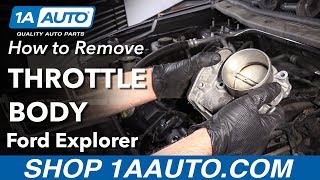
- Replace the Throttle Body: Given the extremely high probability of failure for this specific part on this vehicle, the most direct and common solution is to replace the electronic throttle body assembly. It is held on by four 8mm bolts. 🎬 See this quick guide on how to remove the throttle body.
- Perform a Throttle Relearn: After installing the new throttle body, a relearn procedure is required. The simplest method is to disconnect the negative battery cable for at least 15 minutes to clear the PCM's Keep Alive Memory (KAM). An alternative method involves jumping the disconnected negative cable to the positive terminal for a few minutes to drain stored voltage. Reconnect the battery, start the engine, and allow it to idle for several minutes to warm up and for the PCM to recalibrate the new throttle position values.
Parts You'll Likely Need

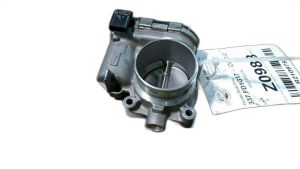
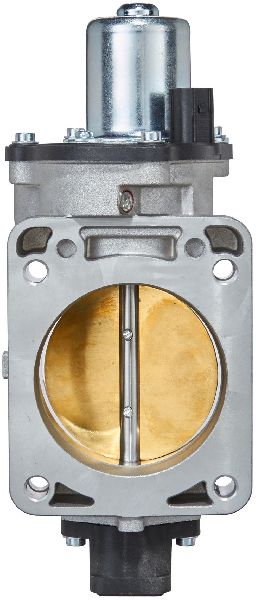
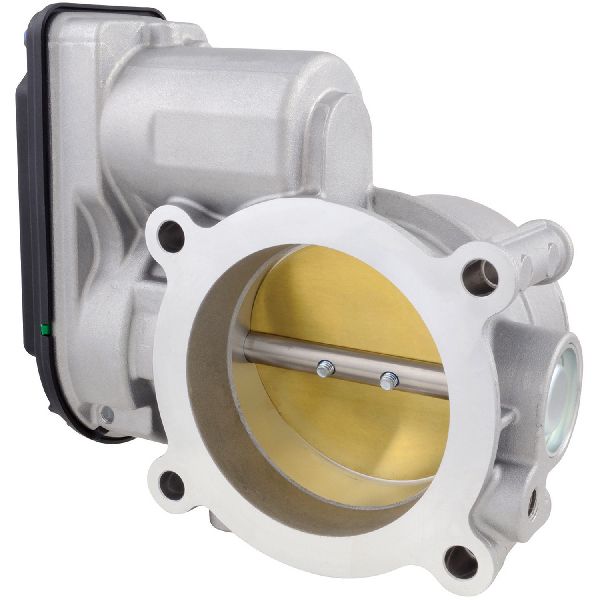
- Electronic Throttle Body Assembly
(OEM #BB5Z-9E926-C)— This is the root cause of code P2101 in the vast majority of cases for this vehicle due to a known internal electronic defect. The original part number may have been superseded by BB5Z-9E926-D, which may offer improvements.
Trusted brands: Motorcraft (OEM), Bosch, Hitachi, Standard Motor Products (SMP), Dorman
OEM price range: $250-$350
Aftermarket price range: $100-$220
Related Codes That Often Appear With This One
- P2111 — This code for 'Throttle Actuator Control System - Stuck Open' often appears with P2101 as the PCM detects the throttle plate is not where it should be.
- P2112 — This code for 'Throttle Actuator Control System - Stuck Closed' is very common alongside P2101, indicating the PCM has detected the throttle plate cannot open as commanded.
- P2110 — This code, 'Throttle Actuator Control System - Forced Limited RPM,' is a direct indicator that the PCM has activated the 'limp mode' as a result of the throttle fault detected by P2101.
Technical Service Bulletins (TSBs) & Recalls

- TSB 16-0139: Addresses intermittent loss of power and wrench light with DTCs P2111, P2112, and/or P2119 on various 2015-2016 Ford models, including the Explorer, built on or before 31-May-2016.
- Customer Satisfaction Program 16B32: A program initiated by Ford to replace faulty electronic throttle bodies on affected vehicles, including certain 2016 Explorers. The program expired on Sept 30, 2017.
- TSB 16-0163: A manufacturer bulletin for other Ford platforms that lists P2101 alongside P2111 and P2112, providing service procedures to correct conditions where the throttle body may become disabled.
- TSB 25-2320: Notes that P2101 stored in the PCM may be due to software levels in the module, requiring a service procedure to update.
- TSB 23-2364: Describes a condition where vehicles exhibit reduced engine power on startup and an illuminated wrench indicator with DTC P2101, which may be corrected by updating the PCM software.
Platform-Specific Known Issues
- Ford issued Customer Satisfaction Program 16B32 due to the high failure rate of the electronic throttle body. It covered certain 2016 Explorers (and other models) and provided a free replacement. The program expired on September 30, 2017, but serves as official acknowledgment of the defect.
- TSB 16-0139 was also released, providing technicians with diagnostic information for DTCs P2111, P2112, and P2119 related to this issue on vehicles built on or before May 31, 2016.
Mechanic-Grade Diagnostic Values
- Throttle Position Sensor (TPS) Signal Voltage Sweep — expected: A smooth sweep from approximately 0.5-0.9V at closed throttle to ~4.5V at wide-open throttle (WOT).. Failure: Voltage that is erratic, has flat spots, drops out, or reads below ~0.5V at idle (e.g., 0.2V) indicates a worn or faulty internal sensor.
- Voltage Drop Test on Throttle Actuator Control (TAC) Motor Circuit — expected: Less than 0.5V drop between the PCM supply voltage and the voltage measured at the motor connector with the ignition on.. Failure: A voltage drop greater than 0.5V points to high resistance in the wiring or a corroded connector.
- Live Data: Throttle Angle Percentage (TAP) vs. Commanded Torque — expected: The reported throttle angle should closely match the PCM's commanded angle.. Failure: A consistent discrepancy greater than ±10% between the actual and commanded values suggests internal wear or a communication fault.
- Ground Integrity at G104 — expected: A clean, tight connection with minimal resistance to the chassis.. Failure: A loose or corroded ground at this location can mimic sensor faults and cause intermittent throttle issues.
Hidden / Shadow Codes Worth Checking
- Mode $06: While not a hidden code, Mode $06 provides access to the results of non-continuous self-tests run by the PCM, including for the electronic throttle control system. It shows raw test values, min/max limits, and a pass/fail status for specific component tests (TIDs and CIDs). (see via A professional-level OBD-II scanner with Mode $06 capability. The readiness monitors must have completed for the data to be valid.)
Scan Tool Commands That Help

- Ford IDS / FDRS or equivalent bidirectional scanner: Throttle Body Actuation Test — Used to command the throttle plate to open and close while observing its movement and sensor data. This can verify if the motor is physically stuck or if the sensors are reading correctly through the range of motion.
- Ford IDS / FDRS or manual procedure: Clear/Reset Keep Alive Memory (KAM) — This must be performed after replacing the throttle body. It clears the old adaptive fuel and idle trim values stored by the PCM, forcing it to relearn the parameters for the new component. A manual KAM reset can be done by disconnecting the battery.
Wiring & Ground Locations

- C175B — The 6-pin electrical connector on the Electronic Throttle Body itself.. This is the single point of connection for all power, ground, and signal wires for the throttle body. The key pins are TACM+ and TACM- for the motor, and TP1, TP2, ETCREF (Reference Voltage), and ETCRTN (Signal Return) for the position sensors.
- G104 — A key ground point located on the firewall in the engine bay.. A poor connection at this ground can cause erratic voltage and phantom electronic issues, including those that mimic a throttle body failure. It should be checked for corrosion and tightness before condemning expensive parts.
- G101 / G103 — General PCM ground points, typically located on the firewall or inner fender in the engine bay.. These are critical ground points for the Powertrain Control Module. High resistance here can affect the operation of all sensors and actuators controlled by the PCM, including the throttle body.
Real Owner Repair Stories
- Go-Parts Repair Database / CarComplaints.com (2013 Ford Taurus 3.5L (mechanically similar)) — Check engine light with code P2111.
✅ What actually fixed it The owner replaced the throttle body assembly and performed a specific manual relearn procedure: 'key on, engine off', slowly press and release the accelerator pedal over 10 seconds each way, then key off. - Ford F150 Forum User (2007 F150 5.4L (similar electronic throttle system)) — After replacing the throttle body with a Duralast (aftermarket) part, the truck was a crank-no-start and threw codes P2101, P2104, P2110, and P2111.
❌ Tried (didn't work) Installing an aftermarket throttle body.
✅ What actually fixed it The user was advised to double-check the wiring of the new connector, verify the part number was correct, and if the issue persisted, to replace the aftermarket unit with an OEM Motorcraft part. This highlights the potential for issues with non-OEM parts.
Documented NHTSA Reports
- NHTSA ODI #11075272: An owner reported that a mechanic scanned their vehicle and found codes P2101 and P2111, both referring to the electronic throttle body being stuck open.
- NHTSA ODI #10564644: A report describes a vehicle where the check engine light came on after the engine had been warm and then cooled down. The ECU stored codes P2101, P2111, and P2135, causing the throttle body to become disabled and the vehicle to lose acceleration. The issue was resolved by replacing the unit with a new Ford part.
OEM Part Supersession History
BB5Z-9E926-C→BB5Z-9E926-D— Often indicates a revision to address a known failure mode or improve reliability.
Heads up: The -D revision is generally considered a direct replacement and potential improvement over the -C version. No known incompatibilities.
Diagnostic Flowchart
Other Known Issues on This Vehicle
Issues unrelated to this code that are worth knowing about as an owner of this generation:
- Internal Water Pump Failure 🔴 High — Commonly occurs between 60,000 and 120,000 miles. Failure can be catastrophic to the engine. (Ref: No recall, but subject of multiple class-action lawsuits.)
- Power Transfer Unit (PTU) Overheating/Failure 🔴 High — Common on AWD models. The 'lifetime' fluid degrades from heat, leading to failure. Regular fluid changes (every 30k miles) are recommended as preventative maintenance.
- Exhaust Odor / Carbon Monoxide In Cabin 🔴 High — Widespread issue, especially on 2011-2017 models, leading to a major NHTSA investigation. (Ref: Multiple TSBs issued (e.g., 16-0166, 17-0029, 17-0044) for sealing the body and modifying exhaust components.)
- Electronic Power Steering Rack Failure 🟠 Medium — Failures of the electronic power steering rack can cause loss of assist or wandering. It's a costly replacement. (Ref: Several recalls were issued for related steering components on early models.)
- Cracked Exhaust Manifold 🟡 Low — Can cause an exhaust leak, leading to a ticking noise when cold and potentially contributing to cabin fumes.
Used vs. New Parts: Buying Guide for This Vehicle
When a used part is the smart pick: For this specific failure, a used part is almost never a smart choice. The root cause is a well-documented internal electronic defect and contamination that occurs over time. A used part from a salvage yard likely has the same latent fault or is already failing.
What to inspect on the donor part:
- Not applicable, as a used part is strongly discouraged regardless of appearance.
OEM-only on this vehicle (don't cheap out):
- Electronic Throttle Body Assembly
Aftermarket brands forum-validated for this vehicle:
- While some brands like Bosch or Hitachi may be reliable, forum consensus and mechanic recommendations heavily favor the OEM Motorcraft part to guarantee compatibility and avoid premature failure.
Brands owners have reported issues with on this vehicle:
- Store-brand or no-name aftermarket parts have been reported by users to be dead-on-arrival or fail quickly. A forum user reported a crank-no-start condition immediately after installing a Duralast throttle body.
Real Owner Stories
Aggregated from forums and TSBs cited above. Mileages and costs reflect what owners reported in those sources.
2013 Ford Explorer 3.5L V6
Symptoms: The vehicle would randomly go into limp mode and set code P2111, which indicates the throttle is stuck open.
What fixed it: The community confirmed that throttle body replacement is the standard fix for this issue.
Source hint: Reddit (r/FordExplorer): A user with a 2013 Explorer described random limp mode with code P2111 ('throttle stuck open'), with the community confirming throttle body replacement is the standard fix.
2015 Ford Explorer 3.5L V6
Symptoms: Sudden limp mode while driving, accompanied by the wrench light on the dashboard and codes P2101, P2111, or P2112.
What fixed it: The resolution was replacing the entire electronic throttle body assembly, which owners confirm is a common DIY fix.
Source hint: explorerforum.com: Multiple threads describe the classic P2101/P2111/P2112 failure: sudden limp mode while driving, wrench light, and resolution by replacing the throttle body. Owners confirm it's a common DIY fix.
2016 Ford F-150 3.5L V6
Symptoms: Intermittent loss of engine power with the illuminated wrench lamp on the dash, as described in TSB 16-0139.
What fixed it: The issue was confirmed to be the widespread electronic throttle body (ETB) failure common to this engine family, requiring replacement of the part.
Source hint: Ford F150 Forum: A thread titled 'Illuminated Wrench Lamp ***TSB 16-0139***' discusses the exact symptoms across multiple vehicles with the same engine family, confirming the widespread nature of the ETB failure.
Related OBD-II Codes
Frequently Asked Questions
My 2016 Explorer is showing a wrench light and going into limp mode. Is there a recall for the P2101 code?
What is the most common cause of code P2101 on the 3.5L V6 Explorer?
Is replacing the electronic throttle body a difficult DIY job on my Explorer?
After I install a new throttle body, is there a special procedure I need to follow?
Along with the check engine light for P2101, I'm also seeing an 'AdvanceTrac service' warning. Are these related?
Do other Ford vehicles with the 3.5L engine have this same throttle body problem?
Helpful Videos
Used OEM Parts in Stock

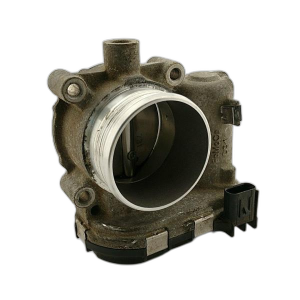

New Aftermarket Parts Available


The information in this article is provided for general reference and educational purposes only. Vehicle specifications, procedures, and part compatibility can vary by production date, trim level, and region. Always consult your vehicle's factory service manual and verify part numbers before purchasing or performing repairs. Safety-critical components such as airbags, seat belts, and braking systems should be installed by a qualified professional.
- Ford Explorer:
- 🎬 Helpful Videos
- 🛍️ Shop This Part
- What's Unique About the 2011-2019 Ford Explorer
- Symptoms You May Notice
- Most Likely Causes
- Rare But Worth Checking
- Diagnosis Steps
- Parts You'll Likely Need
- Related Codes That Often Appear With This One
- Technical Service Bulletins (TSBs) & Recalls
- Platform-Specific Known Issues
- Mechanic-Grade Diagnostic Values
- Hidden / Shadow Codes Worth Checking
- Scan Tool Commands That Help
- Wiring & Ground Locations
- Real Owner Repair Stories
- Documented NHTSA Reports
- OEM Part Supersession History
- Diagnostic Flowchart
- Other Known Issues on This Vehicle
- Used vs. New Parts: Buying Guide for This Vehicle
- Real Owner Stories
- 2013 Ford Explorer 3.5L V6
- 2015 Ford Explorer 3.5L V6
- 2016 Ford F-150 3.5L V6
- Related OBD-II Codes
- Frequently Asked Questions
- 🎟️ Get 5% Off