

P2096 on 2008-2012 Ford Escape: Lean Fuel Trim Causes and Fixes
On a 2008-2012 Ford Escape, code P2096 is most often caused by an exhaust leak before the downstream O2 sensor or a failing downstream O2 sensor itself. A thorough inspection for exhaust leaks, especially at manifold gaskets and flex pipes, is critical before replacing any parts. For the V6, which has two downstream sensors, identifying the correct Bank 1 sensor is a common point of confusion.
- Code P2096 on a 2008-2012 Escape means the downstream O2 sensor on Bank 1 is detecting a lean condition.
- Before buying any parts, thoroughly inspect the exhaust system for leaks between the engine and the sensor. This is the most common cause.
- The second most common cause is a failed downstream oxygen sensor.
- If you replace the oxygen sensor, you MUST perform a Keep Alive Memory (KAM) reset or a KOER self-test with a proper scan tool. Simply clearing the code is often not enough to fix the problem on a Ford.
What's Unique About the 2008-2012 Ford Escape
For this generation of Ford Escape, the causes for P2096 are fairly typical and not tied to a specific, widespread factory defect like on some later models. However, a common pitfall for owners is the repair procedure itself. After replacing a part like an oxygen sensor, it is crucial to reset the engine's adaptive memory, known as the Keep Alive Memory (KAM). Simply clearing the code with a basic scanner is often not enough, as the PCM retains the old fuel trim adjustments. The P2096 code may return until a proper KAM reset or a "Key On Engine Running" (KOER) self-test is performed with a capable scan tool. Disconnecting the battery for an extended period is a less reliable method for clearing the KAM. For the 3.0L V6, there are two downstream O2 sensors, and owners often mistakenly replace the more accessible one (Bank 2) instead of the correct Bank 1 sensor, which is harder to reach.
Symptoms You May Notice
- Check Engine Light is on
- Decreased fuel economy
- Vehicle may fail an emissions test.
- Rough idle or hesitation (less common, but possible if caused by a large vacuum leak).
- Sluggish acceleration or loss of power.
- Audible exhaust noise or a ticking sound from the engine bay if caused by an exhaust leak.
- Immediately replacing the oxygen sensor without first thoroughly checking for exhaust leaks. A leak will cause the new sensor to report the same lean condition, making the repair seem unsuccessful.
- Replacing the oxygen sensor and only clearing the code with a basic scanner, without performing a proper KAM reset. The code may return until the engine's learned fuel adaptations are fully reset.
- On the 3.0L V6, replacing the wrong downstream oxygen sensor. Many owners replace the easier-to-access Bank 2 sensor (front of vehicle) when the code is for the Bank 1 sensor (rear of vehicle).
Most Likely Causes
- Exhaust System Leak 🔴 High Probability Exhaust components like manifold gaskets, flex pipes, and pipe welds are exposed to constant heat cycles, moisture, and road salt, leading to corrosion and cracks over time. These leaks allow unmetered air to be sucked into the exhaust stream, fooling the O2 sensor.
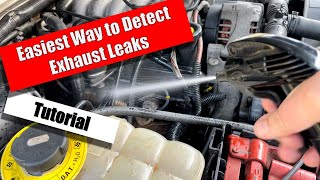
How to confirm: Perform a thorough visual inspection of the exhaust system from the engine's exhaust manifold(s) to the downstream oxygen sensor. Look for cracks, rust holes, or black soot marks indicating a leak. Listen for a ticking or hissing noise that is loudest on a cold start. The most effective method is to use a smoke machine to pressurize the exhaust system and watch for smoke escaping. 🎬 Watch: The easiest way to find hidden exhaust leaks.
Typical fix: Repair the leak. This may involve replacing a cracked exhaust manifold, a failed gasket, or welding a patch over a hole in the pipe. For small cracks, high-temperature exhaust putty can be a temporary solution.
Est. part cost: $20-$300 - Faulty Downstream Oxygen Sensor (Bank 1, Sensor 2) 🔴 High Probability Oxygen sensors are wear items with a typical lifespan of 70,000-100,000 miles. They can become contaminated by fuel, oil, or coolant, or simply fail electronically over time, sending incorrect low-voltage (lean) signals.
How to confirm: Use a scan tool to monitor the live data from the downstream O2 sensor (B1S2). A healthy sensor on a warm engine should show a relatively stable voltage. If the voltage is stuck low (e.g., below 0.2V) or is not responding, and no exhaust leaks are present, the sensor is likely faulty. Ensure wiring to the sensor is intact and not melted or corroded.
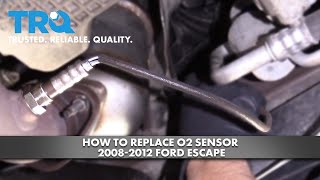
Typical fix: Replace the Bank 1 downstream oxygen sensor. On the 3.0L V6, this is the sensor on the rear bank (firewall side). 🎬 Watch this DIY walkthrough for replacing the Bank 1 sensor. After replacement, perform a KAM reset or KOER self-test.
Est. part cost: $50-$150 - Engine Vacuum Leak 🟡 Medium Probability Vacuum hoses made of rubber and plastic can become brittle and crack with age and heat cycles. Intake manifold gaskets can also fail, allowing unmetered air into the engine. This typically sets a P0171 code first, but can also contribute to P2096.
How to confirm: Listen for a hissing sound around the engine bay at idle. With the engine running, carefully spray short bursts of brake cleaner or an unlit propane torch around suspected leak areas like vacuum lines and the intake manifold gasket. A change in engine idle indicates the location of the leak. A smoke test of the intake system is the most reliable method.
Typical fix: Replace the cracked vacuum hose or faulty gasket.
Est. part cost: $5-$150 - Low Fuel Pressure or Clogged Fuel Injectors ⚪ Low Probability
How to confirm: Check the fuel pressure using a fuel pressure gauge connected to the fuel rail's service port. Compare the reading to the manufacturer's specification. This is less likely as it would typically trigger other codes like P0171 (System Too Lean Bank 1) first, as the upstream sensor would detect the primary lean condition.
Typical fix: Replace the failing fuel pump, clogged fuel filter, or have the fuel injectors professionally cleaned or replaced.
Est. part cost: $50-$500
Rare But Worth Checking
- Failing Catalytic Converter: While P2096 usually points to issues *before* the sensor, a partially clogged or inefficient catalytic converter can sometimes alter exhaust flow in a way that triggers this lean code before a P0420 (Catalyst Efficiency) code appears. A glowing red hot converter after a drive is a sign of a severe clog.
- Dirty or Faulty Mass Airflow (MAF) Sensor: A dirty MAF sensor can under-report the amount of air entering the engine, causing the PCM to command less fuel and creating a true lean condition. Cleaning the MAF sensor with a dedicated MAF sensor cleaner is a simple and inexpensive diagnostic step.
- PCM Software Issue: In some cases, particularly on other makes, outdated Powertrain Control Module (PCM) software can cause a false P2096 code. While not widely reported for this specific Escape generation, it's a possibility if all other causes are ruled out. A dealer would need to check for and apply any available software updates.
Diagnosis Steps
- Check for any other stored diagnostic trouble codes (DTCs) to provide more context. Codes like P0171 or P0420 can significantly change the diagnostic path.
- Perform a thorough visual and audible inspection of the entire exhaust system for signs of leaks, such as cracks, rust holes, or black soot trails, especially around welds and gaskets. Listen for a ticking noise on a cold start.
- If no obvious leaks are found, perform a smoke test on the exhaust system to pinpoint any small, hard-to-see leaks.
- Inspect the wiring and connector for the downstream Bank 1 oxygen sensor for any damage, corrosion, or loose connections. Ensure the wiring is not melted on the exhaust.
- Using a capable scan tool, monitor the live data from the downstream O2 sensor (B1S2). The voltage should be relatively stable on a warm engine. If it is stuck low (e.g., below 0.2V), it indicates a lean reading.
- If exhaust leaks are ruled out and the sensor is reading lean, test for engine vacuum leaks using a smoke machine or by carefully spraying starter fluid around the intake manifold and vacuum hoses while monitoring engine RPM.
- If no vacuum or exhaust leaks are found, the oxygen sensor itself is the most likely culprit. Replace the Bank 1, Sensor 2 oxygen sensor. For the 3.0L V6, confirm you are replacing the sensor on the rear bank (firewall side).
- CRITICAL STEP: After replacement, use a scan tool to perform a Keep Alive Memory (KAM) reset. If this option is not available, a Key On Engine Running (KOER) self-test may also reset the adaptations. Disconnecting the battery for 30 minutes is a less reliable alternative.
- If the code returns, test fuel pressure to rule out a fuel delivery problem and inspect the MAF sensor for contamination.
Parts You'll Likely Need
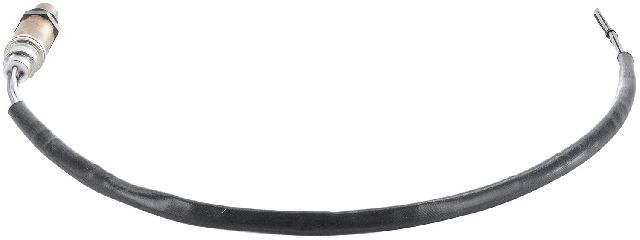
- Downstream Oxygen Sensor (Bank 1, Sensor 2)
(OEM #DY-1176 (for 2.5L models 2011-2012))— This sensor is the primary component responsible for the reading that triggers the P2096 code. It is a common wear item.
Related Codes That Often Appear With This One
- P0171 — If a large vacuum leak or significant fuel delivery issue exists, the upstream oxygen sensor will also detect the lean condition, setting a P0171 (System Too Lean Bank 1) code alongside the P2096. If P0171 is present, the root cause is likely on the engine intake or fuel side, not the exhaust.
- P0420 — If the catalytic converter is failing, you may see a P0420 (Catalyst System Efficiency Below Threshold Bank 1) code along with P2096, as both sensors are reporting data inconsistent with a properly functioning converter. Seeing both codes together strongly suggests a bad catalytic converter.
- P2270 — This code, "O2 Sensor Signal Stuck Lean Bank 1 Sensor 2," is a more direct indicator that the downstream sensor itself is electrically stuck in a lean-reporting state. A YouTube user with a 2010 Escape 3.0L V6 reported having both P2096 and P2270, which was resolved by replacing the correct (rear) downstream O2 sensor.
Technical Service Bulletins (TSBs) & Recalls
- While no TSBs are specific to the 2008-2012 Escape for P2096, a notable TSB for the next generation (2013-2014) Escape with the 2.0L GTDI engine is TSB 16-0031. It addresses oil migrating from VVT solenoids into the O2 sensor wiring harness, causing P2096. This is not a known issue for the 2008-2012 models but is useful context for the code on the Escape nameplate.
- Manufacturer Bulletin #TSB160031 also notes that vehicles built between 09/01/2012 and 08/01/2013 may exhibit an illuminated MIL with DTC P2096.
- Bulletin #16-0031 further clarifies that for certain engines, the P2096 code (post catalyst fuel trim system too lean bank 1) may be stored in the powertrain control module (PCM) memory due to engine oil migrating from the VVT solenoids.
Platform-Specific Known Issues
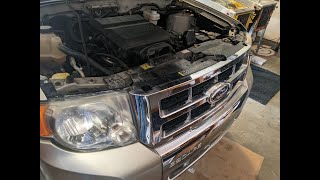
- Confusion over Bank 1 on 3.0L V6: On the transversely mounted 3.0L V6, Bank 1 is the cylinder bank located at the rear of the engine bay, against the firewall. The downstream O2 sensor for Bank 1 is significantly harder to access than the Bank 2 sensor at the front. Owners frequently replace the wrong sensor by mistake, leading to the code returning. A DIY video on YouTube highlights this exact issue, where the creator had to replace the second, more difficult sensor after the code returned.
Mechanic-Grade Diagnostic Values
- Downstream O2 Sensor (B1S2) Voltage — expected: Relatively stable voltage, typically between 0.6V and 0.8V on a healthy, warm engine with a good catalytic converter.. Failure: A voltage that is consistently stuck low (e.g., below 0.2V) indicates a lean condition or a faulty sensor. A Reddit user with a 2010 2.5L Escape reported a B1S2 value of 0.4499V which was flagged as 'OK' by their scanner, but the code was present, indicating the threshold for the code can be complex.
- Upstream O2 Sensor (B1S1) Live Data — expected: Should fluctuate rapidly between approximately 0.1V and 0.9V as the PCM adjusts the air/fuel mixture.. Failure: A sensor that is slow to respond or stuck at a certain voltage is faulty. If it's stuck low, it indicates a lean condition that would likely also set a P0171 code.
Scan Tool Commands That Help
- Ford IDS (Integrated Diagnostic System): Reset KAM — After replacing a component like an O2 sensor to clear all learned adaptive values from the PCM. The path is typically Toolbox > Powertrain > TCM > Reset KAM. This is the most reliable way to ensure the PCM relearns strategy with the new part.
- FORScan: Clear Transmission Adaptive Tables / Reset KAM — A popular and powerful aftermarket tool that can perform the KAM reset. This function is crucial after a part replacement to prevent the old, faulty fuel trim data from causing the P2096 code to return.
- Generic Scan Tool: Key On Engine Running (KOER) Self-Test — If a dedicated KAM reset function is not available, running a KOER self-test can also trigger a reset of the adaptive tables on some Ford vehicles. This should be done after the engine is at normal operating temperature.
Real Owner Repair Stories
- YouTube video comment section (paraphrased) (2010 Ford Escape 3.0L V6) — Check Engine Light with codes P2096 and P2270.
❌ Tried (didn't work) Replacing the incorrect (Bank 2, front) downstream O2 sensor.
✅ What actually fixed it Replacing the correct Bank 1 (rear, firewall side) downstream oxygen sensor resolved both codes. - NHTSA ODI #11618319: An owner reported that their engine light came on with code P2096, and after a while, the vehicle started misfiring and showed an additional code of P0302.
OEM Part Supersession History
BB5Z-9G444-A→CV6Z-9G444-A, CV6Z-9G444-B— Part evolution for improved reliability or manufacturing changes.
Heads up: While these part numbers are listed for various Ford models, always verify the specific part number for your vehicle's VIN. The listed part numbers are often associated with newer 2.0L engines but show up in cross-references.
Model Year Variations Within This Range
- 2009-2012: For the 2009 model year, the base engine was upgraded from a 2.3L to a new 2.5L I4. The 3.0L V6 was significantly updated, increasing power from ~200 hp to 240 hp. The 4-speed automatic was replaced with a more efficient 6-speed automatic (6F35). These changes mean that while the P2096 code's root causes are similar, specific part numbers for sensors and the PCM's software strategy may differ from the 2008 model.
- 2008: The 2008 model year was a 'half-gen' that used the new body style but carried over the powertrain from the first generation, including the 2.3L I4 and a ~200 hp 3.0L V6 mated to a 4-speed automatic transmission. When sourcing parts, it's critical to distinguish between a 2008 and a 2009+ model.
Diagnostic Flowchart
Used vs. New Parts: Buying Guide for This Vehicle
When a used part is the smart pick: For major exhaust components like an exhaust manifold or a catalytic converter assembly, a used OEM part from a low-mileage, non-corroded donor vehicle can be a good value. Used OEM catalytic converters are often more reliable and effective than cheap aftermarket alternatives.
Donor-vehicle mileage cap: roughly under 80000 miles for the part to have meaningful remaining life.
What to inspect on the donor part:
- For exhaust manifolds, check for any hairline cracks, especially around the collector and mounting flanges.
- For catalytic converters, ensure the honeycomb substrate is intact and not rattling or broken inside the housing.
- Check for severe rust or corrosion, particularly in vehicles from the salt belt. Surface rust is normal, but deep pitting or flaking is a bad sign.
OEM-only on this vehicle (don't cheap out):
- Catalytic Converter (Recommended): While not strictly required, OEM converters are designed to meet the specific emissions standards for the vehicle and are less likely to cause future P0420 (Catalyst Efficiency) codes than some budget aftermarket units.
Aftermarket brands forum-validated for this vehicle:
- NTK (O2 Sensors): NTK is a brand of NGK and is often the Original Equipment supplier for Ford.
- Denso (O2 Sensors): A high-quality OEM supplier known for reliable sensors that meet or exceed OE specifications.
- Bosch (O2 Sensors): A well-known OEM manufacturer, though some forum users report mixed experiences with their aftermarket sensors compared to NTK or Denso on Ford vehicles.
- Walker (Exhaust Components): A reputable brand for aftermarket exhaust pipes, gaskets, and catalytic converters.
Brands owners have reported issues with on this vehicle:
- Off-brand 'universal' oxygen sensors that require splicing wires. These often have incorrect heater resistance or response times, leading to persistent codes or poor performance.
Real Owner Stories
Aggregated from forums and TSBs cited above. Mileages and costs reflect what owners reported in those sources.
2010 Escape 3.0L V6
Symptoms: Check Engine Light was on with codes P2096 and P2270 stored.
What fixed it: Replacement of the downstream Bank 1 oxygen sensor. The owner specifically noted that this was the more difficult sensor to access, located behind the oil pan, and that people often mistakenly replace the easier Bank 2 sensor first.
Source hint: YouTube - 2010 Escape 3.0L V6 P2096 & P2270 O2 Sensor DIY
2010 Escape 2.5L — 111847 miles
Symptoms: Owner reported a P2096 code and noted their O2 sensor values appeared normal on their scanner. They were confused if the cause could be the catalytic converter or a fuel pump issue, especially after a strange fuel gauge incident.
What fixed it: The owner was seeking advice and the final repair was not specified in the source.
Source hint: Reddit r/AskMechanics - 2010 Escape 2.5L P2096
2009 Escape Hybrid
Symptoms: A P2096 code appeared after a shop attempted to "clean" the catalytic converter.
What fixed it: A responding technician advised that the catalytic converter likely needed replacement and that the O2 sensor was probably damaged during the attempted cleaning service.
Source hint: 2CarPros Forum - 2009 Escape Hybrid P2096
Related OBD-II Codes
Frequently Asked Questions
On my 3.0L V6 Escape, which side is Bank 1 for the P2096 code?
After replacing the downstream O2 sensor, is there a special procedure I need to follow?
Why is my 2008-2012 Escape prone to exhaust leaks that cause P2096?
Can a vacuum leak cause a P2096 code on this vehicle?
I found TSB 16-0031 for a Ford Escape with code P2096. Does this apply to my 2011 model?
I have a 2009 Mercury Mariner with a P2096 code. Is this article's information relevant?
Helpful Videos
We Have This Part in Stock


The information in this article is provided for general reference and educational purposes only. Vehicle specifications, procedures, and part compatibility can vary by production date, trim level, and region. Always consult your vehicle's factory service manual and verify part numbers before purchasing or performing repairs. Safety-critical components such as airbags, seat belts, and braking systems should be installed by a qualified professional.
- Ford Escape:
- 🎬 Helpful Videos
- 🛍️ Shop This Part
- What's Unique About the 2008-2012 Ford Escape
- Symptoms You May Notice
- Most Likely Causes
- Rare But Worth Checking
- Diagnosis Steps
- Parts You'll Likely Need
- Related Codes That Often Appear With This One
- Technical Service Bulletins (TSBs) & Recalls
- Platform-Specific Known Issues
- Mechanic-Grade Diagnostic Values
- Scan Tool Commands That Help
- Real Owner Repair Stories
- OEM Part Supersession History
- Model Year Variations Within This Range
- Diagnostic Flowchart
- Used vs. New Parts: Buying Guide for This Vehicle
- Real Owner Stories
- 2010 Escape 3.0L V6
- 2010 Escape 2.5L — 111847 miles
- 2009 Escape Hybrid
- Related OBD-II Codes
- Frequently Asked Questions
- 🎟️ Get 5% Off