

P1776 on 2007-2018 Ram 2500 6.7L Cummins: Solenoid Valve Fixes
On a Ram 2500 with a 6.7L Cummins, P1776 means the transmission is stuck in 'limp mode' due to a stuck valve. The most common cause is a worn-out valve body, not just the solenoid pack. A complete valve body replacement is the typical fix, costing between $800 and $2000 at a shop.
- P1776 means the transmission is in limp mode because a critical valve is stuck.
- Do not replace the solenoid pack first. The problem is almost always the valve body itself or outdated software.
- Check for software updates with a dealer before authorizing any hardware replacement.
- Continued driving in limp mode can cause severe overheating and lead to a full transmission rebuild.
- This is a complex repair that should be handled by a professional transmission shop.
What's Unique About the 2007-2018 Ram 2500
This code is a well-documented issue on the Chrysler 68RFE transmission paired with the 6.7L Cummins. The core of the problem is often not the electronic solenoid pack, but the physical bore for the Solenoid Switch Valve (SSV) inside the aluminum valve body. Over time, the steel valve wears the aluminum bore, creating hydraulic leaks that cause it to stick. Many owners mistakenly replace the more accessible solenoid pack, only for the code to return because the root cause in the valve body was not addressed. Aftermarket companies like Sonnax and BD Diesel offer remanufactured valve bodies with a steel sleeve inserted into the SSV bore to prevent future wear.
Generation note: This issue affects both the third-generation (2007.5-2009) and fourth-generation (2010-2018) Ram 2500s equipped with the 6.7L Cummins engine. Both generations use the 68RFE transmission, which has this inherent design vulnerability in the valve body. The diagnosis and repair are consistent across the entire 2007.5-2018 year range.
Symptoms You May Notice
- Check Engine Light is on
- Vehicle is stuck in one gear (limp mode), often 2nd or 3rd gear
- Harsh or failed shifts
- Inability to use higher gears or achieve highway speeds
- No torque converter lockup
- Feels like it's dragging or locking up in reverse
- Replacing only the transmission solenoid pack. Many sources and even Chrysler tech tips explicitly warn that the P1776 code is most often caused by a worn valve body, not the solenoid pack it bolts to. Replacing the solenoid pack alone frequently leads to the code returning.
Most Likely Causes
- Worn Solenoid Switch Valve (SSV) Bore in Valve Body 🔴 High Probability The 68RFE's aluminum valve body bore wears down from the movement of the steel SSV, causing hydraulic pressure leaks that prevent the valve from moving freely. This is a widely recognized design flaw.
How to confirm: This is difficult to confirm without removing the valve body. A definitive diagnosis can be made by vacuum testing the SSV bore; it should hold a minimum of 16 in-Hg. It is typically diagnosed by eliminating other possibilities. If a new solenoid pack doesn't fix the code, a worn valve body is almost certain.
Typical fix: Replace the entire transmission valve body, preferably with a quality remanufactured unit that has been updated with wear-resistant steel sleeves or oversized valves to prevent recurrence.
Est. part cost: $500-$1200 - Outdated Powertrain Control Module (PCM) Software 🟡 Medium Probability Ram has released software updates to change the sensitivity of the fault monitoring for P1776. TSB 18-018-13 REV. D for 2013 models and TSB 18-091-16 for others change it from a 'one-trip' fault to a 'two-trip' fault, preventing intermittent glitches from triggering limp mode.
How to confirm: A dealership or a shop with a wiTECH scan tool can check the current software version against available Technical Service Bulletins (TSBs).
Typical fix: Reprogram the PCM with the latest software. This should always be done before replacing any hardware.
Est. part cost: $0 - Faulty Transmission Solenoid Pack 🟡 Medium Probability The solenoid pack, which contains multiple electronic solenoids, can fail electrically or mechanically. While a common failure point on the 68RFE, it is often replaced unnecessarily for P1776 when the valve body is the real issue.
How to confirm: A professional scan tool can command the solenoids to check for response. The L/R solenoid should have a resistance of around 1.3 Ohms. However, a functional solenoid cannot overcome a stuck valve in the valve body, making this a tricky diagnosis.
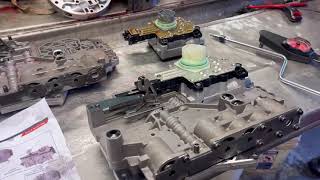
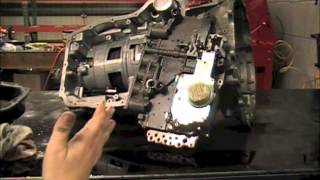
Typical fix: Replace the transmission solenoid pack. This is often attempted first due to being slightly easier than a full valve body replacement. 🎬 See this walkthrough on how to replace the solenoid block pack.
Est. part cost: $350-$650 - Misadjusted Shifter Cable ⚪ Low Probability If the shifter cable is stretched or misadjusted, the manual valve inside the transmission may not be fully in the 'Drive' position, causing a logic error that can trigger P1776.
How to confirm: A Chrysler-specific scan tool can read the 'TRS Code' in the event data. If it reads 'TR2' instead of 'OD', it indicates a shifter alignment issue.
Typical fix: Inspect and adjust the shifter linkage and cable according to factory procedures.
Est. part cost: $0
Rare But Worth Checking
- Cracked Transmission Accumulator Piston: The factory plastic accumulator pistons are a known weak point in the 68RFE valve body. A cracked accumulator piston can create debris and erratic hydraulic pressure, which may indirectly trigger a P1776 code. This is uncommon but possible.
- Faulty Powertrain Control Module (PCM): An internal failure of the transmission control circuits within the PCM is extremely rare and should only be considered after all mechanical, hydraulic, and wiring issues have been definitively ruled out.
Diagnosis Steps
- Check for any available Technical Service Bulletins (TSBs) related to P1776 for your specific model year. A software update (like TSB 18-018-13 or 18-091-16) may be the first and easiest fix.
- Use a professional scan tool to check the freeze frame data. Note the 'TRS Code'; if it is 'TR2', investigate the shifter cable adjustment.
- Check the transmission fluid level and condition. Burnt, dark, or debris-filled fluid indicates excessive heat and internal wear, pointing towards a significant mechanical issue.
- If software and fluid are good, the next step is to remove the transmission pan and valve body assembly.
- Carefully inspect the Solenoid Switch Valve and its bore for scoring, debris, or excessive play. The valve should move freely.
- For a definitive test, perform a vacuum test on the SSV bore. A reading below 16 in-Hg confirms a leak and a worn valve body.
- If the bore is worn, the most effective repair is to replace the entire valve body, preferably with a remanufactured unit that has steel bore sleeves.
- If the bore tests well, the solenoid pack is the likely culprit. Replace the solenoid pack.
- Install the new valve body/solenoid, torquing all bolts to specification. Install a new transmission sump filter, spin-on filter, and pan gasket.
- Refill the transmission with the correct type of ATF (Mopar ATF+4).
- Perform a transmission 'Quicklearn' procedure using a compatible scan tool to allow the TCM to adapt to the new components. This step is mandatory.
Parts You'll Likely Need
- Transmission Valve Body
(OEM #68033980AI (or superseding numbers))— This is the most common root cause of P1776. The aluminum bore for the Solenoid Switch Valve wears out, causing the valve to stick. Replacing the entire unit is the most reliable fix.
Trusted brands: Mopar (OEM), RevMax, BD Diesel, Sonnax (sells repair kits and upgraded components)
OEM price range: $800-$1300
Aftermarket price range: $500-$900 - Transmission Solenoid Pack (Block)
(OEM #68002342AG (supersedes multiple previous versions))— This part is a common failure point and is often replaced for P1776, sometimes incorrectly. It contains the electronic solenoids that control the transmission. The original gray connector pack is often replaced by an updated white connector version.
Trusted brands: Mopar (OEM), Rostra
OEM price range: $400-$650
Aftermarket price range: $350-$500 - Transmission Filter Kit and Fluid
(OEM #68019688AA (Filter Kit))— The sump filter, spin-on filter, and pan gasket must be replaced any time the valve body is serviced. Approximately 7-9 quarts of ATF+4 fluid are required for a pan drop and valve body service.
Related Codes That Often Appear With This One
- P0700 — This is a generic Transmission Control System Malfunction code. It simply means the Transmission Control Module (TCM) has stored a specific fault (like P1776) and has requested the main engine computer to turn on the Check Engine Light.
- P0871 — This code relates to the Overdrive Pressure Switch Rationality. Since the Solenoid Switch Valve is involved in controlling pressure for different clutch packs, a fault with it can cause illogical readings from other pressure switches, triggering P0871 alongside P1776.
- P1775 — This code is for 'Solenoid Switch Valve Latched in TCC Position,' which is the same valve as P1776 but stuck in the opposite direction. Seeing both codes together strongly points to a mechanical issue with the SSV or its bore.
- P0944 — This code means 'Loss of Hydraulic Pump Prime'. It can be triggered by the same internal hydraulic leaks in the valve body that cause P1776.
Technical Service Bulletins (TSBs) & Recalls
- TSB 18-018-13 REV. D: For 2013 models, this TSB involves a PCM software update. Among other improvements, it changes the logic for P1776 from a one-trip fault to a two-trip fault to reduce false MIL illuminations.
- TSB 18-091-16: Similar to the above, this TSB for other model years also addresses erroneous P1776 codes via a software flash.
Platform-Specific Known Issues
- The 68RFE transmission is known for valve body and solenoid pack issues, with P1776 being a signature code for a worn Solenoid Switch Valve bore.
Mechanic-Grade Diagnostic Values
- L/R Solenoid Coil Resistance — expected: 1.3 Ohms at room temperature.. Failure: Significantly higher resistance, or an open (infinite) or shorted (near zero) reading indicates a failed solenoid coil.
- Solenoid Switch Valve (SSV) Bore Vacuum Test — expected: Minimum 16 in-Hg.. Failure: A reading below 16 inches of Mercury (in-Hg) confirms a hydraulic leak due to a worn bore, which requires valve body replacement or re-sleeving.
- Valve Body to Transmission Case Bolt Torque — expected: 105 in-lbs (12 Nm).. Failure: Incorrect torque can cause hydraulic cross-leaks between passages or damage the valve body casting.
- Clutch Volume Index (CVI) for L/R Clutch — expected: 45-134 for RFE series transmissions.. Failure: An excessively high CVI value indicates a hydraulic leak in the circuit or a worn clutch pack, which can create debris that causes valves to stick.
Hidden / Shadow Codes Worth Checking
- TR2: This is not a DTC but a status code found in the P1776 event data. It indicates the Transmission Range Sensor (TRS) detected the shifter was in a transitional zone between Neutral and Overdrive when the fault occurred. (see via View the 'Event Data' or 'Freeze Frame' for the P1776 code using a professional scan tool like wiTECH.)
Scan Tool Commands That Help
- wiTECH or equivalent professional scanner: Transmission Quicklearn — This is a mandatory procedure after replacing the valve body or solenoid pack. It resets adaptive memory and allows the TCM to learn the hydraulic characteristics of the new parts to ensure proper shift quality.
- wiTECH or equivalent professional scanner: Solenoid Actuation Test — This bidirectional command allows a technician to individually cycle each solenoid on and off while monitoring for an audible click and pressure changes. It can help isolate a specific electrically failed solenoid within the pack, though it won't identify a mechanically stuck valve.
Wiring & Ground Locations
- Transmission Solenoid / TRS Assembly Connector (C1) — The main 23-pin round connector on the driver's side of the 68RFE transmission case.. This is the primary electrical interface for the entire valve body. Pin 2 is the control circuit for the Low/Reverse solenoid. A fault on this pin or its corresponding wire in the harness could mimic a solenoid failure.
- Pin 14 - (T50) L/R Pressure Switch Sense Circuit — At the 23-pin main transmission connector (C1).. This is the specific circuit the TCM uses to monitor the L/R pressure switch. The P1776 code sets when the TCM sees pressure on this circuit at the wrong time. A short to ground on this wire can cause the code even with a perfectly good transmission.
Real Owner Repair Stories
- Cummins Forum user (2013 Ram 2500 6.7L Cummins) — Check engine light on with codes P1776 and P0871, transmission forced into limp mode.
❌ Tried (didn't work) Replaced the transmission solenoid pack
✅ What actually fixed it The code returned after the solenoid pack replacement. The problem was ultimately resolved by replacing the entire transmission valve body with a remanufactured unit, indicating the root cause was the worn Solenoid Switch Valve bore.
OEM Part Supersession History
68002342AA (and AB, AC, AD, AE, AF)→68002342AG— Multiple revisions were released by Mopar to improve the reliability of the solenoid pack. The final 'AG' version is considered the most robust and is recommended for all repairs.
Heads up: While older versions may physically fit, using the latest 'AG' part number ensures you have the most recent design improvements.
Model Year Variations Within This Range
- 2007.5-2010: These years originally came with a white connector solenoid pack.
- 2011-2018: These later models came from the factory with a gray connector solenoid pack. However, the white connector solenoid pack is backward and forward compatible and can be used on all 2007.5-2018 models. The gray connector pack can only be used on 2011-2018 models.
- 2013+: Some later model valve bodies may have a larger .453" diameter solenoid switch valve, compared to the .420" diameter valve in earlier versions. Repair kits are specific to the valve size.
Diagnostic Flowchart
Other Known Issues on This Vehicle
Issues unrelated to this code that are worth knowing about as an owner of this generation:
- Death Wobble 🔴 High — Common on solid front axle trucks, especially after 50,000 miles or with larger tires. Caused by a culmination of worn steering/suspension parts.
- VGT Turbo Sticking / Actuator Failure 🔴 High — Extremely common across all years (2007.5-2018). Soot buildup causes the variable geometry vanes to stick, leading to loss of power, no exhaust brake, and fault codes.
- EGR Valve & Cooler Failure 🔴 High — Very common, especially on pre-2013 models. Soot and carbon buildup clogs the valve and can cause the cooler to crack, leading to coolant loss and overheating.
- Cracked Exhaust Manifold 🟠 Medium — Frequent issue due to heat cycles, causing exhaust leaks and loss of power.
- Blown Head Gasket 🟠 Medium — More common than on the previous 5.9L engine, especially on tuned trucks or those that have experienced overheating from other cooling system failures.
- DPF Clogging 🟠 Medium — Common for trucks that see a lot of city driving or idling, which prevents the DPF from completing regeneration cycles.
Used vs. New Parts: Buying Guide for This Vehicle
When a used part is the smart pick: A used valve body from a junkyard is a very high-risk purchase and is NOT recommended. The primary failure mode (worn SSV bore) is internal and cannot be seen. A used part is likely to have the same or an impending P1776 failure. Only a professionally remanufactured valve body with oversized, sleeved, or updated valves should be considered.
Donor-vehicle mileage cap: roughly under 50000 miles for the part to have meaningful remaining life.
What to inspect on the donor part:
- For a remanufactured unit, verify the seller provides documentation of the updates performed (e.g., Sonnax kits used, bores reamed and sleeved).
- Ensure the remanufacturer vacuum tests the valve body and provides the results.
- Confirm compatibility of the solenoid pack connector (white vs. gray) if included, although a new solenoid pack is always recommended.
OEM-only on this vehicle (don't cheap out):
- Transmission Solenoid Pack: While some aftermarket options exist (like Rostra), the OEM Mopar solenoid pack is widely considered the most reliable replacement to avoid electrical compatibility issues.
Aftermarket brands forum-validated for this vehicle:
- RevMax
- BD Diesel
- Sonnax (for valve body repair kits and components)
- ATS Diesel
- SunCoast Converters
Brands owners have reported issues with on this vehicle:
- Unbranded, no-name valve bodies and solenoid packs from online marketplaces are extremely likely to be poorly rebuilt cores or low-quality copies that fail quickly.
Real Owner Stories
Aggregated from forums and TSBs cited above. Mileages and costs reflect what owners reported in those sources.
2015 Ram 2500 6.7L Cummins Diesel
Symptoms: Check engine light with codes P1776 and P0871, transmission in limp mode.
What fixed it: The problem was ultimately resolved by replacing the entire transmission valve body with a remanufactured unit after a new solenoid pack failed to fix the issue.
Source hint: Cummins Forum thread 'p1776-and-p0871-limp-mode.1002041/'
Related OBD-II Codes
Frequently Asked Questions
My 2013 Ram 2500 has a P1776 code. Is there a specific software update I should check for?
What is the most common cause of P1776 on the 68RFE transmission in these trucks?
Should I replace the solenoid pack first to fix P1776? It seems easier than the valve body.
How can a technician definitively confirm my valve body is bad?
After replacing the valve body or solenoid pack, what is the final mandatory step?
My scan tool showed a 'TRS Code' of 'TR2' in the freeze frame data. What does that mean for P1776?
Does this P1776 valve body issue also affect the Ram 3500?
Helpful Videos
We Have This Part in Stock


The information in this article is provided for general reference and educational purposes only. Vehicle specifications, procedures, and part compatibility can vary by production date, trim level, and region. Always consult your vehicle's factory service manual and verify part numbers before purchasing or performing repairs. Safety-critical components such as airbags, seat belts, and braking systems should be installed by a qualified professional.
- Ram 2500:
- 🎬 Helpful Videos
- 🛍️ Shop This Part
- What's Unique About the 2007-2018 Ram 2500
- Symptoms You May Notice
- Most Likely Causes
- Rare But Worth Checking
- Diagnosis Steps
- Parts You'll Likely Need
- Related Codes That Often Appear With This One
- Technical Service Bulletins (TSBs) & Recalls
- Platform-Specific Known Issues
- Mechanic-Grade Diagnostic Values
- Hidden / Shadow Codes Worth Checking
- Scan Tool Commands That Help
- Wiring & Ground Locations
- Real Owner Repair Stories
- OEM Part Supersession History
- Model Year Variations Within This Range
- Diagnostic Flowchart
- Other Known Issues on This Vehicle
- Used vs. New Parts: Buying Guide for This Vehicle
- Real Owner Stories
- 2015 Ram 2500 6.7L Cummins Diesel
- Related OBD-II Codes
- Frequently Asked Questions
- 🎟️ Get 5% Off