

P1775 on 1993-1997 Eagle Vision 3.5L: Causes and Fixes for a Stuck Transmission Valve
On a 1993-1997 Eagle Vision, P1775 almost always means the Solenoid Switch Valve is sticking inside the transmission valve body due to a worn bore. The most common fix is replacing the valve body, not just the solenoid pack. Expect a harsh clunk when stopping.
- P1775 on your Eagle Vision means a valve inside the transmission is stuck, causing a harsh clunk when you stop.
- The problem is almost always a worn-out channel inside the transmission's valve body, not just a bad electronic solenoid.
- To fix it correctly, you must replace the valve body, not just the cheaper solenoid pack.
- While driving is possible in 'limp mode', it can cause more expensive damage to the transmission.
- This is a complex job; professional repair is strongly recommended.
What's Unique About the 1993-1997 Eagle Vision
The Eagle Vision uses a Chrysler A606 (42LE) transmission, which is notorious for this specific problem across the entire LH platform. 🎬 Watch: Original Chrysler MasterTech training on the 42LE transmission. The issue stems from a design choice: the transmission valve body is made of aluminum, while the steel Solenoid Switch Valve moves within it. Over many miles, the harder steel valve wears out its channel in the softer aluminum bore, causing it to bind and stick. This is a mechanical failure, which is why simply replacing the electronic solenoid pack often fails to fix the code, as the root cause in the valve body itself remains.
Symptoms You May Notice
- A harsh jerk or 'clunk' when slowing to a stop, typically below 5 MPH.
- Vehicle enters 'limp mode,' feeling sluggish as it is stuck in 2nd or 3rd gear.
- Check Engine Light is illuminated.
- Delayed or no engagement when shifting from Park into Drive or Reverse.
- Transmission fails to downshift into 1st gear when stopping.
- Replacing only the transmission solenoid pack. Many owners and shops do this first, which may solve other codes (like P0841), but the P1775 code often appears right after because the underlying mechanical wear issue in the valve body was not addressed.
Most Likely Causes
- Worn Solenoid Switch Valve (SSV) Bore in Valve Body 🔴 High Probability The A606/42LE transmission has an aluminum valve body that is prone to wear from the steel SSV, causing the valve to stick. This is the most common cause of P1775 on this platform.
How to confirm: This is the default assumption if code P1775 is present, especially on a high-mileage vehicle. The valve can be physically inspected for scoring and sticking after removing the valve body. A visible wear ridge in the bore is a definitive sign.
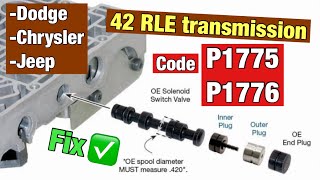
Typical fix: Replace the entire transmission valve body with a remanufactured unit that has an oversized, sleeved SSV bore. Alternatively, a transmission shop can use a kit like the Sonnax 92835-21 to ream the original bore and install an oversized valve. 🎬 See how the solenoid switch valve fails and how to fix it.
Est. part cost: $250-$500 for a remanufactured valve body, or $50-$100 for a reaming kit (labor not included). - Failed Transmission Solenoid Pack 🟡 Medium Probability The solenoid pack (also called the solenoid/pressure switch assembly) can fail electrically or mechanically. However, it's more often a misdiagnosis for P1775, or replaced as part of the larger valve body job.
How to confirm: A diagnostic scan tool can sometimes actuate the solenoids. Resistance checks can be performed on the solenoid terminals, but this won't detect a mechanical issue within the valve body. The resistance for the individual solenoids should be between 1-3 Ohms.
Typical fix: Replace the solenoid pack. This is almost always done at the same time as the valve body replacement. A period-correct Mopar part number was 4659783AB, though it has been superseded.
Est. part cost: $150-$300 - Low or Degraded Transmission Fluid (ATF) ⚪ Low Probability Old, burnt, or low fluid can cause poor hydraulic pressure and varnish buildup, contributing to sticky valves. While rarely the sole cause, it can accelerate the primary valve body wear.
How to confirm: Check the transmission fluid dipstick. The fluid should be at the correct level, pink/red in color, and not smell burnt. Dark, brown, or glittery fluid indicates a more severe internal problem.
Typical fix: Perform a transmission fluid and filter change. This is rarely a fix on its own but is a critical part of replacing the valve body or solenoid pack.
Est. part cost: $50-$100 for fluid and filter
Rare But Worth Checking
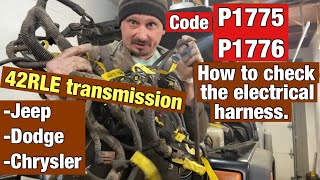
- Wiring Harness Issue: The wiring to the transmission solenoid connector can become corroded or damaged, leading to intermittent signals. A visual inspection of the harness and checking for good ground connections is warranted. 🎬 Watch: How to properly test the transmission electrical harness.
- Faulty Powertrain Control Module (PCM): In very rare cases, the transmission control circuits within the PCM can fail. This should only be considered after all other possibilities have been exhausted. Some later model Chrysler vehicles had TSBs for a PCM reflash to fix this code, but this is unlikely for this early generation.
Diagnosis Steps
- Verify the code with an OBD-II scanner. Confirm P1775 is present, often with P0700.
- Check the transmission fluid level and condition. If the fluid is black, burnt, or contains metal shavings, a transmission rebuild is likely needed.
- Note the primary symptom. A harsh clunk when stopping almost certainly points to the P1775-related valve body issue.
- Given the high probability on this specific vehicle, the next step is to plan for a valve body and solenoid pack replacement.
- Drop the transmission pan.
- Disconnect and remove the transmission filter, solenoid pack, and valve body assembly.
- Inspect the old valve body's solenoid switch valve bore for scoring or a visible wear ridge. This confirms the diagnosis.
- Install the new or remanufactured valve body and a new solenoid pack.
- Install a new transmission filter and reinstall the pan with a new gasket.
- Refill the transmission with the correct type of fluid (Chrysler ATF+4 is typically specified).
- Clear the trouble codes and perform a test drive, specifically checking for smooth downshifts to a stop.
Parts You'll Likely Need
- Transmission Valve Body — This is the primary point of failure due to the worn internal bore for the Solenoid Switch Valve.
Trusted brands: Sonnax (for rebuild components like kit 92835-21), Transtar, Whatever remanufactured brand your transmission shop trusts.
OEM price range: N/A (Typically replaced with remanufactured)
Aftermarket price range: $250-$500 (Remanufactured) - Transmission Solenoid Pack / Assembly
(OEM #4659783AB (superseded))— It is best practice to replace this assembly along with the valve body, as it can also be faulty or fail soon after.
Trusted brands: Mopar, Standard Motor Products (SMP), ATP Automotive
OEM price range: $250-$400
Aftermarket price range: $150-$300 - Transmission Filter and Pan Gasket Kit — Required for any service that involves dropping the transmission pan.
Trusted brands: Mopar, ATP Automotive, Wix
OEM price range: $30-$50
Aftermarket price range: $15-$30 - Chrysler ATF+4 Transmission Fluid — This is the specified fluid for this transmission. Using the wrong fluid can cause shifting problems.
Trusted brands: Mopar, Valvoline, Castrol
OEM price range: $10-$15 per quart
Aftermarket price range: $7-$12 per quart
Related Codes That Often Appear With This One
- P0700 — This is a generic Transmission Control System Malfunction code. It's an informational code that simply tells you the PCM has stored a more specific transmission-related code, like P1775.
- P0841 — This code relates to the L/R (Low/Reverse) Pressure Switch Rationality. Since the P1775 involves the valve that controls L/R clutch pressure, these codes are often seen together as they point to the same faulty circuit.
- P1776 — This code, 'Solenoid Switch Valve Latched in LR Position,' points to the same Solenoid Switch Valve but stuck in the opposite direction. Seeing P1775 and P1776 together strongly points to a mechanical failure of the valve or its bore within the valve body.
Technical Service Bulletins (TSBs) & Recalls
- No specific TSB for P1775 on the 1993-1997 Eagle Vision was found. However, Chrysler has issued TSBs for newer vehicles with different transmissions (e.g., TSB 18-043-17) that address P1775 with a PCM software update, indicating the persistence of this fault code in the manufacturer's ecosystem.
Platform-Specific Known Issues
- High-mileage A606/42LE transmissions are highly susceptible to wear in the solenoid switch valve bore, making P1775 a very common code for this platform.
- The issue is so well-known that aftermarket companies like Sonnax have developed specific oversized valve kits to ream and repair the worn valve body, which is often preferred over sourcing a potentially equally worn used part.
Mechanic-Grade Diagnostic Values
- Transmission Solenoid Resistance — expected: 1.0 - 3.0 Ohms (cold or hot). Failure: An infinite reading indicates an open circuit in the solenoid. A reading outside the specified range suggests a faulty solenoid.
- L/R, 2/4, and OD Pressure Switch Resistance — expected: ~299 Ohms. Failure: A significant deviation from this value indicates a faulty pressure switch within the solenoid pack assembly.
Scan Tool Commands That Help
- Chrysler DRB II / DRB III: Read DTCs, 1 Trip Failures or Freeze Frame, Clear DTCs — The dealer-level DRB scan tool can read specific transmission fault data and one-trip failures that generic OBD-II scanners might miss. It can also be used to perform transmission-specific tests. For this vehicle range, a DRB III with a SuperCard2 (1994-1997) would be required.
- Chrysler DRB III: Quick Learn Procedure — After replacing the valve body or solenoid pack, a Quick Learn procedure should be attempted to reset adaptive values. However, if the P1775 fault is active due to the mechanical bore wear, the procedure will likely fail to complete, as reported by some owners.
Wiring & Ground Locations
- Powertrain Control Module (PCM) — In the engine compartment, on the driver's side, underneath a plastic cover next to the battery.. The PCM contains the transmission control logic for this vehicle. All sensor inputs and solenoid outputs are routed to and from this module. Verifying its connections and grounds is a key step in diagnosing electrical faults.
- Transmission Solenoid Connector — On the front of the transmission case, accessible from underneath the vehicle. It is a 10-way connector on the 42LE.. This is the main electrical interface to the transmission. Testing for resistance and voltage at this connector's pins can diagnose the solenoid pack and wiring harness without dropping the transmission pan. Pin 3 is the +12V input from the EATX relay.
- Chassis/Engine Ground Straps — Key grounds are typically located from the battery negative terminal to the chassis and from the chassis to the engine block or transmission case.. A corroded or broken ground strap can cause a wide range of electrical issues, including erratic sensor readings and improper solenoid function, potentially leading to transmission fault codes. Ensuring clean, tight ground connections is a fundamental diagnostic step.
Real Owner Repair Stories
- 2CarPros.com forum user (2003 Chrysler Concorde (same LH platform and 42LE transmission)) — Initially had codes P0841 and P0700 with trouble shifting from 2nd to 3rd. After a fix, developed a new symptom: a harsh jerk when stopping below 5 MPH and a new code, P1775.
❌ Tried (didn't work) Replacing the solenoid pack with new ATF+4 fluid and filter.
✅ What actually fixed it The user was advised by a technician on the forum that the new P1775 code after replacing the solenoid pack pointed directly to a worn valve body. The recommended and correct fix was to replace the valve body with a rebuilt unit. This story is a textbook example of the common misdiagnosis.
OEM Part Supersession History
4539766→4659783AB (and likely others since)— Part updates and revisions over the production life of the transmission.
Heads up: The solenoid unit had a low service life before 1999 and was subsequently modernized. Using an early-style pack in a later transmission (or vice-versa) may cause issues, though the primary P1775 failure is mechanical in the valve body, not electronic in the pack.
Model Year Variations Within This Range
- 1993-1997: The A606/42LE transmissions in this early generation are Non-VLP (Variable Line Pressure). Later versions of the related 42RLE (starting in 2007) became VLP. This is important because diagnostic procedures and some internal valve body components differ between VLP and non-VLP models. For this Eagle Vision, non-VLP specific parts and procedures apply.
- 1993 vs 1994-1997: For 1993 models, a DRB II scan tool with SuperCard1 is needed. For 1994-1997 models, a DRB III with SuperCard2 is the correct dealer tool. This affects the ability to perform advanced diagnostics.
Diagnostic Flowchart
Other Known Issues on This Vehicle
Issues unrelated to this code that are worth knowing about as an owner of this generation:
- Premature Water Pump Failure 🔴 High — Commonly occurs between 50,000 and 100,000 miles. Since the water pump is driven by the timing belt, a pump failure can cause the belt to break, risking catastrophic engine damage.
- Front Suspension Noise and Wear 🟠 Medium — Worn sway bar bushings, end links, and lower arm ball joints are common, causing clunking or rattling noises over bumps.
- Sticky or Notchy Steering 🟠 Medium — Owners report a 'sticking' or 'notchy' feeling in the steering, especially at the center position. This can be caused by a worn steering rack, failing power steering pump, or a bad bearing in the steering column.
- A/C System Malfunctions 🟡 Low — Complaints include refrigerant leaks, compressor failures, and musty odors from the vents.
Used vs. New Parts: Buying Guide for This Vehicle
When a used part is the smart pick: For this specific P1775 repair, buying a used valve body or solenoid pack from a junkyard is NOT recommended. The primary cause of the code is a wear item (the valve body bore), and a used part is highly likely to have the same wear or fail soon after installation.
Donor-vehicle mileage cap: roughly under 80000 miles for the part to have meaningful remaining life.
What to inspect on the donor part:
- If forced to consider a used valve body, source it from the lowest-mileage donor vehicle possible.
- Avoid parts from vehicles that show signs of poor maintenance or have dark, burnt transmission fluid.
- There is no reliable way to visually inspect for the microscopic wear in the solenoid switch valve bore without disassembly and measurement, making any used purchase a significant gamble.
OEM-only on this vehicle (don't cheap out):
- While not strictly 'OEM-only', using a high-quality remanufactured valve body with an oversized, sleeved Sonnax valve is the industry-standard best practice and is superior to a new old stock (NOS) OEM part which would still have the original aluminum bore design prone to wear.
Aftermarket brands forum-validated for this vehicle:
- Sonnax: For valve body rebuild kits (like 92835-21 or 92835-32K depending on valve diameter) and oversized valves. They are the leading name in solving this specific problem.
- Mopar: For a replacement solenoid pack, if needed, though quality aftermarket brands are also acceptable.
- Valvoline, Castrol: For ATF+4 fluid, as they are licensed and meet the MS-9602 specification.
Brands owners have reported issues with on this vehicle:
- Avoid unbranded, 'white-box' solenoid packs from online marketplaces, as their quality control can be highly inconsistent.
Real Owner Stories
Aggregated from forums and TSBs cited above. Mileages and costs reflect what owners reported in those sources.
2000 Dodge Grand Caravan
Symptoms: A rough 2-1 downshift described as a 'clunking' when coming to a stop, which triggered fault code P1775.
What fixed it: A tech moderator confirmed the proper fix is to 'Replace the valve body'.
Source hint: DodgeForum.com: '2-1 rough downshift, fault code P1775...'
2003 Chrysler Concorde
Symptoms: After replacing the solenoid pack to fix a P0841 code, the vehicle began to jerk harshly when coming to a stop and set code P1775.
What fixed it: This case illustrates a common misdiagnosis. Replacing the solenoid pack did not fix the root cause, which was the underlying valve body wear, leading to the new P1775 code.
Source hint: 2CarPros.com: '2003 Chrysler Concorde Code P1775, Jerks When Coming to a Stop'
Related OBD-II Codes
Frequently Asked Questions
My Eagle Vision has a harsh clunk when I slow to a stop. Is this the common P1775 issue?
I have a P1775 code. Should I just replace the transmission solenoid pack?
What is the recommended fix for the P1775 valve body problem on my 1993-1997 Vision?
Are there any official TSBs from Chrysler for the P1775 code on my Eagle Vision?
My mechanic wants to test the solenoids. What should the resistance be?
I have a 1995 Dodge Intrepid with the same symptoms. Does this information apply?
What kind of transmission fluid should I use after replacing the valve body?
Helpful Videos
We Have This Part in Stock

The information in this article is provided for general reference and educational purposes only. Vehicle specifications, procedures, and part compatibility can vary by production date, trim level, and region. Always consult your vehicle's factory service manual and verify part numbers before purchasing or performing repairs. Safety-critical components such as airbags, seat belts, and braking systems should be installed by a qualified professional.
- Eagle Vision:
- 🎬 Helpful Videos
- 🛍️ Shop This Part
- What's Unique About the 1993-1997 Eagle Vision
- Symptoms You May Notice
- Most Likely Causes
- Rare But Worth Checking
- Diagnosis Steps
- Parts You'll Likely Need
- Related Codes That Often Appear With This One
- Technical Service Bulletins (TSBs) & Recalls
- Platform-Specific Known Issues
- Mechanic-Grade Diagnostic Values
- Scan Tool Commands That Help
- Wiring & Ground Locations
- Real Owner Repair Stories
- OEM Part Supersession History
- Model Year Variations Within This Range
- Diagnostic Flowchart
- Other Known Issues on This Vehicle
- Used vs. New Parts: Buying Guide for This Vehicle
- Real Owner Stories
- 2000 Dodge Grand Caravan
- 2003 Chrysler Concorde
- Related OBD-II Codes
- Frequently Asked Questions
- 🎟️ Get 5% Off