

P1629 on 1999-2007 GMC Sierra: Theft System No-Start Causes and Fixes
This code means the truck's anti-theft system is preventing it from starting. The most common cause is a faulty ignition lock cylinder, which contains the Passlock security sensor. Expect to pay $50-$150 for the part, with a DIY difficulty of 3/5.
- P1629 means your truck thinks it's being stolen and has shut off the fuel.
- Before buying parts, always try the 30-minute security relearn procedure first, as it can fix software glitches for free.
- The most likely failed part is the ignition lock housing (ACDelco D1403G), which contains the Passlock sensor. The second most likely cause is one of the three small wires breaking inside the steering column.
- This is a very common problem on all GMT800 platform trucks, including the Chevy Silverado, Tahoe, and Suburban.
What's Unique About the 1999-2007 GMC Sierra
The 1999-2007 Sierra uses GM's Passlock II anti-theft system. Unlike later systems with a transponder chip in the key, Passlock uses a sensor in the ignition lock cylinder housing to detect the rotation of the key. This design's primary weakness is the durability of that sensor and its associated wiring in the steering column. Over time, wear from normal use causes these components to fail, leading to the P1629 code and a no-start condition 🎬 Watch: Diagnostic steps for GM truck Passlock no-start issues, a very common complaint among owners of these trucks.
Generation note: This range covers the first-generation GMC Sierra (GMT800 platform). The 2007 model year was an overlap, with the GMT800 being sold as the 'Sierra Classic' alongside the new GMT900 generation. The information here primarily applies to the GMT800 models, which are most associated with this specific Passlock system issue.
Symptoms You May Notice
- Engine cranks but will not start
- Engine starts and immediately stalls (within 1-2 seconds)
- Flashing or steadily illuminated 'Security' light on the instrument cluster
- No sound from the fuel pump when the key is turned to 'ON'
- Replacing the fuel pump. The fuel pump is intentionally disabled by the security system; it is usually not the root cause of the problem.
- Replacing the starter. The engine cranks, which means the starter is working. The problem is a lack of fuel, not a failure to crank.
- Replacing the Powertrain Control Module (PCM). While possible, PCM failure is much rarer than a failure of the Passlock sensor, wiring, or BCM.
Most Likely Causes
- Faulty Ignition Lock Cylinder / Housing 🔴 High Probability The Passlock sensor is integrated into the lock cylinder housing. After thousands of key cycles, the internal contacts and sensor components wear out, failing to send the correct resistance value to the BCM.
How to confirm: After ruling out simpler fixes like the relearn procedure, this becomes the most likely cause. If wiggling the key in the ignition sometimes allows the truck to start, it strongly points to a worn lock cylinder or housing. The issue is with the housing that contains the sensor, not the key tumbler itself.
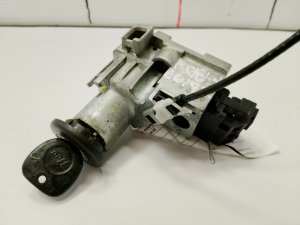
Typical fix: Replace the ignition lock cylinder housing (which includes the Passlock sensor) and perform the 30-minute security relearn procedure. The OEM part is ACDelco D1403G (GM 15795322).
Est. part cost: $50-$150 - Broken or Damaged Wiring at Ignition Switch 🟡 Medium Probability The three small-gauge wires (typically yellow, black, and white or orange) that connect the Passlock sensor to the main harness run down the steering column. Years of tilting the steering wheel can cause these wires to fatigue and break internally, often right at the connector or where they flex.
How to confirm: Remove the steering column shrouds and visually inspect the small yellow, black, and white/orange wires coming from the ignition lock cylinder. Gently tug on them to check for breaks inside the insulation. Check for a loose connector where these wires plug in. A multimeter can be used to check for continuity through these wires while wiggling them.
Typical fix: Repair the broken wire(s) by soldering and heat-shrinking, or replace the pigtail connector. In some cases, simply securing a loose connector or adding dielectric grease can solve the problem.
Est. part cost: $0-$20 - Security System Glitch / Loss of Synchronization ⚪ Low Probability Low battery voltage during cranking, jump-starting, or replacing the battery can sometimes cause the BCM and PCM to lose their security synchronization.
How to confirm: This is confirmed by successfully starting the vehicle after performing the security relearn procedure without replacing any parts.
Typical fix: Perform the 30-minute security relearn procedure.
Est. part cost: $0 - Faulty Body Control Module (BCM) ⚪ Low Probability While less common than sensor or wiring failure, the BCM itself can fail internally. Symptoms often extend beyond just the P1629 code and can include erratic behavior of lights, door locks, windows, or a parasitic battery drain that kills the battery overnight.
How to confirm: This is typically diagnosed by exclusion. If the ignition lock cylinder, wiring, and relearn procedure have all been addressed and the problem persists, the BCM is the next suspect. A professional scan tool is needed to check for BCM-specific communication errors (U-codes) and to monitor data streams.
Typical fix: Replace the Body Control Module. This new module MUST be programmed to the vehicle's VIN by a dealer or a well-equipped independent shop.
Est. part cost: $200-$400
Diagnosis Steps
- Check the Battery: Ensure the battery has a full charge (at least 12.4 volts). Low voltage is a known cause of GM electronic module communication errors. Charge or replace the battery if necessary.
- Try the Spare Key: If you have one, try the spare key. While the key itself isn't chipped, a worn key can affect the lock cylinder's mechanics, potentially influencing the Passlock sensor's reading.
- Perform the 30-Minute Security Relearn: This procedure can often resolve temporary glitches. Turn the key to 'ON' (don't start). The 'Security' light will be on. Wait about 10 minutes until the light goes out. Turn the key 'OFF' for 5 seconds. Repeat this process two more times for a total of three 10-minute cycles. After the third cycle, the system should be relearned. Try to start the truck.
- Inspect Ignition Wiring: Remove the plastic shrouds around the steering column. Locate the thin wires (usually a set of three: yellow, black, and white/orange) coming from the back of the ignition lock cylinder. Inspect for any signs of damage, chafing, or loose connections. Gently tug each wire to check for internal breaks.
- Test/Replace the Ignition Lock Cylinder Housing: If the relearn fails and the wiring appears intact, the ignition lock cylinder housing containing the Passlock sensor is the most likely failed component. Replacement is the most effective repair.
- Check BCM and Fuses: Inspect fuses related to the BCM and theft deterrent system in the interior and under-hood fuse panels. If all else fails, the BCM may be faulty, which typically requires professional diagnosis and programming.
Parts You'll Likely Need
- Ignition Lock Cylinder Housing with Passlock Sensor
(OEM #ACDelco D1403G (GM 15795322))— This is the most common failure point for the P1629 code on this platform. The integrated Passlock sensor wears out over time.
Trusted brands: ACDelco (OEM), Dorman (e.g., 924-719), Standard Motor Products
OEM price range: $100-$180
Aftermarket price range: $50-$120
Related Codes That Often Appear With This One
- B2960 — This code means 'Security System Sensor Data Incorrect but Valid'. It often appears with P1629 and points directly to a problem with the Passlock sensor in the ignition lock cylinder housing.
- U-series codes (e.g., U0140) — Communication codes (U-codes) indicate a network problem. If you see these alongside P1629, it strongly suggests the issue is related to wiring or a faulty module (like the BCM) rather than just the ignition sensor.
Technical Service Bulletins (TSBs) & Recalls
- While no specific TSB for P1629 was found in the search, TSB PIC5460B is noted for later models (2004-2009) and points to wiring issues near the ECM as a potential cause for no-crank conditions, which is relevant context.
Mechanic-Grade Diagnostic Values
- Passlock Sensor Resistance (for bypass) — expected: Varies per vehicle; can be up to 14,000 Ohms (14kΩ). Must be measured from the specific vehicle.. Failure: An open circuit (infinite resistance) or a value that is unstable when wiggling the key indicates a failed sensor. The BCM expects a value within a tight tolerance (typically +/- 5-10%) of the learned value.
- Passlock Sensor Wires Voltage Check — expected: With key ON, one wire (typically Orange/Black) should have ~5V reference from the BCM. Another (Black) should be ground. The third (Yellow) is the signal wire, which sends a specific voltage back to the BCM based on the sensor's resistance.. Failure: Missing 5V reference or ground indicates a wiring or BCM issue, not a sensor failure. An incorrect or fluctuating voltage on the signal wire points to a bad sensor.
Scan Tool Commands That Help
- GM Tech 2: BCM Data Display -> Passlock Data — To view the live voltage or state the BCM is receiving from the Passlock sensor without cutting wires. This is the primary professional diagnostic step to confirm if the sensor signal is the root cause.
- GM Tech 2: Special Functions -> Security Relearn — To initiate the security system relearn process after replacing a component like the ignition lock housing or BCM. This is faster than the 30-minute manual procedure.
- GM Tech 2 with SPS: BCM Programming — This is mandatory when replacing the Body Control Module (BCM). The new module must be programmed with the vehicle's VIN and configuration before it will function correctly.
Wiring & Ground Locations
- Passlock Sensor Wires — A small 3-wire connector attached to the ignition lock cylinder housing, inside the steering column shrouds.. These wires (typically Yellow, Orange/Black, Black) are the direct communication line from the sensor to the BCM. They are a common failure point due to flexing and breaking from tilt-steering use.
- G203 — Under the top of the instrument panel, near the base of the driver's side A-pillar where it meets the firewall.. This is a primary ground point for the Body Control Module (BCM). A poor connection at G203 can cause the BCM to malfunction, leading to P1629 and other bizarre electrical issues.
- Main Engine/Frame Grounds — Key locations include a strap from the passenger-side cylinder head to the firewall, and a ground point on the frame rail below the driver's door.. While not a direct cause, poor overall vehicle grounding can lead to voltage drops and communication errors between modules (BCM, PCM), which can trigger a false security event. Cleaning these grounds is a best practice for any electrical diagnosis on a GMT800.
Real Owner Repair Stories
- GM-Trucks.com forum user (1999 Chevy Silverado) — Engine starts and dies after a couple of seconds. No security light illuminated.
❌ Tried (didn't work) 30-minute relearn procedure.
✅ What actually fixed it The user noted this exact issue had happened before and was fixed by replacing the ignition switch and cylinder. They also confirmed fuel pressure was good, correctly ruling out the fuel pump as the cause.
OEM Part Supersession History
26085516, 26108340, 89060589, 19149941→15795322 (ACDelco D1403G)— Part has been revised and consolidated by GM over the years to improve reliability or for manufacturing changes.
Model Year Variations Within This Range
- 1999-2007 ('Classic'): The GMT800 platform consistently uses the Passlock II system, which does not have a chip or resistor in the key itself. This is distinct from the earlier VATS system and the later Passkey 3 (PK3) system found on GMT900 trucks. The diagnostic and repair process is largely identical across this entire generation.
Diagnostic Flowchart
Other Known Issues on This Vehicle
Issues unrelated to this code that are worth knowing about as an owner of this generation:
- Instrument Cluster Gauge Stepper Motor Failure 🟠 Medium — Extremely common, typically occurring around 80,000-120,000 miles. Affects speedometer, tachometer, fuel, and other gauges, causing them to stick, read incorrectly, or fail completely. (Ref: GM extended warranty coverage for some models, but most are now beyond the time/mileage limit. The fix involves replacing the individual stepper motors (part X27.168) on the cluster's circuit board.)
- Rusted/Failed Brake Lines 🔴 High — Very common in regions that use road salt. The factory steel brake lines are prone to severe corrosion, which can lead to a sudden loss of brake fluid and a dangerous reduction in braking ability. (Ref: NHTSA investigated the issue for 1999-2003 models, but no full recall was issued. The recommended fix is to replace all original lines with corrosion-resistant stainless steel or copper-nickel lines.)
- 4L60E Automatic Transmission Failures 🔴 High — Common in 1500 models, with failures often occurring between 100,000 and 150,000 miles. Known weak points include the 3-4 clutch pack, the reaction sun shell, and the TCC regulator valve.
- HVAC Blend Door/Mode Door Actuator Failure 🟡 Low — A very common annoyance where the small plastic gears in the actuators fail, causing clicking noises from the dash and an inability to control air temperature or direction.
- Intermediate Steering Shaft Clunk 🟡 Low — A clunking or popping sound/feel from the steering column, most noticeable at low speeds. Caused by a lack of lubrication in the splined slip-joint of the intermediate shaft. The fix is often a temporary re-greasing or a more permanent replacement with an updated part.
Used vs. New Parts: Buying Guide for This Vehicle
When a used part is the smart pick: A used Body Control Module (BCM) from a junkyard can be a viable, cost-saving option, but it absolutely requires professional reprogramming to the truck's VIN to function. Other unrelated electrical components like window switches or radios are also good candidates for used parts.
Donor-vehicle mileage cap: roughly under 150000 miles for the part to have meaningful remaining life.
What to inspect on the donor part:
- For a BCM, check for zero corrosion on the connectors.
- Ensure the donor vehicle is the same model year and has identical major options (engine, transmission, 4WD).
- Avoid parts from vehicles with obvious signs of flood or fire damage.
OEM-only on this vehicle (don't cheap out):
- Ignition Lock Cylinder Housing (with Passlock Sensor): This is a high-wear item. Aftermarket versions are known to fail prematurely or have incorrect resistance values out of the box, leading to a repeat of the P1629 code. Sticking with the ACDelco Genuine GM part is strongly advised for this specific component.
Aftermarket brands forum-validated for this vehicle:
- Standard Motor Products (SMP) is a reputable brand for general automotive electronics if an OEM part is unavailable.
Brands owners have reported issues with on this vehicle:
- Unbranded, low-cost ignition lock housings from online marketplaces are frequently reported on forums to be unreliable and a waste of time and money.
Real Owner Stories
Aggregated from forums and TSBs cited above. Mileages and costs reflect what owners reported in those sources.
2005 GMC Sierra 1500
Symptoms: Vehicle would crank but fail to start, or would start for a second and then immediately stall. The 'Security' light was illuminated on the dash.
What fixed it: The problem was resolved by replacing the ignition lock housing, which contains the Passlock sensor, and then performing the 30-minute security relearn procedure.
Source hint: GM-Trucks.com
Related OBD-II Codes
Frequently Asked Questions
My 2004 Sierra cranks but won't start and the 'Security' light is flashing. Is this the Passlock system?
I just replaced the battery in my truck and now it won't start. What's the first thing I should try for a P1629?
I need to fix the P1629 code on my Sierra. What is the exact part that usually fails in the ignition?
After I install a new ignition lock cylinder housing, does it need to be programmed by a dealer?
The 30-minute relearn didn't fix my P1629 code. What's the next most likely cause on these trucks?
My truck has P1629, but also has a parasitic battery drain and the power windows act weird. Are these related?
Does this P1629 Passlock issue also happen on the Chevy Silverado or Tahoe?
Helpful Videos
We Have This Part in Stock


The information in this article is provided for general reference and educational purposes only. Vehicle specifications, procedures, and part compatibility can vary by production date, trim level, and region. Always consult your vehicle's factory service manual and verify part numbers before purchasing or performing repairs. Safety-critical components such as airbags, seat belts, and braking systems should be installed by a qualified professional.
- GMC Sierra:
- 🎬 Helpful Videos
- 🛍️ Shop This Part
- What's Unique About the 1999-2007 GMC Sierra
- Symptoms You May Notice
- Most Likely Causes
- Diagnosis Steps
- Parts You'll Likely Need
- Related Codes That Often Appear With This One
- Technical Service Bulletins (TSBs) & Recalls
- Mechanic-Grade Diagnostic Values
- Scan Tool Commands That Help
- Wiring & Ground Locations
- Real Owner Repair Stories
- OEM Part Supersession History
- Model Year Variations Within This Range
- Diagnostic Flowchart
- Other Known Issues on This Vehicle
- Used vs. New Parts: Buying Guide for This Vehicle
- Real Owner Stories
- 2005 GMC Sierra 1500
- Related OBD-II Codes
- Frequently Asked Questions
- 🎟️ Get 5% Off