

P1450 on 2015-2024 Ford Mustang 2.3L: "Unable to Bleed Up Fuel Tank Vacuum" Causes and Fixes
On a 2015-2024 Mustang 2.3L EcoBoost, code P1450 is almost always caused by a faulty canister purge valve that is stuck open. This is a simple and affordable DIY fix, with the updated OEM part costing between $40 and $90. Symptoms often include a rough start or stalling immediately after refueling.
- P1450 means the EVAP system can't get rid of the vacuum in the fuel tank.
- For the 2015-2024 Mustang 2.3L, the problem is almost certainly a bad canister purge valve.
- A key symptom is trouble starting the car right after you get gas.
- You can test the purge valve in minutes with no special tools: if it's sucking air while the engine runs, it's bad.
- Replacing the purge valve is a very easy and cheap DIY job that usually takes less than 30 minutes.
What's Unique About the 2015-2024 Ford Mustang
The S550 generation Mustang, particularly the 2.3L EcoBoost model, has a widely documented issue with the canister purge valve failing and sticking open. This failure is so common that Ford issued a Technical Service Bulletin (TSB 17-0019) specifically for the 2017 Mustang 2.3L, identifying the canister purge valve as the primary culprit for P1450. This makes diagnosis on this platform more straightforward than on other vehicles. Owner forums like Mustang6G.com are filled with threads confirming this exact failure and fix.
Generation note: The 2015-2024 year range covers the entire S550 generation of the Ford Mustang. The causes and fixes for P1450 are consistent across this generation for the 2.3L EcoBoost engine, as well as the V6 and 5.0L V8 models which use a similar EVAP system layout.
Symptoms You May Notice
- Check Engine Light is on
- Difficulty starting the engine, especially after filling the gas tank
- Rough or unstable idle immediately after refueling
- Engine stalling after a fill-up
- Slightly reduced fuel economy
- A whooshing sound from the gas tank when opening the cap due to vacuum
- May be accompanied by codes P0456 (small leak) or P144C (purge valve performance)
- Replacing the gas cap. While a loose gas cap can cause other EVAP codes (like P0455 or P0457), it does not cause P1450. The Mustang's capless fuel filler system can sometimes be a factor if the seal is dirty or faulty, but the purge valve is far more likely to be the culprit.
Most Likely Causes
- Stuck or Leaking Canister Purge Valve 🔴 High Probability This is a very common failure point on many Ford vehicles, including the Mustang. The valve gets stuck in the open position, allowing constant, un-commanded engine vacuum to pull on the fuel tank. Ford issued TSB 17-0019 for the 2017 2.3L model, which explicitly calls for replacing this valve to fix code P1450.
How to confirm: With the engine running, disconnect the EVAP hose from the purge valve. Place your finger over the port on the valve itself. If you feel any suction, the valve is stuck open and must be replaced. A healthy, de-energized purge valve is normally closed and should allow no vacuum to pass.
Typical fix: Replace the canister purge valve assembly. This is a straightforward 15-minute job involving disconnecting two hoses and an electrical connector, and removing one or two bolts.
Est. part cost: $40-$90 - Blocked or Kinked EVAP Vent Hose 🟡 Medium Probability Hoses can become clogged with dirt or debris, or get pinched during other repairs. A Ford TSB for the Transit van (TSB 21-2106) notes a kinked vent line as a cause for P1450, indicating it's a known issue in Ford EVAP system designs. [TSB 21-2106]
How to confirm: Visually inspect all EVAP lines running from the engine bay to the charcoal canister near the fuel tank. Look for any obvious kinks, collapses, or damage. A professional smoke test can also be used to find blockages.
Typical fix: Straighten the kinked hose or replace the damaged/clogged section of the line.
Est. part cost: $15-$50 - Faulty Canister Vent Solenoid ⚪ Low Probability The vent solenoid, located near the charcoal canister, is normally open to allow fresh air into the system to bleed off vacuum. If it gets stuck closed, the vacuum cannot be released, triggering the P1450 code. This is less common than the purge valve failure.
How to confirm: Using a capable scan tool, command the vent solenoid to open and close. You should hear a clicking sound. You can also apply 12V directly to the solenoid to test its function.
Typical fix: Replace the canister vent solenoid, which is usually located on or near the charcoal canister by the fuel tank.
Est. part cost: $30-$70
Rare But Worth Checking
- Faulty Fuel Tank Pressure (FTP) Sensor: The sensor could be sending incorrect vacuum level data to the PCM. However, this is unlikely to be the cause unless all other EVAP components have been tested and confirmed working. One owner complaint noted that replacing this part did NOT fix the issue, suggesting it's less common. [ODI #11321251]
- Clogged Charcoal Canister: This can happen if you habitually overfill your gas tank ('topping off'). Liquid fuel can saturate the charcoal pellets, turning the canister into a blockage that prevents the system from bleeding vacuum. This is an expensive part, so it should be the last thing to check.
Diagnosis Steps
- Read the code with an OBD-II scanner to confirm P1450 is present.
- Check for any accompanying codes like P0456 or P144C, which further point to the purge valve.
- Locate the canister purge valve on the 2.3L engine. It's mounted on the driver's side of the engine, under the plastic engine cover, with two hoses and one electrical connector.
- Start the engine and let it idle.
- Disconnect the EVAP hose that runs from the purge valve toward the rear of the car.
- Place your finger over the port on the valve where the hose was connected. If you feel suction, the valve is stuck open and needs to be replaced. This is the most common failure and confirms the diagnosis.
- If no vacuum is present, the issue may be downstream. Visually inspect the EVAP hoses for any visible kinks, pinches, or damage between the engine and the fuel tank.
- If hoses are clear, the next step would be to test the canister vent solenoid near the fuel tank for proper operation using a scan tool or by applying power.
- As a final step, consider a professional smoke test to check for blockages in the system or test the Fuel Tank Pressure sensor's accuracy.
Parts You'll Likely Need
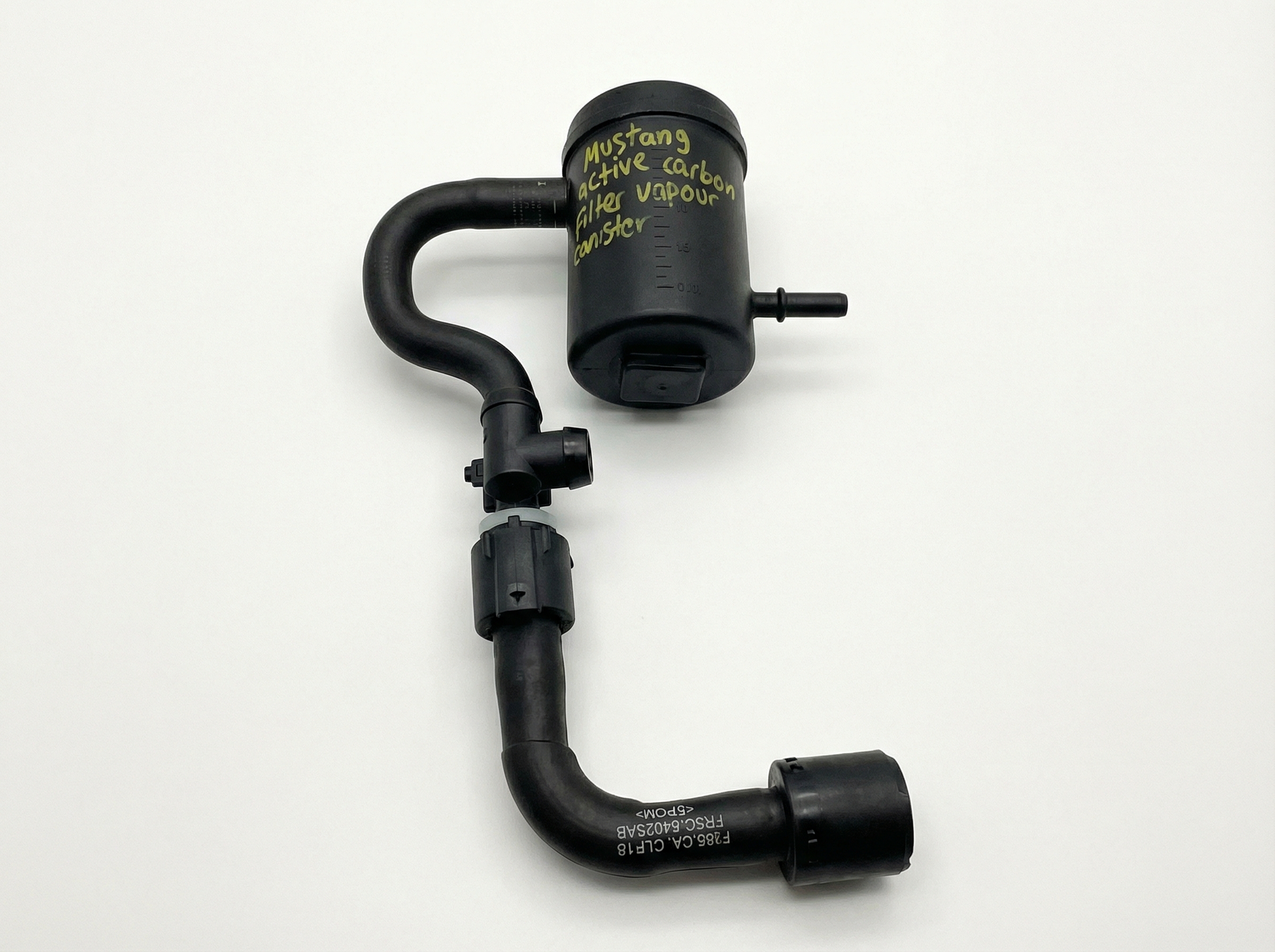
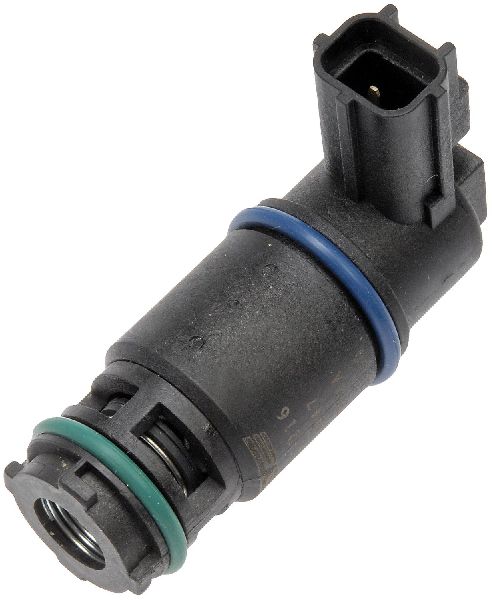
- Canister Purge Valve / Hose Fuel Vapour Assembly
(OEM #FR3Z-9G297-H)— This is the most frequent cause of code P1450 on this vehicle. The original part (ending in -A or -C) is known to fail. The updated part number is FR3Z-9G297-H. This is confirmed by Ford's own Technical Service Bulletin TSB 17-0019.
Trusted brands: Motorcraft (OEM), Dorman, Standard Motor Products
OEM price range: $60-$90
Aftermarket price range: $40-$70
Related Codes That Often Appear With This One
- P0456 — This code indicates a 'very small leak' in the EVAP system. TSB 17-0019 lists P1450 and P0456 together, as a faulty purge valve can cause both conditions.
- P144C — This is another Ford-specific EVAP code for 'Evap Emission System Purge Check Valve Performance'. It is also mentioned in TSB 17-0019 and TSB 17-0051 alongside P1450, as it directly relates to the function of the canister purge valve.
Technical Service Bulletins (TSBs) & Recalls
- TSB 17-0019: For 2017 Mustang 2.3L, instructs technicians to replace the canister purge valve and reprogram the PCM to fix P1450, P0456, and/or P144C.
- TSB 21-2106: While for a Ford Transit, it establishes a precedent for kinked EVAP lines causing a P1450 code within Ford's system design.
- TSB 17-0051: For 2017 Escape/MKC with 2.3L engines, links P1450 with a faulty EVAP canister purge valve.
Platform-Specific Known Issues
- TSB 17-0019 was issued for some 2017 Mustang 2.3L models built on or before January 13, 2017, for codes P1450, P0456, and/or P144C. The official fix is to replace the evaporative emission canister purge valve and reprogram the PCM.
- TSB 17-0051 addresses the same codes (including P1450) for 2017 Escape and Lincoln MKC models with 1.5L, 2.0L, or 2.3L engines, also pointing to the purge valve.
Mechanic-Grade Diagnostic Values
- Fuel Tank Pressure (FTP) Sensor Voltage at atmospheric pressure (engine off, gas cap off) — expected: Approximately 2.4V to 2.8V. Failure: A voltage significantly outside this range may indicate a biased or failed FTP sensor, but this is a rare cause for P1450.
- Canister Purge Valve Solenoid Resistance — expected: Approximately 12 - 18 ohms. Failure: A reading of infinite resistance (open circuit) or zero resistance (short circuit) indicates a failed solenoid coil. However, the typical failure for P1450 is mechanical (stuck open), not electrical.
Scan Tool Commands That Help
- FORScan or professional-grade scan tool (Autel/Launch): Live Data Monitoring of EVAP PIDs — Monitor the 'FTP' (Fuel Tank Pressure), 'EVAP_PCT' (Commanded Purge Valve Duty Cycle), and 'EVAPCV' (Vent Solenoid Commanded State) PIDs. With the engine running and EVAP_PCT at 0%, the FTP should not show a deepening vacuum. If it does, it confirms the purge valve is leaking vacuum when it is commanded closed, pointing to a stuck-open valve.
- Any OBD-II Scanner: Clear Codes / Reset KAM (Keep Alive Memory) — After replacing the purge valve, it is essential to clear the P1450 trouble code. Performing a KAM reset can also be beneficial to clear the old learned fuel trim and EVAP test adaptations, forcing the PCM to relearn with the new, functional hardware.
Wiring & Ground Locations
- Canister Purge Valve Connector — On the purge valve itself, located on the driver's side of the 2.3L engine, under the plastic engine cover.. This is a 2-wire connector. One pin receives power with the ignition in the 'Run' position, and the other is a ground-side switched wire controlled by the PCM. A poor connection or damaged wire here could prevent the valve from operating, but the P1450 code is almost always caused by a mechanically stuck valve, not an electrical fault.
- G108 / Engine-to-Chassis Ground — General location for S550 Mustangs is on the driver's side shock tower, with straps connecting to the engine block.. While a bad ground is not a common cause for P1450, a poor engine ground can cause a wide range of unpredictable electrical issues. If multiple, unrelated codes are present or if electrical components behave erratically, inspecting the main engine-to-chassis ground straps for corrosion or looseness is a valid secondary check.
Real Owner Repair Stories
- Dorman Product Review for a similar Ford model (2014 Ford Fusion with P1450 code) — After filling up with fuel, the car would not start unless the accelerator pedal was held down.
✅ What actually fixed it Replacing the canister purge valve. The owner noted the replacement Dorman part had improved connector clips that were easier to handle than the original Ford part. - Reddit user post (Ford Mustang EcoBoost) — Hard starts and rough idling immediately after refueling.
✅ What actually fixed it Replacing the EVAP Purge Valve with the updated part number, FR3Z-9G297-H, resolved the symptoms. - Mustang6G Forum User (2015 Mustang GT (5.0L, but uses a similar system)) — Check Engine Light with code P1450.
❌ Tried (didn't work) Clearing the code (it returned after 235 miles).
✅ What actually fixed it The user was advised by multiple forum members that this is the most common error code for a failed purge valve on the S550 platform, and replacement is the standard fix.
OEM Part Supersession History
FR3Z-9G297-A→FR3Z-9G297-H— The original part design was prone to mechanical failure, specifically sticking in the open position. The -H revision is the updated, more reliable version.
Model Year Variations Within This Range
- 2015-2024: While TSB 17-0019 specifically calls out 2017 models built before a certain date, the purge valve failure is common across all model years of the S550 generation. The replacement procedure, requiring only 8mm and 10mm sockets to remove the engine cover and valve, is consistent across the entire 2015-2024 range.
Diagnostic Flowchart
Other Known Issues on This Vehicle
Issues unrelated to this code that are worth knowing about as an owner of this generation:
- Engine Failure ('Ecoboom') 🔴 High — More common on earlier 2015-2019 models, often linked to tunes, lugging the engine, or low-quality fuel. A design flaw in the engine block's coolant passages between cylinders is a suspected cause, leading to head gasket failure and coolant intrusion. (Ref: A class-action lawsuit has been filed covering 2015-2024 Mustangs with the 2.3L EcoBoost, alleging Ford was aware of defects causing coolant leaks into the engine cylinders.)
- A/C Evaporator Core Leak 🟠 Medium — A very common issue across the S550 platform (2015-2017 in particular) where the A/C system stops blowing cold air due to a refrigerant leak from the evaporator core inside the dashboard. This is an expensive, labor-intensive repair. (Ref: TSB 18-2256 (superseded by TSB 19-2309) was issued, acknowledging the leak and providing a procedure to replace only the evaporator core instead of the entire climate control housing.)
- Low-Speed Pre-Ignition (LSPI) 🔴 High — A risk in many small-displacement, turbocharged direct-injection engines. It's a premature combustion event at low RPM and high load that can cause catastrophic engine damage. Using high-quality fuel and avoiding 'lugging' the engine can help mitigate risk.
- Turbocharger Wastegate Rattle / Failure 🟡 Low — Over time, the wastegate actuator arm or bushing can wear out, causing a distinct rattle on deceleration or low RPMs. In some cases, it can lead to boost control problems (e.g., code P0299 Turbo Underboost).
Used vs. New Parts: Buying Guide for This Vehicle
When a used part is the smart pick: For this specific repair, buying a used part from a junkyard is strongly discouraged. The original equipment purge valve has a very high rate of failure. A used part is likely to have the same defect or fail soon after installation.
What to inspect on the donor part:
- Not applicable, as a new part is the only recommended path.
OEM-only on this vehicle (don't cheap out):
- While not strictly 'OEM-only', the updated Motorcraft part (FR3Z-9G297-H) is the most proven and reliable fix. If choosing aftermarket, ensure it is a quality brand.
Aftermarket brands forum-validated for this vehicle:
- Dorman: Frequently cited as a viable alternative. Some users report that Dorman's replacement parts feature improved connector clips that are easier to release than the original Ford design.
- Standard Motor Products (SMP): A well-known aftermarket manufacturer that produces a replacement for this valve.
Brands owners have reported issues with on this vehicle:
- No specific brands were consistently cited with negative reviews, but unbranded, low-cost parts from online marketplaces carry a higher risk of premature failure.
Real Owner Stories
Aggregated from forums and TSBs cited above. Mileages and costs reflect what owners reported in those sources.
2016 Mustang GT
Symptoms: Check engine light with code P1450.
What fixed it: Replacing the purge valve.
Cost: $30-$40
Source hint: mustang6g.com: 'P1450 Code - Purge valve'
2015 Mustang 2.3L EcoBoost
Symptoms: Hard start after refueling; the old purge valve was confirmed to be stuck open.
What fixed it: Replacement of the canister purge valve (part FR3Z-9G297-C).
Source hint: mustang6g.com: '2015 Mustang Canister Purge Valve to Resolve P1450'
2023 Mustang
Symptoms: Check engine light P1450 appeared; users identified it as a common, non-urgent issue.
What fixed it: Purge valve replacement.
Source hint: mustang6g.com: 'Help. Check engine light P1450'
2015-2024 Mustang 2.3L EcoBoost
Symptoms: Starting issues and check engine light with codes P144A and P1450.
What fixed it: Replaced the purge valve, which resolved the light and the hard-start after filling the tank.
Source hint: mustang6g.com: 'Starting issue...'
Related OBD-II Codes
Frequently Asked Questions
Does TSB 17-0019 apply to my 2017 Mustang 2.3L EcoBoost?
Why does my Mustang struggle to start only after I fill up the gas tank?
Is the P1450 code related to the 'Ecoboom' engine failure issue mentioned for the 2.3L?
Can I test the purge valve myself before buying a new one?
Where is the canister purge valve located on the Mustang 2.3L EcoBoost engine?
Is P1450 an urgent repair for my Mustang?
Helpful Videos
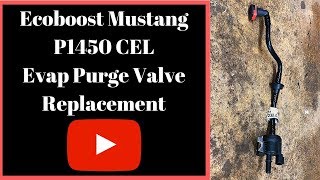


Used OEM Parts in Stock
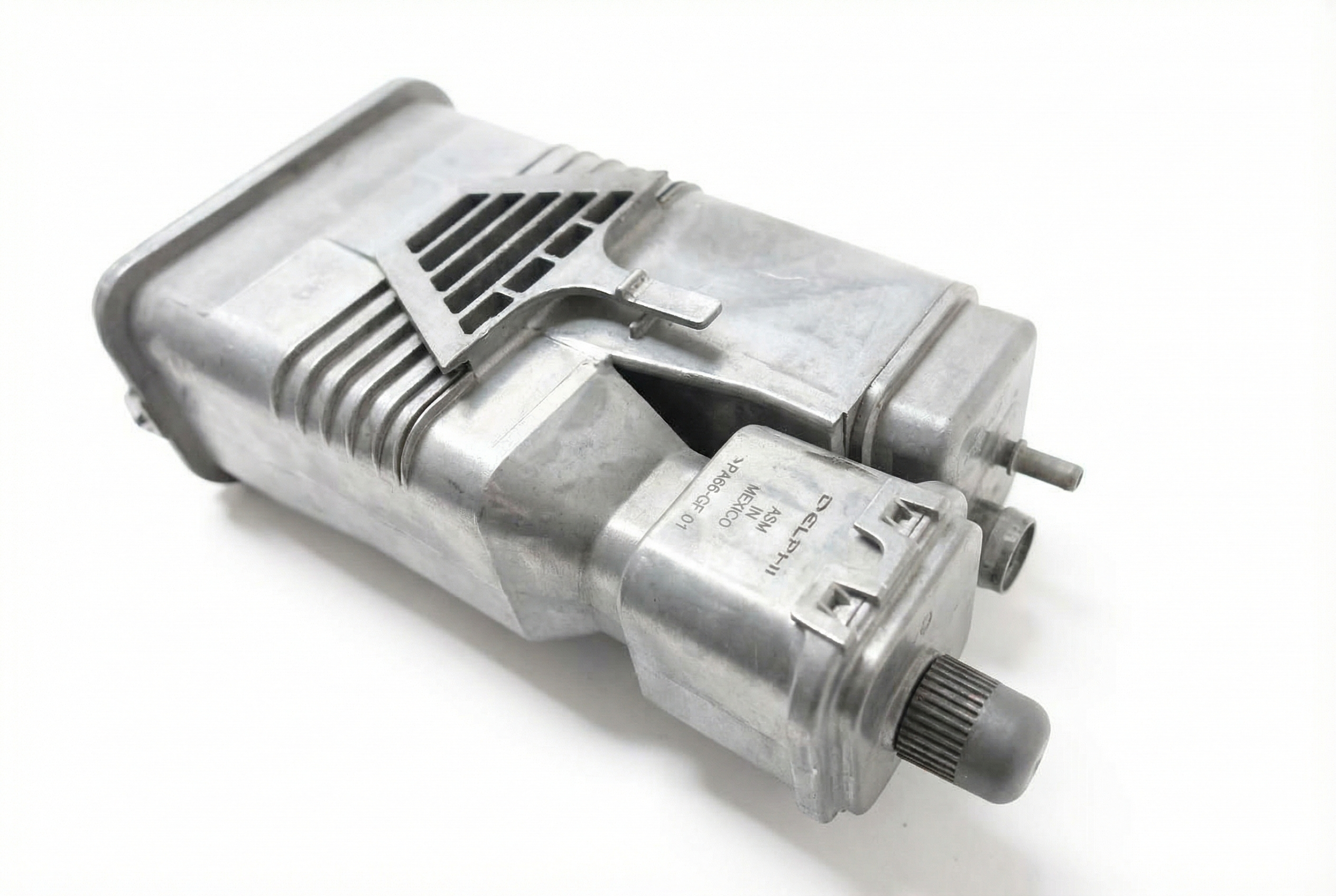
New Aftermarket Parts Available


The information in this article is provided for general reference and educational purposes only. Vehicle specifications, procedures, and part compatibility can vary by production date, trim level, and region. Always consult your vehicle's factory service manual and verify part numbers before purchasing or performing repairs. Safety-critical components such as airbags, seat belts, and braking systems should be installed by a qualified professional.
- Ford Mustang:
- 🎬 Helpful Videos
- 🛍️ Shop This Part
- What's Unique About the 2015-2024 Ford Mustang
- Symptoms You May Notice
- Most Likely Causes
- Rare But Worth Checking
- Diagnosis Steps
- Parts You'll Likely Need
- Related Codes That Often Appear With This One
- Technical Service Bulletins (TSBs) & Recalls
- Platform-Specific Known Issues
- Mechanic-Grade Diagnostic Values
- Scan Tool Commands That Help
- Wiring & Ground Locations
- Real Owner Repair Stories
- OEM Part Supersession History
- Model Year Variations Within This Range
- Diagnostic Flowchart
- Other Known Issues on This Vehicle
- Used vs. New Parts: Buying Guide for This Vehicle
- Real Owner Stories
- 2016 Mustang GT
- 2015 Mustang 2.3L EcoBoost
- 2023 Mustang
- 2015-2024 Mustang 2.3L EcoBoost
- Related OBD-II Codes
- Frequently Asked Questions
- 🎟️ Get 5% Off