

P1450 on 2013-2020 Ford Fusion Energi: Causes and Fixes for 'Unable to Bleed Up Fuel Tank Vacuum'
On a 2013-2020 Ford Fusion Energi, code P1450 is almost always caused by a faulty canister purge valve that is stuck open. This is a well-documented issue confirmed by Ford's technical service bulletins. Replacing the valve is a DIY-friendly fix, with the part costing between $50 and $100. The most common symptom, besides the check engine light, is difficulty starting the engine immediately after refueling.
- P1450 on your Fusion Energi almost certainly means you need a new canister purge valve.
- A key symptom is the engine struggling to start right after you fill the gas tank.
- The diagnosis is simple: if you can feel vacuum from the purge valve's tank port at idle, or can blow through it when the engine is off, the valve is bad.
- This is a known issue with a Ford Technical Service Bulletin (19-2207), making the diagnosis highly confident.
- The repair is DIY-friendly and can be done in under an hour with basic tools, but a PCM update recommended by the TSB requires a shop.
What's Unique About the 2013-2020 Ford Fusion Energi
The Ford Fusion Energi, along with its Hybrid and C-Max/Lincoln MKZ Hybrid siblings, is specifically called out in manufacturer documents for this issue. Ford released Technical Service Bulletin (TSB) 19-2207, which directly identifies a faulty canister purge valve as the primary cause for P1450 on these models. This makes diagnosis much more certain compared to other vehicles where P1450 could have a wider range of potential causes. The problem is so common that the purge valve is the first and most likely component to check and replace.
Symptoms You May Notice
- Check Engine Light is on.
- Difficulty starting the engine, or engine stalls immediately after refueling. 🎬 See why your Fusion stalls after refueling and how to fix it.
- A loud 'whoosh' sound of air rushing in when opening the capless fuel filler door.
- Rough or unstable idle, especially after refueling.
- Fuel pump nozzle clicks off repeatedly when trying to refuel.
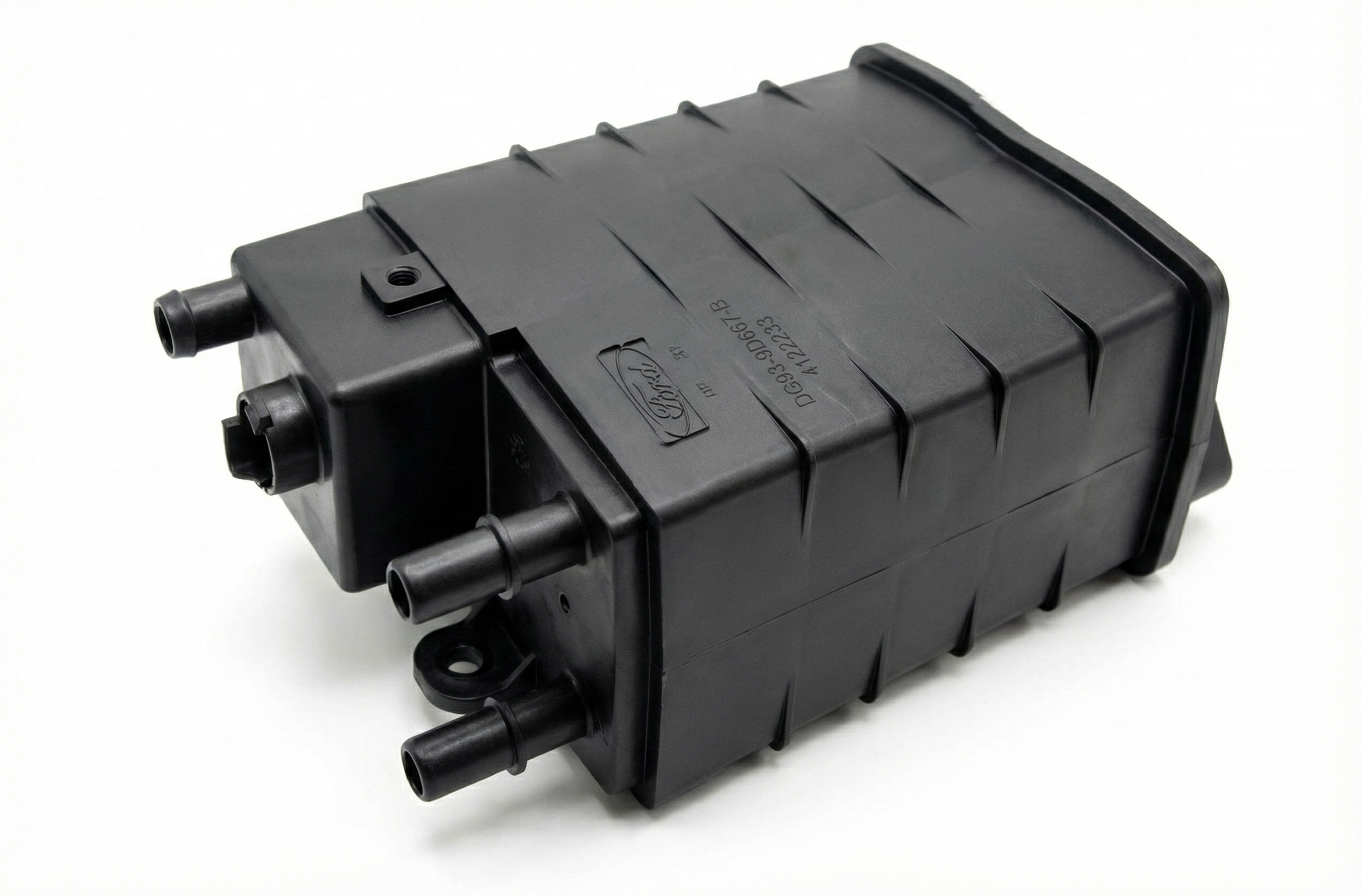
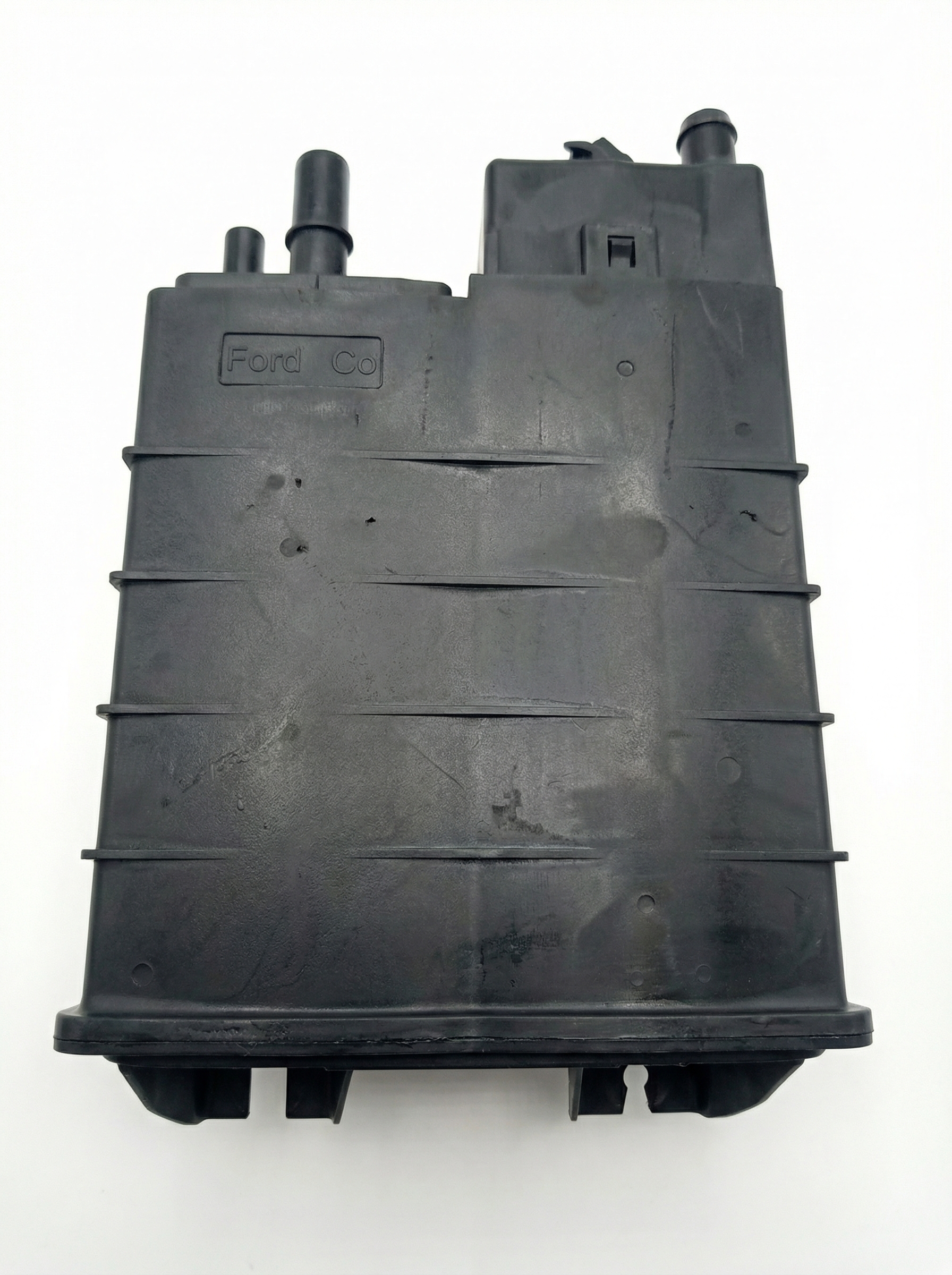
- Replacing the vapor canister. The canister itself is rarely the cause of a P1450 code; the issue is almost always the purge valve in the engine bay.
- Assuming a fuel cap issue. The Fusion Energi has a capless fuel filler system, so there is no cap to replace. While the filler neck mechanism can fail, it is not the common cause for this specific code.
Most Likely Causes
- Stuck or Leaking Canister Purge Valve 🔴 High Probability Ford TSB 19-2207 explicitly states that the sealing capability of the original canister purge valve may be insufficient, leading to this code on Fusion Hybrid and Energi models. This is widely confirmed as the number one cause. The valve gets stuck open, allowing constant engine vacuum to be applied to the fuel tank.
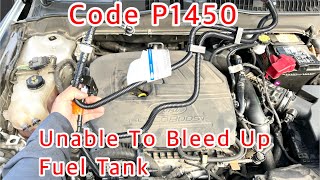
How to confirm: With the engine off, disconnect the EVAP line running from the purge valve to the fuel tank. Try to blow through the valve; if any air passes, it is stuck open and faulty. Alternatively, start the engine, let it idle, and place your finger over the valve's port where the tank line was connected. If you feel any suction, the valve is leaking and needs to be replaced. A video guide demonstrates this test. 🎬 Watch: How to test the purge valve for vacuum leaks.
Typical fix: Replace the canister purge valve assembly located in the engine bay, on top of the engine. Ford also recommends reprogramming the PCM with the latest software after replacement, which may require a dealer visit or a capable scan tool.
Est. part cost: $50-$100 - Blocked EVAP Canister Vent Solenoid or Hose ⚪ Low Probability
How to confirm: Locate the EVAP canister and vent solenoid, usually near the rear of the vehicle by the fuel tank. Inspect the hoses for kinks, damage, or blockages. Check the vent solenoid's filter and outlet for obstructions like dirt, debris, or insect nests.
Typical fix: Clean the obstruction from the hose or vent solenoid filter. If the solenoid itself is faulty (stuck closed), it will need to be replaced.
Est. part cost: $30-$70 - Faulty Fuel Tank Pressure (FTP) Sensor ⚪ Low Probability
How to confirm: This requires a scan tool capable of reading live data. Monitor the FTP sensor reading (typically in inches of water, InH2O, or volts). The reading should change when the fuel filler is opened. If the sensor reading is stuck or irrational, it is likely faulty.
Typical fix: Replace the Fuel Tank Pressure sensor. This sensor is often located on top of the fuel tank or fuel pump assembly.
Est. part cost: $40-$90
Diagnosis Steps
- Confirm the Check Engine Light is on and scan for codes. Verify P1450 is present.
- When it is safe to do so (ideally before your next refuel), open the fuel filler door. Listen for a distinct 'whoosh' of air. This sound confirms excessive vacuum is present in the tank.
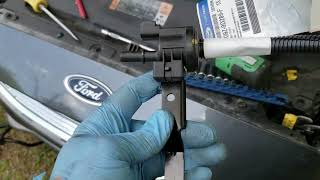
- Locate the canister purge valve in the engine bay. It's a small black valve with two hoses and an electrical connector, typically sitting on top of the engine 🎬 Watch this easy walkthrough to replace the purge valve yourself. near the intake manifold.
- With the engine OFF, disconnect the electrical connector and the vapor line coming from the fuel tank.
- Attempt to blow through the valve from the intake side. A functioning valve is normally closed and should not allow air to pass. If you can blow through it, the valve is stuck open and is the culprit.
- If the blow test is inconclusive, reconnect the valve and start the engine. Let it idle. Disconnect the vapor line from the fuel tank again and place your finger over the port on the valve. If you feel any suction, the valve is leaking internally and must be replaced.
- If the purge valve tests good, proceed to inspect the EVAP canister vent hoses and vent solenoid near the fuel tank for any blockages or kinks.
Parts You'll Likely Need
- Canister Purge Valve
(OEM #AU5Z-9C915-E)— This is the definitive cause for P1450 on this vehicle, as identified by Ford's own Technical Service Bulletins. The original part had a sealing issue, and this is the updated replacement. It is also sold under Motorcraft service number CX-2695. Previous part numbers like AU5Z-9C915-A, -B, -C, and -D have all been superseded by this -E version.
Trusted brands: Motorcraft, Bosch, Dorman, Standard Motor Products
OEM price range: $60-$100
Aftermarket price range: $40-$75
Related Codes That Often Appear With This One
- P0456 — TSB 19-2207 lists this 'Small EVAP Leak' code as appearing alongside P1450, likely because the faulty purge valve can cause various incorrect pressure readings during the EVAP monitor test.
- P04EE — This code for 'EVAP System Canister Purge Valve 'A' Stuck Closed' is also cited in TSB 19-2207, indicating a failure of the same component.
- P04EF — This code for 'EVAP System Canister Purge Valve 'A' Stuck Open' directly describes the mechanical failure that causes the P1450 vacuum condition.
- P0172 — A 'System Too Rich' code can occur because a stuck-open purge valve allows un-metered fuel vapors to be constantly drawn into the intake manifold, disrupting the air-fuel ratio. This is a classic companion code.
- P0496 — This code for 'EVAP Flow During a Non-Purge Condition' also points directly to a purge valve that is flowing vapor when it should be closed, making it a strong indicator that the purge valve is the culprit.
Technical Service Bulletins (TSBs) & Recalls
- TSB 19-2207: For 2013-2017 Hybrid/Energi models, states the cause of P1450 is the sealing capability of the canister purge valve and instructs technicians to replace the valve and reprogram the PCM. It also lists P0456, P0457, P04EE, and P04EF as related codes.
- SSM 48301: Applies to 2018 Fusion Hybrid models and lists P1450 among a group of EVAP codes, pointing towards a common diagnostic path starting with the purge valve.
Platform-Specific Known Issues
- Ford TSB 19-2207 was issued for 2013-2017 Fusion Hybrid/Energi models for code P1450, identifying a faulty canister purge valve and recommending its replacement along with a PCM software update.
- While the TSB officially covers up to 2017, the issue is widely known to persist with the same cause and fix on 2018-2020 models, which use the same fundamental powertrain and EVAP system design.
Mechanic-Grade Diagnostic Values
- Fuel Tank Pressure (FTP) Sensor Voltage — expected: 2.40 - 2.80 Volts. Failure: A voltage significantly outside this range at KOEO (Key On, Engine Off) indicates a biased or faulty sensor.
- EVAP Canister Vent Valve Solenoid Resistance — expected: 12 - 80 Ohms. Failure: A resistance reading outside this range indicates a faulty solenoid coil.
- Canister Purge Valve Solenoid Resistance — expected: 15 - 25 Ohms (Note: some sources cite 30-38 Ohms for other Ford models, but this range is more commonly reported for this platform). Failure: A reading significantly outside this range suggests a faulty coil.
- EVAP Canister Vent Valve Connector Voltage — expected: Battery Voltage. Failure: No voltage at Pin 2 (Green wire) with key on indicates a wiring or fuse issue.
Hidden / Shadow Codes Worth Checking
- P1450-00: This is an extended format of the code that may be seen on some advanced scan tools. The '-00' suffix does not change the diagnostic procedure, which still points primarily to a stuck purge valve or blocked vent path. (see via Ford IDS, FORScan, or other professional-level scan tools.)
Scan Tool Commands That Help
- Ford IDS, FORScan, advanced bidirectional scanners: EVAP Purge Valve Control / Commanded Evaporative Purge — This is the definitive test for a stuck purge valve. With the engine running at idle, command the purge valve to 0% (closed). While monitoring the Fuel Tank Pressure (FTP) sensor PID, if vacuum continues to build (pressure value drops), the valve is mechanically stuck open and must be replaced.
- Ford IDS, FORScan, advanced bidirectional scanners: EVAP System Test — This is a comprehensive automated test that commands various EVAP components to check for leaks and proper function. For P1450, it will attempt to seal the system and then bleed off vacuum. A failure at the bleed-up stage confirms the code's condition, pointing towards a stuck purge valve or blocked vent.
Wiring & Ground Locations
- G108 (PHEV) — Located at the right rear of the engine compartment.. This is a key ground point specified for the PHEV model. A poor connection here could cause erratic behavior or failure of engine bay components, including the canister purge valve solenoid.
- G113 (PHEV) — Located at the base of the left 'A' pillar.. Another ground point specific to the PHEV. While less likely to affect the engine-mounted purge valve, it's a critical ground for interior modules that communicate with the PCM.
- G111 / G112 — Located at the left front of the engine compartment.. These are primary engine compartment grounds. Corrosion or looseness at these points can affect multiple sensors and solenoids, including the EVAP purge valve.
- Engine Bay Fuse Box - Fuse F8 — Located in the main engine fuse box on the driver's side of the engine bay.. On many Fusions of this generation, fuse #8 is reported to supply power to the EVAP system. If there is no power at a solenoid, this fuse should be checked before condemning the component or wiring.
Real Owner Repair Stories
- Car Talk Community user 'mamamoore2013_162939' (2015 Ford Fusion Titanium) — Recurring P1450 code for over a year, difficult restart after refueling, unstable idle, loud 'whoosh' from fuel filler.
❌ Tried (didn't work) Replaced canister purge valve and solenoid, Replaced spark plugs, Replaced both high and low fuel pressure sensors, Checked all EVAP hoses
✅ What actually fixed it The user did not post a final resolution, but their story is a valuable cautionary tale that even after replacing the most common culprit (purge valve) and other related parts, the issue can persist, potentially pointing to an edge case like a faulty capless filler neck or a wiring problem. - Reddit user 'FeistyIllustrator961' (2011 Ford Fusion SE 2.5L (similar EVAP logic)) — P1450 code, stalls after refueling, occasional stalling at red lights.
❌ Tried (didn't work) Replaced the canister purge valve on the engine.
✅ What actually fixed it The user's problem was not resolved after replacing the purge valve. Other users suggested the next logical step was to diagnose the canister vent valve (located near the fuel tank) or perform a smoke test to find a blockage in the vent line, as a stuck-closed vent valve can also cause this code.
OEM Part Supersession History
AU5Z-9C915-A, AU5Z-9C915-B, AU5Z-9C915-C, AU5Z-9C915-D→AU5Z-9C915-E— The original parts had insufficient sealing capability, leading to internal leaks that cause P1450 and other EVAP codes. The -E revision is the updated, more robust design.
Heads up: While older revisions will physically fit, they are prone to the same failure and should not be used. Always install the latest available revision, AU5Z-9C915-E (also sold as Motorcraft CX-2695).
Diagnostic Flowchart
Other Known Issues on This Vehicle
Issues unrelated to this code that are worth knowing about as an owner of this generation:
- HF35 eCVT Transmission Failure 🔴 High — Can occur at various mileages, sometimes under 100k miles. Symptoms include whining, grinding, or a hole being worn through the transmission case in extreme examples. Some 2014-2015 models had a known bearing defect. (Ref: Some owners report transmission replacement under a TSB for grinding sounds.)
- Shift Cable Bushing Failure 🟠 Medium — A very common issue where a small plastic bushing degrades, detaching the shift cable from the transmission and leaving the vehicle stuck in whatever gear it was in. (Ref: Ford Recall 22S43 was issued to replace the bushing and add a protective cap.)
- High-Voltage Battery Degradation 🟠 Medium — Owners report a noticeable loss of all-electric range over time, especially on older models. A 2013 model might only get 8-10 miles of EV range, down from an original ~21. The battery is not liquid-cooled, which can contribute to faster degradation. (Ref: Warranty typically covers complete failure, not gradual degradation, which can be a point of frustration for owners.)
- Engine Coolant Intrusion (2.0L EcoBoost, not Hybrid) 🔴 High — While the 2.0L Atkinson cycle engine in the Hybrid/Energi is considered reliable, the standard 2.0L EcoBoost engine in non-hybrid Fusions is known for a defect where coolant can leak into the cylinders, potentially causing engine failure. This does not apply to the Energi model but is a major platform issue. (Ref: TSB 22-2134 addresses this for the EcoBoost engines.)
- Minor Electrical Problems / Warning Lights 🟡 Low — Owners report a tendency for various, often intermittent, warning lights and messages to appear on the dash that may resolve on their own, causing frustration.
- High Voltage BEC Cover (2019 models) 🟠 Medium — Specific to some 2019 models, a missing cover over high-voltage fuses could pose a shock risk. (Ref: Ford Recall 19C05 was issued to install a Bus Electrical Center (BEC) cover.)
Used vs. New Parts: Buying Guide for This Vehicle
When a used part is the smart pick: For this specific P1450 fault, obtaining a used part is almost never a smart choice. The primary cause is a canister purge valve with a known design flaw that was corrected in later part revisions. A used part from a donor vehicle is highly likely to either have an older, failure-prone revision or have significant wear that will lead to premature failure.
What to inspect on the donor part:
- Not applicable, as used parts are not recommended for this repair.
OEM-only on this vehicle (don't cheap out):
- Canister Purge Valve: Due to the high failure rate of original and some aftermarket parts, using the latest revision OEM Motorcraft part (AU5Z-9C915-E) is strongly recommended for a lasting repair. Ford's TSB also calls for a PCM update which is best performed with an OEM part installed.
Aftermarket brands forum-validated for this vehicle:
- Bosch
- Standard Motor Products (SMP)
- Dorman (Note: While widely available, some forum users report mixed long-term reliability compared to OEM.)
Brands owners have reported issues with on this vehicle:
- Unbranded, 'white-box' parts from online marketplaces. Forum users frequently report these failing within months, causing the P1450 code to return.
Real Owner Stories
Aggregated from forums and TSBs cited above. Mileages and costs reflect what owners reported in those sources.
2013 Ford Fusion 2.0L Hybrid/Energi
Symptoms: The car stalls when getting gas and requires holding the pedal down to start.
What fixed it: Replacement of the canister purge valve. The owner noted that cheap aftermarket valves can fail quickly and suggested using parts with a lifetime warranty for free replacements.
Source hint: Reddit r/fordfusion - 'Code P1450 Failed Bleed Up Fuel Tank Vaccum, stalls when getting gas'
2015 Ford Fusion 2.0L Hybrid/Energi
Symptoms: Recurring P1450 code for over a year and difficulty starting the vehicle after refueling.
What fixed it: The owner replaced the purge valve and other sensors, though they noted the code recurred, highlighting potential issues with aftermarket part longevity.
Source hint: Car Talk Community - 'P1450 code!'
2018 Ford Fusion 2.0L Hybrid/Energi
Symptoms: Check engine light with code P1450.
What fixed it: Replacement of the OEM canister purge valve assembly and releasing specific line connectors as shown in a detailed repair guide.
Source hint: YouTube - 'Ford Fusion Ecoboost Purge Valve Replace - Code P1450'
Related OBD-II Codes
Frequently Asked Questions
Does TSB 19-2207 apply to my 2013-2017 Ford Fusion Energi?
I have a 2019 Fusion Energi; is the cause of P1450 the same as the older models covered by the TSB?
Why does my Fusion Energi stall or struggle to start only after I fill up the gas tank?
Is there a simple way to test the purge valve on my Fusion at home?
Are there other major issues I should watch for on my Fusion Energi besides EVAP codes?
Does the 'coolant intrusion' engine failure issue affect my Fusion Energi's 2.0L engine?
Helpful Videos



Used OEM Parts in Stock
New Aftermarket Parts Available


The information in this article is provided for general reference and educational purposes only. Vehicle specifications, procedures, and part compatibility can vary by production date, trim level, and region. Always consult your vehicle's factory service manual and verify part numbers before purchasing or performing repairs. Safety-critical components such as airbags, seat belts, and braking systems should be installed by a qualified professional.
- Ford Fusion Energi:
- 🎬 Helpful Videos
- 🛍️ Shop This Part
- What's Unique About the 2013-2020 Ford Fusion Energi
- Symptoms You May Notice
- Most Likely Causes
- Diagnosis Steps
- Parts You'll Likely Need
- Related Codes That Often Appear With This One
- Technical Service Bulletins (TSBs) & Recalls
- Platform-Specific Known Issues
- Mechanic-Grade Diagnostic Values
- Hidden / Shadow Codes Worth Checking
- Scan Tool Commands That Help
- Wiring & Ground Locations
- Real Owner Repair Stories
- OEM Part Supersession History
- Diagnostic Flowchart
- Other Known Issues on This Vehicle
- Used vs. New Parts: Buying Guide for This Vehicle
- Real Owner Stories
- 2013 Ford Fusion 2.0L Hybrid/Energi
- 2015 Ford Fusion 2.0L Hybrid/Energi
- 2018 Ford Fusion 2.0L Hybrid/Energi
- Related OBD-II Codes
- Frequently Asked Questions
- 🎟️ Get 5% Off