

P1450 on 2013-2020 Ford Fusion 1.5L: Fixes for 'Unable to Bleed Up Fuel Tank Vacuum'
On a 2013-2020 Ford Fusion with the 1.5L engine, trouble code P1450 is almost always caused by a faulty canister purge valve stuck open. This common failure leads to difficulty starting after refueling, a 'whoosh' sound from the fuel filler, and a check engine light. Replacing the purge valve assembly is the definitive fix, costing around $60-$120 for the part and is a manageable DIY repair for most owners.
- P1450 on your 1.5L Fusion almost certainly means the canister purge valve is stuck open.
- The most common symptom is the engine stalling or being very difficult to start right after you get gas.
- This is a known safety issue. Check if your vehicle is covered under Ford recall 18S32 before paying for repairs.
- Replacing the purge valve is a DIY-friendly job that can prevent serious damage to your fuel tank.
- The correct replacement part is likely an assembly with hoses, OEM part number HG9Z-9D289-F for 2017-2020 models.
What's Unique About the 2013-2020 Ford Fusion
The second-generation Ford Fusion, particularly with EcoBoost engines like the 1.5L, is highly susceptible to this issue. The problem of a stuck-open canister purge valve causing excessive fuel tank vacuum is so well-known that Ford issued safety recall 18S32. This recall addresses the risk of the plastic fuel tank deforming or even stalling the engine due to the constant vacuum. This history, corroborated by countless owner complaints and repair videos, makes the diagnosis of P1450 on this vehicle very direct, with the purge valve being the primary suspect by a wide margin.
Symptoms You May Notice
- Difficulty starting, sputtering, or stalling immediately after refueling.
- Check Engine Light is on.
- Engine stalling randomly while driving, sometimes at red lights.
- A 'whoosh' or buzzing sound of air rushing in when opening the capless fuel filler.
- Rough idle.
- Car refuses to start unless the accelerator pedal is held down during cranking.
- Replacing the gas cap. The Ford Fusion has a capless fuel filler system, so there is no traditional cap to replace. The issue is almost always further down the EVAP system line with the purge valve itself.
Most Likely Causes
- Stuck-Open Canister Purge Valve (CPV) 🔴 High Probability This is a well-documented, extremely common failure on this platform, leading to Ford issuing safety recall 18S32 (NHTSA #18V735) because a stuck-open valve can cause tank deformation and stalling. Owner complaints and forum discussions frequently cite this as the cause, with some owners replacing the part multiple times. [ODI #11415649, ODI #11511799, 22]
How to confirm: With the engine off, disconnect the vapor line from the purge valve that leads to the EVAP canister. Try to blow through the valve; if air passes through, it's stuck open and bad. Alternatively, start the engine, leave the valve's electrical connector unplugged, and feel for vacuum at the port where the hose was connected; if vacuum is present, the valve has failed.
Typical fix: Replace the canister purge valve and its associated hose assembly. This is a single unit. After replacement, clear the codes with a scanner.
Est. part cost: $60-$120
Rare But Worth Checking
- Blocked EVAP Canister Vent Solenoid or Hoses: Debris, dirt, or insect nests can block the EVAP system's vent path, preventing the tank from equalizing pressure. This can mimic a bad purge valve. This is diagnosed by smoke testing the system after confirming the purge valve is good. Check the vent solenoid and hoses near the charcoal canister (rear of vehicle) for obstructions.
- Faulty Fuel Tank Pressure (FTP) Sensor: While less common, the sensor that reports the fuel tank's pressure to the computer can fail, leading to an incorrect P1450 code. This is usually diagnosed after confirming the purge valve and vent paths are clear. One owner on a Car Talk forum replaced multiple EVAP parts before finding the FTP sensor was the culprit.
- Loose or Damaged EVAP Hoses: A kinked, pinched, or disconnected EVAP hose can disrupt the system's ability to manage vacuum, potentially triggering the code. TSB 19-2171 for similar engines advises checking all EVAP line connections. A visual inspection of all lines connected to the purge valve assembly is a good first step.
Diagnosis Steps
- Read the code with an OBD-II scanner to confirm P1450 is present. Note any other codes like P2196 or P0496.
- Check for Recalls: Enter your vehicle's VIN on the NHTSA or Ford owner website to check for open recalls, specifically 18S32, which directly relates to this issue and may entitle you to a free repair.
- Listen for Symptoms: Pay attention to a 'whoosh' sound from the fuel filler area after driving or a buzzing noise from the rear of the car. Note if the car is difficult to start only after refueling.
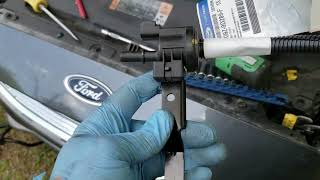
- Inspect and Test the Canister Purge Valve (CPV): Locate the purge valve assembly on the top of the 1.5L engine. It is a black plastic valve with several attached hoses.
- Perform the Blow-Through Test (Engine OFF): Disconnect the valve and its hoses. Try to blow air through the port that connects to the fuel tank. If any air passes through, the valve is stuck open and must be replaced.
- Perform the Vacuum Test (Engine ON): Disconnect the electrical connector and the EVAP line coming from the fuel tank side. Start the engine. Place your finger over the port on the valve where the line was connected. If you feel any suction (vacuum), the valve is stuck open and must be replaced.
- Inspect Vent Lines: If the purge valve tests good, trace the EVAP hoses from the engine bay to the charcoal canister (usually at the rear of the vehicle). Look for any kinks, damage, or blockages.
- Clear Codes: After replacing any faulty parts, clear the diagnostic trouble codes with an OBD-II scanner and drive the vehicle to see if the light returns.
Parts You'll Likely Need
- Vapor Canister Purge Valve Assembly
(OEM #HG9Z-9D289-F)— This is the component that fails over 95% of the time for code P1450 on this vehicle. It gets stuck open, creating constant vacuum on the fuel tank. The part for the 1.5L engine is an assembly with multiple hoses. This part number supersedes previous versions HG9Z-9D289-A and HG9Z-9D289-C and is typically for 2017-2020 models.
Trusted brands: Motorcraft (OEM), Dorman, Standard Motor Products
OEM price range: $80-$120
Aftermarket price range: $50-$90
Related Codes That Often Appear With This One
- P2196 — A stuck-open purge valve creates a vacuum leak, pulling extra un-metered fuel vapors into the engine. This can make the air-fuel mixture too rich, causing an O2 sensor to get stuck in a rich-reading state, as reported by an owner in NHTSA complaint ODI #11580810 and noted in recall documentation.
- P0456 — This code for a 'very small leak' can sometimes accompany P1450. A purge valve that isn't sealing perfectly can be interpreted by the PCM as a leak under some test conditions. TSB 19-2207 for hybrid models groups these codes together as pointing to a bad purge valve.
- P0496 — This code indicates 'EVAP Flow During a Non-Purge Condition,' which is another way of saying the purge valve is flowing vapor when it shouldn't be. It's a very common companion code to P1450 and points directly to a stuck-open purge valve.
Technical Service Bulletins (TSBs) & Recalls
- TSB 19-2207: Applies to 2013-2017 Fusion Hybrid/Energi models with P1450, recommending a purge valve replacement and PCM update due to poor sealing of the original valve. While for a different engine, it shows a pattern of failure on the platform.
- Recall 18S32 / 18V735: The most critical document for this issue, addressing the stuck-open purge valve, potential for tank deformation, and engine stalling on Fusions.
Platform-Specific Known Issues
- Recall 18S32 (NHTSA #18V735): Ford issued this recall because the PCM software may not properly detect a stuck-open canister purge valve, which can lead to fuel tank deformation and potential engine stalling, increasing the risk of a crash. The remedy involves a PCM software update and, if necessary, replacing the purge valve and/or fuel tank.
- Fuel Tank Deformation: As a direct result of the constant vacuum from a failed purge valve, the plastic fuel tank can be crushed or deformed. This is a serious consequence that can damage the fuel pump and lead to fuel leaks.
- Repeat Failures of Aftermarket Parts: Some owners on forums report that cheaper aftermarket purge valves fail again within a year, suggesting that using the OEM Motorcraft part is a more durable long-term solution.
Mechanic-Grade Diagnostic Values
- Canister Purge Valve (CPV) Solenoid Resistance — expected: 14 - 18 Ohms. Failure: Infinite resistance (open circuit) or near-zero resistance (short circuit) indicates a failed coil.
- Fuel Tank Pressure (FTP) Sensor Voltage (Key On, Engine Off) — expected: ~2.4V - 2.8V at atmospheric pressure. Failure: A voltage significantly outside this range, or one that shows a vacuum (lower voltage) with the fuel filler open, suggests a biased or faulty sensor.
- EVAP Canister Vent Valve Solenoid Resistance — expected: 12 - 80 Ohms. Failure: A reading outside this range indicates a faulty solenoid coil. This part is located at the rear of the vehicle near the charcoal canister.
Scan Tool Commands That Help
- Ford IDS, FORScan, or other bidirectional scanner: EVAP Purge Valve Control / Purge Solenoid Command — This is the definitive test for a stuck purge valve. With the engine running, command the valve to 0% (closed). While monitoring the Fuel Tank Pressure (FTP) sensor live data, if vacuum continues to build (pressure drops), the valve is mechanically stuck open and has failed.
- Ford IDS, FORScan, or other bidirectional scanner: EVAP Canister Vent Valve Command — Used to test the vent valve at the rear of the vehicle if the purge valve tests good. The vent valve is normally open. Commanding it closed should cause it to click and seal the system. If it doesn't click or seal, it may be faulty.
Wiring & Ground Locations
- Canister Purge Valve (CPV) Connector — On the purge valve assembly, located on the top/front of the 1.5L engine.. This is the connection point for testing the solenoid. It receives power and a control signal from the PCM to operate the valve.
- EVAP Canister Vent Valve Connector — Underneath the vehicle at the rear, connected to the EVAP charcoal canister assembly.. This connector's wiring is exposed to the elements and can corrode. Pin 2 (often a Green wire) should have battery voltage with the key on. Pin 1 (often Green/Blue) is the control ground from the PCM.
- Primary Ground Point — A main ground connection point is located in the engine compartment near the fuse box, to the right of the battery.. A poor ground connection can cause erratic behavior in sensors and solenoids within the EVAP system, although it is not a common cause for P1450 specifically.
Real Owner Repair Stories
- Car Talk Community user 'mamamoore2013_162939' (2015 Ford Fusion Titanium) — P1450 code, occasional negative pressure in tank with horrible noise, inconsistent hard starting after refueling.
❌ Tried (didn't work) Replaced purge valve and solenoid, Replaced spark plugs, Replaced high and low fuel pressure sensors, Checked all hoses
✅ What actually fixed it Another user reported a similar saga on their 2012 Fusion where the final culprit for P1450 was a faulty EVAP Purge Valve that was stuck open, but only after a Fuel Tank Pressure (FTP) sensor had been replaced for a prior code. The original poster acknowledged the FTP sensor was the next logical part to test. - Reddit user 'CommercialTrip8813' and commenters (2013 Ford Fusion Titanium 2.0L (symptoms/fix are identical for 1.5L)) — P1450, car won't start after getting gas unless the accelerator pedal is held down.
❌ Tried (didn't work) One user noted a cheap aftermarket purge valve failed after a month.
✅ What actually fixed it Replacing the vapor canister purge valve assembly. One user recommended buying a part from AutoZone with a lifetime warranty, as they had experienced repeat failures with cheaper online parts and kept exchanging the warrantied part for free. - YouTube channel 'DIY-IT' (Ford Fusion (post-2012)) — P1450, won't start after a full tank of gas, whining/hissing noises from the rear of the car.
❌ Tried (didn't work) First replaced the vent valve solenoid by the charcoal canister, which did not fix the problem.
✅ What actually fixed it Replacing the entire vapor canister purge valve and hose assembly in the engine bay solved the code and symptoms.
"I Checked Everything" — The Actual Cause
- In cases where the purge valve and vent lines are confirmed to be good and a smoke test shows no leaks, the root cause can be a faulty Fuel Tank Pressure (FTP) sensor. A biased FTP sensor can incorrectly report a vacuum to the PCM when none exists, causing the P1450 code to set without any physical leak or blockage in the system. This was the final resolution for an owner on the Car Talk Community forums after they had already replaced the purge valve.
OEM Part Supersession History
HG9Z-9D289-A, HG9Z-9D289-C→HG9Z-9D289-F— Improved design or material to address the common sticking/leaking failure of the original valve.
Heads up: This part number is for the 2017-2020 1.5L Fusion. Earlier models (2013-2016) may use a different part number, such as AU5Z-9C915-E, which has a different physical configuration.
Model Year Variations Within This Range
- 2017-2020: These models typically use the canister purge valve assembly part number HG9Z-9D289-F.
- 2013-2016: These earlier models may use a different purge valve assembly, often cited as part number AU5Z-9C915-E. It is critical to verify the correct part for your specific model year via VIN, as the hose routing and valve configuration are different.
Diagnostic Flowchart
Other Known Issues on This Vehicle
Issues unrelated to this code that are worth knowing about as an owner of this generation:
- Engine Coolant Intrusion 🔴 High — Common enough to warrant multiple TSBs (e.g., 20-2100) and a Customer Satisfaction Program (21N12). Can occur around 100,000 miles. (Ref: TSB 20-2100, CSP 21N12)
- Shifter Cable Bushing Failure 🔴 High — Widespread failure leading to a major safety recall. Affects 2013-2016 models. The bushing degrades, causing a disconnect between the shifter and transmission, which can lead to a rollaway risk. (Ref: Recall 18S20 / 22S43 (NHTSA #18V471 / #22V413))
- Harsh or Delayed Transmission Shifting 🟠 Medium — Some owners report issues with the 6F35 automatic transmission, including harsh shifts or delays. Sometimes addressed with software updates, other times requires more significant repair.
- Failing Front Lower Control Arm Bushings 🟠 Medium — The rear bushings on the front lower control arms can wear out prematurely, causing clunking noises from the front suspension, especially over bumps.
Used vs. New Parts: Buying Guide for This Vehicle
When a used part is the smart pick: For this specific P1450 repair, buying a used canister purge valve from a junkyard is NOT recommended. This part has an extremely high failure rate, and a used part is likely to have either already failed or have very little remaining service life.
What to inspect on the donor part:
- Not applicable, avoid used parts for this repair.
OEM-only on this vehicle (don't cheap out):
- Canister Purge Valve Assembly - While not strictly 'OEM-only', using the OEM Motorcraft part is highly recommended for longevity. Forum users report premature and repeated failures from cheaper, unbranded aftermarket parts.
Aftermarket brands forum-validated for this vehicle:
- Dorman (often available with a lifetime warranty from retailers like AutoZone, which can be useful for this high-failure part)
- Standard Motor Products (SMP)
Brands owners have reported issues with on this vehicle:
- Unbranded, low-cost parts from online marketplaces like Amazon or eBay are frequently reported to fail within months.
Real Owner Stories
Aggregated from forums and TSBs cited above. Mileages and costs reflect what owners reported in those sources.
2015 Ford Fusion 1.5L
Symptoms: P1450 code; after filling the tank with gas, the car won't start for 5-10 minutes and requires several cranks to fire up.
What fixed it: Replacement of the purge valve. Note: The owner had previously replaced an oxygen sensor which did not resolve the issue.
Source hint: Reddit r/fordfusion thread titled 'I have a 2015 ford fusion 1.5L with a p1450 code...'
2013 Ford Fusion
Symptoms: Stalling specifically after refueling; failed bleed up fuel tank vacuum.
What fixed it: Replacing the purge valve. A user recommended using a part with a lifetime warranty due to the potential for repeat failures.
Source hint: Reddit r/fordfusion - Code P1450 Failed Bleed Up Fuel Tank Vaccum, stalls when getting gas
2015 Ford Fusion 1.5L EcoBoost
Symptoms: Hard start after filling the tank and a P1450 trouble code.
What fixed it: The forum identified the cause as a stuck valve that fails to bleed off vacuum.
Source hint: Ford Fusion Forum - Trouble code P1450
2015 Ford Fusion
Symptoms: A year-long battle with P1450 where replacing the purge valve, plugs, and sensors did not initially solve the problem.
What fixed it: The Fuel Tank Pressure (FTP) sensor was found to be the ultimate culprit in this specific case.
Source hint: Car Talk Community - P1450 code!
Related OBD-II Codes
Frequently Asked Questions
Is there a recall for the P1450 code on my Ford Fusion?
Why does my Fusion struggle to start only after I fill up at the gas station?
Can a P1450 code lead to a damaged fuel tank on the 1.5L EcoBoost?
Does TSB 19-2207 apply to my 1.5L EcoBoost Fusion?
Should I use an aftermarket purge valve or the Motorcraft part?
What is the 'whoosh' sound I hear when opening my gas cap?
Helpful Videos

Used OEM Parts in Stock

New Aftermarket Parts Available


The information in this article is provided for general reference and educational purposes only. Vehicle specifications, procedures, and part compatibility can vary by production date, trim level, and region. Always consult your vehicle's factory service manual and verify part numbers before purchasing or performing repairs. Safety-critical components such as airbags, seat belts, and braking systems should be installed by a qualified professional.
- Ford Fusion:
- 🎬 Helpful Videos
- 🛍️ Shop This Part
- What's Unique About the 2013-2020 Ford Fusion
- Symptoms You May Notice
- Most Likely Causes
- Rare But Worth Checking
- Diagnosis Steps
- Parts You'll Likely Need
- Related Codes That Often Appear With This One
- Technical Service Bulletins (TSBs) & Recalls
- Platform-Specific Known Issues
- Mechanic-Grade Diagnostic Values
- Scan Tool Commands That Help
- Wiring & Ground Locations
- Real Owner Repair Stories
- "I Checked Everything" — The Actual Cause
- OEM Part Supersession History
- Model Year Variations Within This Range
- Diagnostic Flowchart
- Other Known Issues on This Vehicle
- Used vs. New Parts: Buying Guide for This Vehicle
- Real Owner Stories
- 2015 Ford Fusion 1.5L
- 2013 Ford Fusion
- 2015 Ford Fusion 1.5L EcoBoost
- 2015 Ford Fusion
- Related OBD-II Codes
- Frequently Asked Questions
- 🎟️ Get 5% Off