

P1450 on 2016-2018 Ford Focus RS: Causes and Fixes for Unable to Bleed Up Fuel Tank Vacuum
On a 2016-2018 Focus RS, code P1450 is almost always caused by a faulty canister purge valve sticking open. This is a known issue addressed by Ford TSB 17-0016 and Safety Recall 18S32. Replacing the purge valve is a simple DIY fix, with the part costing around $40-$80.
- P1450 on your Focus RS is almost certainly a bad canister purge valve.
- Check with a Ford dealer for open Safety Recall 18S32 before paying for any repairs, as the fix may be free.
- Symptoms include a check engine light, rough idle after fueling, and potentially an incorrect fuel gauge.
- This is a safety-related issue that can cause the engine to stall; do not ignore it.
- Replacing the purge valve is a beginner-friendly DIY task that can be done in under 30 minutes with basic tools.
What's Unique About the 2016-2018 Ford Focus
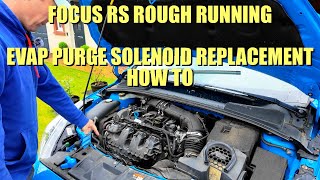
The 2.3L EcoBoost engine in the Focus RS is specifically called out in Ford 🎬 Watch: Step-by-step Focus RS EVAP purge solenoid replacement guide. Technical Service Bulletin (TSB) 17-0016 for this exact code, which may also be accompanied by P0456 and P144A. The issue of a sticking canister purge valve is so prevalent that it also prompted Safety Recall 18S32 / NHTSA 18V735. The recall notes that a stuck-open purge valve can create enough vacuum to physically deform the plastic fuel tank, leading to inaccurate fuel gauge readings, erratic distance-to-empty calculations, and even engine stalling, which is a significant safety risk.
Symptoms You May Notice
- Check Engine Light is on.
- Difficulty starting the engine, or a rough/stumbling idle, immediately after refueling.
- Rough or unstable idle, especially after filling the gas tank.
- Engine may stall while driving, particularly at low speeds.
- Inaccurate or erratic fuel gauge readings (e.g., fuel level appears to increase while driving).
- Audible 'whoosh' of vacuum when opening the capless fuel filler door.
- Reduced fuel economy.
- Replacing the gas cap. The Focus RS has a capless fuel filler system. While a problem with the filler neck seal can cause EVAP leak codes, it is not the typical cause for P1450, which is about an inability to *release* vacuum, not a failure to hold it.
Most Likely Causes
- Sticking/Leaking Canister Purge Valve 🔴 High Probability This is a well-documented failure part on this platform, subject to both a TSB (17-0016) and a Safety Recall (18S32). The valve can get stuck open, allowing constant engine vacuum to be pulled on the fuel tank. The failure is common across many Ford models from this era.
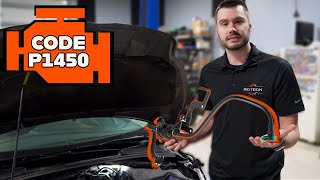
How to confirm: With the engine running, disconnect the electrical connector from the purge valve, then disconnect the EVAP hose that runs from the valve towards the charcoal canister. Place your finger over the port on the valve itself. If you feel any suction/vacuum, the valve is stuck open and must be replaced. This is the definitive test. 🎬 See how to perform this simple P1450 diagnostic test.
Typical fix: Replace the canister purge valve assembly and clear the trouble codes. The valve is located in the engine bay and is a straightforward replacement. 🎬 Watch: How to replace the purge valve on 2.0L models. Per TSB 17-0016 and Recall 18S32, a PCM software update by a dealer is also required to improve the system's ability to detect this failure in the future and prevent fuel tank deformation.
Est. part cost: $40-$80
Rare But Worth Checking
- Blocked EVAP Canister or Vent Solenoid: If the purge valve tests good, the next step is to check for a blockage elsewhere in the system. The canister vent solenoid (located near the charcoal canister under the car) is supposed to be open at rest to allow fresh air in. If it's stuck closed or the canister itself is blocked by debris or saturated with fuel, the system cannot bleed off vacuum.
- Kinked or Blocked EVAP Hose: A physically damaged, collapsed, or pinched hose between the fuel tank, charcoal canister, and purge valve can prevent the system from venting properly, trapping vacuum.
- Faulty Fuel Tank Pressure (FTP) Sensor: In rare cases, the sensor that measures tank pressure could be faulty, sending incorrect data to the PCM and making it believe there is a vacuum when there isn&#'t. This is unlikely and should only be considered after all other components have been verified.
Diagnosis Steps
- Check for Recalls: First, contact a Ford dealer with your VIN to see if Safety Recall 18S32 is open for your vehicle. If so, the dealer will perform the necessary repairs, which include reprogramming the PCM and, if fault codes are present, replacing the purge valve and potentially the fuel tank and canister at no cost.
- Scan for other codes: Check for other related EVAP codes like P0456, P144A, or P2196, which reinforce the diagnosis of a bad purge valve. NHTSA ODI #11467127 notes that P1450 may also be accompanied by misfire codes such as P0300 and P0316 due to a sticking canister purge valve pulling a constant vacuum.
- Test the Canister Purge Valve: Locate the purge valve in the engine bay, on the side of the intake manifold. With the engine running, unplug its electrical connector. Disconnect the vapor line coming from the rear of the car. If you feel vacuum on the valve's inlet port, it has failed and needs to be replaced.
- Inspect Hoses: Visually inspect all accessible EVAP hoses for obvious kinks, collapses, or damage. The lines are rigid plastic, so check for cracks or breaks, especially at the connection points.
- Inspect Canister Vent Solenoid: If the purge valve is good, the next most likely culprit is a blockage at the vent end of the system. Inspect the EVAP canister and vent solenoid, located under the rear of the vehicle, for blockages from dirt, debris, or insects.
Parts You'll Likely Need
- Canister Purge Valve / Vapor Hose Assembly
(OEM #BV6Z-9D289-E)— This is the overwhelmingly common failure point for code P1450 on this vehicle, as documented by Ford's own TSB 17-0016 and Recall 18S32. The part is an assembly including the valve and attached plastic lines.
Trusted brands: Motorcraft
OEM price range: $50-$90
Aftermarket price range: $30-$60
Related Codes That Often Appear With This One
- P0456 — Small EVAP Leak. TSB 17-0016 and Recall 18S32 both list P1450 alongside P0456 as codes caused by a faulty canister purge valve.
- P144A — EVAP System Purge Vapor Line Restricted/Blocked. This code is also mentioned in TSB 17-0016 as being related to the same faulty purge valve.
- P2196 — O2 Sensor Signal Biased/Stuck Rich (Bank 1, Sensor 1). A stuck-open purge valve allows un-metered fuel vapors into the intake, causing a rich condition that the O2 sensor detects. This code is also listed in the recall documentation.
- P0443 — EVAP Purge Control Valve Circuit. This code points to an electrical fault in the purge valve circuit and is also listed as a possible related code in Safety Recall 18S32.
- P0420 — Catalyst System Efficiency Below Threshold. NHTSA ODI #11531982 describes a vehicle running P1450 and P0420 simultaneously, resulting in low catalyst system efficiency due to excessive vacuum in the EVAP system.
Technical Service Bulletins (TSBs) & Recalls
- TSB 17-0016: For 2016-2017 Focus RS built on or before 10-Dec-2016. Instructs to replace the canister purge valve (part no. BV6Z-9D289-E) and reprogram the PCM for DTCs P1450, P0456, and/or P144A due to an intermittent sticking valve.
- Bulletin #TSB 17-0016: Confirms that 2.3L gasoline turbocharged direct injection engines may exhibit an illuminated MIL with DTCs P0456, P1450, and/or P144A due to an intermittent sticking EVAP canister purge valve.
Platform-Specific Known Issues
- Safety Recall 18S32 / NHTSA 18V735 was issued because a stuck-open canister purge valve can cause excessive vacuum, deforming the fuel tank and potentially leading to engine stalls. The recall procedure involves a PCM reprogram and, if needed, replacement of the purge valve, carbon canister, and fuel tank.
- TSB 17-0016 specifically addresses DTC P1450 on the 2016-2017 Focus RS and instructs dealers to replace the purge valve (part no. BV6Z-9D289-E) and reprogram the PCM.
- Owner Experience: A common real-world symptom is the car stalling or running very poorly right after getting gas. This happens because the stuck-open purge valve allows a rush of fuel vapor into the intake manifold, overwhelming the engine.
Documented NHTSA Reports
- NHTSA ODI #11343783: An owner reported that a stuck canister purge valve triggered the P1450 "unable to bleed up fuel tank vacuum" code specifically after filling up at a gas station, which may cause the engine to stall.
- NHTSA ODI #11531982: A report describes the car stuttering and shaking when accelerating from a stop after filling the gas tank, with fault codes P1450 and P0420 present.
- NHTSA ODI #11321251: An owner noted the vehicle stalls and has trouble starting with code P1450; in this instance, replacing the fuel tank pressure solenoid did not resolve the problem.
Mechanic-Grade Diagnostic Values
- Fuel Tank Pressure (FTP) Sensor Voltage — expected: Approximately 2.4V to 2.8V at rest (Key On, Engine Off), with atmospheric pressure in the tank.. Failure: With the engine running and purge valve commanded closed (0%), if the voltage drops significantly below 2.4V, it indicates a vacuum is being pulled, likely by a leaking purge valve.
- Fuel Tank Pressure (FTP) Sensor Live Data (Pressure) — expected: Near 0 PSI or 0 inches of water (inH2O) at rest, with the fuel cap off or vent solenoid open.. Failure: With the engine running, if the scan tool shows a steady, deepening vacuum (negative pressure reading) when the purge valve is commanded OFF, it confirms the valve is mechanically stuck open.
- FTP Sensor 3-Wire Connector Test — expected: With the sensor unplugged and key on, you should find a 5V reference wire, a ground wire (near 0V), and a signal wire.. Failure: Missing 5V reference or a bad ground points to a wiring or PCM issue, not a faulty sensor.
Scan Tool Commands That Help
- Ford IDS, FORScan, or high-end bidirectional scanner (Autel/iCarsoft): EVAP Purge Valve Control / Actuation Test — This is the definitive test for a stuck purge valve. Command the valve to 0% (closed) while monitoring Fuel Tank Pressure (FTP) data. If vacuum still builds in the tank, the valve is mechanically failed and must be replaced.
- Ford IDS, FORScan, or high-end bidirectional scanner: EVAP System Test — This is a PCM-controlled automated test that closes the vent solenoid, opens the purge valve to build vacuum, and then monitors for decay. For P1450, the system fails because it cannot bleed off the vacuum after the test, but running the test can help verify the function of all components in a controlled manner.
Wiring & Ground Locations
- G104 — Located on the left front of the motor compartment.. This is a primary chassis ground point in the engine bay. While not directly for the EVAP system, a poor engine bay ground can cause erratic sensor readings and behavior. One owner reported a no-start after transmission work was resolved by cleaning and tightening a ground on the transmission bell housing, showing the importance of good grounds for overall engine management.
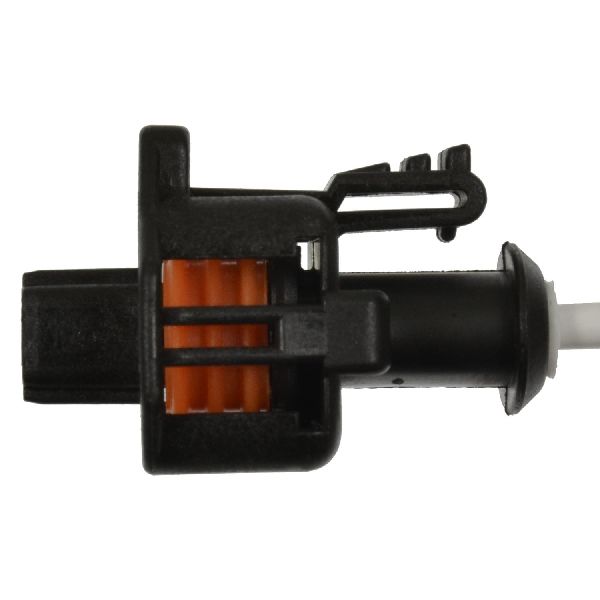
- Canister Purge Valve Connector — On the canister purge valve, located on the side of the intake manifold.. This 2-wire connector provides power and control to the purge valve solenoid. A damaged connector, corroded terminals, or chafed wiring can cause an electrical fault (like P0443) instead of the mechanical P1450, but should always be inspected during replacement.
Real Owner Repair Stories
- Reddit user on r/FordFocus (2014 Ford Focus SE) — Check Engine Light with code P1450.
❌ Tried (didn't work) Replacing the canister purge valve.
✅ What actually fixed it The user replaced the purge valve, but the light remained. A Ford dealer technician in the comments advised to re-check the quick-connect fittings on the new valve assembly to ensure they were fully seated and that the electrical connector was locked. They also noted the code must be cleared with a scan tool, as the EVAP monitor can take a long time to run and turn the light off on its own. In a separate but similar case, another user found a chafed wiring harness was the ultimate cause after replacing parts failed to fix the issue. - Fiesta ST Forum user (Ford Fiesta ST (similar EVAP system design)) — P1450 and P219A, stuttering/rough idle after fill-ups, smell of gasoline.
❌ Tried (didn't work) Attempting to replace just the valve and not the full hose assembly, which proved nearly impossible.
✅ What actually fixed it Replacing the entire purge valve and line assembly fixed the issue. The user strongly recommended buying the complete assembly because swapping the old nylon lines onto a new valve is extremely difficult. Another user in the same thread noted the fix only lasted about a year before symptoms started returning, suggesting the OEM part design may be inherently flawed.
OEM Part Supersession History
BV6Z-9D289-D→BV6Z-9D289-E— This is the specific part number called out in TSB 17-0016 and is the primary replacement for the 2.3L EcoBoost application. The change likely involves internal improvements to prevent the valve from sticking.BV6Z-9D289-A, BV6Z-9D289-B→BV6Z-9D289-R— This part number chain is listed for the 2.0L Focus engine. While it may look physically similar, it is intended for a different application and should not be used on the 2.3L RS unless explicitly cross-referenced by a dealer.
Heads up: Using a part designed for the 2.0L on the 2.3L could result in improper flow characteristics or premature failure. Always use the part number specified for the RS (BV6Z-9D289-E).
Model Year Variations Within This Range
- Late 2017-2018: Late 2017 and all 2018 models received a revised head gasket from the factory to address the well-known head gasket failure issue on 2016-early 2017 models. This does not affect the P1450 diagnosis but is a critical distinction for the vehicle overall.
- 2018 only: The 2018 Focus RS came standard with a front Quaife mechanical limited-slip differential (LSD), which was not available on previous years. This has no bearing on the EVAP system or code P1450.
Diagnostic Flowchart
Other Known Issues on This Vehicle
Issues unrelated to this code that are worth knowing about as an owner of this generation:
- Head Gasket Failure 🔴 High — Common on models built from Aug 2015 to July 2017. Caused by an incorrect gasket being installed at the factory. (Ref: Customer Satisfaction Program 17B32 was issued to replace the head gasket and, if necessary, the cylinder head.)
- Drive Mode Selection Unavailable 🟡 Low — A relatively common electronic fault. Owners report this message appearing on the dash, preventing switching between Normal, Sport, Track, and Drift modes. (Ref: No specific TSB, but common causes identified by owners include a stuck exhaust valve (especially in cold weather), a failing wheel speed sensor, or low battery voltage.)
- Sticking Exhaust Valve 🟡 Low — The valve in the exhaust that opens in Sport/Track modes can get stuck due to carbon buildup, especially in cold climates. (Ref: null)
- Poor Interior Build Quality / Rattles 🟡 Low — Many owners report various interior rattles, particularly from the A-pillar trims and seats, as a trade-off for the car's performance focus. (Ref: null)
Used vs. New Parts: Buying Guide for This Vehicle
When a used part is the smart pick: For this specific P1450 repair, using a used part is NOT recommended. The primary cause, the canister purge valve, is a known high-failure item due to a design flaw. A used part from a donor vehicle is highly likely to either be faulty already or fail shortly after installation.
What to inspect on the donor part:
- Not applicable, as used parts are not advised for this repair.
OEM-only on this vehicle (don't cheap out):
- Canister Purge Valve / Vapor Hose Assembly: While aftermarket options exist, the OEM Motorcraft part (specifically the latest revision, BV6Z-9D289-E) is the most reliable choice, as it is the result of Ford's own engineering revisions to fix the problem.
Brands owners have reported issues with on this vehicle:
- Unbranded/white-box parts: Some owners have reported that even new aftermarket or OEM parts can fail again within a year, suggesting quality control can be an issue. Sticking with a reputable supplier for the genuine Motorcraft part is the safest bet.
Real Owner Stories
Aggregated from forums and TSBs cited above. Mileages and costs reflect what owners reported in those sources.
2017 Focus RS — 90000 miles
Symptoms: Check engine light on (P1450 & P0456), struggled to start and died once after fueling.
What fixed it: Replacing the evaporative emissions system lines (part number BV6Z9D289E).
Source hint: r/FocusRS thread titled 'P1450 & P0456 : r/FocusRS'
2015 Ford Mustang 2.3L EcoBoost
Symptoms: Stalling after fill-ups and power loss.
What fixed it: Replacing the canister purge valve.
Source hint: Mustang Forums at StangNet - 'P1450 issue 2015 ecoboost pp'
Related OBD-II Codes
Frequently Asked Questions
Does Safety Recall 18S32 apply to my 2016-2018 Focus RS?
I have a 2017 Focus RS with P1450; is there a specific TSB for this?
Why does my Focus RS struggle to start only after I fill up the gas tank?
Can a P1450 code cause my fuel gauge to act crazy?
How can I personally test if the purge valve is the cause of my P1450 code?
Is the purge valve replacement a difficult DIY project for an RS owner?
Helpful Videos


Used OEM Parts in Stock
New Aftermarket Parts Available


The information in this article is provided for general reference and educational purposes only. Vehicle specifications, procedures, and part compatibility can vary by production date, trim level, and region. Always consult your vehicle's factory service manual and verify part numbers before purchasing or performing repairs. Safety-critical components such as airbags, seat belts, and braking systems should be installed by a qualified professional.
- Ford Focus:
- 🎬 Helpful Videos
- 🛍️ Shop This Part
- What's Unique About the 2016-2018 Ford Focus
- Symptoms You May Notice
- Most Likely Causes
- Rare But Worth Checking
- Diagnosis Steps
- Parts You'll Likely Need
- Related Codes That Often Appear With This One
- Technical Service Bulletins (TSBs) & Recalls
- Platform-Specific Known Issues
- Documented NHTSA Reports
- Mechanic-Grade Diagnostic Values
- Scan Tool Commands That Help
- Wiring & Ground Locations
- Real Owner Repair Stories
- OEM Part Supersession History
- Model Year Variations Within This Range
- Diagnostic Flowchart
- Other Known Issues on This Vehicle
- Used vs. New Parts: Buying Guide for This Vehicle
- Real Owner Stories
- 2017 Focus RS — 90000 miles
- 2015 Ford Mustang 2.3L EcoBoost
- Related OBD-II Codes
- Frequently Asked Questions
- 🎟️ Get 5% Off