

P1450 on 2011-2014 Ford F-150 5.0L: Causes for 'Unable to Bleed Fuel Tank Vacuum'
On a 2011-2014 F-150, code P1450 is almost always caused by a faulty canister purge valve that is stuck open. The most common symptom is difficulty starting the truck right after refueling. It's a simple, 15-minute DIY fix, with an OEM Motorcraft part (AU5Z-9C915-B, superseded by AU5Z-9C915-E) typically costing between $30 and $60.
- P1450 on your F-150 means there's too much vacuum in the fuel tank that the system can't release.
- The most likely cause by a wide margin is a bad canister purge valve, part number AU5Z-9C915-B or the newer AU5Z-9C915-E.
- The classic symptom is a long crank or stall immediately after refueling.
- Testing the purge valve is a 5-minute job: if it has suction at its port while the engine is idling and the electrical connector is unplugged, it's bad.
- If the purge valve is good, check the vent solenoid and its filter near the spare tire for dirt/mud clogs.
What's Unique About the 2011-2014 Ford F-150
For the 12th generation F-150 (2009-2014), the P1450 code is exceptionally common and very frequently traced back to a single, inexpensive part: the canister purge valve. While other EVAP system failures can cause this code, the purge valve is the culprit in a vast majority of cases for this specific truck. Owners often experience difficulty starting the truck immediately after refueling, which is a classic symptom pointing directly to the purge valve failing on this platform. Ford even issued TSB 11-1-5 for the 2009-2010 F-150 which directly links 'hard start after refueling' and P1450 to a faulty purge valve.
Symptoms You May Notice
- Check Engine Light is on
- Difficulty starting the engine, especially right after getting gas (long crank time).
- Engine stalls after starting post-refuel.
- Rough or unstable idle immediately after starting post-refuel.
- A 'whoosh' sound from the capless fuel filler neck when opening the fuel door (due to vacuum release).
- Replacing the gas cap. A bad gas cap typically causes a large leak code (like P0455 or P0457), not an excessive vacuum code like P1450. This platform has a capless system, making this diagnosis even less likely.
- Replacing the charcoal canister first. While it can be a cause, it's much less frequent than a failed purge valve or blocked vent. It should be diagnosed, not replaced on a guess.
Most Likely Causes
- Canister Purge Valve Stuck Open 🔴 High Probability This part is a very common failure point on many Ford vehicles from this era, including the F-150. It often gets stuck open, allowing engine vacuum to constantly pull on the fuel tank. TSB 11-1-5 was issued for this exact problem on the preceding model years.
How to confirm: With the engine running, disconnect the electrical connector from the purge valve. Then, disconnect the EVAP hose from the purge valve. If you can feel suction on the valve's port with your finger, it has failed and is stuck open. The valve should be normally closed when the engine is running at idle and the valve is unplugged.
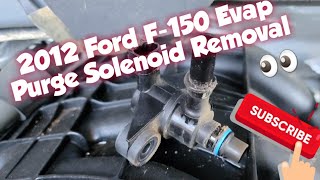
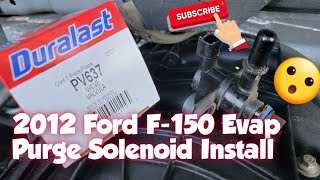
Typical fix: Replace the canister purge valve. It is located on the driver's side of the 5.0L engine's intake manifold and is held by two 8mm bolts.
Est. part cost: $30-$80 - Blocked or Kinked EVAP Hoses 🟡 Medium Probability Hoses can become brittle over time or can be kinked or blocked by debris, especially the lines running to the rear of the truck. Ford TSB 21-2106 for the Transit notes a kinked vent line as a cause for P1450.
How to confirm: Visually inspect all EVAP lines running from the engine to the charcoal canister near the fuel tank. Look for any visible kinks, damage, or blockages. Pay special attention to the vent line that runs from the canister to the vent solenoid.
Typical fix: Straighten any kinked hoses or replace any that are damaged or clogged.
Est. part cost: $20-$100 - Clogged Canister Vent Solenoid or Filter ⚪ Low Probability The vent solenoid and its filter are located near the spare tire, making them susceptible to being clogged with dirt, mud, or debris from the road. This is a well-documented issue on F-150s.
How to confirm: Locate the charcoal canister and vent solenoid assembly near the spare tire. Inspect the filter box and vent tube for any blockages. One owner on f150forum.com noted a 'prefilter' box on the assembly was completely filled with dirt, and cleaning it solved the P1450 code. You can attempt to blow through the vent solenoid with low pressure air to check for restrictions.
Typical fix: Clean the debris from the filter and vent tube. If the solenoid itself is stuck closed, it will need to be replaced.
Est. part cost: $40-$100
Rare But Worth Checking
- Faulty Fuel Tank Pressure (FTP) Sensor: While less common, the sensor that reads the tank pressure can fail and send incorrect data to the PCM, causing it to set the P1450 code. This is listed as a potential cause in Ford's diagnostic aids.
- Restricted EVAP Charcoal Canister: This can happen if you habitually 'top off' your fuel tank after the pump clicks off. This can force liquid fuel into the canister and saturate the charcoal, causing a restriction. A canister saturated with fuel will often be accompanied by a strong fuel smell.
Diagnosis Steps
- Confirm the P1450 code is present using an OBD-II scanner.
- After driving, listen for a 'whoosh' sound when opening the fuel door, which indicates excessive vacuum is present.
- Start the engine and let it idle. Locate the canister purge valve on the driver's side of the 5.0L engine's intake manifold.
- Disconnect the electrical connector from the purge valve.
- Disconnect the EVAP line that runs from the purge valve back towards the fuel tank. There is a small tab to press to release the connector.
- Place your finger over the port on the purge valve where the hose was connected. If you feel any vacuum suction, the valve is stuck open and must be replaced. This is the most common failure.
- If the purge valve is not leaking, proceed to inspect the EVAP lines for kinks or blockages between the engine and the fuel tank.
- Inspect the canister vent solenoid and its filter, located near the spare tire, for clogs from dirt or debris. Pay close attention to the small pre-filter box on the assembly.
- If all other components are confirmed to be working, the Fuel Tank Pressure (FTP) sensor may be faulty.
Parts You'll Likely Need
- Vapor Canister Purge Valve
(OEM #AU5Z-9C915-B (Superseded by AU5Z-9C915-E))— This is the most frequent cause of code P1450 on this F-150. It gets stuck open, allowing constant engine vacuum to be applied to the fuel tank.
Trusted brands: Motorcraft, Bosch, Dorman, Standard Motor Products (CP758)
OEM price range: $40-$70
Aftermarket price range: $25-$50
Related Codes That Often Appear With This One
- P0496 — This is another EVAP code often related to a faulty purge valve, indicating 'Evaporative Emission System High Purge Flow'.
- P0455 — A purge valve that is stuck completely open can sometimes be interpreted by the vehicle's diagnostic system as a very large leak in the EVAP system, triggering this code.
- P0171/P0174 — If the purge valve is stuck open, it creates a vacuum leak that can cause the engine to run lean, potentially triggering 'System Too Lean' codes for Bank 1 and Bank 2.
Technical Service Bulletins (TSBs) & Recalls
- TSB 11-1-5: Addresses rough running and/or hard start after refueling for 2009-2010 F-150s with code P1450, directing replacement of the canister purge valve.
- TSB 21-2106 (For Ford Transit): While not for the F-150, it documents P1450 being caused by a kinked evaporator emissions fresh air vent line, showing it's a plausible cause to investigate.
Platform-Specific Known Issues
- The NHTSA has received multiple owner complaints about this code on various Ford models, frequently pointing to a stuck canister purge valve causing stalling after refueling.
- Ford TSB 11-1-5, for 2009-2010 F-150s, explicitly identifies P1450 with hard start after refueling and directs technicians to replace the canister purge valve, corroborating this as the primary fix.
- A user on f150forum.com with a 2008 F-150 experiencing P1450 found the 'prefilter' box on the EVAP canister assembly completely filled with dirt. Cleaning it out resolved the code and the hard-start symptom.
Mechanic-Grade Diagnostic Values
- Canister Purge Valve Solenoid Resistance — expected: 30 to 38 ohms. Failure: A reading significantly outside this range, or an open/short circuit, indicates a failed solenoid.
- Canister Vent Solenoid Resistance — expected: 48 to 65 ohms. Failure: A reading of 'OL' (open circuit) or near 0 ohms indicates a failed solenoid.
- Fuel Tank Pressure (FTP) Sensor Voltage (KOEO, atmospheric pressure) — expected: ~2.4V - 2.7V. Failure: A reading significantly outside this range with the gas cap off suggests a faulty sensor or wiring issue.
- Voltage at Canister Vent Valve Connector (Pin 1) — expected: Battery Voltage (~12.6V) with Key On, Engine Off. Failure: Low or no voltage indicates a wiring or fuse issue (check fuse F26 in the under-hood box).
Hidden / Shadow Codes Worth Checking
- Mode $06, Test ID $39: This monitor test checks the EVAP system's ability to hold pressure/vacuum for leak detection. A failure here can point to an emerging issue even if a specific DTC like P1450 hasn't set yet. (see via A professional scan tool or advanced DIY software like FORScan that can access Mode $06 test results.)
Scan Tool Commands That Help
- Ford IDS, FORScan, high-end bidirectional scanners: EVAP System Test / Output State Control (OSC) — Allows the technician to command the canister purge and vent solenoids on and off independently. This is used to verify solenoid function (listening for a click) and to seal the system for a smoke or vacuum test without having to manually apply power to the components.
Wiring & Ground Locations
- Canister Purge Valve Connector — On the driver's side of the 5.0L engine's intake manifold, just above the throttle body.. This is the primary connection point for testing and replacing the most common failed part for P1450.
- Connector C435 — The electrical connector at the EVAP canister vent valve solenoid, located on the driver's side frame rail near the fuel tank.. This is the primary test point for checking voltage and resistance of the vent solenoid, a less common but possible cause.
- Ground G401 — Under the rear of the vehicle, located above the spare tire.. This is a primary chassis ground point for several rear-mounted components, including the EVAP vent solenoid. A corroded or loose ground here can cause intermittent circuit issues for the vent solenoid.
- Fuse F26 — In the under-hood Battery Junction Box (power distribution box).. This fuse provides the 12V power supply to the EVAP canister vent solenoid. A blown fuse will cause a vent solenoid circuit code, but it's a relevant part of the system to check.
Real Owner Repair Stories
- f150forum.com user 'ahlbe1cl' (2008 Ford F-150 5.4L (Note: Pre-generation but same P1450 issue and functionally similar components)) — P1450 code present, hard to start after filling the fuel tank, especially when over 3/4 full.
❌ Tried (didn't work) Initial visual inspection revealed nothing obvious.
✅ What actually fixed it The user located a small 'prefilter' box attached to the EVAP canister assembly near the spare tire. This box was completely filled with dirt. After removing the assembly and cleaning out the filter box and canister with compressed air, the hard-start symptom and P1450 code were resolved.
"I Checked Everything" — The Actual Cause
- Because P1450 is an 'excessive vacuum' code, not a leak code, a smoke test will almost always come back clean. The issue is not air getting out, but rather air not being able to get in (blocked vent) or vacuum being applied when it shouldn't be (stuck purge valve). A clean smoke test strongly points away from a leak and toward a component failure or blockage, which is the normal diagnostic path for this code.
OEM Part Supersession History
AU5Z-9C915-A, AU5Z-9C915-B, AU5Z-9C915-C, AU5Z-9C915-D→AU5Z-9C915-E— Standard part revision by Ford, likely for improved durability, material changes, or manufacturing process updates.
Heads up: The new part number AU5Z-9C915-E is a direct, fully compatible replacement for the previous versions.
Model Year Variations Within This Range
- 2011-2014: The canister purge valve (Motorcraft AU5Z-9C915-B/E) for the 5.0L engine is located on the driver's side of the intake manifold, making it much easier to access than on the 2009-2010 models with 4.6L/5.4L engines, where it was located on the top rear of the engine near the firewall.
Diagnostic Flowchart
Other Known Issues on This Vehicle
Issues unrelated to this code that are worth knowing about as an owner of this generation:
- Coolant Leak from Upper Radiator Hose T-Connector 🔴 High — Extremely common. The O-rings in the plastic quick-connect T-fitting degrade, causing leaks that often drip down onto the front differential or run along the oil pan, appearing to come from the rear of the engine.
- Molded Lead Frame Connector Failure (6R80 Transmission) 🔴 High — Common enough to warrant a recall (e.g., 19S07). Causes sudden, unexpected downshifts to 1st or 2nd gear, loss of speedometer, and transmission getting stuck in one gear. (Ref: Recall 19S07)
- Fuel Pump Fuse #27 Relocation 🔴 High — A well-documented fire and stalling hazard. The original 20A mini-fuse in slot 27 of the under-hood fuse box can overheat and melt, causing a sudden loss of power to the fuel pump. (Ref: TSB 15-0137)
- Abnormal Intake Valve Wear / Engine Knock 🟠 Medium — Affected a number of early 2011-2012 5.0L engines, sometimes described as an out-of-round cylinder issue or excessive valve wear, leading to a knocking sound and potential engine replacement. Less common on 2013-2014 models.
- Coolant Leak from Reservoir Tank Hose 🟠 Medium — The quick-connect fitting on the small hose at the bottom of the coolant reservoir is a frequent leak point. The official fix is often to replace the entire reservoir/airbox assembly, but aftermarket kits exist to replace just the fitting.
Used vs. New Parts: Buying Guide for This Vehicle
When a used part is the smart pick: For this specific repair, buying used parts is generally not recommended. The primary failure part, the canister purge valve, is an inexpensive electronic solenoid that wears out over time. A new OEM or quality aftermarket part offers significantly more reliability for a low cost.
Donor-vehicle mileage cap: roughly under 60000 miles for the part to have meaningful remaining life.
What to inspect on the donor part:
- If considering a used charcoal canister, ensure it comes from a vehicle in a dry climate to minimize moisture and dirt contamination.
- Shake the canister; if it rattles like a maraca, the internal charcoal is broken down and the part is useless.
- Inspect all hose connection points for cracks or brittleness.
OEM-only on this vehicle (don't cheap out):
- Canister Purge Valve: While some aftermarket versions work, owner reports suggest some brands have a high failure rate. Given the low cost of the OEM Motorcraft part (AU5Z-9C915-E), it is the most recommended choice for reliability.
Aftermarket brands forum-validated for this vehicle:
- Standard Motor Products (SMP)
- Bosch
Brands owners have reported issues with on this vehicle:
- Dorman: Some owners have reported premature failure of Dorman-branded purge valves, sometimes within a few thousand miles, leading to a recurrence of the P1450 code and symptoms.
Real Owner Stories
Aggregated from forums and TSBs cited above. Mileages and costs reflect what owners reported in those sources.
2008 Ford F-150
Symptoms: P1450 code and hard-start symptoms after refueling.
What fixed it: Cleaning out a 'prefilter' box on the EVAP canister assembly that was completely filled with dirt.
Source hint: f150forum.com Thread 'P1450 Error Code Excessive Fuel tank Vacuum'
2011-2014 Ford F-150 5.0L
Symptoms: Hard start after fueling and a P1450 code; the valve passed a manual 'blow through' test but was still failing.
What fixed it: Replacement of the canister purge valve, confirming that these valves can fail intermittently.
Source hint: f150forum.com Thread 'Hard start after fueling'
2009-2010 Ford F-150
Symptoms: Rough running and/or hard start immediately after refueling with code P1450 present.
What fixed it: Replacement of the canister purge valve as directed by the manufacturer.
Source hint: TSB 11-1-5
Related OBD-II Codes
Frequently Asked Questions
Does TSB 11-1-5 apply to my 2011-2014 Ford F-150 with the 5.0L engine?
Where is the canister purge valve located on my 5.0L V8 F-150?
I hear a 'whoosh' sound when I open my capless fuel door; is this related to P1450?
Can a dirty air filter near the spare tire cause this code?
Is there a specific fuse I should check if my truck stalls after getting gas?
Why does my F-150 only have trouble starting right after I fill up the gas tank?
Helpful Videos
Used OEM Parts in Stock

New Aftermarket Parts Available


The information in this article is provided for general reference and educational purposes only. Vehicle specifications, procedures, and part compatibility can vary by production date, trim level, and region. Always consult your vehicle's factory service manual and verify part numbers before purchasing or performing repairs. Safety-critical components such as airbags, seat belts, and braking systems should be installed by a qualified professional.
- Ford F-150:
- 🎬 Helpful Videos
- 🛍️ Shop This Part
- What's Unique About the 2011-2014 Ford F-150
- Symptoms You May Notice
- Most Likely Causes
- Rare But Worth Checking
- Diagnosis Steps
- Parts You'll Likely Need
- Related Codes That Often Appear With This One
- Technical Service Bulletins (TSBs) & Recalls
- Platform-Specific Known Issues
- Mechanic-Grade Diagnostic Values
- Hidden / Shadow Codes Worth Checking
- Scan Tool Commands That Help
- Wiring & Ground Locations
- Real Owner Repair Stories
- "I Checked Everything" — The Actual Cause
- OEM Part Supersession History
- Model Year Variations Within This Range
- Diagnostic Flowchart
- Other Known Issues on This Vehicle
- Used vs. New Parts: Buying Guide for This Vehicle
- Real Owner Stories
- 2008 Ford F-150
- 2011-2014 Ford F-150 5.0L
- 2009-2010 Ford F-150
- Related OBD-II Codes
- Frequently Asked Questions
- 🎟️ Get 5% Off