

P1441 on 1996-2001 Oldsmobile Bravada: EVAP Flow During Non-Purge Causes and Fixes
On a 1996-2001 Oldsmobile Bravada, code P1441 is almost always caused by a faulty EVAP Purge Solenoid Valve located on the engine's intake plenum. This is a common failure, and a replacement part typically costs between $25 and $50 for an easy DIY fix. Confirm the failure by removing the valve and trying to blow through it; if air passes, it's bad.
- P1441 means the EVAP purge valve is likely stuck open.
- The most probable fix is replacing the EVAP Canister Purge Solenoid Valve on top of the engine, a simple and inexpensive DIY job.
- Before replacing the part, perform a quick blow-through test on the old solenoid to confirm it has failed.
- Always replace the small seal under the purge solenoid to prevent future vacuum leaks.
- If charcoal pellets are found in the EVAP lines, the charcoal canister must also be replaced and the lines cleaned to prevent a repeat failure.
What's Unique About the 1996-2001 Oldsmobile Bravada
The Oldsmobile Bravada from this era is part of GM's GMT330 platform, which it shares with the Chevrolet S-10 Blazer and GMC S-15 Jimmy. These trucks are known for issues with the EVAP system, particularly the purge solenoid valve mounted on the 4.3L V6 engine. The Bravada was positioned as the upscale version, featuring the full-time 'SmartTrak' all-wheel-drive system as standard, but it shares the same core engine and emissions components as its Chevy and GMC counterparts. For the 1996 model year specifically, a Technical Service Bulletin (TSB) was issued for a potential software glitch in the vehicle's computer that could falsely trigger a P1441 code, which could be resolved by reprogramming the VCM (Vehicle Control Module).
Symptoms You May Notice
- Check Engine Light is on
- Slightly rough or unstable idle, especially after refueling
- A faint fuel odor near the engine bay
- Difficulty starting the engine when it's hot (rare)
- Reduced fuel economy
- A slight 'whoosh' sound when opening the gas cap may be absent, as the system is not holding a vacuum.
- Replacing the gas cap. A bad gas cap typically causes a large leak code like P0455 or a small leak code (P0442), not a flow-during-non-purge code.
- Replacing the EVAP Vent Solenoid. The vent solenoid is located near the fuel tank and is responsible for sealing the system for pressure tests. While it can fail, it typically sets other codes (like P0446 or P0449) and is not the cause of P1441.
Most Likely Causes
- Faulty EVAP Canister Purge Solenoid Valve 🔴 High Probability The purge solenoid on the GM 4.3L V6 is a very common failure item. Its internal diaphragm or plunger can fail, causing it to get stuck open internally due to age or contamination from a deteriorating charcoal canister.
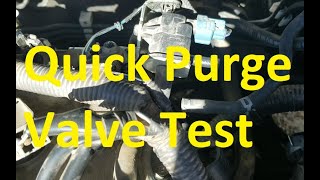
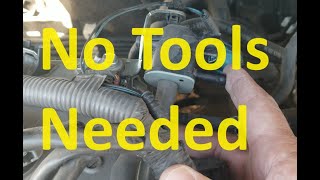
How to confirm: With the engine off, disconnect the electrical connector and both vacuum lines from the solenoid. Try to blow through it. If any air passes, the valve is stuck open and is faulty. 🎬 Watch: How to test if your purge valve is stuck open without tools. Alternatively, attach a hand vacuum pump to the solenoid's intake manifold port; it should hold vacuum. If it doesn't, it's bad. Sometimes, lightly tapping the solenoid can temporarily free the stuck valve, which also confirms it needs replacement.
Typical fix: Replace the EVAP canister purge solenoid valve and its mounting seal. It is located on the intake plenum near the front of the engine, held by a small bracket. 🎬 Watch: GM 4.3L V6 purge valve removal and installation guide.
Est. part cost: $25-$50 - Deteriorated or Cracked EVAP Vacuum Hoses 🟡 Medium Probability The vacuum lines, especially the rubber elbows and connectors, can become brittle and crack over time due to engine heat and age, causing leaks that can sometimes contribute to this code.
How to confirm: Visually inspect all vacuum lines connected to the purge solenoid and the charcoal canister for cracks, splits, or loose connections. A smoke test is the most definitive way to find small, hard-to-see leaks in the system.
Typical fix: Replace the damaged section of vacuum hose or the entire line.
Est. part cost: $5-$20 - Contaminated Charcoal Canister ⚪ Low Probability If the charcoal canister begins to break down internally, small black charcoal pellets can travel through the EVAP lines and jam the new or existing purge solenoid open, causing a recurring P1441 code. This is often a result of consistently overfilling the fuel tank.
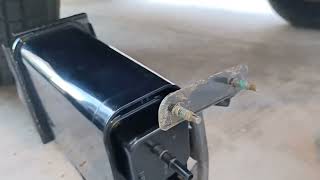
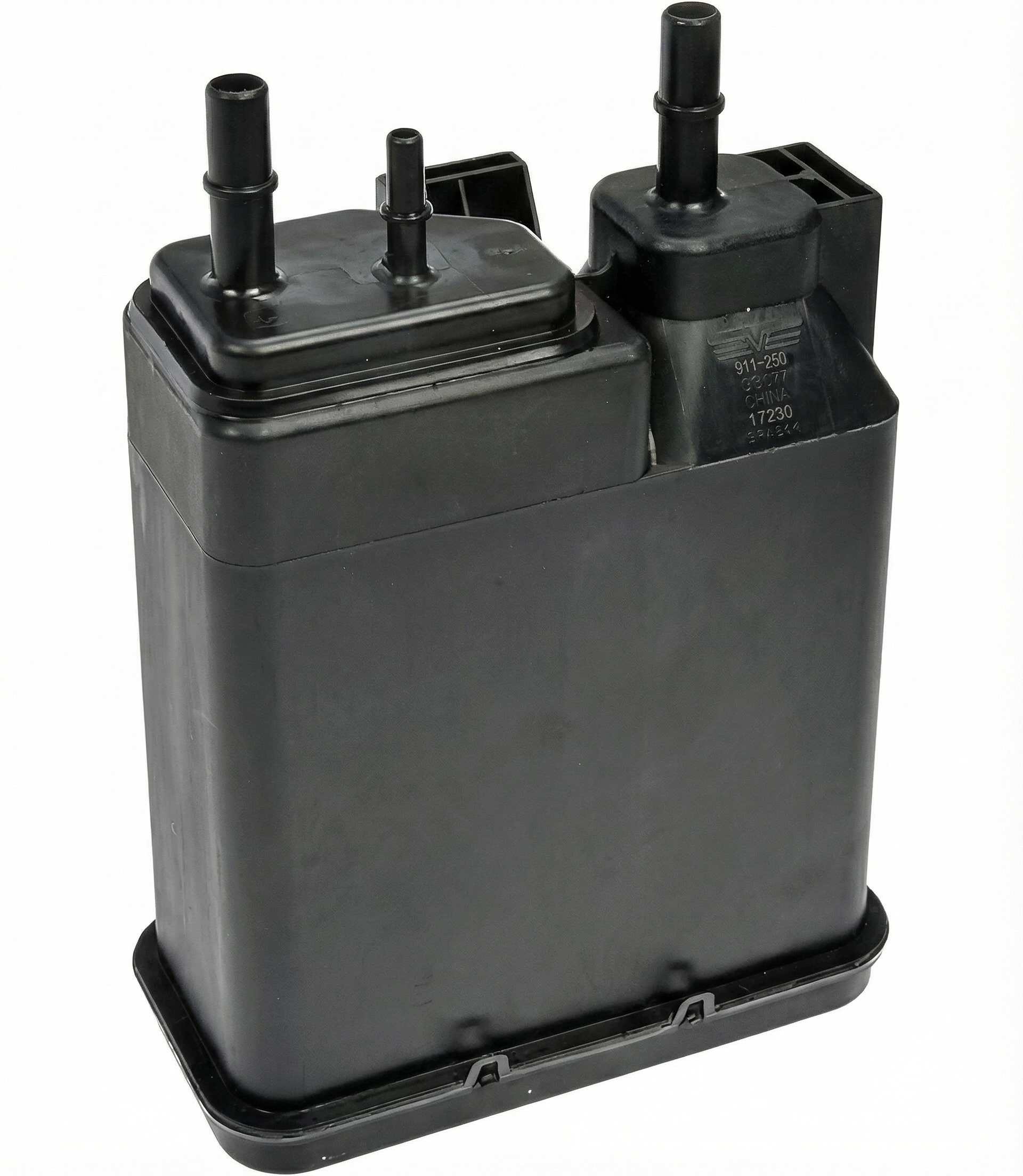
How to confirm: Disconnect the EVAP line at the purge solenoid that comes from the canister. Check for the presence of black charcoal pellets inside the line or the solenoid's inlet port. If charcoal is found, shake the canister; if it rattles, it is defective. 🎬 See this walkthrough on replacing a contaminated charcoal canister.
Typical fix: If charcoal is found, the charcoal canister, purge solenoid, and vent solenoid must all be replaced. All EVAP lines must be thoroughly blown out with compressed air to clear any remaining contamination before installing new parts.
Est. part cost: $70-$150
Rare But Worth Checking
- VCM Software Glitch (1996 models): A Technical Service Bulletin (00-06-04-039) was issued for some 1996 models where the Vehicle Control Module (VCM) calibration was too sensitive and could incorrectly set a P1441. The fix is to have a dealership reprogram the VCM with an updated calibration.
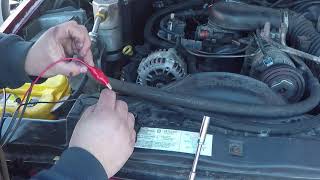
- Shorted Purge Solenoid Control Wire: If the control wire (ground side) for the purge solenoid shorts to ground, the solenoid can be held open continuously, mimicking a stuck valve. This can be tested with a test light on the control wire with the key on, engine off; the light should not illuminate.
Diagnosis Steps
- Verify the code with an OBD-II scanner. Confirm P1441 is present and note any other codes.
- Locate the EVAP Purge Solenoid on the engine's intake plenum, near the ignition coil.
- Test the Purge Solenoid mechanically. Disconnect the electrical connector and both vacuum lines. Try to blow through the solenoid. If air passes through, the valve is stuck open and must be replaced. This is the most common failure.
- (Alternate Test) Use a hand vacuum pump on the port that leads to the intake manifold. With the solenoid de-energized, it should hold vacuum. If it bleeds down, it is faulty.
- Check for charcoal contamination. Inspect the vacuum line coming from the rear of the vehicle and the inlet port of the solenoid for black charcoal pellets. If found, the canister is failing and the entire system is contaminated.
- Inspect vacuum lines. Carefully check all EVAP hoses running from the canister (near the fuel tank) to the purge solenoid for obvious cracks, brittleness, or loose connections, especially at the rubber elbows.
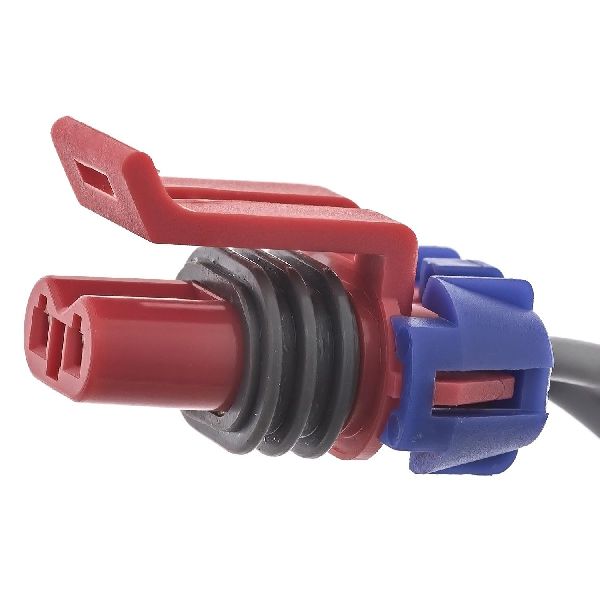
- Test the electrical circuit. If the solenoid tests good mechanically, check for a shorted wire. The connector has a Pink wire (ignition power) and a Dark Green/White wire (PCM control). Connect a test light to battery positive and probe the Dark Green/White wire at the solenoid's connector (key on, engine off). The light should not illuminate. If it does, the circuit is shorted to ground.
- For 1996 models, if no mechanical or electrical fault is found, investigate TSB 00-06-04-039 regarding a VCM re-flash.
Parts You'll Likely Need
- EVAP Canister Purge Solenoid Valve
(OEM #ACDelco 214-641 (GM 1997278))— This is the most common failure point for code P1441 on this vehicle, as the internal valve tends to stick open.
Trusted brands: ACDelco (OEM), Standard Motor Products (CP412), Dorman (911-385)
OEM price range: $40-$70
Aftermarket price range: $25-$45 - Purge Solenoid Mounting Seal/Gasket — The old seal can become hard and brittle, and will not seal properly if reused. It is critical to replace it to prevent a vacuum leak.
Trusted brands: Dorman, Fel-Pro
OEM price range: $5-$10
Aftermarket price range: $3-$8
Technical Service Bulletins (TSBs) & Recalls
- 00-06-04-039: Addresses an issue on 1996 models where the SES light may illuminate with a DTC P1441 due to a sensitive VCM calibration; the fix is to reprogram the VCM.
Platform-Specific Known Issues
- For 1996 models, a specific TSB (00-06-04-039) exists that addresses a potential software issue in the VCM that could cause a false P1441. The solution is a dealer-performed software update.
Mechanic-Grade Diagnostic Values
- EVAP Purge Solenoid Coil Resistance — expected: 30 to 38 ohms. Failure: A reading significantly outside this range indicates a faulty solenoid coil.
- Fuel Tank Vacuum Level (DTC Trigger) — expected: Pressure should not decrease below -11 inches of H2O when the purge valve is commanded OFF.. Failure: If the vacuum level increases (pressure drops below -11 in. H2O) during the non-purge test, it indicates an unwanted flow and sets DTC P1441.
- Purge Solenoid Control Circuit Voltage (Key On, Engine Off) — expected: Near battery voltage (B+). Failure: A low or zero voltage reading indicates a short to ground in the control wire or a faulty PCM driver.
Scan Tool Commands That Help
- GM Tech 2 (or equivalent professional scanner): EVAP Purge/Seal Function Test — This bidirectional command allows the technician to manually command the purge and vent solenoids on and off to test their operation and check if the system can hold a vacuum, directly verifying the function of the components involved in P1441.
- GM Tech 2 (or equivalent professional scanner): EVAP Purge Solenoid Control (% duty cycle) — Allows the technician to command the purge solenoid from 0% to 100% while monitoring fuel tank pressure or short-term fuel trim. This can confirm if the valve is physically responding to the PCM's commands. A change in fuel trim should be observed when the valve is opened.
Wiring & Ground Locations
- EVAP Purge Solenoid Connector — On the EVAP purge solenoid, located on the top of the engine's intake plenum.. This is where electrical tests are performed. Pin A (Pink wire) should have ignition voltage with the key on. Pin B (Dark Green/White wire) is the control circuit, grounded by the PCM to open the valve.
- G117 — On the right rear of the engine block.. This is a primary engine ground point shown on wiring diagrams for the sister vehicle, the Chevy Blazer. A poor connection here could potentially affect the PCM's ability to control engine-mounted solenoids, although it's an unlikely cause for this specific code.
Real Owner Repair Stories
- GM Forum user (2003 Pontiac Bonneville SSEi (Similar GM EVAP system and P1441 code)) — Service Engine Soon light with code P1441.
❌ Tried (didn't work) Initial diagnosis at a dealership was quoted at $80 before any repairs.
✅ What actually fixed it The owner decided to replace the most likely components themselves. They purchased the EVAP purge solenoid, valve, and canister for approximately $65 from an online GM parts dealer and replaced them. This resolved the code and the issue did not return.
OEM Part Supersession History
1997301→1997278— Standard part evolution and replacement.
Heads up: The newer part number (1997278) is the correct service replacement for the original.
Model Year Variations Within This Range
- 1998-2001: Starting in 1998, all vehicles were required to have 'Enhanced EVAP' systems. While the P1441 code's cause (stuck purge valve) remains the same, the 1998-2001 models have a more sophisticated self-test routine that uses a dedicated fuel tank pressure sensor to monitor the system, making the diagnosis slightly different from earlier, non-enhanced systems.
- 1996: As noted in TSB 00-06-04-039, 1996 models may have an overly sensitive VCM calibration that can falsely trigger a P1441 code. This is a software issue unique to this model year that requires a dealer re-flash, not a hardware replacement.
Diagnostic Flowchart
Other Known Issues on This Vehicle
Issues unrelated to this code that are worth knowing about as an owner of this generation:
- Lower Intake Manifold (LIM) Gasket Leak 🔴 High — Extremely common failure. The original plastic-framed gaskets degrade, causing external coolant leaks or, more severely, internal leaks mixing coolant with engine oil.
- Central Port 'Spider' Fuel Injector Failure 🟠 Medium — The original Central Sequential Fuel Injection (CSFI) system is prone to failure, with injectors sticking or leaking fuel, causing misfires (P030x), rough running, and hard starting. An upgraded Multiport Fuel Injection (MFI) spider is the common fix.
- SmartTrak AWD Transfer Case Failure 🟠 Medium — The BorgWarner 4472 (or similar) transfer case can suffer from issues with the viscous clutch or encoder motor, leading to binding during turns ('crow hop') or complete failure of the AWD system. Using incorrect fluid or fluid breakdown is a common cause. (Ref: GM Document ID# 1242381 addresses a shudder issue fixed by an encoder motor module replacement and fluid flush on similar platforms.)
- Distributor and Ignition Component Wear 🟡 Low — The distributor gear can wear over time, leading to timing issues, rough idle, and misfires. The cap and rotor are regular maintenance items.
- Fuel Pump Failure 🟠 Medium — The in-tank fuel pump module is a common failure item, often preceded by long crank times, whining from the tank, or stalling.
Used vs. New Parts: Buying Guide for This Vehicle
When a used part is the smart pick: A used part only makes sense for the charcoal canister, which can be expensive new. A used purge solenoid is not recommended as it is a high-failure, low-cost part.
Donor-vehicle mileage cap: roughly under 100000 miles for the part to have meaningful remaining life.
What to inspect on the donor part:
- For a charcoal canister, inspect the donor part for any physical cracks or damage.
- Shake the canister vigorously; if you hear any rattling, it means the internal charcoal bed has broken apart and the canister is bad.
- Ensure all hose ports are intact and not broken or clogged with dirt.
Aftermarket brands forum-validated for this vehicle:
- ACDelco (OEM supplier)
- Standard Motor Products (SMP)
- Dorman
Brands owners have reported issues with on this vehicle:
- No-name, unbranded parts sold on online marketplaces should be avoided, as the quality of their internal diaphragms and electronics is unverified and can lead to a quick repeat failure.
Real Owner Stories
Aggregated from forums and TSBs cited above. Mileages and costs reflect what owners reported in those sources.
1996-2001 Chevrolet S-10 Blazer 4.3L V6
Symptoms: Check Engine Light was on for code P1441. Upon inspection, found small black charcoal pellets inside the EVAP vapor lines coming from the rear of the vehicle.
What fixed it: The problem was a failed charcoal canister that was breaking apart internally. The fix required replacing the canister and the purge solenoid, and then thoroughly blowing out all the EVAP lines with compressed air to clear the contamination.
Source hint: BlazerForum.com - Thread 'P1441: Charcoal in Vapor Lines / Bad Canister'
Related OBD-II Codes
Frequently Asked Questions
My Bravada is a 1996 model. Is there anything special I should know about code P1441?
I replaced the EVAP purge solenoid on my Bravada, but the P1441 code came back. What's the most likely cause?
How do I know if the charcoal canister is bad on my 4.3L V6?
What is the most common and easiest-to-test cause for P1441 on this engine?
Where is the EVAP purge solenoid located on my Oldsmobile Bravada?
If I find charcoal pellets in the EVAP lines, can I just clean them out?
Are other GM trucks like the S-10 Blazer or GMC Jimmy also prone to this P1441 issue?
Helpful Videos
Used OEM Parts in Stock
New Aftermarket Parts Available


The information in this article is provided for general reference and educational purposes only. Vehicle specifications, procedures, and part compatibility can vary by production date, trim level, and region. Always consult your vehicle's factory service manual and verify part numbers before purchasing or performing repairs. Safety-critical components such as airbags, seat belts, and braking systems should be installed by a qualified professional.
- Oldsmobile Bravada:
- 🎬 Helpful Videos
- 🛍️ Shop This Part
- What's Unique About the 1996-2001 Oldsmobile Bravada
- Symptoms You May Notice
- Most Likely Causes
- Rare But Worth Checking
- Diagnosis Steps
- Parts You'll Likely Need
- Technical Service Bulletins (TSBs) & Recalls
- Platform-Specific Known Issues
- Mechanic-Grade Diagnostic Values
- Scan Tool Commands That Help
- Wiring & Ground Locations
- Real Owner Repair Stories
- OEM Part Supersession History
- Model Year Variations Within This Range
- Diagnostic Flowchart
- Other Known Issues on This Vehicle
- Used vs. New Parts: Buying Guide for This Vehicle
- Real Owner Stories
- 1996-2001 Chevrolet S-10 Blazer 4.3L V6
- Related OBD-II Codes
- Frequently Asked Questions
- 🎟️ Get 5% Off