

P1437 on 2010-2016 Mercedes E-Class: A/C or Exhaust Sensor Fault? (Gas vs. Diesel)
The meaning of code P1437 on a 2010-2016 E-Class depends entirely on the engine. On diesel models (like the E350 BlueTEC with the OM642 engine), it indicates a failed Exhaust Gas Temperature (EGT) sensor. On gasoline models, it points to a fault in the air conditioning (A/C) system, often the evaporator temperature sensor or a communication failure with the A/C module.
- **Crucially, you must know if your E-Class is gasoline or diesel.** The fix for one will not work for the other.
- For **diesel** engines, P1437 means a bad **Exhaust Gas Temperature (EGT) sensor**. Do not delay this repair to avoid damaging the DPF.
- For **gasoline** engines, P1437 means a fault in the **A/C system**, most likely the evaporator temperature sensor.
- A generic OBD-II code reader is not sufficient. You need a scanner that can read Mercedes-specific codes from the A/C and engine modules to diagnose this correctly.
- Do not replace the DPF on a diesel or the A/C compressor on a gasoline model until you have diagnosed the relevant sensor circuit first.
What's Unique About the 2010-2016 Mercedes-Benz E-Class
The W212/C207 E-Class platform was offered with a wide range of engines, including V6 gasoline (M272/M276) and V6 diesel (OM642) options. Mercedes assigned code P1437 to two different systems. On the diesel engines, which use a complex after-treatment system with a Diesel Particulate Filter (DPF), the EGT sensors are critical for managing DPF regeneration. A failure can halt this process. On gasoline models, the same code was assigned to a less critical, body-related system: the climate control's evaporator temperature sensor or its communication bus. This dual-meaning is a common source of confusion, and using a generic code definition can lead to replacing completely unrelated parts.
Generation note: This guide covers the W212 (Sedan/Wagon), C207 (Coupe), and A207 (Convertible) E-Class models from 2010-2016. The primary difference regarding this code is not the generation but the engine type (gasoline vs. diesel).
Symptoms You May Notice
- For Diesel Engines:
- Check Engine Light is on
- Vehicle may enter a power-limiting 'limp mode'
- Warning messages related to the Diesel Particulate Filter (DPF), such as 'DPF Full'
- Failure of the DPF to perform automatic regeneration
- AdBlue or exhaust fluid warnings may appear
- Noticeable increase in soot from the exhaust if DPF becomes critically full
- For Gasoline Engines:
- Check Engine Light may be on
- Air conditioning (A/C) blows warm or ambient air
- A/C compressor does not engage
- A/C system may shut down after a few minutes of operation
- On some climate control units, the A/C button light may blink several times before turning off
- Replacing A/C components (compressor, refrigerant) on a gasoline model without first checking the evaporator temperature sensor.
- Replacing the expensive Diesel Particulate Filter (DPF) on a diesel model when a faulty EGT sensor is the true cause of regeneration failure.
- Using a generic OBD-II scanner that provides the wrong definition for the vehicle's engine, leading to diagnosing the wrong system entirely.
- On a diesel, replacing the wrong EGT sensor due to misidentification. The OM642 has multiple sensors in different locations that are not interchangeable.
Most Likely Causes
- Diesel Only: Failed Exhaust Gas Temperature (EGT) Sensor 🔴 High Probability EGT sensors are located in the hot exhaust stream and fail over time due to extreme temperature cycles. The OM642 diesel engine has up to four EGT sensors as part of its DPF and emissions system, and their failure is a common maintenance item.
How to confirm: Use a Mercedes-specific scan tool (like Xentry/DAS) to monitor live data from all EGT sensors. The faulty sensor will often show an erratic, stuck, or illogical temperature reading (e.g., stuck at 250°C, or not changing with engine load) compared to the others.
Typical fix: Replace the failed EGT sensor. Diagnosis is key to replacing the correct one. There are multiple sensors with different part numbers and locations (pre-turbo, post-turbo, pre-DPF, post-DPF).
Est. part cost: $80-$200 - Gasoline Only: Failed A/C Evaporator Temperature Sensor 🔴 High Probability This sensor (also known as B10/4) is located deep within the dashboard in a damp environment, making it prone to failure from contamination or simple age. Its failure prevents the climate control module from properly regulating the A/C compressor to prevent evaporator icing.
How to confirm: A Mercedes-specific scanner is needed to read fault codes and live data from the A/C control module (N19). The sensor's temperature reading will be irrational (e.g., -40°F or 200°F) or will not change.
Typical fix: Replace the evaporator temperature sensor. Access usually involves removing panels in the driver or passenger footwell. The sensor pulls out of the evaporator housing.
Est. part cost: $20-$60 - Damaged Wiring or Connector ⚪ Low Probability On diesel models, the EGT sensor wiring is near the hot exhaust and can become brittle or damaged. On all models, wiring in the footwell area near the A/C sensor can be disturbed during other repairs, like cabin air filter replacement.
How to confirm: Visually inspect the wiring harness leading to the suspected component (EGT sensor or A/C evaporator sensor). Check for continuity and shorts using a multimeter. For EGT sensors, check for 5V reference at the connector.
Typical fix: Repair or replace the damaged section of the wiring harness.
Est. part cost: $10-$100
Rare But Worth Checking
- Gasoline Only: A/C Control Module Malfunction: A forum post for a 2011 E350 specifically mentioned a scanner code for 'Communication with the air conditioner has a malfunction,' which could indicate a problem with the control unit itself, not just the sensor. This requires more advanced CAN bus diagnostics.
- Faulty Engine Control Module (ECM) or Relay: One report for an OM642 engine linked a similar fault code (143700) to a short in 'circuit T 87', which suggests a relay or power supply issue controlled by the ECM. This is a rare and complex diagnosis.
Diagnosis Steps
- Identify Your Engine: Determine if you have a gasoline or diesel engine. This is the most critical first step.
- Scan with a Mercedes-Specific Tool: Use a diagnostic tool capable of reading manufacturer-specific codes from all modules (Engine, A/C, etc.). A generic scanner may not provide the correct definition or access the necessary modules.
- For Diesel Engines (OM642):
- a. Navigate to the engine control module's live data.
- b. Monitor the temperature readings from all exhaust gas temperature sensors while the engine runs. There are up to four sensors.
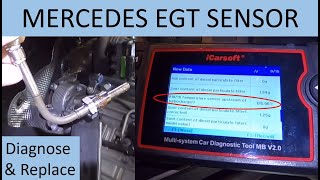
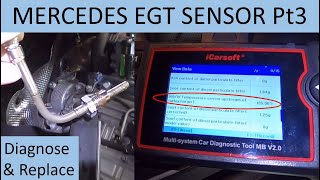
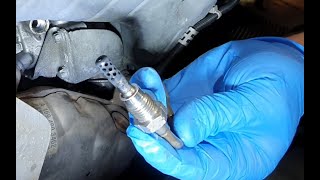
- c. Identify the sensor that provides an illogical or static reading. A common failure is a sensor stuck at a fixed temperature (e.g., 250°C) regardless of engine state 🎬 Watch: How to diagnose a faulty OM642 EGT sensor, or one that reads ambient temperature when the engine is hot.
- d. Unplug the suspect sensor; a functioning sensor should have a resistance of around 220 ohms when cold.
- e. Inspect the wiring to the identified sensor for any signs of heat damage, melting, or corrosion, particularly near the exhaust manifold and DPF.
- For Gasoline Engines (M272/M276):
- a. Navigate to the A/C (or HVAC) control module's live data.
- b. Check for fault codes related to the evaporator temperature sensor (often called B10/4).
- c. Monitor the live temperature reading from the evaporator sensor. If it is irrational (e.g., -40°F or 200°F) or does not change, the sensor is likely faulty.
- d. If the code indicates a communication failure, this points towards a more complex issue with the A/C control module or the vehicle's CAN bus network, requiring advanced diagnostics.
Parts You'll Likely Need
- Exhaust Gas Temperature (EGT) Sensor (Diesel Only)
(OEM #A0009050901 (example, varies by location))— This is the most common cause of P1437 on OM642 diesel engines, failing due to constant heat exposure. There are multiple sensors, and the correct part number depends on its position in the exhaust.
Trusted brands: Bosch, NTK, Genuine Mercedes-Benz
OEM price range: $150-$250
Aftermarket price range: $80-$150 - A/C Evaporator Temperature Sensor (Gasoline Only)
(OEM #2108300772)— This sensor is the most likely cause of P1437 on gasoline models, leading to A/C system malfunction.
Trusted brands: Mahle, Behr, Febi Bilstein, Genuine Mercedes-Benz
OEM price range: $40-$70
Aftermarket price range: $20-$40
Related Codes That Often Appear With This One
- P2031, P2033, P0546 — On diesel models, P1437 may appear with other EGT sensor codes like P2031, P2033, or P0546, each pointing to a specific sensor in the exhaust stream (e.g., 'Sensor 1 Bank 1 Circuit High').
- P2459 — On diesel models, this code for 'Diesel Particulate Filter Regeneration Frequency' can be triggered when a bad EGT sensor (P1437) prevents successful regenerations.
- B10/4 — On gasoline models, this is not a 'P' code but an internal Mercedes fault code for the A/C Evaporator Temperature Sensor, which would be found when scanning the HVAC module directly.
Technical Service Bulletins (TSBs) & Recalls
- LI05.10-P-056435: Addresses the cold-start rattle on M276/M278 engines by recommending the installation of updated chain tensioners and new oil-supply check valves. While not directly related to P1437, it's a critical TSB for owners of the gasoline E-Class models.
Platform-Specific Known Issues
- Multiple EGT Sensor Locations on OM642 Diesel: The OM642 engine has up to four EGT sensors in different locations: one before the turbo, one after the turbo, one before the DPF, and one after the DPF. They are not interchangeable. A helpful diagram showing the physical sensor and electrical connector locations can be found on forums like MBWorld.org, which is crucial for correct diagnosis and replacement.
Mechanic-Grade Diagnostic Values
- Gasoline Only: A/C Evaporator Temperature Sensor (B10/4) Resistance — expected: Resistance changes with temperature. Example values: ~6.3 kΩ at 23°F (-5°C), ~2.3 kΩ at 68°F (20°C), ~1.2 kΩ at 86°F (30°C).. Failure: An open circuit (infinite resistance) or a short circuit (zero resistance). A reading that is wildly out of line with the ambient temperature (e.g., reading 17 kΩ at 72°F) also indicates a failure.
- Diesel Only: EGT Sensor Live Data (Cold Engine) — expected: With the engine cold (off for several hours), all EGT sensors should read a temperature very close to the ambient air temperature.. Failure: One sensor reading a default value like -40°C, 250°C, or a temperature significantly different from the other EGT sensors and ambient temperature.
Hidden / Shadow Codes Worth Checking
- 143700: A Mercedes-specific fault code that often translates to 'A short circuit was detected at pin 2 of circuit 87'. 'Circuit 87' refers to a relay-switched power supply circuit, often controlled by the front SAM (Signal Acquisition Module) or ECM. This points to a power supply or relay issue rather than just a sensor failure. (see via This code is typically seen on more advanced scanners like iCarsoft, Autel, or the dealer-level Xentry/DAS system, and may not show up on basic OBD-II readers.)
- P1436 / P1438: These are companion codes for the diesel EGT sensor, specifying the failure mode. P1436 indicates a short to ground or an open circuit, while P1438 indicates a short to positive. They help pinpoint whether the issue is the sensor itself or the wiring. (see via Mercedes-specific scanners (Xentry, Autel, etc.).)
Scan Tool Commands That Help
- Xentry/DAS: Actual Values (in CDI or A/C Control Unit) — This is the primary diagnostic step. For diesel, navigate to the CDI (engine) module to view all EGT sensor temperatures simultaneously on one screen. For gasoline, navigate to the AAC (A/C) module to view the B10/4 evaporator temperature reading. This allows for direct comparison and identification of a faulty sensor providing illogical data.
- Xentry/DAS: Adaptations / Initial Startup — After replacing certain components, particularly control modules, this function may be required to teach the vehicle about the new part. While typically not required for a simple sensor replacement, if the A/C control module itself is replaced on a gasoline model, an initial startup procedure may be necessary to restore communication.
- Xentry/DAS: Guided Tests — If 'Actual Values' are inconclusive, Xentry provides guided test procedures. For an EGT sensor fault, it may walk the technician through checking wiring, connector pins, and expected resistance values to differentiate between a bad sensor and a wiring problem.
Wiring & Ground Locations
- W11 (or W11/x) — In the engine compartment, typically on the left side inner fender/wheelhouse area.. This is a major ground point for the engine control module (ECM/CDI) wiring harness. A corroded or loose W11 ground can cause erratic sensor readings, including from the EGT sensors on a diesel, leading to incorrect fault codes.
- Main Battery Ground (W10) — The primary ground cable from the battery negative terminal to the chassis, often at the front strut tower in the engine bay.. While a general ground, corrosion at this main point can create system-wide voltage issues that manifest as strange electronic faults. It's a known weak point that can get corroded from water ingress.
- EGT Sensor Harness Connector — On the OM642 diesel, the connectors for the EGT sensors are typically clipped to brackets on or near the engine/turbocharger. The wiring then routes down to the sensors in the exhaust.. The connectors themselves are a failure point. Before replacing a sensor, it's crucial to disconnect it, inspect the pins for corrosion or damage, and test for reference voltage at the harness side. The harness is exposed to extreme heat and can become brittle.
Real Owner Repair Stories
- MBClub UK forum user (2011 E350 CDI (OM642 Diesel)) — Check Engine Light with code P0546 (related to EGT sensor).
❌ Tried (didn't work) Initial code reading pointed to an EGT sensor but didn't specify which one.
✅ What actually fixed it Using a Mercedes-specific scanner, the owner monitored live data and found one EGT sensor was stuck reading 349.96 degrees Celsius while the engine was cold. After plugging in a new sensor (without fully installing it), the live data reading changed to a plausible 25 degrees (ambient). This confirmed the old sensor was faulty. The final fix was the physical replacement of that specific sensor. - YouTube video by 'Mercedes S class will not start' (2013 S-Class 350 BlueTEC (W221 with OM642 engine)) — Engine will not start. Fault code 143700: 'shortcut was detected at pin 2 of circuit 87'.
✅ What actually fixed it The fault code was not caused by a sensor, but by a blown 20-amp fuse in the under-hood fuse box. The 'circuit 87' designation in the fault description pointed to a power supply issue. Replacing the fuse resolved the no-start condition. - MBWorld.org forum user (OM642 350 BlueTEC (model year unspecified)) — Check Engine Light, limp mode, and codes P2089 and P0546 for EGT Bank 1 Sensor 1, even after the sensor was replaced. Also saw DPF soot codes (P2464).
❌ Tried (didn't work) Replacing the EGT sensor blindly based on the code.
✅ What actually fixed it The user was advised that replacing the sensor without clearing the underlying cause was the issue. A faulty EGT sensor prevents DPF regeneration, causing the DPF to fill with soot (triggering P2464). Once the DPF soot level exceeds a certain threshold (e.g., 200%), the vehicle will not perform an automatic regeneration, even with a new, working EGT sensor. The fix requires using a high-level scanner (like Xentry) to force a DPF regeneration after the sensor is replaced, and potentially clearing DPF adaptations.
OEM Part Supersession History
2108300572→2108300772, 2208300772— Standard part evolution and consolidation across multiple chassis.
Heads up: The part number 2108300772 is widely cited for the W212 gasoline models, but it's a very old part number also used on W210, W202, etc. Later models may use a different number, but 2108300772 remains a common replacement. Always verify with VIN.
Diagnostic Flowchart
Other Known Issues on This Vehicle
Issues unrelated to this code that are worth knowing about as an owner of this generation:
- OM642 Diesel Oil Cooler Seal Leak 🔴 High — Very common, especially on pre-2010 models with original orange seals. Can occur any time after 60,000 miles. The job is labor-intensive (8-12 hours). (Ref: Mercedes updated the seals from orange (perbunan) to purple (viton) in later years to improve longevity, but no formal recall was issued.)
- M276/M278 Gasoline Engine Timing Chain Rattle on Startup 🟠 Medium — Common on early production M276/M278 engines (approx. 2011-2013). A metallic rattle for 2-10 seconds after a cold start is the primary symptom. (Ref: TSB LI05.10-P-056435 was issued to address this by installing updated secondary chain tensioners and new check valves in the cylinder heads to prevent oil pressure bleed-down.)
- Airmatic Air Suspension Failure 🟠 Medium — Common on higher-mileage vehicles or those around 8-10 years old. Rear air springs are the most frequent failure point, followed by the compressor and level sensors.
- OM642 Diesel "Black Death" (Injector Seal Leak) 🔴 High — A known issue on many Mercedes diesel engines where the copper injector seals fail, allowing combustion gases to leak and form a hard, tar-like substance around the injectors.
Used vs. New Parts: Buying Guide for This Vehicle
When a used part is the smart pick: For expensive electronic modules like the A/C Control Unit or Front SAM, a used part from a reputable dismantler can offer significant savings. However, be prepared for potential coding/programming requirements.
Donor-vehicle mileage cap: roughly under 80000 miles for the part to have meaningful remaining life.
What to inspect on the donor part:
- For sensors, ensure the connector is free of corrosion, and the wiring isn't brittle or cracked.
- For control modules, check for any signs of water damage or corrosion on the casing and pins.
- Verify the part number on the used component exactly matches the original part being replaced.
OEM-only on this vehicle (don't cheap out):
- Exhaust Gas Temperature (EGT) Sensor (Diesel): These sensors live in a harsh environment and are critical for DPF function. Cheap, unbranded aftermarket sensors have a high failure rate and can lead to repeat repairs or DPF damage. Sticking to Genuine Mercedes-Benz or a known OE supplier like Bosch or NTK is highly recommended.
Aftermarket brands forum-validated for this vehicle:
- A/C Evaporator Temperature Sensor: Behr, Mahle, Vemo, ACM are all reputable OEM or OE-quality suppliers for this part.
- EGT Sensor: Bosch, NTK.
Brands owners have reported issues with on this vehicle:
- Unbranded, no-name EGT sensors from online marketplaces should be avoided. Forum stories suggest they often fail quickly or are dead on arrival, leading to wasted time and labor.
Real Owner Stories
Aggregated from forums and TSBs cited above. Mileages and costs reflect what owners reported in those sources.
2011 Mercedes-Benz E350 Gasoline
Symptoms: The A/C stopped working and the vehicle logged DTC 1437.
What fixed it: The issue was identified as an A/C communication malfunction related to the climate control system.
Source hint: PeachParts Mercedes-Benz Forum: '2011 E350 - AC stopped working. DTC 1437'
Mercedes-Benz E-Class (W212) OM642 Diesel
Symptoms: The owner needed to diagnose which EGT sensor was failing to address a similar exhaust temperature code.
What fixed it: Used a scanner to compare temperature readings across all sensors; the faulty sensor was found stuck at a high temperature.
Source hint: MBClub UK: 'W212 (OM642) Exhaust gas temperature sensor'
Related OBD-II Codes
Frequently Asked Questions
Does TSB LI05.10-P-056435 apply to my 2012 E-Class with the M276 engine?
Why is my E350 diesel entering 'limp mode' with code P1437?
My 2011 E350 gasoline model has code P1437 and the A/C is blowing warm air. What is the likely cause?
How many EGT sensors does my OM642 diesel E-Class have, and are they the same part?
Can I use a generic OBD-II scanner to diagnose P1437 on my Mercedes?
Where is the A/C evaporator temperature sensor located in the E-Class?
Helpful Videos
Used OEM Parts in Stock

New Aftermarket Parts Available



The information in this article is provided for general reference and educational purposes only. Vehicle specifications, procedures, and part compatibility can vary by production date, trim level, and region. Always consult your vehicle's factory service manual and verify part numbers before purchasing or performing repairs. Safety-critical components such as airbags, seat belts, and braking systems should be installed by a qualified professional.
- Mercedes-Benz E-Class:
- 🎬 Helpful Videos
- 🛍️ Shop This Part
- What's Unique About the 2010-2016 Mercedes-Benz E-Class
- Symptoms You May Notice
- Most Likely Causes
- Rare But Worth Checking
- Diagnosis Steps
- Parts You'll Likely Need
- Related Codes That Often Appear With This One
- Technical Service Bulletins (TSBs) & Recalls
- Platform-Specific Known Issues
- Mechanic-Grade Diagnostic Values
- Hidden / Shadow Codes Worth Checking
- Scan Tool Commands That Help
- Wiring & Ground Locations
- Real Owner Repair Stories
- OEM Part Supersession History
- Diagnostic Flowchart
- Other Known Issues on This Vehicle
- Used vs. New Parts: Buying Guide for This Vehicle
- Real Owner Stories
- 2011 Mercedes-Benz E350 Gasoline
- Mercedes-Benz E-Class (W212) OM642 Diesel
- Related OBD-II Codes
- Frequently Asked Questions
- 🎟️ Get 5% Off