

P1326 on 2019 Hyundai Veloster: Engine Failure Warning, Limp Mode, and Fixes
P1326 on a 2019 Veloster means the Knock Sensor Detection System (KSDS) has detected vibrations indicating severe connecting rod bearing wear. This is a critical code that triggers limp mode to prevent catastrophic failure. The most common outcome is an engine inspection and replacement, often covered under an extended warranty (like TXXM or Campaign 966) if specific conditions are met, including having the KSDS software update installed.
- P1326 on a 2019 Veloster is a critical alert for likely connecting rod bearing failure, not just a simple sensor issue.
- Do NOT clear the code or continue driving. The vehicle will be in a protective limp mode. Have it towed to a Hyundai dealer immediately.
- This repair is very often covered by an extended 15-year/150,000-mile warranty (TXXM) from Hyundai, provided the vehicle has had the required KSDS software update (Campaign 966).
- The dealer must perform a specific Bearing Clearance Test (BCT) to confirm the failure. A 'fail' typically leads to a warranty engine replacement, while a 'pass' leads to further diagnosis of the knock sensor and wiring.
What's Unique About the 2019-2019 Hyundai VELOSTER
The 2019 Veloster, particularly models with the 2.0L Nu GDI and 1.6L Gamma GDI/T-GDI engines, is part of a wide-ranging and well-documented issue concerning premature connecting rod bearing failure across the Hyundai/Kia lineup. Hyundai addressed this by issuing service campaigns (like 953 and 966) to install the Knock Sensor Detection System (KSDS) software. Therefore, the P1326 code on a Veloster is a direct consequence of this factory-installed monitoring system 🎬 Watch: How the Knock Sensor Detection System actually works. and serves as the primary alert for a known, widespread engine defect that may be covered by an extended warranty of up to 15 years/150,000 miles.
Diagnostic Flowchart
Tap your situation to follow the diagnostic path that matches what you're seeing on this vehicle.
Symptoms You May Notice
- Flashing Check Engine Light (MIL).
- Audible chime from the dashboard.
- Vehicle enters 'limp mode' (reduced power, will not accelerate past ~1,800-2,000 RPM 🎬 See what happens when your Hyundai enters limp mode.).
- Engine knocking, rattling, or metallic slapping noise.
- Difficulty starting the engine or no-start condition.
- Rough idle or stalling.
- Oil smells like gasoline.
- Replacing the knock sensor without further diagnosis. The P1326 code is generated by a software system (KSDS) using the knock sensor as an input; the sensor itself is rarely the root cause. Replacing it will not fix the underlying mechanical engine wear and the code will likely return.
- Clearing the code. Clearing the P1326 code is strongly discouraged. A Hyundai dealer must see the active code to begin the warranty claim and diagnostic process. The code will almost certainly return as the mechanical fault persists, and clearing it can delay proper diagnosis.
Most Likely Causes
- Excessive Connecting Rod Bearing Wear 🔴 High Probability This is a known manufacturing defect related to metallic debris left in the crankshaft during production or other flaws, affecting many Hyundai Theta II, Nu, and Gamma GDI engines, leading to oil starvation and bearing failure. 🎬 Watch: A deep dive into the cause of engine failures.
How to confirm: A Hyundai dealership must perform a specific Bearing Clearance Test (BCT) as outlined in technical service bulletins like 21-EM-004H-1. This involves using a special tool set (like SST KQ231-2T110QQK) to apply pressure and vacuum to a cylinder to measure bearing play without full engine disassembly.
Typical fix: Engine replacement (short block or long block assembly). This repair is often covered under Hyundai's extended warranty (Campaign TXXM / 966) which extends coverage to 15 years or 150,000 miles if the vehicle has had the KSDS update and meets the warranty criteria.
Est. part cost: $0 (under warranty) - $9,000+
Rare But Worth Checking
- Faulty Knock Sensor or Wiring: In rare cases, a faulty knock sensor, a damaged wiring harness, or moisture in the connector can incorrectly trigger the KSDS. This should only be considered after a dealer has performed the Bearing Clearance Test and it passes. A real-world example from a Kona N owner showed that moisture entering the harness connector between the engine and radiator caused false P1326 codes after car washes; the fix was to clean and apply dielectric grease to the connector. Replacing the sensor without a passed BCT is a common misdiagnosis.
- Outdated or Corrupt ECU Software: If the vehicle never received the initial KSDS software update (e.g., Campaign 953 or 966), it may need it to enable the protection. In some instances where the BCT passes, a subsequent software update may be available to refine the KSDS sensitivity, though this is less common than actual engine failure.
Diagnosis Steps
- DO NOT CLEAR THE CODE. The active P1326 code is required for the dealer to initiate the warranty process.
- Confirm the vehicle is in 'limp mode' (flashing CEL, RPM limited to ~2000).
- Check your vehicle's VIN for open recalls and service campaigns on Hyundai's website (e.g., HyundaiUSA.com/Campaign). Specifically look for Campaign 966 (KSDS update) and the engine warranty extension TXXM.
- Have the vehicle towed to a Hyundai dealership. Driving is not recommended.
- The dealer will verify the code and check the vehicle's campaign history. They will require maintenance records (oil changes) to proceed with a warranty claim.
- The dealer will perform the mandatory Bearing Clearance Test (BCT) following TSB 21-EM-004H-1 or a similar procedure. This involves removing spark plugs and using a special tool to test for play.
- If the BCT fails, the dealer will submit a Prior Approval (PA) request to Hyundai for an engine replacement under the extended warranty.
- If the BCT passes, the technician will then inspect the knock sensor wiring for damage, corrosion, or moisture. They will also check for any available ECU software updates. If no other cause is found, they may replace the knock sensor itself.
Parts You'll Likely Need
- Engine Assembly (Short or Long Block)
(OEM #Varies by production date, e.g., 21101-2EG15FFF for some Nu engines.)— This is the definitive fix for the connecting rod bearing failure that triggers the P1326 code.
Trusted brands: Hyundai OE (New or Remanufactured)
OEM price range: $6000-$9000+
Aftermarket price range: N/A - Knock Sensor
(OEM #39250-2E600 (for 2.0L Nu) or 39250-2B020 (for 1.6L Gamma))— Replaced only if the Bearing Clearance Test passes and the sensor or its wiring is deemed faulty. This is not the primary fix.
Trusted brands: Hyundai OE, Bosch
OEM price range: $80-$150
Aftermarket price range: $40-$90
Technical Service Bulletins (TSBs) & Recalls
- 22-01-023H-2 (Service Campaign T6G): Supersedes earlier versions and provides the procedure for P1326 diagnosis on vehicles including the Veloster (Gamma 1.6L) and Tucson (Nu 2.0L), leading to either engine replacement or software update.
- 21-EM-004H-1: Provides the specific, detailed service procedure for performing the 'Bearing Clearance Test' (BCT) with the required special service tool.
- Campaign 966: The service campaign to install the KSDS software on a wide range of vehicles, including the Veloster. Completion is a prerequisite for the extended warranty.
- Warranty Extension TXXM (TSB 22-EM-006H-1 or later): Details the 15-year/150,000-mile extended warranty for connecting rod bearing failure for vehicles that have completed the KSDS update.
- 20-01-004H-3: An earlier TSB for P1326, primarily focused on Theta II engines but outlines the general diagnostic flow of inspect, replace engine, or update ECU.
Platform-Specific Known Issues
- The 2019 Veloster is included in a massive group of Hyundai and Kia vehicles with engines prone to premature bearing failure. This led to class-action lawsuits and a settlement covering Nu and Gamma engines.
- Hyundai created the Knock Sensor Detection System (KSDS) via a software update (Campaign 953/966) specifically to detect this failure mode and trigger the P1326 code.
- As a result of this known defect, Hyundai extended the powertrain warranty to 15 years/150,000 miles for affected vehicles that have had the KSDS update performed, often covering the cost of engine replacement (Warranty Extension TXXM).
Mechanic-Grade Diagnostic Values
- Knock Sensor Installation Torque — expected: 15 ft-lbs. Failure: Incorrect torque can damage the sensor or lead to improper vibration detection.
- Knock Sensor Wiring Repair — expected: When splicing a new connector, cut the original wire 20-40mm from the connector.. Failure: Do not cut past 40mm, as the wiring beyond this point is shielded to prevent external noise interference.
Scan Tool Commands That Help
- Hyundai GDS (Global Diagnostic System): Special Inspection > Bearing Clearance Test — This is the mandatory first diagnostic step required by Hyundai upon presentation of a P1326 code to test for mechanical engine failure.
- Hyundai GDS (Global Diagnostic System): Software Management > Reset Adaptive Values — This is a required final step after replacing the knock sensor to ensure the Engine Control Module relearns parameters with the new component.
- Hyundai GDS (Global Diagnostic System): Flight Record — This function can be used to capture data during a drive cycle to help diagnose intermittent problems that may trigger a false P1326.
Wiring & Ground Locations
- Knock Sensor — Under the intake manifold, next to the fuel rail, specifically near the #3 fuel injector.. This location makes replacement labor-intensive. Its proximity to the fuel injector harness requires careful routing of the new sensor wire to prevent electrical interference that can cause false knock signals.
- Engine Harness Connector (susceptible to moisture) — On some platforms like the Kona N, a key connector is located between the engine and the radiator; the knock sensor signal passes through the center of three connectors.. This connector is vulnerable to water intrusion from car washes or heavy rain, which can cause a short and trigger a false P1326 code. Cleaning and applying dielectric grease can be a permanent fix.
Real Owner Repair Stories
- YouTube comment on 'Hyundai Kona N 2.0 Turbo P1326 Fix Knock Code' (2023 Hyundai Kona N (similar platform/engine family)) — Vehicle entered limp mode with P1326 code, reproducible after car washes or driving through heavy rain.
❌ Tried (didn't work) Taking it to the dealer, who 'pleaded dumb to the situation'.
✅ What actually fixed it The owner located the knock sensor wiring at the center connector between the engine and radiator. He disconnected it, blew out moisture, applied dielectric grease to the seal, and reconnected it. The problem was resolved for two years. - Reddit r/KiaSoulClub user post (Hyundai vehicle (model not specified, but same P1326 issue)) — P1326 code and limp mode occurred after the KSDS recall update. The dealer performed a Bearing Clearance Test which passed, but then suggested expensive, exploratory engine teardown at the owner's expense.
❌ Tried (didn't work) Dealer diagnosis which found no fault but offered no solution besides costly teardown.
✅ What actually fixed it The owner researched and found a specific wiring harness part (91400 C2100QQH) designed to reroute the knock sensor wiring. After purchasing the part and having an independent shop install it, the P1326 code and limp mode issues were permanently resolved.
"I Checked Everything" — The Actual Cause
- In the context of P1326, the equivalent of a 'smoke test clean' is when the mandatory Bearing Clearance Test (BCT) passes, yet the code persists. In these cases, the root cause is often electrical. One documented fix was moisture entering a harness connector located between the engine and radiator; cleaning the connector and applying dielectric grease resolved the false code. Another successful fix involved installing a specific, updated wiring harness (Part # 91400 C2100QQH) designed to reroute the knock sensor wiring away from interference sources.
OEM Part Supersession History
N/A→91200-IB000FFF— Wiring repair kit specified in TSB 24-EM-010H to address water intrusion issues on Veloster N models.
Heads up: This kit is specifically for the repair procedure outlined in the TSB for Veloster N, Elantra N, and Kona N models experiencing false P1326 codes from moisture.
Model Year Variations Within This Range
- 2019: While all 2019 Veloster models are subject to the P1326 KSDS logic, the Veloster N (with the 2.0L T-GDI Theta II engine) is specifically called out in TSB 24-EM-010H for false P1326 codes caused by water intrusion into the knock sensor connector after a car wash or heavy rain. The fix is to replace the sensor and install a specific wiring repair kit, a different procedure than for a standard bearing failure.
Helpful Videos
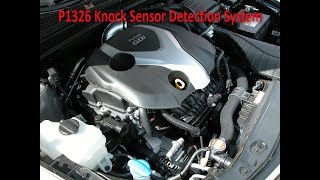
Used OEM Parts in Stock

New Aftermarket Parts Available

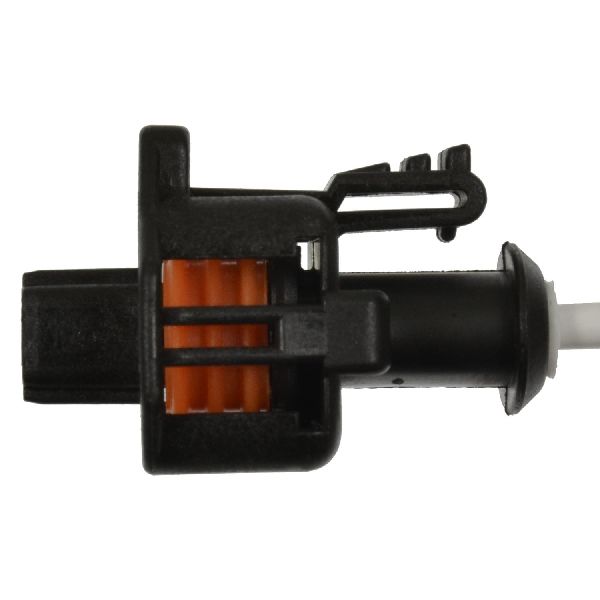
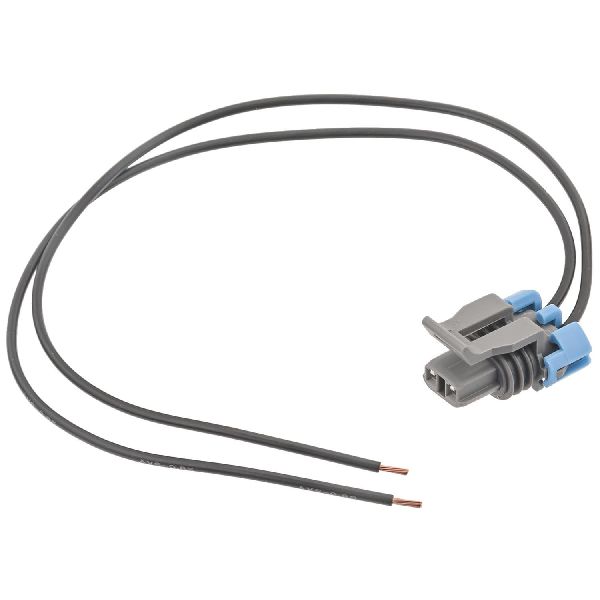

The information in this article is provided for general reference and educational purposes only. Vehicle specifications, procedures, and part compatibility can vary by production date, trim level, and region. Always consult your vehicle's factory service manual and verify part numbers before purchasing or performing repairs. Safety-critical components such as airbags, seat belts, and braking systems should be installed by a qualified professional.
- Hyundai VELOSTER:
- 🎬 Helpful Videos
- 🛍️ Shop This Part
- What's Unique About the 2019-2019 Hyundai VELOSTER
- Diagnostic Flowchart
- Symptoms You May Notice
- Most Likely Causes
- Rare But Worth Checking
- Diagnosis Steps
- Parts You'll Likely Need
- Technical Service Bulletins (TSBs) & Recalls
- Platform-Specific Known Issues
- Mechanic-Grade Diagnostic Values
- Scan Tool Commands That Help
- Wiring & Ground Locations
- Real Owner Repair Stories
- "I Checked Everything" — The Actual Cause
- OEM Part Supersession History
- Model Year Variations Within This Range
- 🎟️ Get 5% Off