

P1296 on 1998-2006 Audi TT 1.8T: Cooling System Malfunction Causes and Fixes
On a Mk1 Audi TT 1.8T, code P1296 is almost always a faulty Engine Coolant Temperature (ECT) sensor or a stuck-open thermostat. Start by replacing the cheap and easy-to-access ECT sensor first (~$15-$40), as the original black sensor is a known failure point. If that doesn't fix it, the more complex thermostat replacement is likely needed.
- P1296 means your Audi TT's engine isn't warming up fast enough.
- The most likely cause is a bad Engine Coolant Temperature (ECT) sensor. It's a cheap part and very easy to replace.
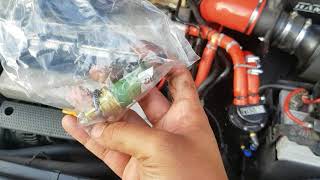
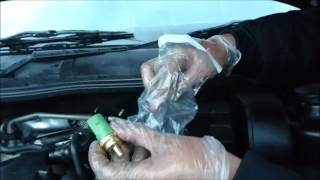
- Always start by replacing the ECT sensor. If your car still has the original black sensor, replace it with the updated green one (part # 059919501A).
- If a new sensor doesn't fix the problem, the thermostat is almost certainly stuck open and needs to be replaced.
- Driving with this code can hurt your fuel mileage and hide potential overheating problems, so it should be addressed promptly.
What's Unique About the 1998-2006 Audi TT
The first-generation Audi TT (Type 8N) with the 1.8T engine is well-known for this specific issue. The primary culprit is often the original black Engine Coolant Temperature (ECT) sensor, which was notoriously unreliable and was later superseded by a more durable green-colored sensor. This sensor failure is so common that owners and mechanics often replace it as the first and most logical step before suspecting the thermostat, which is much more difficult to access on this engine. The ECT sensor (G62) on this engine is actually a dual-thermistor unit; one part sends a signal to the ECU for fuel and timing calculations, and the other sends a signal to the dashboard temperature gauge. A failure in the ECU-facing side can trigger P1296 even if the dashboard gauge appears to be working correctly.
Symptoms You May Notice
- Check Engine Light is on
- Temperature gauge on the dashboard is erratic, stays at cold, or drops at highway speeds
- Reduced fuel economy
- Engine feels sluggish or bogs down, especially when cold
- Cooling fans run constantly, even when the engine is cold
- Difficulty starting the engine, especially when cold
- White, watery exhaust smoke (due to rich running condition from the ECU thinking the engine is cold)
- Replacing the thermostat first. The ECT sensor is much easier and cheaper to replace and is the more common failure point for this specific code on the 1.8T engine. Always start with the sensor.
- Replacing the wrong temperature sensor. The Mk1 TT has one primary sensor (G62) that causes this fault. Later generation TTs may have a second sensor (G83) at the radiator outlet for fan control, which is not the cause of P1296.
Most Likely Causes
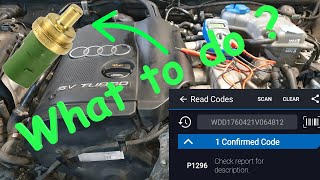
- Faulty Engine Coolant Temperature (ECT) Sensor (G62) 🔴 High Probability The original black-colored OEM sensor is a known high-failure part. The updated OEM replacement is green and much more reliable. Due to its dual-function nature, a partial failure can send bad data to the ECU while the dash gauge seems fine, making it a tricky but extremely common culprit. 🎬 Watch: Diagnosing and replacing the sensor to clear code P1296.
How to confirm: Check the color of your sensor. If it's black, it's suspect. You can also monitor live data with a scan tool; if the temperature reading is illogical (e.g., -40°C) or doesn't rise smoothly, the sensor is bad. Given the low cost ($15-$40) and ease of replacement, many owners replace it preventatively.
Typical fix: Replace the ECT sensor, its o-ring, and the retaining clip. This is a very simple DIY job that takes less than 30 minutes.
Est. part cost: $15-$40 - Stuck-Open Thermostat 🟡 Medium Probability Thermostats are a common wear item. When stuck open, they allow coolant to circulate through the radiator constantly, preventing the engine from warming up properly, especially in cooler weather or at highway speeds.
How to confirm: If a new ECT sensor doesn't clear the code, the thermostat is the next suspect. After 10-15 minutes of idling from a cold start, feel the upper and lower radiator hoses. If both hoses are getting warm at the same rate, the thermostat is likely stuck open. A properly functioning thermostat will keep the lower hose cool until the engine reaches operating temp (around 87°C).
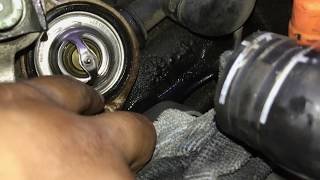
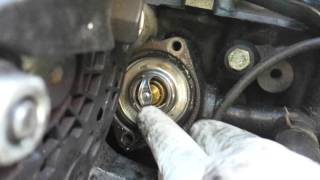
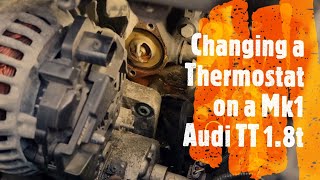
Typical fix: Replace the thermostat and its housing/seal. This is a more involved job due to tight access behind the alternator. Many owners recommend removing the alternator for better access. 🎬 See this walkthrough for replacing the thermostat on a 1.8T.
Est. part cost: $25-$100 - Damaged ECT Sensor Wiring or Connector ⚪ Low Probability Engine bay heat and age can make wiring and plastic connectors brittle. The plastic locking tab on the connector is notoriously fragile.
How to confirm: Visually inspect the wiring harness and connector for the ECT sensor. Look for cracked insulation, corrosion on the pins, or a loose connection. Wiggle the connector with the engine running to see if the temperature reading on a scan tool fluctuates. Check for continuity on the wires running back to the ECU.
Typical fix: Repair the damaged section of wire or replace the connector pigtail.
Est. part cost: $15-$40
Rare But Worth Checking
- Failing Water Pump: While a failing water pump more commonly causes overheating, if the impeller is damaged or has separated from the shaft, it could lead to improper circulation and trigger this code. This is usually considered only after the sensor and thermostat have been ruled out. It's often replaced with the timing belt as a preventative measure.
Diagnosis Steps
- Read the fault code with an OBD-II scanner to confirm P1296 is present.
- Check the stored Freeze Frame data. A temperature reading of -40°C strongly points to a faulty sensor or wiring.
- Visually inspect the Engine Coolant Temperature (ECT) sensor and its connector. It is located on a plastic coolant flange on the driver's side of the cylinder head. Note if the sensor is the old black style or the updated green one.
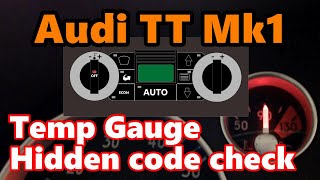
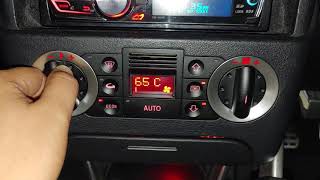
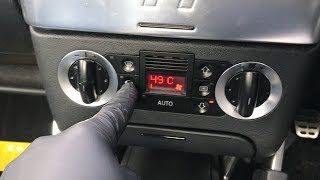
- Use the hidden climate control menu (Code 49c) to view live coolant temperature as seen by the ECU. Compare this to the dashboard gauge and a scan tool reading to check for discrepancies. 🎬 Watch: How to access the hidden 49c coolant temperature menu.
- Due to the high failure rate and low cost, the recommended first step is to replace the ECT sensor, o-ring, and clip. Clear the codes and drive the vehicle to see if the code returns.
- If the code returns, the thermostat is the next likely cause. Confirm by checking if the radiator hoses warm up evenly from a cold start, which indicates a stuck-open thermostat. The lower hose should remain cool until the engine is fully warm.
- If the thermostat is suspected, proceed with its replacement. This is a more labor-intensive job, often requiring alternator removal for access.
- If the issue persists, perform a thorough inspection of the ECT sensor wiring for continuity and check for a failing water pump.
Parts You'll Likely Need
- Engine Coolant Temperature Sensor (G62)
(OEM #059919501A)— This is the most common failure point for code P1296 on this engine. The original black sensor was prone to failure and was updated to this more reliable green sensor.
Trusted brands: Hella, Vemo, Delphi, Bosch
OEM price range: $30-$50
Aftermarket price range: $15-$30 - Thermostat
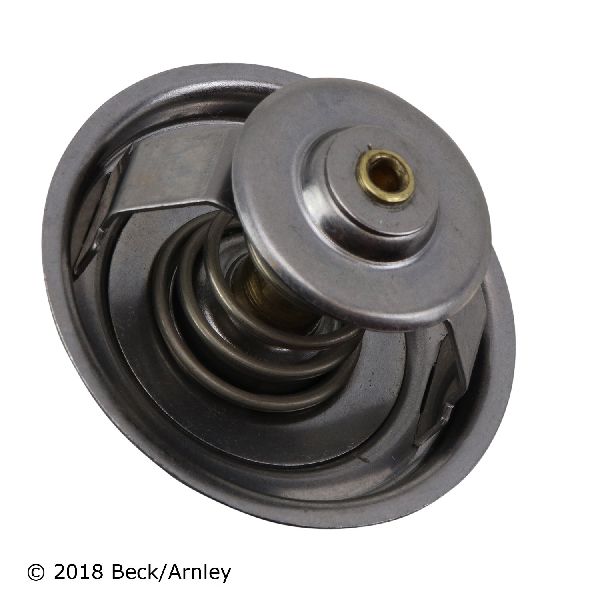
(OEM #050121113C)— The second most common cause, it gets stuck open and prevents the engine from reaching operating temperature. It's typically replaced if a new ECT sensor does not resolve the code. The thermostat opens at 87°C.
Trusted brands: Mahle, Behr, Wahler, Gates
OEM price range: $40-$70
Aftermarket price range: $25-$50 - ECT Sensor Retaining Clip and O-Ring
(OEM #N90316802 (Clip), N90316801 (O-Ring))— The plastic clip becomes brittle with age and often breaks during removal. The O-ring provides the seal and should always be replaced with the sensor to prevent leaks. Most quality sensor kits include these.
Trusted brands: OEM, Meyle
OEM price range: $2-$5 each
Aftermarket price range: $1-$3 each
Related Codes That Often Appear With This One
- P0128 — This is a generic OBD-II code for 'Coolant Temperature Below Thermostat Regulating Temperature.' It has the same meaning and causes as P1296; some vehicles may use one code over the other.
- P2181 — Another VW/Audi code for 'Cooling System Performance.' It can be triggered by the same faults, indicating the engine temperature is not where the ECU expects it to be.
- P0117 — This code for 'Engine Coolant Temperature Sensor Circuit Low Input' can appear if the sensor has failed completely or the wiring is shorted, often resulting in a -40°C reading.
Platform-Specific Known Issues
- The original black Engine Coolant Temperature (ECT) sensor is a known weak point and should be replaced with the updated green version (part number 059919501A) on sight, even as a preventative measure.
- Access to the thermostat is notoriously difficult, located behind the alternator. While some claim it can be done without removing the alternator, most DIY guides and mechanics recommend removing it for sane access.
- The climate control unit has a hidden diagnostic menu that can be accessed to read sensor values directly. Code '49c' displays the coolant temperature in Celsius as read by the ECU, which is invaluable for diagnosing this issue without a scan tool.
Mechanic-Grade Diagnostic Values
- Engine Coolant Temperature (G62) Sensor Resistance — expected: Approximately 2.0-3.0 kΩ at 20°C (68°F), dropping to ~200-400 Ω at 90°C (194°F).. Failure: An infinite resistance (open circuit), near-zero resistance (short circuit), or values that do not change smoothly with temperature indicate a faulty sensor.
- ECT (G62) Sensor Connector Voltage (Key On, Engine Off) — expected: With the sensor unplugged, one pin (signal wire) should show a 5-volt reference from the ECU when measured against a known good ground. Another pin should show near 0 volts (sensor ground).. Failure: Absence of the 5V reference voltage points to a wiring issue or a problem with the ECU's power supply.
- VCDS Measuring Block Group 032 (Long Term Fuel Trim) — expected: Values should be close to 0%, typically within +/- 10%.. Failure: Consistently high positive fuel trims (e.g., >10%) can indicate the ECU is adding excessive fuel because it incorrectly thinks the engine is cold, a symptom of a failing ECT sensor.
Scan Tool Commands That Help
- VCDS (VAG-COM): Basic Settings - Group 060: Throttle Body Adaptation (TBA) — After replacing a thermostat or ECT sensor, or after disconnecting the battery, some owners report that performing a TBA is necessary to resolve lingering issues. The ECU relearns the throttle valve's closed, part-load, and full-open positions. While not directly related to the cooling system, it can help stabilize idle and performance after the ECU has been operating with incorrect temperature data.
Wiring & Ground Locations
- G62 Sensor Connector (4-pin) — On the plastic coolant flange on the driver's side of the cylinder head.. This connector is the interface for the sensor. The pins are for two separate thermistors: one for the ECU (triggers P1296) and one for the dash gauge. Pin 1 is typically the ECU signal and Pin 3 is the gauge signal. Pins 2 and 4 are the respective grounds. Testing voltage and resistance at these specific pins is crucial for diagnosis.
- Engine Ground Strap — A primary ground strap connects the engine block/transmission case to the vehicle's chassis, often near the driver-side engine mount.. A corroded or loose main ground strap can cause a floating ground, leading to unstable and incorrect readings from various sensors, including the ECT sensor. This can mimic sensor failure and should be inspected if sensor replacement doesn't fix the issue.
- Valve Cover Ground — A smaller ground wire is typically bolted directly to the valve cover, grounding the ignition coil harness.. While primarily for the ignition system, ensuring all engine grounds are clean and secure is a best practice when diagnosing any electronic fault code, as it eliminates a common variable.
Real Owner Repair Stories
- Audi-Sport.net forum user (2001 Audi TT 225 (AMU engine)) — Persistent P1296 code, temperature gauge reading low and taking a long time to reach 90°C.
❌ Tried (didn't work) Replaced Engine Coolant Temperature sensor (G62), Replaced thermostat
✅ What actually fixed it The user discovered a hairline crack in the plastic coolant flange that the ECT sensor mounts into. The crack was not causing a major, visible leak but was weeping slightly and likely causing erratic sensor readings or introducing air into the system. Replacing the plastic flange (a common failure point on 1.8T engines) finally resolved the code. - Audizine forum user (2003 Audi TT 1.8T (AWP engine)) — P1296 code returned immediately after replacing both the ECT sensor and thermostat.
❌ Tried (didn't work) New green ECT sensor, New OEM thermostat
✅ What actually fixed it After the new parts failed to fix the issue, the owner performed a Throttle Body Adaptation (TBA) using VCDS. After the TBA procedure, the code was cleared and did not return. The theory is that the ECU's learned values were corrupted from running with bad temperature data for so long, and the adaptation reset was needed to align its operating parameters with the now-correct sensor inputs.
OEM Part Supersession History
059919501→059919501A— The original black-colored sensor was known for a high failure rate, causing erratic readings and premature failure. The updated part is green and uses improved internal components for better durability and accuracy.
Heads up: While other sensors like the blue 078919501C may physically fit, the green 059919501A is the correct, updated replacement for this specific application and fault. Using other colors may result in incorrect temperature readings.
Model Year Variations Within This Range
- 1998-2001 (e.g., AJQ engine code): Early Mk1 TTs have minor differences in vacuum line routing and component layout around the coolant flange area compared to later AWP/AUQ engines. While the cause and fix for P1296 are identical, physical access to the sensor and thermostat may be slightly different.
Diagnostic Flowchart
Other Known Issues on This Vehicle
Issues unrelated to this code that are worth knowing about as an owner of this generation:
- Instrument Cluster Failure 🔴 High — Extremely common. Gauges (fuel, temp) become erratic or fail, center LCD pixelates or dies, or the entire cluster fails intermittently. Often starts around 60k-100k miles.
- Timing Belt & Water Pump Failure 🔴 High — Critical maintenance item. The 1.8T is an interference engine, so a snapped belt will cause catastrophic engine damage. The recommended interval was revised down to 75,000 miles / 7 years, but many specialists recommend 60,000 miles. The water pump with its plastic impeller is a known weak point and must be replaced with the belt. (Ref: A class-action lawsuit for 2000-2003 models resulted in a temporary warranty extension which has since expired.)
- Ignition Coil Pack Failure 🟠 Medium — Very common. Leads to engine misfires, rough idle, and flashing check engine light. A recall was issued for many 1.8T models. Easy to diagnose and replace. (Ref: Recalls were issued, but owners should check their specific VIN.)
- Oil Sludge / Blocked Oil Pickup Tube 🔴 High — Can occur if oil change intervals are stretched, especially with non-synthetic oil. The oil pickup tube in the sump gets clogged, starving the engine of oil and leading to turbo failure or complete engine seizure. Frequent, high-quality synthetic oil changes are critical.
- Brittle Plastic and Vacuum Hoses 🟠 Medium — Universal issue on cars of this age. Numerous plastic components in the engine bay (PCV system, coolant flanges, dipstick tube) and vacuum lines become brittle from heat cycles and crack, causing vacuum/boost leaks, coolant leaks, and running issues.
Used vs. New Parts: Buying Guide for This Vehicle
When a used part is the smart pick: A used wiring connector pigtail from a junkyard is a perfectly acceptable repair if your original connector is broken, as they are not wear items. Inspect the donor part for brittle plastic or corrosion before purchasing.
Donor-vehicle mileage cap: roughly under 75000 miles for the part to have meaningful remaining life.
What to inspect on the donor part:
- For a thermostat: Only consider from a documented, very low-mileage front-end collision donor. Test it in boiling water to ensure it opens correctly before installation.
- For a wiring pigtail: Ensure the plastic isn't brittle, the locking tab is intact, and there are several inches of wire to work with.
OEM-only on this vehicle (don't cheap out):
- Thermostat: Many forum users and specialists strongly recommend using a genuine Audi/VW OEM thermostat. Aftermarket versions, even from known OEM suppliers like Behr or Mahle, have been reported to open at slightly different temperatures or not as wide, potentially causing the engine to run slightly off-spec. Given the high labor cost of replacement, the small price premium for a genuine part is considered cheap insurance.
Aftermarket brands forum-validated for this vehicle:
- ECT Sensor (G62): Hella, Vemo, Bosch, Meyle
- Thermostat: Mahle, Behr, Wahler (though OEM is still preferred by many)
Brands owners have reported issues with on this vehicle:
- Unbranded or 'white-box' sensors and thermostats from online marketplaces. These parts have a very high failure rate and can be inaccurate right out of the box, wasting time and money.
Real Owner Stories
Aggregated from forums and TSBs cited above. Mileages and costs reflect what owners reported in those sources.
Audi TT Mk1 1.8T
Symptoms: Owner used the 49c climate control code and confirmed the temperature was not reaching the target 90C.
What fixed it: The diagnosis pointed towards a bad thermostat being the cause of the issue.
Source hint: AudiWorld Forums - 'Just got a TT mk1 and want to sort out 2 issues (A/C and P1296)'
Audi TT 1.8T
Symptoms: The owner had fault code P1296 and had already replaced the temperature sensor, but the code returned.
What fixed it: Forum members advised that the next logical steps were to check or replace the thermostat or, less commonly, the water pump.
Source hint: AudiForums.com - 'fault code p1296'
Related OBD-II Codes
Frequently Asked Questions
My temperature gauge on the dash seems to work fine, but I still have the P1296 code. Could the coolant sensor still be the problem?
My Audi TT has a black coolant temperature sensor. Should I replace it even if there's no Check Engine Light?
How can I check my TT's real coolant temperature without an OBD-II scanner?
Is it true that you have to remove the alternator to replace the thermostat on this car?
What is the very first part I should replace when I get a P1296 code?
My temperature gauge is acting erratically. Is this definitely related to the P1296 code?
My scanner showed a freeze frame temperature of -40°C. What does that mean?
Helpful Videos
We Have This Part in Stock



The information in this article is provided for general reference and educational purposes only. Vehicle specifications, procedures, and part compatibility can vary by production date, trim level, and region. Always consult your vehicle's factory service manual and verify part numbers before purchasing or performing repairs. Safety-critical components such as airbags, seat belts, and braking systems should be installed by a qualified professional.
- Audi TT:
- 🎬 Helpful Videos
- 🛍️ Shop This Part
- What's Unique About the 1998-2006 Audi TT
- Symptoms You May Notice
- Most Likely Causes
- Rare But Worth Checking
- Diagnosis Steps
- Parts You'll Likely Need
- Related Codes That Often Appear With This One
- Platform-Specific Known Issues
- Mechanic-Grade Diagnostic Values
- Scan Tool Commands That Help
- Wiring & Ground Locations
- Real Owner Repair Stories
- OEM Part Supersession History
- Model Year Variations Within This Range
- Diagnostic Flowchart
- Other Known Issues on This Vehicle
- Used vs. New Parts: Buying Guide for This Vehicle
- Real Owner Stories
- Audi TT Mk1 1.8T
- Audi TT 1.8T
- Related OBD-II Codes
- Frequently Asked Questions
- 🎟️ Get 5% Off