

P1239 on 2013-2015 Ram 1500 3.6L: Engine Oil Temperature Too Low Causes and Fixes
For the 2013-2015 Ram 1500 with the 3.6L V6, code P1239 is most often caused by a software glitch in the powertrain control module (PCM), particularly on 2015 models. The primary fix is a software update performed by a Ram dealer, as specified in Technical Service Bulletin #18-103-16 REV. B. Do not replace parts before checking for this software update, as it's the most common and manufacturer-recommended solution.
- For a 2013-2015 Ram 1500 3.6L with code P1239, the first step is to check if a PCM software update (TSB #18-103-16 REV. B) has been performed, especially for 2015 models.
- Do not replace the oil temperature sensor or other parts before verifying the software status, as a dealer reflash is the most common, cheapest, and manufacturer-recommended fix.
- If hardware replacement is necessary, be aware that replacing the oil temperature sensor is a significant job requiring several hours of labor to remove the intake manifolds.
What's Unique About the 2013-2015 Ram 1500
What's unique about this code on the 2015 Ram 1500 3.6L is that Chrysler specifically identified it as a software logic problem. The PCM's parameters for monitoring the oil temperature were too sensitive, causing the code to set even when no mechanical fault existed. As a result, the most common and manufacturer-recommended fix is not a hardware replacement, but a simple PCM reflash. This solution is documented in official service bulletins, making it a known issue for this specific model year and engine combination.
Diagnostic Flowchart
Tap your situation to follow the diagnostic path that matches what you're seeing on this vehicle.
Symptoms You May Notice
- Check Engine Light is on
- Engine may take longer than usual to warm up
- Slightly reduced fuel economy
- Heater may not blow hot air or takes a long time to warm up.
- In rare cases, the vehicle may enter a limited-power "limp mode".
- Temperature gauge on the dashboard reading lower than normal or fluctuating.
- Replacing the Engine Oil Temperature sensor before checking for PCM software updates. Many owners and shops have replaced the sensor multiple times only to find the issue was a software glitch fixed by a dealer reflash for about one hour of labor.
Most Likely Causes
- Outdated Powertrain Control Module (PCM) Software 🔴 High Probability Ram issued TSB #18-103-16 REV. B specifically to correct this false code on 2015 models with the 3.6L engine by updating the PCM software's sensitivity. This is a widely acknowledged issue.
How to confirm: A Ram dealer or a qualified shop with a wiTECH scan tool can check the current software calibration ID against the latest version recommended by the TSB.
Typical fix: Reprogram (flash) the PCM with the latest manufacturer software. This is typically a 0.2-0.5 hour labor charge at a dealership.
Est. part cost: $0 - Faulty Engine Oil Temperature (EOT) Sensor 🟡 Medium Probability The sensor provides the direct reading to the PCM. It can fail over time by sending inaccurate, low-voltage, or open-circuit signals.
How to confirm: Monitor the EOT sensor data on a scan tool during warm-up. If the reading is stuck (often at -40°F), erratic, or doesn't rise smoothly with engine temperature, the sensor is suspect. Wiggling the wiring harness at the back of the engine may cause the reading to change, indicating a wiring issue.
Typical fix: Replace the engine oil temperature sensor. On the 3.6L V6, this is a difficult job as the sensor is located in the oil filter housing assembly, under the lower intake manifold. This requires removing both the upper and lower intake plenums for access.
Est. part cost: $15-$50 - Thermostat Stuck Open ⚪ Low Probability If the thermostat fails in the open position, coolant will circulate continuously, preventing the engine from reaching its proper operating temperature efficiently. This slow warm-up can cause the oil temperature to lag behind the PCM's model, triggering the code.
How to confirm: Monitor the Engine Coolant Temperature (ECT) on a scan tool or the dashboard gauge. If it takes an excessively long time to reach ~195°F or the temperature drops significantly at highway speeds, the thermostat is likely stuck open. 🎬 Watch: Step-by-step guide to replacing a bad 3.6L thermostat.
Typical fix: Replace the engine thermostat and gasket.
Est. part cost: $25-$75
Rare But Worth Checking
- Wiring or Connector Damage: The wiring harness to the EOT sensor is routed in a hot, tight space in the engine valley. It can be damaged by heat, oil, or rodents, causing high resistance or a short/open in the circuit. Always inspect the harness before replacing the sensor, as wiggling the wires may reveal the fault on a scan tool.
- Incorrect Engine Oil Viscosity: Using an engine oil that is thicker than the manufacturer's recommendation (e.g., 5W-20) could theoretically slow the warm-up process slightly, especially in very cold climates.
- Failing Oil Cooler / Filter Housing Assembly: The entire oil cooler and filter housing assembly, which contains the EOT sensor, is a known failure point on the 3.6L Pentastar, often for leaks. It's possible for internal cracks or blockages to affect sensor readings. Given the high labor cost to access the sensor, many shops recommend replacing the entire assembly if a sensor failure is confirmed.
Diagnosis Steps
- Connect an OBD-II scanner and confirm P1239 is the active code.
- IMPORTANT: Contact a Ram dealer or use a professional resource like ALLDATA or Mitchell to check if TSB #18-103-16 REV. B applies to your vehicle's VIN and if the PCM software has been updated. This TSB is specific to the 2015 model year for this code. If the update has not been performed, this is the first and most likely repair.
- If the software is already updated, use a scan tool to graph the Engine Oil Temperature (EOT) and Engine Coolant Temperature (ECT) sensors from a cold start.
- Observe the readings. Both should rise smoothly. The EOT will typically lag behind the ECT but should follow a similar curve. Erratic jumps, flat lines (especially at -40°), or extremely low readings from the EOT sensor point to a faulty sensor or wiring.
- If the EOT sensor reading is suspect, try to access the wiring harness leading to the oil filter housing in the engine valley. Wiggle the harness while watching the live data on the scan tool. If the reading changes or drops out, a wiring fault is likely.
- If both the EOT and ECT are very slow to warm up and do not reach full operating temperature (~195-205°F), or if the temperature drops at highway speeds, suspect a thermostat that is stuck open.
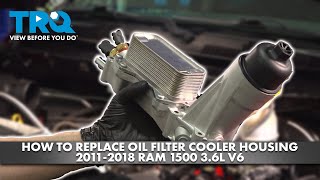
- If the sensor is confirmed bad, prepare for replacement. This requires removing the upper and lower intake manifolds. Due to the labor involved, consider replacing the entire oil filter/cooler housing assembly, which includes new sensors and gaskets, as these are also common failure points. 🎬 See this walkthrough for replacing the entire oil cooler housing.
- If the sensor, wiring, and thermostat are confirmed to be good, the final possibility is a faulty PCM, though this is very rare.
Parts You'll Likely Need
- Engine Oil Temperature Sensor
(OEM #05149077AB)— This sensor provides the temperature reading to the PCM. If it fails, it is the most common hardware cause for this code after a software issue has been ruled out. Note that this part number may also be listed as a coolant temperature sensor, as they are physically similar.
Trusted brands: Mopar, Standard Motor Products, NTK
OEM price range: $30-$50
Aftermarket price range: $15-$35
Related Codes That Often Appear With This One
- P0116 — This code for 'Engine Coolant Temperature Sensor Performance' can appear for similar reasons, such as a stuck thermostat or software issues, which affect the overall engine warm-up cycle monitored by the PCM. It is explicitly listed in TSB #18-103-16 REV. B alongside P1239.
- P0197 / P0198 — These codes relate to the EOT sensor circuit being low (P0197) or high (P0198). They point more directly to a sensor or wiring fault rather than a performance/logic issue, but can sometimes appear if the sensor is failing intermittently.
Technical Service Bulletins (TSBs) & Recalls
- 18-103-16 REV. B: Specifies a PCM reflash to correct P1239 - Engine Oil Temperature Too Low specifically on 2015 MY Ram 1500 vehicles with the 3.6L engine (Sales Code ERB).
- 18-010-16: An earlier version of the bulletin, also mentioning P1239 and a PCM reflash for 3.6L powertrain enhancements.
- 18-060-16: A similar TSB for the 2014 Jeep Wrangler 3.6L that also lists P1239 as a code fixed by a PCM software update, showing a pattern for the Pentastar engine.
Platform-Specific Known Issues
- A known software calibration issue causes the P1239 code to be set incorrectly on 2015 Ram 1500 3.6L models, requiring a PCM reflash to fix, as documented in TSB #18-103-16 REV. B.
- The location of the EOT sensor on the 3.6L Pentastar engine is extremely difficult to access, requiring the removal of the upper and lower intake manifolds. This significantly increases labor costs for what would otherwise be a simple sensor replacement.
Mechanic-Grade Diagnostic Values
- EOT Sensor Signal Voltage (KOEO, sensor disconnected) — expected: ~5.0 Volts. Failure: Voltage significantly lower than 5.0V indicates a short to ground or a faulty PCM. No voltage indicates an open in the reference circuit or a faulty PCM.
- EOT Sensor Signal Voltage (KOEO, sensor signal and ground pins jumped) — expected: ~0.0 Volts. Failure: Voltage significantly higher than 0.0V indicates high resistance in the ground circuit or a faulty sensor.
- EOT Sensor Resistance at ~70°F (21°C) — expected: ~2.0-2.5 kOhms. Failure: An open circuit (infinite resistance) or short circuit (near zero resistance) indicates a failed sensor. Resistance should decrease smoothly as sensor temperature increases.
- DTC Set Condition Threshold — expected: The PCM models an expected oil temperature curve during warm-up.. Failure: The code P1239 sets if the actual oil temperature reported by the sensor is lower than the modeled temperature for more than three minutes. On some similar platforms, this trigger is specified as a difference of more than 40°C (104°F).
Hidden / Shadow Codes Worth Checking
- Mode 6 Data Inaccuracy: This is not a hidden code, but a related diagnostic issue. On some Chrysler products of this era, the software updates that fix P1239 also correct inaccuracies in Mode 6 data reporting to generic scan tools. This prevents misdiagnosis based on misleading test results. (see via Mode 6 is a standard OBD-II function available on most advanced scan tools. The fix is applied via the PCM flash.)
Scan Tool Commands That Help
- wiTECH: Reprogram PCM / Flash ECU — This is the primary repair procedure for a 2015 model year vehicle with P1239, as instructed by TSB #18-103-16 REV. B. It updates the PCM's software logic to correct the overly sensitive monitoring parameters that cause the false code.
- wiTECH or advanced scan tool: View Freeze Frame Data — When P1239 is set, analyzing the freeze frame data is critical. It provides a snapshot of all sensor values (EOT, ECT, ambient air temp, time since start, etc.) at the exact moment the fault was triggered, which can help determine if the reading was illogical (e.g., setting a 'too low' code when the engine was already partially warm).
Wiring & Ground Locations
- Engine Oil Temperature (EOT) Sensor Connector — In the engine valley, plugged into the rear of the oil filter/cooler housing assembly, near the firewall. It is a 2-pin connector.. This is the direct connection point for the sensor. Damage to the connector or wiring harness in this tight, hot area is a common cause of sensor circuit faults (P0197/P0198) and can contribute to P1239 if the signal is intermittent or has high resistance.
- EOT Sensor Pinout — At the sensor connector.. Pin 1 is the EOT Signal circuit (often a Gray wire, circuit G224) which carries the 5V reference from the PCM. Pin 2 is the Sensor Ground circuit (often a Black/Brown wire, circuit K900). Knowing the pinout is essential for performing voltage and resistance tests to isolate a fault between the sensor, wiring, and PCM.
- Engine Block Grounds — There are multiple ground points on the engine block and chassis. A key engine-to-chassis ground is often located on the passenger side frame rail. Other sensor grounds may be bundled and attached to the block itself.. A poor engine ground can cause floating or incorrect readings on multiple sensors, including the EOT sensor. While not a primary cause for P1239 specifically, verifying main grounds is a good practice when diagnosing any electrical issue.
Real Owner Repair Stories
- Forum user reports (2015 Ram 1500 3.6L) — Check Engine Light with code P1239, sometimes appearing only in very cold weather.
❌ Tried (didn't work) Considering replacing the thermostat or oil temperature sensor.
✅ What actually fixed it The dealership performed a PCM software update (reflash) as specified in TSB #18-103-16 REV. B. The code did not return after the update. - YouTube channel "Joy of Wrenching" (Dodge Ram 1500 with 3.6L Pentastar engine) — Check Engine Light with code P0197 (EOT Sensor Circuit Low), which defaulted to a -40° reading on the scan tool.
❌ Tried (didn't work) Initial assumption was a bad sensor.
✅ What actually fixed it While wiggling the wiring harness behind the intake manifold, the technician was able to make the sensor reading drop out to -40°. The fault was a bad connection or broken wire in the harness leading to the sensor, not the sensor itself.
"I Checked Everything" — The Actual Cause
- The most common scenario for this code on a 2015 model is that all hardware components (sensor, thermostat, wiring) will test perfectly fine. The root cause is not a physical failure but a logic error within the Powertrain Control Module (PCM) software. Technicians who follow standard diagnostic paths without first checking for the applicable TSB will replace good parts unnecessarily. The actual fix is a software reflash.
OEM Part Supersession History
5149096AB→05149077AB— Part number consolidation and potential minor design revision for reliability. The sensor is used across many Chrysler/Dodge/Jeep/Ram platforms for both oil and coolant temperature.
Model Year Variations Within This Range
- 2015 only: The TSB #18-103-16 REV. B specifically lists the P1239 code fix as applicable to the 2015 model year with the 3.6L (ERB) engine. While the hardware is the same for 2013-2014 models, the specific software calibration that contains this logic flaw appears to be unique to or most prevalent on the 2015 models.
Helpful Videos
We Have This Part in Stock



The information in this article is provided for general reference and educational purposes only. Vehicle specifications, procedures, and part compatibility can vary by production date, trim level, and region. Always consult your vehicle's factory service manual and verify part numbers before purchasing or performing repairs. Safety-critical components such as airbags, seat belts, and braking systems should be installed by a qualified professional.
- Ram 1500:
- 🎬 Helpful Videos
- 🛍️ Shop This Part
- What's Unique About the 2013-2015 Ram 1500
- Diagnostic Flowchart
- Symptoms You May Notice
- Most Likely Causes
- Rare But Worth Checking
- Diagnosis Steps
- Parts You'll Likely Need
- Related Codes That Often Appear With This One
- Technical Service Bulletins (TSBs) & Recalls
- Platform-Specific Known Issues
- Mechanic-Grade Diagnostic Values
- Hidden / Shadow Codes Worth Checking
- Scan Tool Commands That Help
- Wiring & Ground Locations
- Real Owner Repair Stories
- "I Checked Everything" — The Actual Cause
- OEM Part Supersession History
- Model Year Variations Within This Range
- 🎟️ Get 5% Off