

P1101 on 2003-2012 Saab 9-3 2.0T: Intake Airflow Performance Causes and Fixes
On a Saab 9-3 with the B207 engine, code P1101 is most often caused by unmetered air leaks in the intake system or a dirty Mass Airflow (MAF) sensor. Start by cleaning the MAF sensor with a dedicated cleaner and thoroughly inspecting all intake hoses for cracks or loose clamps, especially the main intake boot between theairbox and turbo.
- P1101 on your Saab 9-3 means the engine is getting more air than the computer expects, usually from a leak.
- Do not immediately buy a new MAF sensor. The most common fixes are much cheaper: cleaning the existing MAF sensor and finding/fixing an air leak.
- A can of MAF sensor cleaner (around $10) is your first and most important tool for this job.
- Thoroughly inspect all air intake hoses between the MAF sensor and the engine for cracks or loose connections.
- If you use an aftermarket air filter, make sure it is not over-oiled and that it allows the airbox to seal completely.
What's Unique About the 2003-2012 Saab 9-3
The Saab 9-3's B207 engine uses a sophisticated Trionic 8 engine management system that is highly sensitive to airflow characteristics. Unlike a generic MAF sensor failure code, P1101 on this platform is specifically a *performance* code, indicating a discrepancy in airflow volume. The system actively cross-checks sensor data and has found a conflict, making unmetered air leaks (vacuum leaks) a very common cause. A particularly common failure point is the main intake hose splitting in its flexible sections. Additionally, issues with the PCV system, while common on many modern cars, can also manifest as a P1101 code on these engines.
Generation note: The 2003-2012 year range covers the entire second generation (YS3F) of the Saab 9-3. This includes the pre-facelift (2003-2007) and facelift (2008-2012) models. The B207 2.0L Turbo engine and Trionic 8 engine management system were used throughout, so the causes and diagnostic procedures for P1101 are consistent across this generation.
Symptoms You May Notice
- Check Engine Light illuminated
- Reduced engine power or entering 'Limp Mode'
- Rough or unstable idle
- Hesitation or stumbling during acceleration
- Decreased fuel economy
- Audible 'whooshing' or hissing sound from the engine bay during acceleration, indicating an air leak
- Immediately replacing the MAF sensor without first cleaning it or checking for air leaks. An air leak is a very common cause, and a new MAF sensor will not fix it.
- Replacing the throttle body without first attempting to clean it. Carbon buildup is a more likely issue than a complete electronic failure.
Most Likely Causes
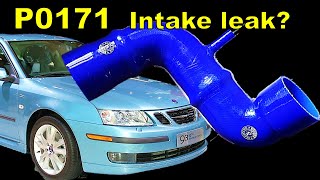
- Air leak in the intake system 🔴 High Probability The plastic and rubber components of the intake and vacuum system can become brittle and crack with age and heat cycles. A very common failure is the large, corrugated intake hose (or 'cobra pipe') between the MAF sensor and the turbo 🎬 Watch: How to find and fix cobra pipe intake leaks, which can split on the underside. Other vacuum lines for the brake booster or EVAP system can also crack.
How to confirm: Visually inspect all intake ducting for cracks, especially ribbed sections. Check that all hose clamps are tight. The most effective method is to have a smoke test performed, which will reveal the exact location of any leaks in the intake manifold, vacuum lines, or gaskets.
Typical fix: Replace the cracked hose, tighten the loose clamp, or replace the faulty gasket. The main intake hose is a frequent culprit and can be replaced with an OEM part or a more durable aftermarket silicone version.
Est. part cost: $10-$150 - Dirty Mass Airflow (MAF) Sensor 🔴 High Probability Oil vapor from the PCV system or fine dust that gets past the air filter can contaminate the MAF sensor's delicate hot wire, causing it to read incorrectly. The use of aftermarket oiled air filters (like K&N) is a frequent source of contamination if they are over-oiled.
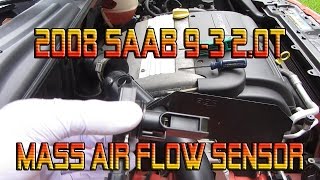
How to confirm: Remove the MAF sensor (held in by two T20 Torx screws) and visually inspect the small wires inside. Even if it looks clean, contamination can be invisible. Cleaning is the first diagnostic step.
Typical fix: Clean the sensor using a dedicated MAF sensor cleaner spray. 🎬 See this walkthrough on cleaning your MAF sensor properly Do not use brake cleaner or carb cleaner, as they can damage the sensor. Spray the wires generously and let it air dry completely before reinstalling.
Est. part cost: $10-$15 for cleaner - Clogged or Improperly Seated Air Filter 🟡 Medium Probability A poorly fitting air filter, especially a cheap aftermarket one, can allow the airbox lid to be sealed improperly, creating a path for unmetered air to be drawn in around the filter. A severely clogged filter can also restrict airflow, causing a discrepancy.
How to confirm: Open the air filter housing and inspect the filter. Check that it is seated correctly and that the housing is securely clamped shut on all sides.
Typical fix: Replace the dirty air filter with a quality part (e.g., Mann, Mahle) and ensure it is installed correctly, allowing the airbox to seal properly. 🎬 Watch: How to replace the air filter and clean the sensor
Est. part cost: $20-$50 - Faulty Mass Airflow (MAF) Sensor ⚪ Low Probability
How to confirm: If cleaning the sensor and confirming there are no air leaks does not resolve the code, the sensor itself may have failed. A diagnostic scan tool can be used to observe live data from the MAF sensor to see if its readings are erratic or non-responsive to changes in engine RPM. A common real-world test is to clear codes, and if the car idles very poorly or stalls immediately, it points towards a bad MAF or a significant air leak.
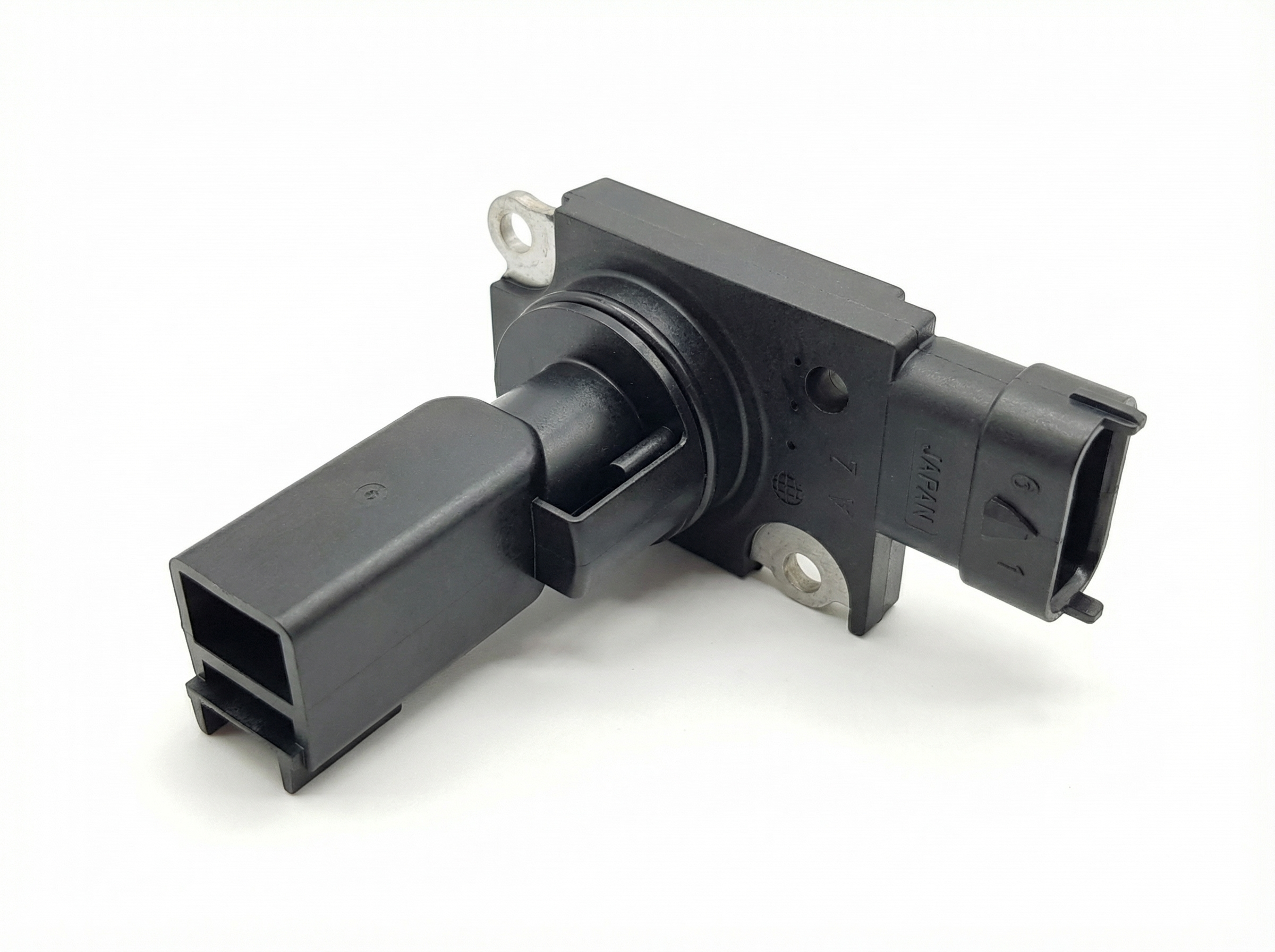
Typical fix: Replace the MAF sensor. It is highly recommended to use an OEM-quality part from Bosch, who was the original supplier. The correct Bosch part number is typically 0 280 218 086.
Est. part cost: $100-$250
Rare But Worth Checking
- Dirty or Faulty Throttle Body: The official Saab diagnostic procedure lists a dirty, coking, or damaged throttle body as a potential cause. Carbon buildup can prevent the throttle plate from closing properly, allowing in more air at idle than expected. Cleaning the throttle body is a valid diagnostic step for high-mileage cars after checking for leaks and cleaning the MAF.
- Low Battery Voltage: The Saab workshop manual explicitly mentions that a low battery condition can cause this DTC to set. Before extensive diagnosis, ensure your battery and charging system are healthy.
- Failed PCV System Component: While more common on other GM vehicles, a failed PCV check valve or clogged orifice can alter crankcase pressure and indirectly affect airflow readings, potentially triggering P1101. On the B207, the PCV valve is located inside the intake manifold, making inspection and replacement more involved.
Diagnosis Steps
- Read the code with an OBD-II scanner and confirm P1101 is present. Note any other codes, especially P0171.
- Visually inspect the entire air intake tract from the air filter box to the throttle body. Pay extremely close attention to the flexible, corrugated sections of the main intake boot for hidden cracks. Check all vacuum lines for brittleness or disconnection.
- Inspect the engine air filter. Ensure it is clean and properly seated in the airbox, allowing it to seal correctly.
- Remove and clean the MAF sensor using a dedicated MAF sensor cleaner. Allow it to air dry completely before reinstalling. Clear the codes and test drive.
- If the code returns, perform a smoke test to definitively check for vacuum leaks. This is the most reliable way to find small cracks in hoses or leaking gaskets that are not visually apparent.
- Inspect the MAF sensor electrical connector and wiring for any signs of damage, corrosion, or looseness.
- For higher mileage vehicles, remove and clean the throttle body bore and plate, removing any carbon buildup. Remember to disconnect the battery first.
- If all other possibilities have been exhausted and live data shows erratic MAF readings, the MAF sensor itself is likely faulty and should be replaced with a quality Bosch unit.
Parts You'll Likely Need
- Mass Airflow (MAF) Sensor Cleaner — This is the first and most cost-effective step. A dirty sensor is a very common cause of P1101.
Trusted brands: CRC, Liqui Moly
Aftermarket price range: $10-$15 - Mass Airflow (MAF) Sensor
(OEM #93183229)— If cleaning the sensor and checking for leaks doesn't solve the issue, the sensor itself has likely failed.
Trusted brands: Bosch (OEM supplier, P/N: 0 280 218 086), Hitachi
OEM price range: $200-$280
Aftermarket price range: $80-$150 - Intake Air Duct / Hose ('Cobra Pipe')
(OEM #12788680)— The flexible rubber or plastic ducts can crack with age, causing unmetered air leaks which are a primary trigger for this code. This specific part is a known weak point.
Trusted brands: Proparts, MTC, do88 (Silicone upgrade)
OEM price range: $70-$120
Aftermarket price range: $40-$80
Related Codes That Often Appear With This One
- P0171 — System Too Lean (Bank 1). An unmetered air leak that causes P1101 also allows excess oxygen into the engine, which the oxygen sensors detect as a lean condition, triggering P0171.
- P0101 — Mass Air Flow (MAF) Circuit Range/Performance. This is a more general MAF performance code. P1101 is the more specific Saab code, but they can sometimes appear together if the sensor's readings are significantly out of range.
Technical Service Bulletins (TSBs) & Recalls
- While no direct Saab TSB for P1101 on the B207 was found, numerous GM TSBs for similar Ecotec engines (e.g., #20-NA-047, #PIP5417C, #PIP5402E) point to PCV system failures and intake air leaks as the primary cause of P1101, which aligns with common Saab owner experiences.
Platform-Specific Known Issues
- Cracked Intake Boot ('Cobra Pipe'): The large rubber intake hose that connects the air filter housing/MAF to the turbocharger inlet is notoriously prone to cracking in the flexible, ribbed sections. These cracks often form on the underside and are not visible without rem
Mechanic-Grade Diagnostic Values
- Mass Airflow (MAF) Sensor Reading at Idle — expected: 3.0 - 5.0 g/s (grams per second) at normal operating temperature.. Failure: A significantly lower value can indicate a vacuum leak after the sensor. A significantly higher value can indicate contamination on the sensor wire.
- Manifold Absolute Pressure (MAP) Sensor Reading at Idle — expected: 26 - 52 kPa at normal operating temperature.. Failure: Readings outside this range suggest a sensor fault or a significant vacuum/boost leak that is skewing the MAF vs. MAP correlation.
- Throttle Position Sensor Correlation Check — expected: The sum of the voltages from the two throttle position potentiometers should always equal 5V.. Failure: If the sum of the two sensor signals deviates from 5V as the throttle is moved, it indicates a fault in the throttle body's sensors or wiring, which can cause the ECM to distrust airflow calculations.
Scan Tool Commands That Help
- Saab Tech 2 / ISAT: IDLING ADAPTATION — This function should be used after cleaning or replacing the throttle body, or replacing the ECM. It forces the Trionic system to relearn the throttle plate's closed position, which is critical for correct idle airflow calculations.
Wiring & Ground Locations
- G7 — On the B207 engine, this ground point is located above the upper right-hand attachment eye of the engine control module (ECM/Trionic 8).. This is the specific grounding point for the Mass Air Flow sensor. A corroded or loose connection at G7 can cause erratic MAF sensor readings, directly leading to a P1101 code without any actual airflow problem.
- G2 — On the side of the left-hand structural member in the engine bay, near the connector bracket.. This is a main battery ground point for the chassis. A poor connection here can create system-wide electrical noise and voltage drops, affecting the stability of all sensors, including the MAF and ECM.
- ECM Connector B (Throttle Body Pins) — The main connector block on the Trionic 8 ECM.. The ECM uses pins 25(B) and 28(B) for the two throttle position signals, and pins 30(B), 31(B), 34(B), and 35(B) for the 5V supply and ground to the throttle position sensors. Checking for correct voltage and continuity at these specific pins is a master-level step to diagnose a faulty throttle body versus a wiring issue.
Real Owner Repair Stories
- SaabCentral Forums user report (Saab 9-3 2.0T) — P1101 and P0171 (System Too Lean) codes, hesitation under acceleration.
❌ Tried (didn't work) Cleaning the MAF sensor, Replacing spark plugs
✅ What actually fixed it A smoke test revealed a crack in one of the hard plastic intercooler hoses located under the radiator. Replacing the cracked hose resolved both codes. - ANCEL technical blog case study (Chevrolet Malibu 1.4T (GM engine with similar PCV design and P1101 cause)) — Persistent P1101 code, oil buildup in the intake duct.
❌ Tried (didn't work) Cleaning the throttle body, Cleaning the MAF sensor
✅ What actually fixed it The root cause was a clogged PCV valve orifice located inside the camshaft cover. Replacing the valve cover (which contains the PCV components) fixed the issue.
"I Checked Everything" — The Actual Cause
- In some cases, a standard intake smoke test may come back clean, but the P1101 code persists. A documented fix in these situations has been a faulty or clogged PCV system component within the valve cover. This creates an internal vacuum leak by drawing unmetered air from the crankcase into the intake manifold, which a smoke test applied only to the intake piping might not reveal.
When the Usual Fixes Don't Work
- While the most common air leak location is the 'cobra pipe' between the airbox and turbo, a confirmed repair story shows that leaks can also occur after the turbocharger, specifically in the intercooler piping. A user with P1101 and P0171 found a crack in a hard plastic intercooler hose after a smoke test, and replacing it solved the problem. This highlights the need to inspect the entire intake path, not just the pre-turbo components.
- If cleaning the MAF and performing a smoke test that comes back negative does not fix the code, do not assume the MAF is bad. A documented cause for P1101 on similar GM engines is a clogged PCV orifice inside the valve cover. This acts as an internal, unmetered air leak that won't be found by an external smoke test, but will cause the MAF to read less air than the engine is actually consuming.
Model Year Variations Within This Range
- 2003-2005: Lower-powered B207 engines (150-175hp) used a Garrett GT2052 turbocharger. From 2006 onwards, these were replaced with a Mitsubishi TD04-11TK turbo. This changes the specific turbo-related hoses and connections, which are potential leak points for P1101.
- 2007-2008: According to owner forums, B207R engines from these two model years were known to have issues with intake valves sticking in very cold weather. While this typically causes misfires, a valve that is not seating correctly could potentially affect airflow and pressure readings, contributing to plausibility codes like P1101.
Diagnostic Flowchart
Real Owner Stories
Aggregated from forums and TSBs cited above. Mileages and costs reflect what owners reported in those sources.
Saab 9-3 2.0L Turbo
Symptoms: Experienced code P1101 accompanied by P0171 and P0101.
What fixed it: Replaced a faulty MAF sensor after cleaning the original MAF and checking for vacuum leaks failed to resolve the issue.
Source hint: SaabCentral Forums - P1101, P0171, P0101 - MAF or Vacuum Leak?
Saab 9-3 2.0L Turbo
Symptoms: Lean running conditions and associated codes like P0171 and P1101 due to unmetered air leaks.
What fixed it: Identified and replaced the intake 'cobra' pipe, which had splits in the concertina sections.
Source hint: YouTube - Cyclone Cyd - Saab 9-3 Air Intake Leak problem | P0171
Saab 9-3 2.0L Turbo
Symptoms: Poor idle quality and erratic live data readings from the MAF sensor.
What fixed it: Reset codes and observed immediate idle quality to differentiate between a learned compensation and a hard fault; followed community advice to check for air leaks and inspect wiring before replacing the MAF with an OE part.
Source hint: Reddit r/saab - Faulty MAF sensor?
Related OBD-II Codes
Frequently Asked Questions
Is there a specific technical service bulletin (TSB) for the P1101 code on my 2003-2012 Saab 9-3?
I hear a whooshing sound when accelerating and have a P1101 code. What is the most likely cause on the B207 engine?
If I need to replace the MAF sensor on my 9-3 2.0T, which brand should I buy?
Can my aftermarket K&N air filter cause the P1101 code on my Saab?
My Saab 9-3 has high mileage and a P1101 code. Besides the MAF and intake pipes, what else should I check?
Helpful Videos


We Have This Part in Stock



The information in this article is provided for general reference and educational purposes only. Vehicle specifications, procedures, and part compatibility can vary by production date, trim level, and region. Always consult your vehicle's factory service manual and verify part numbers before purchasing or performing repairs. Safety-critical components such as airbags, seat belts, and braking systems should be installed by a qualified professional.
- Saab 9-3:
- 🎬 Helpful Videos
- 🛍️ Shop This Part
- What's Unique About the 2003-2012 Saab 9-3
- Symptoms You May Notice
- Most Likely Causes
- Rare But Worth Checking
- Diagnosis Steps
- Parts You'll Likely Need
- Related Codes That Often Appear With This One
- Technical Service Bulletins (TSBs) & Recalls
- Platform-Specific Known Issues
- Mechanic-Grade Diagnostic Values
- Scan Tool Commands That Help
- Wiring & Ground Locations
- Real Owner Repair Stories
- "I Checked Everything" — The Actual Cause
- When the Usual Fixes Don't Work
- Model Year Variations Within This Range
- Diagnostic Flowchart
- Real Owner Stories
- Saab 9-3 2.0L Turbo
- Saab 9-3 2.0L Turbo
- Saab 9-3 2.0L Turbo
- Related OBD-II Codes
- Frequently Asked Questions
- 🎟️ Get 5% Off