

OBD-II Code P0100: Mass Air Flow (MAF) Circuit Malfunction
What P0100 means, why it triggers, and how to fix it
- Cleaning a dirty Mass Air Flow (MAF) sensor with a $10 dedicated spray resolves the P0100 code in over 50% of cases.
- Inspect the wiring harness and replace the engine air filter before spending $150+ on a new MAF sensor.
- Expect a 10% to 20% drop in fuel economy, rough idling, and sluggish acceleration until the MAF circuit is repaired.
- Driving with an active P0100 code for more than a few weeks causes unburned fuel to melt the catalytic converter, turning a $50 repair into a $2,000+ replacement.
What Does P0100 Mean?

The P0100 code indicates the Powertrain Control Module (PCM) detects a malfunction in the Mass Air Flow (MAF) sensor's electrical circuit. The MAF sensor measures the exact volume of air entering the engine so the PCM can inject the correct amount of fuel. If the sensor's electrical signal is erratic, out of range, or absent, the PCM triggers P0100 and defaults to a safe, rich fuel mixture, degrading engine performance.
Technical definition: The official SAE/OBD-II definition is "Mass or Volume Air Flow 'A' Circuit Malfunction". This indicates the powertrain control module (PCM) detects the electrical signal from the Mass Air Flow (MAF) sensor is out of its normal specification or completely absent. The PCM sets this code when it sees a voltage or frequency signal from the sensor that is too high, too low, intermittent, or missing.
Can I Drive With P0100?
Yes, But With Caution. You can drive, but expect poor performance, reduced gas mileage, and unexpected stalling. Fix this within a few weeks; driving long-term with an incorrect air-fuel ratio dumps unburned fuel into the exhaust, destroying the catalytic converter and causing a $1,000 to $4,000 repair.
Common Causes

- Dirty or Contaminated MAF Sensor (Very Common) — Dust, oil from a PCV system, or excess oil from an aftermarket filter coats the sensor's delicate hot wire, insulating it and preventing accurate airflow measurement. 🎬 Watch: How to properly clean your MAF sensor
- MAF Sensor Wiring or Connector Issue (Common) — The electrical connector loosens, or wires fray, break, or corrode at sharp bends in the harness. A corroded ground wire specific to the MAF circuit also causes an unstable or missing signal.
- Faulty or Damaged MAF Sensor (Common) — The sensor fails internally from age, heat cycles, or vibration. The delicate sensing wire breaks, or internal electronics like solder joints fail, requiring a full replacement.
- Vacuum Leak (Common) — A cracked air intake hose, a bad gasket, a loose clamp, or a stuck-open PCV valve allows unmetered air into the engine after the MAF sensor. This mismatch in expected values triggers the code. 🎬 See this guide on finding and fixing vacuum leaks
- Clogged or Dirty Engine Air Filter (Less Common) — A severely clogged air filter restricts airflow so heavily that the MAF sensor's readings drop abnormally low, causing the PCM to flag a circuit fault.
- Aftermarket Air Intake Modifications (Less Common) — Oiled-gauze filters shed oil that contaminates the sensor. Cold-air intake tubes also create turbulent airflow that the stock sensor cannot read correctly.
- Clogged Catalytic Converter or Restricted Exhaust (Rare) — A restricted exhaust prevents air from flowing properly through the engine, causing abnormal MAF sensor readings. This is usually accompanied by other codes.
- Faulty Powertrain Control Module (PCM) (Very Rare) — The car's main computer fails to correctly process the signal from a known-good MAF sensor. Consider this only after exhaustively ruling out all other possibilities.
Symptoms

- Check Engine Light is On — The primary and most immediate indicator that the PCM detects a circuit fault.
- Rough Idle or Stalling — The engine shakes, runs erratically, or shuts off when stopped, at low speeds, or immediately after starting.
- Poor Acceleration and Lack of Power — The car feels sluggish, hesitates, or jerks during acceleration. Some vehicles enter a 'limp mode' with power capped around 2,500-3,000 RPM.
- Reduced Fuel Economy — Gas mileage drops significantly because the PCM guesses the air-fuel mixture, defaulting to a rich (fuel-heavy) state to protect the engine.
- Black Smoke from Exhaust — The engine runs excessively rich, causing unburned fuel to exit the tailpipe as black smoke.
- Hard Starting — The engine cranks for an extended period before starting, or starts and immediately stalls.
Diagnostic Flowchart
Tap your situation to follow the diagnostic path that matches what you're seeing on this code.
Common Fixes & Costs
- Clean the MAF Sensor — Parts: $10-$15, Labor: $50-$100, ~0.5 hr book time (DIY)
- Replace the Engine Air Filter — Parts: $15-$35, Labor: $0-$25, ~0.2 hr book time (DIY)
- Repair MAF Sensor Wiring/Connector — Parts: $10-$50, Labor: $100-$250, ~1.5 hr book time (Intermediate)
- Replace the MAF Sensor
— Parts: $75-$300, Labor: $50-$150, ~0.6 hr book time
(DIY)
Nissan Maxima (2000-2001): OEM
Volkswagen Jetta 2.0T/2.5L (2006-2010): OEM
BMW 325i E46 (2001-2003): OEM - Repair a Vacuum Leak — Parts: $10-$150, Labor: $100-$300, ~2.5 hr book time (Professional)
- Professional Diagnosis — Parts: $0, Labor: $100-$200, ~1.5 hr book time (Professional)
Used vs. New Parts: Buying Guide
When a used part is worth it: A used OEM sensor from a low-mileage vehicle is viable for diagnostic purposes to confirm the fault before buying a new part, but it is generally a gamble for long-term reliability.
Donor-vehicle mileage cap: roughly under 60000 miles for the part to have meaningful remaining life.
Donor quality checklist:
- Verify the donor vehicle was not scrapped for engine or emissions-related failures.
- Visually inspect the sensor for physical damage, corrosion, or oil contamination.
- Match the part number exactly; identical-looking sensors have different calibrations.
- Prefer donors from non-rust-belt areas to minimize corrosion risk.
Decision logic:
- If Vehicle is a European brand (BMW, VW, Mercedes) or a high-performance model → Buy a new OEM or OEM-supplier (Bosch, Denso) part. These vehicles are highly sensitive to sensor accuracy.
- If The cost of a new OEM part is less than $150 → Buy new. The small savings on a used part are not worth the risk of premature failure.
- If Budget is the absolute primary concern and the vehicle is older → A used part is acceptable for a temporary fix, but expect a shorter lifespan.
Warranty tradeoff: Used parts from a salvage yard typically have a 30-day warranty with 'no returns' on electrical parts. New aftermarket parts offer 1-year warranties, while new OEM parts carry a 1-2 year warranty.
Worst-case if a used part fails: $150-$300 if a used part fails shortly after installation, covering repeat labor costs and the price of a new sensor.
What Happens If You Wait — Timeline
- 0-1 month: Check Engine Light illuminates. You experience a slight drop in fuel economy or minor hesitation, but the car remains drivable. (MPG impact: 5-10%% · Added cost: $0-$50 in wasted fuel)
- 1-3 months: Performance issues become consistent: rough idle, stalling at stops, and sluggish acceleration. The engine frequently runs too rich or too lean. (MPG impact: 10-20%% · Added cost: $50-$150 in wasted fuel. Spark plugs begin to foul.)
- 3-6 months: Driving with an incorrect air-fuel ratio damages components. A rich mixture causes the catalytic converter to overheat, while a lean mixture increases engine temperatures. (MPG impact: 15-25%% · Added cost: $200-$500 for fouled spark plugs and oxygen sensors. Early-stage catalytic converter damage begins.)
- 6+ months: Catastrophic failure of the catalytic converter. The internal honeycomb substrate melts, causing a major exhaust blockage and extreme power loss. (MPG impact: >25%% · Added cost: $1,200-$3,000+ for catalytic converter replacement.)
Cost of Not Fixing It
- 0-1 month: Noticeable drop in fuel economy (10-20%), poor acceleration, rough idle, and possible stalling. Increased emissions. (Added cost: $20-$60 in wasted fuel per month.)
- 1-6 months: Prolonged driving with a rich or lean condition causes the catalytic converter to overheat and degrade. Carbon buildup fouls spark plugs and oxygen sensors. (Added cost: $200-$500 for spark plug and O2 sensor replacement.)
- 6+ months: Catastrophic failure of the catalytic converter. The internal substrate melts, causing a severe exhaust restriction and total loss of power. (Added cost: $1200-$2800 for catalytic converter replacement.)
Diagnosis Steps

- Visually Inspect the Air Intake System
Verify the MAF sensor's electrical connector is plugged in securely. Inspect the large air duct between the air filter box and the engine for cracks, tears, or loose clamps.
Tools: Flashlight (Beginner) - Inspect and Clean the Engine Air Filter
Remove the air filter and hold it up to a light. If light does not pass through, replace it. A restricted filter skews MAF readings.
Tools: Screwdriver or socket set (Beginner) - Clean the MAF Sensor
Carefully remove the MAF sensor. Apply 10-15 sprays of dedicated MAF sensor cleaner to the sensor's wire or plate. Do NOT touch the delicate elements. Let it air dry completely for at least an hour before reinstalling.
Tools: Screwdriver/socket set, MAF sensor cleaner spray (Beginner) - Inspect the MAF Sensor Wiring and Connector
Unplug the MAF sensor and check the connector pins for green corrosion, blackness, or bent pins. Tug gently on each wire to ensure it is secure. Inspect the harness for chafing or breaks, especially at sharp bends.
Tools: Flashlight, small pick (Intermediate) - Check for Vacuum Leaks with a Smoke Test
Use a smoke machine to fill the intake system with visible smoke. Smoke exiting the system reveals leaks from cracked hoses, bad gaskets, or a faulty PCV valve.
Tools: Smoke machine (Intermediate) - [PRO TIP] Analyze Live Data with a Scan Tool
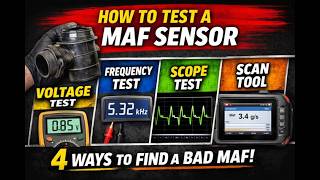
Connect a scan tool and view MAF sensor live data in grams per second (g/s). At a warm idle, a healthy engine reads roughly 0.8-1.2 g/s per liter of engine displacement (e.g., a 2.0L engine reads 1.6-2.4 g/s). This value must rise smoothly to 15-25 g/s at 2500 RPM. If the reading is 0 g/s or stuck at a fixed number, the sensor or circuit is faulty.
Tools: OBD-II scan tool with live data capability (Advanced) - [PRO TIP] Test MAF Sensor Voltage with a Multimeter
Back-probe the MAF connector using a wiring diagram. With the key on, engine off (KOEO), verify 12V power and a 5V reference voltage. Check the ground wire for 0V. With the engine idling, the signal wire should read a steady 0.5V to 1.5V, increasing smoothly to 3.5V-4.5V as RPM rises. A jumpy or dead signal indicates a bad sensor.
Tools: Multimeter, back-probe kit, vehicle-specific wiring diagram (Advanced) - [PRO TIP] Check MAF Waveform with an Oscilloscope
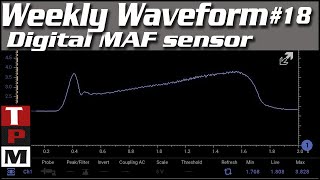
For digital MAF sensors, connect an oscilloscope to the signal wire. You should see a clean square wave. As engine RPM increases, the frequency increases. A flat line or a messy pattern indicates a failed sensor or wiring issue. Warm idle frequency is typically 2,000-4,000 Hz.
Tools: Oscilloscope, wiring diagram (Professional)
When This Code Triggers (Freeze-Frame Conditions)
- Engine Coolant Temp: 180-210°F (The code sets when the engine is fully warmed up, as the PCM expects predictable sensor readings in a stable state.)
- RPM: 1500-3000 (Frequently triggered during steady-state cruising or light acceleration, rather than at idle.)
- Engine Load: 20-50% (Occurs under moderate, constant load where the PCM detects the MAF signal does not correlate with throttle position and RPM.)
- Vehicle Speed: 30-60 mph (Commonly set during city or highway driving when maintaining a constant speed.)
Related Codes
- P0101 — P0100 indicates a circuit malfunction (an electrical fault like a short or open wire). P0101 is a 'Range/Performance' code, meaning the sensor provides a signal, but the reading is irrational compared to what the PCM expects.
- P0102, P0103, P0104 — These are specific MAF circuit codes. P0102 is 'Circuit Low Input', P0103 is 'Circuit High Input', and P0104 is 'Circuit Intermittent'. P0100 is a general code set when the PCM detects a circuit problem but cannot classify it specifically.
- P0171, P0174 (System Too Lean) — These codes often appear with P0100. They are caused by a vacuum leak after the MAF or by a faulty MAF sensor that under-reports entering air, causing the PCM to inject too little fuel.
- P0172, P0175 (System Too Rich) — Triggered if the MAF sensor incorrectly reports more air than is actually entering the engine, causing the PCM to inject too much fuel. This also happens if the sensor signal is shorted.
Climate & Environmental Factors
- High Humidity: Moisture in the air adheres to the sensor element, interfering with readings and leading to corrosion of internal electronics over time.
- Cold Weather: Cold, dense air amplifies the effect of a slightly dirty MAF sensor, leading to noticeable hesitation. Extreme cold also makes plastic intake components brittle and prone to cracking.
- High Altitude: At higher altitudes, air is less dense, causing the MAF sensor to report lower g/s values. Rapid changes in altitude sometimes confuse the system and temporarily set a fault code.
How to Talk to a Mechanic About This Code
Say this: "I have a P0100 code and I'd like to schedule a diagnostic. Please start by checking the MAF sensor wiring and connector, inspecting for vacuum leaks, and viewing the live MAF data in grams per second before recommending a sensor replacement."
This signals you've done research and prevents a shop from immediately replacing an expensive MAF sensor. It directs them to perform a proper diagnostic sequence, checking for cheaper failure points first.
Avoid saying:
- 'My check engine light is on, can you look at it?'
- 'The car is running rough, just fix it.'
- 'I think I need a new mass airflow sensor.'
Questions to ask before authorizing the repair:
- Did you find a vacuum leak or a wiring issue?
- What were the MAF sensor's live data readings (in g/s) at idle and at 2500 RPM?
- If the sensor needs replacement, is the part from the original equipment manufacturer (OEM) or an aftermarket brand?
- What is the warranty on the parts and labor for this repair?
Where to Take It: Dealer vs Independent vs Chain
- Dealer:
Recommended only if the vehicle is under warranty or has a known, complex manufacturer-specific issue that independent shops might miss.
Best for: Vehicles still under powertrain or emissions warranty., Complex, manufacturer-specific quirks, especially on German brands (VW, BMW) known for specific wiring or PCV issues.
Downsides: Highest labor rates, often 1.5-2x more than an independent shop., Defaults to replacing the MAF sensor assembly rather than diagnosing a simpler wiring or vacuum leak issue. (Typical cost: +50% vs. baseline) - Independent Shop:
Best fit for most situations. A good independent shop effectively diagnoses and repairs P0100 by cleaning the sensor, finding vacuum leaks, or replacing the part without the high dealer cost.
Best for: Most out-of-warranty vehicles., Standard diagnosis of common codes like P0100, which they see frequently.
Downsides: Quality and diagnostic capabilities vary widely. Vet the shop through online reviews and ensure they are ASE certified. (Typical cost: +0% vs. baseline) - Chain Shop:
Use with caution. Acceptable if you are certain the fix is simple, but avoid for a full diagnosis, as they often replace the sensor without checking other causes.
Best for: Simple, clear-cut parts replacement like a new air filter or a pre-diagnosed MAF sensor swap.
Downsides: Technician skill varies dramatically. They lack the advanced diagnostic tools to trace wiring faults or find elusive vacuum leaks., High pressure to upsell services. (Typical cost: -10% vs. baseline)
When to Walk Away From the Repair
If the estimated repair cost exceeds 40-50% of the car's private-party value, seriously consider selling or trading it in instead of repairing it.
- Car worth $4000, fix is $500: Fix it. This repair is well below the threshold and restores critical engine performance.
- Car worth $3000, fix is $1500: Walk away. The repair cost is 50% of the car's value, and other age-related issues are likely to appear soon.
What Scan Tool You Need for This Code
Minimum: A scanner that reads and clears codes and displays live sensor data, specifically the MAF sensor reading in grams per second (g/s).
A basic $20 code reader only tells you the P0100 code is present. It cannot show the live data needed to determine if the sensor is dirty, faulty, or if the problem is a vacuum leak.
Budget: BlueDriver Pro (~$99) — Connects to your smartphone and provides detailed code reports, freeze-frame data, and live data graphing for the MAF sensor (g/s), essential for diagnosing P0100.
Mid-range: Innova 5610 (~$330) — A powerful handheld scanner offering extensive live data PIDs, including MAF g/s, and allows you to record data during a test drive to catch intermittent issues.
Professional: Autel MaxiCOM MK808 / XTOOL D7 (~$400-600) — Professional-level diagnostic tablets offering full bidirectional control, advanced data graphing, and manufacturer-specific functions crucial for resetting fuel trims after a MAF replacement.
Rent vs buy: For a one-time diagnosis, major auto parts stores offer a loaner tool program where you borrow an OBD-II scanner for a fully refunded deposit. Buy a scanner only if you perform diagnostics more than once a year.
How to Clear the Code After You Fix It
- Use an OBD-II scan tool to clear the diagnostic trouble codes.
- Let the vehicle idle for 10 minutes to allow the ECU to begin relearning fuel trims with the new or clean sensor.
- Perform a complete OBD-II drive cycle to ensure all readiness monitors run.
- Do not disconnect the battery to clear the code, as this erases adaptive memory and radio presets without permanently clearing the fault.
Drive cycle (~20 minutes): Cold start and idle for 3 minutes. Accelerate to 55 mph and hold steady for 5 minutes. Coast down to 20 mph without braking. Accelerate back to 55 mph and hold for 5 minutes. Drive in stop-and-go city conditions for 5 minutes.
Readiness monitors affected: Catalyst (CAT) monitor, Evaporative System (EVAP) monitor, Oxygen (O2) Sensor monitor, Fuel System monitor
Before emissions retest: drive at least 50 miles to fully set monitors.
Watch out for:
- The code returns immediately if the underlying electrical fault (bad wire, poor connection) is not fixed.
- Failing to complete a full drive cycle leaves readiness monitors incomplete, causing an emissions test failure.
- Clearing the code without repairing the issue does not solve driveability problems or prevent catalytic converter damage.
Will This Fail Emissions / State Inspection?
Yes — this code typically fails an OBD-II emissions inspection.
- California: An active P0100 code is an automatic failure of the smog check. All OBD-II readiness monitors must be 'Ready' for the test to proceed.
- New York: The NYS DMV vehicle safety/emissions inspection includes an OBD-II scan. A P0100 code results in an automatic failure.
- Texas: In the 17 counties requiring emissions testing, a vehicle with an active P0100 code fails the OBD-II portion of the state inspection.
Most Commonly Affected Vehicles
- Nissan Maxima, Frontier, Sentra, Pathfinder (1995-2004) — Cold solder joints on the MAF sensor's internal circuit board fail frequently, causing intermittent stalling and a P0100 code. Sensor replacement and a PCM reprogram are often required.
- Volkswagen/Audi Golf, GTI, Jetta, Passat, A4 (2006-2020) — Commonly affected by P0100 due to a failed PCV valve (oil separator) creating a massive vacuum leak. Another frequent cause is a broken wire in the MAF sensor harness right at the connector.
- BMW & Mercedes-Benz E46, E90, W203, W211 (2000-2015) — Prone to P0100 over 100,000 miles. Cleaning is rarely effective; these vehicles require a complete MAF sensor replacement with a high-quality OEM part (Bosch, VDO) to resolve the issue.
- Ford F-150, Mustang (2004-2024) — The code sets if the sensor frequency drops below a specific limit for more than half a second. This is often caused by a disconnected intake tube after an air filter change.
- Toyota Camry, Tundra, Tacoma (2001-2024) — P0100 is frequently caused by carbon and dirt buildup on the MAF sensor element. Cleaning the sensor is a highly effective first step. Use an OEM Denso sensor if replacement is needed.
- Honda Accord, Civic, CR-V (2003-2024) — Highly sensitive to airflow readings. A common cause of P0100 is a cracked rubber intake hose located between the air filter box and the throttle body.
- Hyundai Santa Fe, Trajet (2001-2006) — The P0100 code triggers if the MAF sensor power supply voltage falls outside a narrow range (e.g., below 4.7V or above 5.1V), pointing directly to a circuit electrical fault.
- Subaru Impreza, Forester, Legacy (1995-2008) — Older, high-mileage models are known for internal MAF sensor failures that trigger P0100, requiring complete sensor replacement.
Manufacturer-Specific Notes
- Nissan: On older Maximas, P0100 is frequently caused by failed solder joints inside the MAF sensor housing. After replacing the sensor, fuel trim learned values must be reset with a scan tool to prevent driveability issues.
- Volkswagen/Audi: A failed PCV valve is an extremely common cause of P0100 on TSI/TFSI engines, creating a massive vacuum leak. Another known issue is a broken wire in the harness right at the MAF connector due to stress from a tight bend.
- BMW/Mercedes-Benz: Cleaning the MAF sensor is often a temporary fix. P0100 is very likely caused by an internally failed MAF sensor requiring replacement. Using a high-quality OEM sensor (Bosch, VDO) is critical.
- Ford: On F-150s, the code sets if the sensor frequency drops below a calibrated limit. This is commonly caused by a leak in the air intake system, such as a disconnected or torn intake boot.
Real Owner Stories
1997 Nissan Maxima with intermittent stalling
Car started stalling at idle and bucking at higher RPMs, progressively worsening until a P0100 code appeared.
What they tried:
- Initially suspected a bad ground or broken wire in the harness.
- Disassembled the MAF sensor and discovered the internal 3-pin connector had cold solder joints.
- Re-soldered the connections with short wire leads to create a robust mechanical and electrical connection.
Outcome: The engine ran perfectly after the repair, resolving a common design flaw in this generation of Maxima.
Lesson: On older Nissans, a P0100 code with stalling is very often an internal MAF sensor failure due to bad solder joints, not a wiring or contamination issue.
2011 Mitsubishi Outlander Diesel, code returns under load
After getting a P0100 code, the owner replaced the MAF sensor, but the code and limp mode returned specifically when driving uphill at high RPMs.
What they tried:
- Replaced the MAF sensor.
- Confirmed wiring was intact.
- Observed that MAF and MAP readings on the scanner were normal right up until the check engine light illuminated.
Outcome: The problem persisted after replacement, indicating the root cause was exposed only under high engine load.
Lesson: If P0100 returns after replacing the sensor under specific conditions like high load, investigate related systems like fuel delivery, vacuum leaks that worsen under load, or exhaust restrictions.
1998 Nissan 200sx with persistent P0100 and stalling
For over a year, the car sputtered and stalled when coming to a stop. Multiple shops failed to diagnose the issue.
What they tried:
- Replaced the MAF sensor, fuel filter, Idle Air Control Valve, Throttle Position Sensor, and intake temperature sensor.
- Cleaned the throttle body and ran fuel system cleaner.
- Back-probed the MAF connector and confirmed voltages were to spec.
Outcome: Despite replacing many parts, the P0100 code and stalling remained, pointing towards an elusive cause like ignition timing or a PCM fault.
Lesson: P0100 is a circuit malfunction code. If replacing the sensor and checking visible wiring fails, the fault lies in a related component influencing the MAF's environment or the PCM itself. Avoid throwing parts at the problem.
How to Prevent This Code From Triggering
- Replace engine air filter at recommended intervals (Every 12,000-15,000 miles, or annually.) — A clean filter prevents dust from contaminating the delicate MAF sensor element. A clogged filter restricts airflow, causing incorrect readings.
- Use high-quality OEM or equivalent dry paper air filters (At every filter change) — Avoid cheap filters that allow unfiltered air to bypass the element. Avoid over-oiled reusable filters, as the oil aerosolizes and coats the MAF sensor.
- Periodically inspect the air intake system (During every oil change) — Check for cracks in the rubber intake boot, loose clamps, or disconnected hoses. Fixing small air leaks early prevents MAF-related codes.
- Clean the MAF sensor as a maintenance item (Every 30,000-40,000 miles) — Proactively cleaning the sensor with a dedicated spray removes minor buildup before it affects performance, extending the sensor's life.
Frequently Asked Questions
Can I just unplug my MAF sensor to fix P0100?
Unplugging the MAF sensor is a diagnostic trick, not a fix. If the engine runs better unplugged, it confirms the sensor was sending bad data and the PCM is now using default values. This results in poor fuel economy and high emissions, so the circuit still requires proper repair.
What is the difference between P0100 and P0101?
P0100 indicates an electrical circuit malfunction, such as a broken wire, short, or dead sensor. P0101 is a performance code, meaning the sensor is sending a signal, but the data doesn't match the engine's current operating conditions. Think of P0100 as a cut phone line, and P0101 as the person on the phone speaking gibberish.
I replaced the MAF sensor, but the code came back. What now?
If a new sensor doesn't fix the code, perform a smoke test to find hidden vacuum leaks. Also, thoroughly inspect the wiring harness and connector for damage, corrosion, or a broken wire.
Can an aftermarket air filter cause a P0100 code?
Yes. Reusable filters that use oil contaminate the sensor element if over-oiled. Additionally, aftermarket intake systems create turbulent airflow that the stock sensor cannot measure accurately.
How long can I drive with a P0100 code?
Drive for no more than a week or two. Prolonged driving with an incorrect air-fuel ratio dumps excess fuel into the exhaust, overheating and destroying the catalytic converter. This turns a minor issue into a $2,000+ repair.
What are the most common mistakes when diagnosing P0100?
The biggest mistake is replacing the MAF sensor without performing a full diagnosis. Always inspect the wiring, check for vacuum leaks, and clean the sensor before buying an expensive new part.
Does a P0100 code always mean the MAF sensor is bad?
No. P0100 is a circuit malfunction code. The problem is often the wiring, the connector, a vacuum leak, or a blown fuse, requiring a thorough diagnosis to pinpoint the exact cause.
Key Takeaways
- Cleaning a dirty Mass Air Flow (MAF) sensor with a $10 dedicated spray resolves the P0100 code in over 50% of cases.
- Inspect the wiring harness and replace the engine air filter before spending $150+ on a new MAF sensor.
- Expect a 10% to 20% drop in fuel economy, rough idling, and sluggish acceleration until the MAF circuit is repaired.
- Driving with an active P0100 code for more than a few weeks causes unburned fuel to melt the catalytic converter, turning a $50 repair into a $2,000+ replacement.
Helpful Videos




The information in this article is provided for general reference and educational purposes only. Vehicle specifications, procedures, and part compatibility can vary by production date, trim level, and region. Always consult your vehicle's factory service manual and verify part numbers before purchasing or performing repairs. Safety-critical components such as airbags, seat belts, and braking systems should be installed by a qualified professional.
- 🎬 Helpful Videos
- What Does P0100 Mean?
- Can I Drive With P0100?
- Common Causes
- Symptoms
- Diagnostic Flowchart
- Common Fixes & Costs
- Used vs. New Parts: Buying Guide
- What Happens If You Wait — Timeline
- Cost of Not Fixing It
- Diagnosis Steps
- When This Code Triggers (Freeze-Frame Conditions)
- Related Codes
- Climate & Environmental Factors
- How to Talk to a Mechanic About This Code
- Where to Take It: Dealer vs Independent vs Chain
- When to Walk Away From the Repair
- What Scan Tool You Need for This Code
- How to Clear the Code After You Fix It
- Will This Fail Emissions / State Inspection?
- Most Commonly Affected Vehicles
- Manufacturer-Specific Notes
- Real Owner Stories
- 1997 Nissan Maxima with intermittent stalling
- 2011 Mitsubishi Outlander Diesel, code returns under load
- 1998 Nissan 200sx with persistent P0100 and stalling
- How to Prevent This Code From Triggering
- Frequently Asked Questions
- Can I just unplug my MAF sensor to fix P0100?
- What is the difference between P0100 and P0101?
- I replaced the MAF sensor, but the code came back. What now?
- Can an aftermarket air filter cause a P0100 code?
- How long can I drive with a P0100 code?
- What are the most common mistakes when diagnosing P0100?
- Does a P0100 code always mean the MAF sensor is bad?
- Key Takeaways
- 🎟️ Get 5% Off