

P1098 on 2005-2019 Subaru Forester: TGV Sensor Circuit High Causes and Fixes
On a Subaru Forester, especially turbo (XT) models, code P1098 almost always points to a failed Tumble Generator Valve (TGV) position sensor on the passenger side (Bank 2). The most common fix is replacing just the sensor, not the entire TGV assembly. The sensor is often sold as a Throttle Position Sensor (Part #22633AA210) and costs around $40-$110.
- P1098 on a Forester points specifically to an electrical fault with the passenger-side Tumble Generator Valve (TGV) position sensor.
- The most likely cause is a failed sensor, not the entire TGV motor or housing. You can save significant money by replacing only the sensor.
- Always check the wiring and connector to the sensor first, as damage from engine heat is a common and simple fix.
- The engine will enter a 'limp mode' with this code active, so driving should be limited until the repair is made.
- Replacement of the sensor is a viable DIY job, but access is tight, and the new sensor must be correctly preloaded during installation.
What's Unique About the 2005-2019 Subaru Forester
On Subaru's boxer engines, particularly the turbocharged EJ and FA series found in Forester XT models, the TGV assemblies are a known weak point. The passenger side (Bank 2) sensor is located in a high-heat area near the turbocharger, which contributes to its high failure rate compared to other components. While dealers may suggest replacing the entire TGV assembly for hundreds of dollars, experienced owners and independent shops know that the sensor is available separately (often as a throttle position sensor) and is usually the sole cause of the P1098 code, offering a much more affordable repair.
Generation note: This guide covers the SG (2005-2008), SH (2009-2013), and SJ (2014-2019) Forester generations. The issue is most prevalent on turbocharged (XT) models from these eras (EJ255 and FA20DIT engines). While the TGV system design varies slightly (e.g., connector types), the principle of operation and the common failure of the position sensor are consistent. A TSB for the SJ generation (FA20DIT engine) confirms ongoing TGV system issues, though for different, mechanical codes.
Symptoms You May Notice
- Check Engine Light is on
- Engine in 'limp mode' with reduced power
- Sluggish or hesitant acceleration
- Rough idle
- Cruise control is disabled
- Decreased fuel economy
- Replacing the entire TGV housing assembly when only the sensor has failed. This is a common dealer recommendation that can cost hundreds more than necessary.
- Replacing the Bank 1 (driver's side) sensor instead of the Bank 2 (passenger side) sensor indicated by P1098.
Most Likely Causes
- Failed TGV Position Sensor (Bank 2) 🔴 High Probability The sensor is electronic and located in a high-heat, high-vibration environment on the side of the engine, particularly close to the turbocharger on XT models, leading to premature failure.
How to confirm: After checking the wiring, use a multimeter to test the sensor's signal wire. A voltage reading that is stuck high (typically near 5V) regardless of key position confirms a failed sensor. 🎬 Watch how to test and diagnose a faulty TGV sensor. A healthy sensor should read around 0.4V at rest with the key on, engine off.
Typical fix: Replace the Bank 2 (passenger side) TGV position sensor. The sensor can be purchased separately from the TGV motor and housing assembly, often as part number 22633AA210. 🎬 Watch this step-by-step passenger side TGV sensor replacement guide.
Est. part cost: $40-$110 - Damaged Wiring or Electrical Connector 🟡 Medium Probability Engine heat can make the wiring brittle and the connector plastic fragile. Wires can chafe or even pull out of the connector housing. A disconnected plug is a very common cause for a 'Circuit High' code. Depending on the model year, it could be a 3-pin or 5-pin connector.
How to confirm: Visually inspect the TGV sensor's electrical connector and the wires leading to it. Check for loose connection, broken locking tab, melted plastic, or frayed/broken wires. A disconnected plug is a common cause for a 'Circuit High' code.
Typical fix: Repair the damaged wiring or replace the connector pigtail. Ensure the wires are re-inserted in the correct order if they have pulled out.
Est. part cost: $15-$30 - Failed TGV Motor (Bank 2) ⚪ Low Probability The electric motor that actuates the TGV butterfly valve can fail over time, though it is more robust than the position sensor. This failure is more likely to throw a mechanical code like P2005 but can sometimes accompany P1098.
How to confirm: Use a capable scan tool to command the TGV motor to open and close. If the live data for the sensor position doesn't change and you don't hear the motor actuate, the motor has likely failed.
Typical fix: Replace the TGV motor. On some models, this is sold as a unit with the sensor, or the entire TGV assembly must be purchased.
Est. part cost: $80-$180
Rare But Worth Checking
- Sticking TGV Butterfly Valve: Carbon buildup or corrosion (as noted in TSB 02-182-19) can cause the valve to bind. This usually throws a mechanical code like P2005 ('Stuck Open'), but if the valve sticks in a position the sensor cannot correctly read, it can contribute to an electrical fault code.
- Faulty Engine Control Unit (ECU): This is extremely rare. The ECU should only be considered as the cause after all other possibilities (sensor, wiring, motor) have been exhaustively ruled out by a professional.
Diagnosis Steps
- Confirm P1098 is the active code using an OBD-II scanner.
- Locate the TGV assembly on the right-hand (passenger side) of the engine, between the intake manifold and the cylinder head. The sensor is a small black plastic component with a 3-wire connector, often tucked near the turbo.
- CRITICAL FIRST STEP: Carefully inspect the electrical connector and wiring. Check for damage, melting, or a loose connection. A disconnected plug is a very common cause.
- If wiring is intact, use a multimeter to back-probe the sensor's signal wire. A reading stuck near 5 volts with the key on indicates a failed sensor. A healthy sensor should read low voltage (e.g., ~0.4V) when the valve is closed.
- If the sensor voltage appears normal, use a scan tool with bidirectional controls to command the TGV motor to open and close. Observe live data to see if the sensor position changes and listen for motor actuation.
- If the motor does not move, it is likely faulty. If it moves but the code returns, the valve may be sticking internally, requiring removal and cleaning/replacement of the TGV assembly.
Parts You'll Likely Need
- Tumble Generator Valve (TGV) Position Sensor
(OEM #22633AA210 (replaces 22633AA140))— This is the most common failure point for code P1098 due to its location in a high-heat environment. It is often sold as a Throttle Position Sensor (TPS) as they are identical parts on many models.
Trusted brands: Subaru (OEM), Denso, NTK
OEM price range: $70-$110
Aftermarket price range: $40-$80 - Tumble Generator Valve (TGV) Motor
(OEM #14120AA090)— If the sensor and wiring are good, the motor that drives the valve is the next most likely component to fail.
Trusted brands: Subaru (OEM)
OEM price range: $120-$180
Aftermarket price range: $80-$130
Related Codes That Often Appear With This One
- P2005 — This code means 'Intake Manifold Runner Control Stuck Open Bank 2'. It's a mechanical fault for the same TGV assembly. A mechanically stuck valve can cause the sensor to report an out-of-range value, triggering P1098 at the same time.
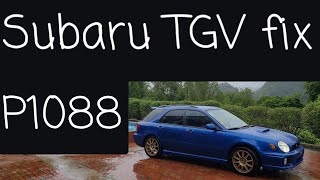
- P1088 — This is the equivalent 'Circuit High' code for the Bank 1 (driver's side) TGV position sensor. Seeing both codes together could point to a shared wiring issue or that both sensors have failed due to age.
Technical Service Bulletins (TSBs) & Recalls
- TSB 02-182-19: While for different codes (P2004, P2005, P2006, P2007) on 2014-2018 Foresters and 2015-19 WRX, this bulletin is highly relevant. It documents a known issue where EGR condensation causes corrosion on the TGV shaft, leading it to bind. This mechanical failure can sometimes lead to the sensor reporting out-of-range values. The fix was a redesigned shaft made of stainless steel.
Platform-Specific Known Issues
- Access to the passenger-side TGV sensor can be very difficult, especially on turbocharged XT models. It is tucked near the turbocharger and up-pipe, often requiring removal of other components for access. Some owners remove the intercooler for better access.
- The sensor must be 'preloaded' during installation. This involves installing the sensor with its connector pointing up (12 o'clock), then rotating it clockwise 90 degrees to the final position (3 o'clock) before tightening the bolts. 🎬 See how to properly preload and swap the sensor. This ensures the internal spring provides the correct tension. Failure to do this will result in immediate codes and poor engine operation.
Mechanic-Grade Diagnostic Values
- TGV Position Sensor Signal Voltage (Valves Open, Engine Warm) — expected: ~0.4V. Failure: A voltage stuck near 5V, or a voltage that doesn't change from the closed state.
- TGV Position Sensor Signal Voltage (Valves Closed, Cold Start) — expected: ~4.2V. Failure: A voltage stuck near 5V, or a voltage that doesn't change as the valve actuates.
- TGV Position Sensor Signal Voltage (KOEO, at rest) — expected: ~0.4V. Failure: A constant voltage near 5V indicates an open signal circuit or internally failed sensor.
- Engine Ground Harness Resistance — expected: < 1 Ω. Failure: Higher resistance can cause a floating ground and lead to incorrect high voltage readings from manifold-grounded sensors like the TGV sensor.
Scan Tool Commands That Help
- Subaru Select Monitor (SSM): Current Data Display / Data Display — To view live data parameters. A technician would monitor 'TGV Position Sensor R' (for Bank 2) to see if the voltage reading is stuck high or responds correctly to engine temperature and throttle changes.
- Subaru Select Monitor (SSM): TGV Drive Status — This parameter shows the commanded state of the TGV motor (OPEN or CLOSE). This is used to verify if the ECU is attempting to actuate the valve, which helps differentiate a motor/mechanical problem from a sensor problem.
Wiring & Ground Locations
- Bank 2 TGV Sensor Connector (B23) — On the passenger side TGV assembly, a 3-pin connector located between the intake manifold runner and the cylinder head, near the turbocharger.. This is the direct connector for the sensor. A 'Circuit High' code is often caused by this connector being unplugged, as the open signal wire will float to the 5V reference voltage.
- TGV Connector Pinout (3-pin type) — At the TGV sensor connector.. For manual testing: Pin 1 is typically 5V Reference, Pin 2 is the Signal wire (variable voltage), and Pin 3 is Sensor Ground. Probing Pin 2 is necessary to confirm if the sensor is stuck high.
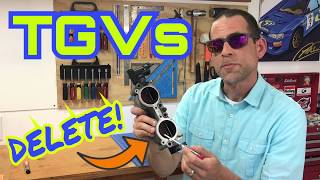
- Intake Manifold Grounding — The TGV assemblies ground through their mounting to the cylinder heads. Some aftermarket TGV deletes or spacers are non-conductive.. If the intake manifold has a poor ground path to the chassis/engine block, it can create a floating ground for the sensors, causing erratic high voltage readings. This is a known issue if non-conductive spacers are installed without adding a supplementary ground wire.
Real Owner Repair Stories
- LegacyGT.com & YouTube Community Consensus (2005+ Subaru Forester XT (and related Legacy GT/WRX models)) — Check Engine Light with code P1098, limp mode, no power, disabled cruise control.
❌ Tried (didn't work) Clearing the code (it returns immediately)., Simply plugging the sensor back on without correct alignment after removal.
✅ What actually fixed it The universal fix is replacing the Bank 2 (passenger side) TGV position sensor (P/N 22633AA210). The critical step during installation is to 'preload' the sensor. The new sensor must be placed onto the TGV shaft with the electrical connector pointing upwards (12 o'clock), then rotated 90 degrees clockwise (to 3 o'clock) against its internal spring tension before the mounting screws are installed. Failure to perform this preloading step results in an immediate P2021 or similar TGV code because the sensor's voltage is not in the expected range at rest.
OEM Part Supersession History
22633AA140→22633AA210— Likely minor internal revisions for durability or manufacturing consistency. The parts are functionally identical.
Model Year Variations Within This Range
- 2005-~2008 (SG/early SH): These models typically use a separate 3-pin connector for the TGV position sensor and a separate 2-pin connector for the TGV motor.
- ~2009-2019 (Late SH/SJ): Many later models, especially from the SH generation onward, switched to a single, integrated 5-pin connector on the TGV assembly that handles both the position sensor and motor functions. It's crucial to visually inspect the connector on the vehicle before ordering replacement pigtails.
- 2014-2018 (SJ XT): The Forester XT in this range uses the FA20DIT engine, which has a different intake manifold and TGV design compared to the older EJ255 engine. While the P1098 code and sensor failure are still relevant, the physical location and access procedures may vary.
Diagnostic Flowchart
Other Known Issues on This Vehicle
Issues unrelated to this code that are worth knowing about as an owner of this generation:
- Head Gasket Failure (Naturally Aspirated EJ25 Engine) 🔴 High — Very common on 1999-2010 Foresters, typically occurring between 80,000 and 150,000 miles. It can present as an external oil/coolant leak or an internal breach causing overheating.
- Excessive Oil Consumption (FB25 Engine) 🟠 Medium — Affects early FB series engines, primarily in 2011-2014 Foresters. Caused by issues with piston rings. A class-action lawsuit led to a settlement extending warranty coverage. (Ref: Class Action Lawsuit (Yaegar v. Subaru, No. 1:14-cv-04490) resulted in an 8-year/100,000-mile extended warranty for affected vehicles.)
- CVT Transmission Issues & Warranty Extension 🟠 Medium — Some owners of 2014-2018 Foresters experience issues like shuddering or hesitation. In response, Subaru extended the CVT warranty to 10 years/100,000 miles for many models. (Ref: TSB 16-115-18, TSB 16-117-18)
- Rear Wheel Bearing Failure 🟠 Medium — A common issue across many Subaru models, including the Forester, causing a loud humming or grinding noise from the rear of the vehicle that changes with speed. Failures can be premature. (Ref: Multiple TSBs have been issued over the years, including 03-50-02, 03-58-08, and 05-70-19, addressing part design changes and replacement procedures.)
- Turbocharger Failure (Turbo Models) 🔴 High — On EJ255 engines, banjo bolt filters for the turbo oil feed line can become clogged, starving the turbo of oil and leading to catastrophic failure. It's a known weak point, especially on modified vehicles.
Used vs. New Parts: Buying Guide for This Vehicle
When a used part is the smart pick: For the TGV motor or the entire TGV housing assembly (if required for a mechanical issue), a low-mileage used part can be a cost-effective option. However, for the electronic position sensor that is the cause of P1098, buying used is NOT recommended.
Donor-vehicle mileage cap: roughly under 80000 miles for the part to have meaningful remaining life.
What to inspect on the donor part:
- For a full TGV assembly, check for minimal carbon buildup on the butterfly valves.
- Ensure the valve shaft moves freely without binding or sticking.
- Inspect plastic connectors for brittleness, cracks, or broken locking tabs.
- Avoid parts from engines that show signs of heavy oil leaks or overheating.
OEM-only on this vehicle (don't cheap out):
- While not strictly 'OEM-only', using a known quality brand for the TGV Position Sensor is critical. Cheap, unbranded aftermarket sensors are notorious for being out of spec and not resolving the code.
Aftermarket brands forum-validated for this vehicle:
- Denso (often the OEM manufacturer)
- NTK
- Standard Motor Products (SMP)
Brands owners have reported issues with on this vehicle:
- Unbranded, low-cost sensors from online marketplaces (e.g., AIP Electronics was mentioned as a brand to avoid in one source).
Real Owner Stories
Aggregated from forums and TSBs cited above. Mileages and costs reflect what owners reported in those sources.
2004 Subaru Impreza (EJ-series engine)
Symptoms: The owner encountered a TGV position sensor error and needed to swap the sensor, emphasizing the importance of the spring tension during the install.
What fixed it: Swapped the TGV position sensor using the 'preloading' method (rotating the sensor 90 degrees during installation) to ensure the internal spring provided correct tension.
Source hint: YouTube - 'Subaru P1086 Error Code: How to swap the TGV position sensor in a 2004 Impreza'
2005-2012 Subaru Legacy GT (EJ255 engine)
Symptoms: Owners reported the P1098 code appearing frequently due to the sensor's proximity to the turbocharger, which causes heat-related failure.
What fixed it: Replacing only the passenger-side sensor (part 22633AA210) and checking for brittle or melted wiring connectors.
Source hint: legacygt.com thread titled 'TGV and Fuel Injector issue'
2014-2018 Subaru Forester (FA20DIT engine)
Symptoms: Mechanical TGV issues where the shaft would bind, potentially leading to sensor codes.
What fixed it: Replacement of the TGV shaft with a redesigned version made of stainless steel to prevent corrosion from EGR condensation.
Source hint: TSB 02-182-19
Related OBD-II Codes
Frequently Asked Questions
Does TSB 02-182-19 apply to my 2017 Forester XT regarding TGV issues?
Can I replace just the sensor on my passenger-side TGV, or do I need the whole assembly?
Why is the P1098 code so common on the Forester XT compared to other models?
Is there a specific trick to installing the new sensor (22633AA210)?
Will a loose plug cause a P1098 'Circuit High' code on my Subaru?
I have a 2013 Forester with high oil consumption; is this related to my P1098 code?
Helpful Videos


We Have This Part in Stock




The information in this article is provided for general reference and educational purposes only. Vehicle specifications, procedures, and part compatibility can vary by production date, trim level, and region. Always consult your vehicle's factory service manual and verify part numbers before purchasing or performing repairs. Safety-critical components such as airbags, seat belts, and braking systems should be installed by a qualified professional.
- Subaru Forester:
- 🎬 Helpful Videos
- 🛍️ Shop This Part
- What's Unique About the 2005-2019 Subaru Forester
- Symptoms You May Notice
- Most Likely Causes
- Rare But Worth Checking
- Diagnosis Steps
- Parts You'll Likely Need
- Related Codes That Often Appear With This One
- Technical Service Bulletins (TSBs) & Recalls
- Platform-Specific Known Issues
- Mechanic-Grade Diagnostic Values
- Scan Tool Commands That Help
- Wiring & Ground Locations
- Real Owner Repair Stories
- OEM Part Supersession History
- Model Year Variations Within This Range
- Diagnostic Flowchart
- Other Known Issues on This Vehicle
- Used vs. New Parts: Buying Guide for This Vehicle
- Real Owner Stories
- 2004 Subaru Impreza (EJ-series engine)
- 2005-2012 Subaru Legacy GT (EJ255 engine)
- 2014-2018 Subaru Forester (FA20DIT engine)
- Related OBD-II Codes
- Frequently Asked Questions
- 🎟️ Get 5% Off