

P1061 on 2022-2023 Ford Maverick Hybrid: Engine Failure Warning Causes & Fixes
P1061 on a 2022-2023 Ford Maverick Hybrid is a critical code indicating the Powertrain Control Module (PCM) has detected a high risk of severe engine damage, specifically a faulty connecting rod bearing. This is not a DIY fix; immediate dealer service is required. The repair is often a complete engine replacement covered under a Ford Customer Satisfaction Program.
- P1061 on a 2022-2023 Maverick Hybrid is a critical alert for potential engine failure.
- Do not drive the vehicle. Have it towed to a Ford dealer immediately.
- The most common cause is a faulty connecting rod bearing, a known manufacturing defect.
- The repair is almost always a complete engine replacement, which should be covered by Ford's Customer Satisfaction Program 23N06 at no cost to you (within 10 years/100,000 miles).
- Do not attempt to clear the code or perform any DIY repairs.
- This issue also affects 2020-2023 Ford Escapes and 2021-2022 Lincoln Corsairs with the 2.5L Hybrid engine.
What's Unique About the 2022-2023 Ford MAVERICK

This code is uniquely tied to a known manufacturing defect in the 2.5L Hybrid engine used in the Maverick and other Ford models like the Escape and Lincoln Corsair. Following a recall (23S27) for engine fire risk due to premature engine failure, Ford updated the vehicle's software to be more sensitive to the signs of this failure. Therefore, P1061 acts as an early warning system. It doesn't point to a simple sensor failure but rather indicates the detection of a severe mechanical issue (a failing connecting rod bearing) that Ford has acknowledged with a specific Customer Satisfaction Program (23N06).
Diagnostic Flowchart
Tap your situation to follow the diagnostic path that matches what you're seeing on this vehicle.
Symptoms You May Notice
- Check Engine Light (Malfunction Indicator Lamp, MIL) illuminated.
- Powertrain Malfunction (Wrench) Indicator illuminated.
- Reduced engine power or 'limp mode', where the vehicle struggles to exceed 30 mph.
- Loud engine noises, such as squeaking, knocking, or clanking.
- Warning messages on the instrument cluster to 'Stop Safely Now'.
- FordPass app notification of 'Powertrain Malfunction/Reduced Power'.
- Replacing the knock sensor. While a knock sensor is integral to detecting the issue, the root cause is not the sensor itself but the severe mechanical failure it is detecting. One owner on MaverickTruckClub.com reported a knock sensor and timing components were replaced unnecessarily before the true cause (rod bearing) was identified and the engine was replaced.
Most Likely Causes

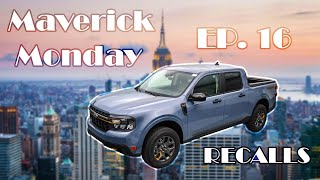
- Faulty Connecting Rod Bearing 🔴 High Probability A known manufacturing defect involving incorrectly machined crankshafts or bearings affected a range of 2.5L Hybrid engines produced before September 2022. The PCM software was updated via recall 23S27 to specifically detect this failure mode and trigger code P1061. 🎬 Watch: Detailed breakdown of the 23S27 engine fire recall
How to confirm: A Ford dealer must perform diagnostics. The presence of P1061 and/or P032F, often combined with engine noise, will confirm the diagnosis per Ford's internal procedures (Customer Satisfaction Program 23N06). The dealer will follow Workshop Manual (WSM) diagnostics for these specific DTCs.
Typical fix: Complete replacement of the engine long block assembly. This repair is typically covered free of charge by Ford under Customer Satisfaction Program 23N06, which extends the warranty for this specific issue to 10 years or 100,000 miles from the warranty start date. If the vehicle is outside these limits, the program was available through July 31, 2025.
Est. part cost: $0 (if covered by Ford program) - Powertrain Control Module (PCM) Software Error ⚪ Low Probability In some cases, the software designed to detect the engine fault can be overly sensitive or contain a bug, incorrectly triggering the code. This can sometimes happen after a recall-related software update is performed.
How to confirm: A Ford dealer will check for applicable Technical Service Bulletins (TSBs), such as TSB 25-2454. If no mechanical fault is found after inspection, a software issue is the likely cause. The dealer may test drive the vehicle to see if the code can be duplicated.
Typical fix: Reprogramming the PCM and/or other modules with the latest software version. This is a dealer-only procedure.
Est. part cost: $0 (if covered under warranty or TSB)
Diagnosis Steps
- DO NOT CLEAR THE CODE. This is critical evidence for the dealer.
- Immediately and safely pull over, shut off the engine, and do not attempt to restart or drive the vehicle.
- Have the vehicle towed to an authorized Ford dealership. Many owners have successfully used AAA for towing. 🎬 See what it's like getting these Maverick recalls resolved
- Inform the service advisor of the P1061 code and any symptoms experienced (e.g., engine noise, power loss, 'Stop Safely Now' message).
- Reference Ford Safety Recall 23S27 and Customer Satisfaction Program 23N06. The dealer will use this information to follow a specific diagnostic path.
- The dealer will verify the codes with their diagnostic tool (FDRS) and inspect the engine as per Ford's instructions in the Workshop Manual (WSM).
- Based on the diagnostic results, the dealer will either perform a PCM reflash (per TSB 25-2454) or initiate an engine replacement under program 23N06.
- Ford provides dealers with up to 3 days of a comparable rental vehicle for customers during the repair.
Parts You'll Likely Need

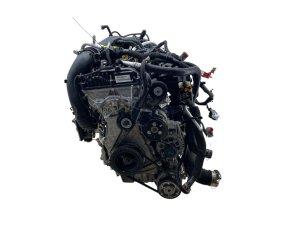
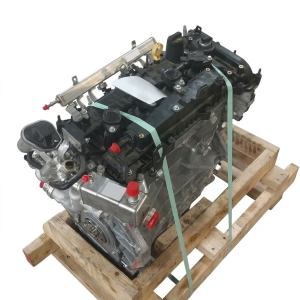
- Engine Long Block Assembly
(OEM #LX6Z-6006-A)— This is the official Ford-mandated repair for a confirmed connecting rod bearing failure indicated by code P1061. The long block includes the engine block and cylinder head assembly, but not accessories like manifolds or wiring.
Trusted brands: Motorcraft
OEM price range: $7000-$9000
Aftermarket price range: N/A
Related Codes That Often Appear With This One
- P032F — This code, 'Combustion Engine Producing Insufficient Torque', is frequently stored alongside P1061. Ford's TSBs and Customer Satisfaction Programs explicitly mention them appearing together as indicators of the same connecting rod bearing issue. P032F sets when the actual engine torque falls below the expected torque for a calibrated period, also pointing to a potential internal mechanical failure.
Technical Service Bulletins (TSBs) & Recalls
- TSB 25-2454: Notes that P1061 and/or P032F with reduced power may be due to a PCM software issue and can be fixed by reprogramming.
- TSB 23N06 / 23N06 S1: Establishes Customer Satisfaction Program for vehicles that have had recall 23S27 performed. It links P1061/P032F directly to a faulty connecting rod bearing detected by the PCM and authorizes engine replacement.
Platform-Specific Known Issues
- This code is a direct consequence of Ford's response to Safety Recall 23S27, which addressed a risk of under-hood fire from catastrophic engine failure on 2.5L Hybrid models.
- Ford has implemented Customer Satisfaction Program 23N06, extending the warranty to 10 years/100,000 miles for a one-time engine replacement if codes P1061 and/or P032F are present and diagnostics confirm the issue.
- Owner forums are filled with reports of this code leading to a dealer-performed engine replacement, confirming the severity and the established repair process. Repair times vary, with some owners reporting the entire process took about a month. 🎬 Watch: A complete overview of all Ford Maverick recalls
Mechanic-Grade Diagnostic Values
- Knock Sensor Voltage (General Test) — expected: Less than 0.5V with Key On, Engine Off (KOEO).. Failure: A voltage reading greater than 0.5V during a KOEO test can indicate a hard electrical fault in the sensor or circuit.
- Knock Sensor PID Value (FORScan/Live Data) — expected: A unitless value, typically fluctuating between 20-60 at idle. Values will increase into the hundreds under load.. Failure: This value represents 'noise' and is interpreted by the PCM. P1061 is triggered when the PCM's logic determines this value has exceeded a calibrated threshold for a set period, indicating mechanical failure, not necessarily a sensor failure.
Scan Tool Commands That Help
- Ford Diagnostic & Repair System (FDRS): PCM Reprogramming / Software Update — This function is the specific fix for cases where P1061 is triggered due to a software bug, as outlined in TSB 25-2454. It should be performed by a dealer when no mechanical engine noise is present but the code is active.
Wiring & Ground Locations
- Main Chassis Ground — In the passenger footwell, there are two threaded ground bolts on the firewall, located just under the BCM and fusebox.. A poor PCM or sensor ground can cause erratic sensor readings. While not the primary cause of P1061, verifying solid grounds is a fundamental step in any complex electrical diagnosis.
- 12V Battery Ground (Hybrid) — The negative battery terminal, which incorporates the Battery Monitoring System (BMS) sensor.. On hybrid models, any auxiliary components or diagnostic tools must be grounded to the chassis or a body ground point, NOT directly to the negative battery post. Grounding to the post bypasses the BMS, which can lead to incorrect battery state-of-charge calculations and other electrical issues.
Real Owner Repair Stories
- MaverickTruckClub.com forum user (2022-2023 Ford Maverick Hybrid) — Power loss, check engine light, P1061 code stored.
❌ Tried (didn't work) The dealership initially misdiagnosed the problem and replaced the knock sensor and all timing chain components.
✅ What actually fixed it After the initial repairs failed to solve the issue, the root cause was correctly identified as the faulty connecting rod bearing. The engine long block was replaced under Ford's Customer Satisfaction Program, which resolved the code and symptoms.
"I Checked Everything" — The Actual Cause
- In the context of P1061, the equivalent of a 'smoke test clean' scenario is when the code is present without any audible engine knocking or mechanical noise. In these cases, the root cause is not the catastrophic engine failure but is instead a software glitch in the Powertrain Control Module (PCM). The official fix, per TSB 25-2454, is for a Ford dealer to reprogram the PCM with updated software.
OEM Part Supersession History
LX6Z-6006-A→N/A— This is the current part number for the engine long block assembly. No supersession is noted in public data.
Heads up: While the part number has not officially changed, it is presumed that replacement long blocks manufactured after the issue was identified have improved quality control regarding the crankshaft and bearing machining to prevent repeat failures.
Model Year Variations Within This Range
- 2024+: For the 2024 model year, Ford made the 2.0L EcoBoost engine standard on all Maverick trims, with the 2.5L Hybrid (the engine affected by P1061) becoming an optional powertrain. This reverses the standard offering from 2022-2023 and limits the P1061 issue primarily to 2022-2023 models and optionally-equipped 2024 models.
Helpful Videos
We Have This Part in Stock

The information in this article is provided for general reference and educational purposes only. Vehicle specifications, procedures, and part compatibility can vary by production date, trim level, and region. Always consult your vehicle's factory service manual and verify part numbers before purchasing or performing repairs. Safety-critical components such as airbags, seat belts, and braking systems should be installed by a qualified professional.
- Ford MAVERICK:
- 🎬 Helpful Videos
- 🛍️ Shop This Part
- What's Unique About the 2022-2023 Ford MAVERICK
- Diagnostic Flowchart
- Symptoms You May Notice
- Most Likely Causes
- Diagnosis Steps
- Parts You'll Likely Need
- Related Codes That Often Appear With This One
- Technical Service Bulletins (TSBs) & Recalls
- Platform-Specific Known Issues
- Mechanic-Grade Diagnostic Values
- Scan Tool Commands That Help
- Wiring & Ground Locations
- Real Owner Repair Stories
- "I Checked Everything" — The Actual Cause
- OEM Part Supersession History
- Model Year Variations Within This Range
- 🎟️ Get 5% Off