

P1058 on 2012-2018 Mazda 6 SKYACTIV-D 2.2L: Cylinder 4 Over-Fueling Causes and Fixes
P1058 means cylinder #4 is getting too much fuel, almost always due to a faulty #4 fuel injector. This is a critical code on this engine, as it's linked to failing injector seals that can cause oil contamination and catastrophic engine failure. Do not drive the vehicle; immediate professional service is required.
- P1058 indicates an over-fueling condition in cylinder #4, most often caused by a bad injector.
- This code is a CRITICAL warning on a 2.2L SKYACTIV-D engine due to its strong association with failing injector seals.
- Failing injector seals contaminate the engine oil, clog the oil pump strainer, and will lead to catastrophic engine failure if not addressed.
- DO NOT drive the vehicle. Seek immediate professional service.
- Any repair must include replacing the injector seal (washer), preferably on all four cylinders, and may require cleaning the oil pan and oil pump strainer.
What's Unique About the 2012-2018 Mazda 6
The 2.2L SKYACTIV-D engine is infamous for a critical design flaw: the failure of the copper washers that seal the fuel injectors. While P1058 directly points to a fuel quantity issue, it is often a symptom or precursor to this seal failure. When the seals leak, hot combustion gases blow past them into the valve cover, superheating the engine oil and cooking it into a thick, hard carbon sludge. This sludge circulates through the engine, clogging the oil pump pickup strainer in the oil pan. This blockage starves the engine of oil, leading to a cascade of catastrophic failures, most notably premature wear and destruction of the exhaust camshaft and the twin turbochargers. Therefore, any injector-related code on this engine must be treated with extreme seriousness as a potential indicator of imminent, widespread engine damage.
Symptoms You May Notice
- Check Engine Light illuminated
- Engine running rough, juddering, or stuttering, especially at idle or under light load
- A labored or uneven engine cranking sound during startup.
- Noticeable loss of engine power, or inconsistent turbo performance
- Increased engine noise, 'chuffing' sounds from the top of the engine, or a knocking sound
- More frequent Diesel Particulate Filter (DPF) regeneration cycles, or the DPF light illuminating
- In severe cases, a red 'Engine Oil Pressure Inspection Required' warning light will appear on the dash, indicating oil starvation.
- Replacing only the injector without replacing the seal and cleaning the injector bore. This fails to address the common root cause and can lead to a repeat failure or catastrophic engine damage.
- Clearing low oil pressure codes (P06DE, P055F) and continuing to drive after an oil change. While fresh oil may temporarily restore pressure, it does not clear the blocked strainer, and the problem will quickly return.
- Ignoring the code or clearing it without investigation. Due to the high risk of oil starvation and engine seizure, this code should never be ignored.
- Confusing the code with a gasoline engine misfire (e.g., P0304) and attempting to replace spark plugs or ignition coils, which this diesel engine does not have.
- Misinterpreting the code as an oxygen sensor fault. Some generic code readers may incorrectly label P1058, but for the SKYACTIV-D 2.2L, it specifically refers to injector quantity.
Most Likely Causes
- Faulty #4 Fuel Injector 🔴 High Probability The high-pressure piezoelectric injectors can fail internally, causing them to stick open or deliver an incorrect fuel quantity. Carbon buildup from leaking seals can also foul the injector tip, affecting its performance.
How to confirm: A mechanic can use a diagnostic scan tool to monitor injector correction values. A significantly high positive value for cylinder #4 confirms over-fueling. The most definitive test is to swap the suspect injector with another cylinder and see if the fault code follows the injector.
Typical fix: Replace the #4 fuel injector. The new injector's unique calibration code must be programmed into the PCM. It is mandatory to also replace the injector seal (washer), O-ring, and the single-use stretch bolt for the clamp at the same time.
Est. part cost: $350-$650 - Failed Injector Seal (Copper Washer) 🔴 High Probability The original copper injector seals are a well-documented, notorious failure point on the SKYACTIV-D 2.2L engine. Combustion gases leak past the seal, creating carbon buildup that contaminates the engine oil and can damage the injector. Mazda later issued an updated, more durable 'silver' colored seal.
How to confirm: Visually inspect the base of the fuel injectors for black, tar-like carbon deposits. Listen for an audible 'chuffing' or puffing sound from the engine cover area at idle, which is the sound of combustion gases escaping past the seal.
Typical fix: Remove all four fuel injectors and replace the copper washers with the updated part (SH01-13-H51). This job requires meticulous cleaning of the injector bores. If this is the cause, the oil pan MUST be removed to inspect and clean/replace the oil pump pickup strainer (SH01-14-240) 🎬 See how to remove the oil pump and strainer. to prevent engine seizure.
Est. part cost: $15-$50 for a set of seals
Rare But Worth Checking
- Clogged Oil Pump Pickup Strainer: This is not a root cause, but a severe and almost certain consequence of leaking injector seals. If P1058 is accompanied by low oil pressure warnings (P06DE, P055F), the strainer is almost certainly blocked with carbon sludge, and the engine is being starved of oil, leading to further damage.
- Worn Exhaust Camshaft: A secondary effect of oil starvation. Metal shavings from the worn camshaft can further contaminate the oil system, and the improper valve lift can cause performance issues that may confuse the PCM's diagnostics.
- Poor Fuel Quality: Inferior quality diesel fuel can contribute to injector deposits and malfunction over time.
- Engine Mechanical Issues: In rare cases, a loss of compression in cylinder #4 could cause the PCM to misinterpret sensor data, but this is highly unlikely to be the primary cause for this specific code.
- PCM Malfunction: While a TSB exists for PCM failure causing injector codes on SKYACTIV-G (gasoline) engines, it is a very rare possibility for this code on a diesel. A TSB for paired injector codes (P0202/P0203) on some 2013-2016 diesel models does exist, making a single-cylinder driver failure a remote possibility.
Diagnosis Steps
- Verify P1058 is the active code using a quality OBD-II scanner. Check for any other codes, especially oil pressure codes (P06DE, P055F) or injector learning codes (P1200, P167B).
- Remove the plastic engine cover. Visually inspect the area around the base of all four fuel injectors for black, tar-like soot.
- With the engine idling, listen carefully for a rhythmic 'chuffing' or 'puffing' sound from the top of the engine, which indicates a leaking injector seal.
- If a scan tool is available, monitor the 'Injector Correction Values' for all cylinders. A value significantly different for cylinder #4 (e.g., outside +/- 1.0 mm³/st) points to a problem.
- If a leak is suspected or confirmed, check the engine oil level and condition. A level that is rising indicates diesel fuel is diluting the oil. Thick, sludgy oil indicates carbon contamination.
- If oil pressure codes are present or live data shows low oil pressure (e.g., below 140 kPa at idle), the vehicle must be shut off immediately and towed. The oil pan must be removed to inspect the oil pump pickup strainer for blockage.
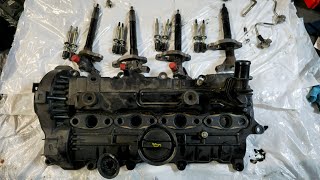
- If the valve cover is removed to service the injectors, inspect the exhaust camshaft lobes for signs of 🎬 Watch this video to see how to inspect the exhaust camshaft. premature wear, such as a 'lipped' or concave appearance on the lobe surface.
- If no external signs of a leak are present, the diagnosis will proceed to testing the fuel injector itself, which is best left to a professional.
Parts You'll Likely Need
- Fuel Injector
(OEM #SH01-13-H50)— This is the most common direct cause for the P1058 code, where the injector itself has failed internally. The OEM is Denso, with an equivalent part number of 295900-0260.
Trusted brands: Denso (OEM supplier), Mazda
OEM price range: $350-$500
Aftermarket price range: $250-$400 (Remanufactured) - Fuel Injector Seal (Washer)
(OEM #SH01-13-H51)— This seal is a critical failure point. It MUST be replaced any time an injector is serviced to prevent catastrophic engine failure from oil contamination. It is best practice to replace all four with the updated 'silver' type.
Trusted brands: Mazda (OEM), Elring
OEM price range: $5-$15 per seal
Aftermarket price range: $2-$10 per seal - Oil Pump Pickup Strainer
(OEM #SH01-14-240)— If the injector seal has been leaking, this strainer becomes clogged with carbonized oil sludge, starving the engine of oil. It is mandatory to inspect and likely replace this part if injector seals have failed.
Related Codes That Often Appear With This One
- P06DE — This code indicates 'Engine Oil Pressure Control Circuit Stuck On'. It is a direct and severe consequence of leaking injector seals causing oil sludging and clogging the oil pump pickup strainer.
- P055F — Another oil pressure-related code, 'Engine Oil Pressure Out of Range', triggered by the same oil starvation issue caused by leaking injector seals and a clogged oil strainer.
- P1055, P1056, P1057 — These are companion codes for over-fueling on cylinders #1, #2, and #3, respectively. If multiple injector codes are present, it strongly suggests a systemic issue like widespread seal failure or severe fuel contamination.
- P0299 — 'Turbocharger/Supercharger Underboost'. This is often a consequence of the cascading failures starting with injector seals, leading to oil contamination and turbocharger damage.
Technical Service Bulletins (TSBs) & Recalls
- R073/15: A detailed TSB outlining the diagnosis and repair procedure for issues related to turbochargers and camshafts, including engine flushing steps and injector tightening procedures, often stemming from the root cause of injector seal leaks.
Platform-Specific Known Issues
- Widespread failure of the original copper injector seals is the single most critical issue for the SKYACTIV-D 2.2L engine, leading to carbon buildup in the oil, clogged oil strainers, and engine seizure.
- Due to the injector seal issue, these engines are very sensitive to oil change intervals and oil quality. Using only the specified low-ash C3 diesel oil and shortening the change interval is recommended by owners to prolong engine life.
Mechanic-Grade Diagnostic Values
- Fuel Injector Correction Values (Live Data at Idle) — expected: Between -1.0 and +1.0 mm³/stroke for a healthy injector.. Failure: A value significantly outside the expected range for cylinder #4 indicates a fueling anomaly. A large positive value suggests over-fueling.
- Fuel Rail Pressure (Live Data) — expected: Must be 35 MPa (5,077 psi) or more for the PCM to run the P1058 diagnostic test.. Failure: Pressure below this threshold may prevent the code from setting but could indicate other system issues.
- Engine Oil Pressure (Live Data, Warm Engine at Idle) — expected: Approximately 160-180 kPa.. Failure: Pressure significantly below 150 kPa at idle is a strong indicator of a blocked oil pickup strainer, a common consequence of leaking injector seals.
Hidden / Shadow Codes Worth Checking
- P1200:00 / P167B:00: These codes are stored by the PCM if the 'Fuel Injector Injection Amount Correction' (learning procedure) is not performed or fails to complete after replacing an injector. If only P167B:00 is stored, the glow plug light may flash. (see via Mazda M-MDS or advanced aftermarket scan tools like FORScan.)
- DTC Status Byte (:XX): Mazda uses a 2-digit status byte (e.g., P1058:00) to provide extra detail, such as whether a fault is current, historical, or pending. This offers more diagnostic context than the main code alone. (see via Mazda M-MDS or advanced aftermarket scan tools like FORScan.)
Scan Tool Commands That Help
- Mazda M-MDS / FORScan: Injector Correction Factors (Program) — This is a mandatory step after installing a new fuel injector. It is used to write the unique 30-digit calibration code printed on the new injector into the PCM.
- Mazda M-MDS / FORScan: Fuel Injector Data Reset — This procedure must be run after replacing a fuel injector to clear the old injector's learned adaptation data from the PCM before the new learning process begins.
- Mazda M-MDS / FORScan: Injector Amount Correction (Learning) — After coding a new injector, this learning procedure must be initiated. The PCM will control the engine speed to learn the precise flow characteristics of the new part. This can also be initiated manually without a scan tool.
Wiring & Ground Locations
- Engine Ground Points — Key grounds for the engine harness are typically located on the transmission housing, on a stud for the passenger side motor mount, and on the cylinder head/valve cover.. A poor or corroded engine ground can cause erratic voltage and signal interference for sensitive components like the piezoelectric fuel injectors, potentially leading to incorrect operation and triggering fuel quantity fault codes.
Real Owner Repair Stories
- Reddit user 'duckdamozz' (2017 Mazda 6 2.2D) — Engine has 'gone bad, full of soot'.
❌ Tried (didn't work) The user notes the failure happened despite good maintenance practices, refuting the idea that only poorly-maintained cars are affected.
✅ What actually fixed it The user states the root cause was the 'malleable' exhaust camshaft and 'crappy injector washers,' confirming the known failure cascade. A long list of replaced parts included the exhaust camshaft, rockers, injector washers (twice), oil pickup, and injector lines, among others. - Aggregated from Reddit (r/mazda6) (Mazda 6 SKYACTIV-D 2.2L) — Owner was aware of the common failure and sought to prevent it.
✅ What actually fixed it The owner proactively replaced the original copper injector seals with the updated 'silver' alloy seals (part number SH01-13-H51) as a preventative measure to avoid the infamous blow-by and subsequent engine damage.
When the Usual Fixes Don't Work
- A common point of confusion found online involves misinterpreting this manufacturer-specific code. For example, a query on a popular expert-for-hire site resulted in a mechanic incorrectly identifying P1058 on a 2015 Mazda 6 as an oxygen sensor fault. This is incorrect for the SKYACTIV-D 2.2L engine, where official Mazda documentation confirms P1058:00 is 'Injection quantity too high cylinder No.4'. This highlights the danger of relying on generic code definitions for manufacturer-specific faults, especially on complex diesel engines.
OEM Part Supersession History
Unknown (Original Copper Washer)→SH01-13-H51— The original copper seals were prone to failure, allowing combustion gases to leak into the crankcase. The updated SH01-13-H51 seal is made of a different, more durable 'silver' colored material to better withstand combustion pressure and heat.
Heads up: Using the old-style copper seals or non-OEM equivalents is highly likely to result in a repeat failure and catastrophic engine damage.
Model Year Variations Within This Range
- 2012-2018: A recall was issued for carbon deposit buildup in the intake shutter valve. The required work varies by VIN, with earlier models potentially requiring more extensive repairs than later ones.
- Later in the generation (approx. 2018+): Some later Euro 6d-TEMP compliant versions of the 2.2L SKYACTIV-D engine introduced an AdBlue (SCR - Selective Catalytic Reduction) system to further reduce NOx emissions. This system is not present on earlier models.
- 2013-2016: A Mazda TSB (01-017/16) was issued for potential PCM failure causing paired injector codes (P0202/P0203) specifically on Japan-built models with DENSO PCMs within a certain VIN range.
Diagnostic Flowchart
Other Known Issues on This Vehicle
Issues unrelated to this code that are worth knowing about as an owner of this generation:
- Premature Exhaust Camshaft Wear 🔴 High — Common on engines over 80,000 miles, especially if oil maintenance has been compromised. The original camshaft material is considered 'soft' and wears against the rocker arms, creating 'lipped' lobes. (Ref: TSB R073/15 discusses related procedures. The camshaft part has undergone multiple revisions.)
- Turbocharger Failure 🔴 High — Can occur due to oil starvation from a clogged strainer or from coking of the turbo's own oil feed lines, especially with frequent short trips.
- Plastic Coolant Bypass Junction Failure 🔴 High — A plastic coolant junction located under the intake manifold is prone to cracking without warning, causing rapid coolant loss and severe engine overheating. Failures reported between 80,000 and 190,000 kms. (Ref: Mazda has released an updated metal replacement part.)
- DPF and EGR System Clogging 🟠 Medium — Common for vehicles used primarily for short-distance, urban driving, which prevents the DPF from completing regeneration cycles. This leads to oil dilution and excessive soot buildup.
- Blown Head Gasket/Cracked Cylinder Head 🔴 High — Less common than other issues, but can occur as a result of sudden overheating events, often linked to the failing plastic coolant bypass junction.
Used vs. New Parts: Buying Guide for This Vehicle
When a used part is the smart pick: For this specific repair, using used parts is strongly discouraged. The only scenario where a 'used' component might be considered is a complete, low-mileage replacement engine from a reputable source. Even then, it is mandatory to service it with new injector seals and a new oil pickup strainer before installation.
Donor-vehicle mileage cap: roughly under 50000 miles for the part to have meaningful remaining life.
What to inspect on the donor part:
- For a complete engine, demand proof of the injector seal service being performed with updated parts.
- Check for any signs of oil sludge in the valve cover or oil filler cap.
- Obtain vehicle history to check for regular oil changes with the correct low-SAPS oil.
OEM-only on this vehicle (don't cheap out):
- Fuel Injector Seal (Washer): Part #SH01-13-H51. Using aftermarket or old-style seals will lead to a repeat of the engine-destroying failure.
- Oil Pump Pickup Strainer: Part #SH01-14-240. This part is inexpensive and critical. Given the labor to access it, only a new OEM part should be used.
Aftermarket brands forum-validated for this vehicle:
- Denso: Denso is the Original Equipment Manufacturer (OEM) for the fuel injectors (Part #SH01-13-H50). A new Denso-branded injector is equivalent to a Mazda-branded one.
- Elring: A known OEM-quality supplier for gaskets and seals, including an equivalent for the injector seal.
Brands owners have reported issues with on this vehicle:
- Unbranded 'new' or 'remanufactured' injectors from online marketplaces (e.g., eBay, AliExpress). These often have questionable quality control and may not be calibrated correctly, leading to poor performance or further engine damage.
Real Owner Stories
Aggregated from forums and TSBs cited above. Mileages and costs reflect what owners reported in those sources.
2014 Mazda CX-5 SKYACTIV-D 2.2L
Symptoms: Low oil pressure warnings (P055F) appearing on the dash.
What fixed it: Discovery and cleaning of a carbon-blocked oil strainer in the oil pan.
Source hint: https://www.mazdas247.com/forum/index.php?threads/2014-cx-5-2-2l-diesel-with-oil-pressure-problem.123868035/page-2
2016 Mazda 6 SKYACTIV-D 2.2L
Symptoms: Labored start, followed by a bumpy ride, a red oil pressure light, and the car entering limp mode.
What fixed it: The owner described this as the 'classic 2.2 Skyactiv' failure sequence involving injector seal leakage and oil starvation.
Source hint: https://www.reddit.com/r/mazda6/comments/1b4j60t/so_my_mazda_6_is_doing_that_classic_22_skyactiv/
2016 Mazda 6 SKYACTIV-D 2.2L
Symptoms: Low oil pressure warnings appearing immediately after a routine oil service.
What fixed it: Diagnosis revealed the root cause was leaking injector washers, not the oil service itself.
Source hint: https://www.reddit.com/r/mazda6/comments/11w9x0l/2016_mazda_6_22d_skyactiv_150_check_engine_and_low/
2012-2018 Mazda 6 SKYACTIV-D 2.2L
Symptoms: P06DE and P055F codes present along with low oil pressure (below 140 kPa at idle).
What fixed it: Replacement of leaking injector washers and cleaning a completely clogged oil pickup strainer.
Source hint: https://www.youtube.com/watch?v=5zC2BgN935c
Related OBD-II Codes
Frequently Asked Questions
My 2014 Mazda 6 is making a 'chuffing' sound from the engine. Is this related to P1058?
Does TSB R073/15 apply to the injector issues on my SKYACTIV-D 2.2L?
What is the specific part number for the updated injector seals for the Mazda 6 2.2L?
If I replace the #4 fuel injector to fix P1058, what else must be replaced?
Why is my oil level rising on my 2015 Mazda 6 diesel?
I have a red 'Engine Oil Pressure Inspection Required' light; can I keep driving?
Helpful Videos

Used OEM Parts in Stock

New Aftermarket Parts Available

The information in this article is provided for general reference and educational purposes only. Vehicle specifications, procedures, and part compatibility can vary by production date, trim level, and region. Always consult your vehicle's factory service manual and verify part numbers before purchasing or performing repairs. Safety-critical components such as airbags, seat belts, and braking systems should be installed by a qualified professional.
- Mazda 6:
- 🎬 Helpful Videos
- 🛍️ Shop This Part
- What's Unique About the 2012-2018 Mazda 6
- Symptoms You May Notice
- Most Likely Causes
- Rare But Worth Checking
- Diagnosis Steps
- Parts You'll Likely Need
- Related Codes That Often Appear With This One
- Technical Service Bulletins (TSBs) & Recalls
- Platform-Specific Known Issues
- Mechanic-Grade Diagnostic Values
- Hidden / Shadow Codes Worth Checking
- Scan Tool Commands That Help
- Wiring & Ground Locations
- Real Owner Repair Stories
- When the Usual Fixes Don't Work
- OEM Part Supersession History
- Model Year Variations Within This Range
- Diagnostic Flowchart
- Other Known Issues on This Vehicle
- Used vs. New Parts: Buying Guide for This Vehicle
- Real Owner Stories
- 2014 Mazda CX-5 SKYACTIV-D 2.2L
- 2016 Mazda 6 SKYACTIV-D 2.2L
- 2016 Mazda 6 SKYACTIV-D 2.2L
- 2012-2018 Mazda 6 SKYACTIV-D 2.2L
- Related OBD-II Codes
- Frequently Asked Questions
- 🎟️ Get 5% Off