

P1025 on 2006-2010 Volkswagen Passat: Causes for Fuel Pressure Faults and Fixes
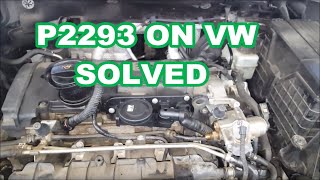
On a 2006-2010 Passat with the 2.0T FSI (BPY) engine, P1025 is almost always caused by a worn-out high-pressure fuel pump (HPFP) cam follower, a ~$40 part. Failure to replace it can lead to destroying the ~$400 HPFP and the intake camshaft. On the 3.6L VR6 engine, this code usually points to a much more serious issue: stretched timing chains, a repair that can cost over $2,500.
- P1025 is a serious code indicating a mechanical fuel system failure; do not continue to drive the vehicle.
- The cause is entirely dependent on your engine. For the 2.0T FSI, immediately inspect the cam follower. For the 3.6L VR6, check for timing chain stretch with a scan tool.
- On the 2.0T FSI, a worn cam follower is the most likely cause. It's a cheap part that, if ignored, leads to extremely expensive repairs.
- On the 3.6L VR6, P1025 is a strong indicator of stretched timing chains, a major and costly repair.
- Do not replace any parts until you have performed the specific inspection for your engine (visual follower check for 2.0T, scan tool timing check for 3.6L).
What's Unique About the 2006-2010 Volkswagen PASSAT

The 2006-2010 (B6 generation) Passat uses a direct injection fuel system that has two very different, engine-specific reasons for triggering code P1025. On the common 2.0T FSI engine, the code is famously linked to the premature wear of the 'cam follower,' a small metal tappet that drives the fuel pump. This part is a well-known weak point. For the less common 3.6L VR6 engine, P1025 is often a symptom of a much larger problem: stretched timing chains that cause the HPFP to run out of sync with the engine, a fault detailed in VW Technical Service Bulletin TT 01 20 05_4.
Diagnostic Flowchart

Tap your situation to follow the diagnostic path that matches what you're seeing on this vehicle.
Symptoms You May Notice
- Check Engine Light (MIL) is on
- EPC (Electronic Power Control) light may be on
- Sudden loss of engine power or entering 'limp mode'
- Engine hesitation or stumbling, especially during acceleration
- Rough or unstable idle
- Engine stalling, sometimes without warning
- Difficulty starting the engine
- A high-pitched whining or unusual noise from the engine bay
- Replacing the in-tank low-pressure fuel pump when the fault is in the high-pressure circuit.
- Replacing the Fuel Rail Pressure Sensor (G247) without first inspecting the cam follower (on 2.0T FSI) or checking timing chain stretch (on 3.6L VR6).
Most Likely Causes

- Worn High-Pressure Fuel Pump (HPFP) Cam Follower 🔴 High Probability This applies specifically to the 2.0T FSI (BPY engine code) used from 2006-2008.5. The flat tappet design is a notorious wear item, with its protective coating eroding over time. Failure is so common that many owners and independent shops consider it a routine maintenance item to be inspected every 20,000-30,000 miles.
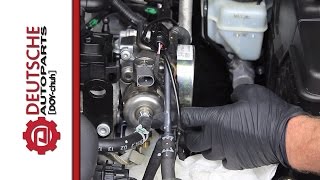
How to confirm: Physically remove the HPFP from the cylinder head (held by three T30 Torx bolts). 🎬 See this walkthrough on replacing the HPFP cam follower The bucket-shaped cam follower can then be pulled out of its bore and visually inspected. Look for a hole worn through the center, deep scoring, or a concave surface where it should be flat.
Typical fix: Replace the cam follower. If it has worn completely through, you must also inspect the HPFP's plunger tip and the intake camshaft lobe for damage. If either is damaged, they must also be replaced. An oil change is highly recommended to remove metal shavings from the engine. The three HPFP bolts are single-use and should be replaced, then torqued evenly to 10 Nm (7.5 ft-lbs).
Est. part cost: $30-$50 - Stretched Timing Chains 🟡 Medium Probability This is the most common cause for the 3.6L VR6 engine. Over time, the timing chains can stretch, causing the camshafts to go out of sync with the crankshaft. Since the HPFP is driven by the camshaft, this desynchronization triggers the P1025 fault, as noted in TSB TT 01 20 05_4.
How to confirm: Use a VW-specific scan tool (like VCDS) to check camshaft adaptation values. Check Measuring Value Blocks 208 and 209. If the phase deviation exceeds +/- 8 degrees, the timing chains are the confirmed cause. A secondary symptom is observing excessively high fuel rail pressure at idle, sometimes spiking as high as 125 bar (1800+ PSI).
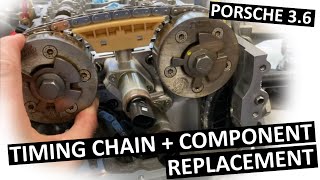
Typical fix: This is a major repair that involves replacing the timing chains, guides, and tensioners. It is extremely labor-intensive as the chains are on the transmission side of the engine, often requiring engine and transmission removal. 🎬 Watch: Complete timing chain replacement guide for the 3.6L engine Forum members report shop quotes ranging from $1,700 to over $2,500 for this job.
Est. part cost: $400-$1200 - Failed High-Pressure Fuel Pump (HPFP) 🟡 Medium Probability The internal regulating valve (N276) can fail mechanically, or the pump itself can be destroyed as a result of a worn-through cam follower (on the 2.0T FSI).
How to confirm: If the cam follower (2.0T) is intact and timing (3.6L) is correct, the pump is the next suspect. A diagnostic test with a VW-specific tool can command the N276 valve to click; if no click is heard, the pump has failed. This code is often seen with P0088 (Fuel Pressure Too High) when the HPFP fails.
Typical fix: Replace the High-Pressure Fuel Pump. On 2.0T FSI engines, the cam follower must be replaced at the same time, regardless of its condition.
Est. part cost: $250-$500
Rare But Worth Checking
- Faulty Fuel Rail Pressure Sensor (G247): This sensor tells the ECM the actual pressure in the fuel rail. While less common, it can fail and send incorrect readings, leading the ECM to believe there is a mechanical fault. It's worth checking its readings on a scan tool before replacing the expensive HPFP.
Diagnosis Steps
- Identify the engine in the vehicle (2.0T FSI or 3.6L VR6), as the diagnostic path is completely different.
- For the 2.0T FSI engine: The first and most critical step is to physically inspect the HPFP cam follower. Safely relieve fuel pressure using the Schrader valve on the HPFP. Remove the three T30 Torx bolts holding the pump to the cylinder head. Remove the pump and check the follower for a hole or severe wear. If it is worn, inspect the camshaft lobe and HPFP plunger for damage.
- For the 3.6L VR6 engine: Use a VW-specific scan tool (like VCDS) to read the camshaft phase position in Measuring Value Blocks 208 and 209. If the value is greater than +/- 8 degrees, the timing chains have stretched and must be replaced.
- If the primary checks above are inconclusive, connect a scan tool and monitor specified vs. actual fuel rail pressure. A large discrepancy confirms a fuel pressure problem. For the 3.6L, look for pressure exceeding 60 bar at idle.
- Listen for the N276 valve on the HPFP to 'click' when activated by a scan tool test. No click suggests a failed pump.
- Check the wiring and connector at the HPFP (N276) and the fuel rail pressure sensor (G247) for any damage or corrosion.
Parts You'll Likely Need
- HPFP Cam Follower
(OEM #06D109309C)— This is the most common point of failure on the 2.0T FSI engine and the direct cause of P1025 in most cases for that engine. Considered a routine maintenance item by enthusiasts.
Trusted brands: INA, VW Genuine
OEM price range: $40-$50
Aftermarket price range: $20-$40 - High-Pressure Fuel Pump (HPFP)
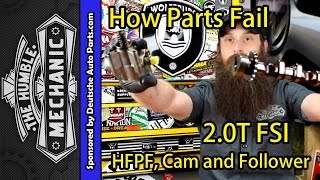
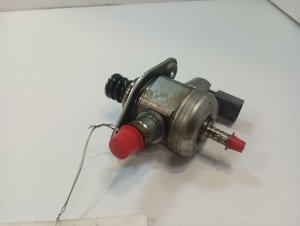
(OEM #06F127025M (supersedes 06F127025L, 06F127025K, 06F127025J, 06F127025H))— This part fails either due to an internal mechanical fault of the N276 valve or, more commonly, 🎬 Watch: How the 2.0T FSI high pressure fuel pump fails due to damage from a worn-through cam follower. It's the primary suspect if the cam follower is intact.
Trusted brands: Bosch, Hitachi, Pierburg
OEM price range: $350-$500
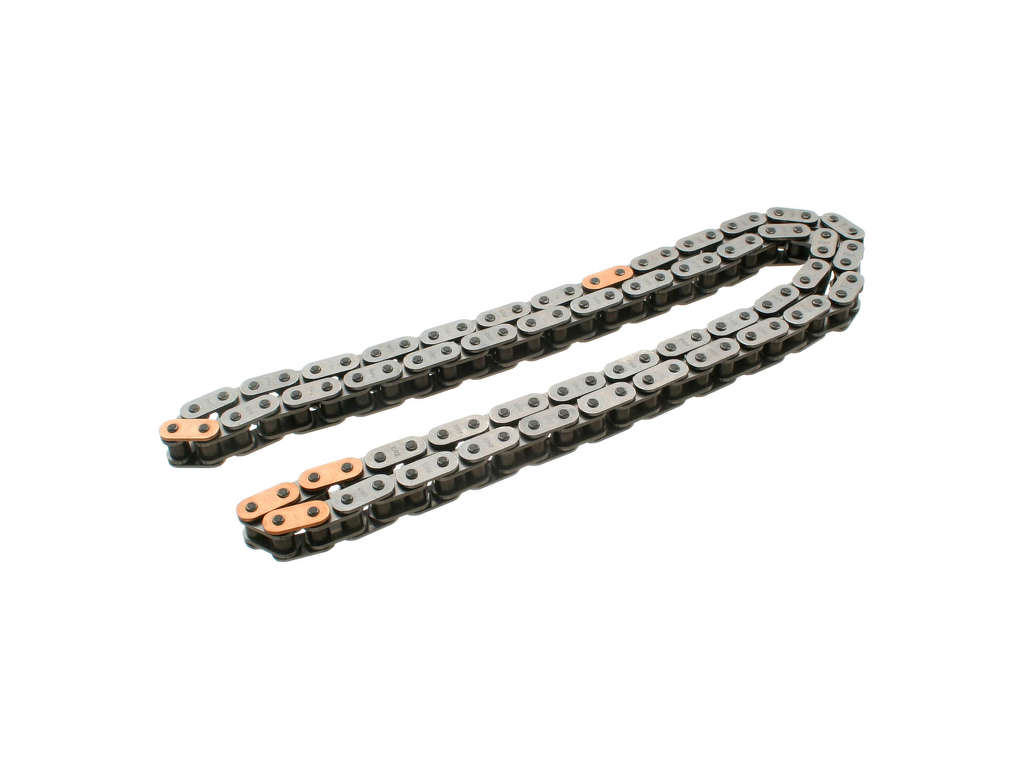
Aftermarket price range: $250-$400 - Timing Chain Kit — For the 3.6L VR6 engine, this is the most probable repair needed to fix the root cause of the HPFP being out of sync. The kit should include all chains, guides, and tensioners.
Trusted brands: Iwis, Febi, VW Genuine
OEM price range: $600-$1200
Aftermarket price range: $400-$800
Related Codes That Often Appear With This One
- P0088 — Stands for 'Fuel Rail/System Pressure - Too High'. This code is explicitly mentioned in TSBs alongside P1025 for the 3.6L VR6 timing chain issue, as the out-of-sync pump creates excessive pressure.
- P0087 — Stands for 'Fuel Rail/System Pressure - Too Low'. This can occur if the worn cam follower has destroyed the HPFP's ability to build any pressure.
- P053F — Stands for 'Fuel Pressure Regulator Valve Cold Start Performance'. This code is also mentioned in TSB TT 01 20 05_4 as being related to the HPFP being out of time.
Technical Service Bulletins (TSBs) & Recalls
- This VW Technical Tip explicitly links DTCs P1025 and P0088 on the 3.6L engine to the high-pressure fuel pump being out of time. It instructs technicians to check camshaft adaptation values (MVB 208/209) for deviation over 8 degrees and notes that fuel pressure can be excessively high (up to 125 bar) at idle as a key symptom.
- An earlier version of the technical tip providing the same diagnostic guidance for P1025 and P0088 on 3.6L engines, confirming the link between high idle fuel pressure (>60 bar) and camshaft deviation exceeding 8 degrees.
Platform-Specific Known Issues
- The 2.0T FSI (BPY) engine used from 2006-2008.5 is known globally for rapid cam follower wear. Many owners perform preventative replacement every 20,000-30,000 miles to avoid catastrophic damage to the HPFP and camshaft.
- The 3.6L VR6 engine is known for timing chain stretch, which is a very expensive, labor-intensive repair. P1025 is a key indicator of this issue, often appearing before any audible chain rattle.
Mechanic-Grade Diagnostic Values

- Camshaft Adaptation Phase Position (3.6L VR6) — expected: -8.0 to +8.0 degrees at warm idle. Failure: A value exceeding +/- 8.0 degrees confirms stretched timing chains. Check MVB 208/209 (pre-2012) or IDE00182/IDE00184 (2012+).
- High-Pressure Fuel Rail at Idle (3.6L VR6) — expected: Approx. 40-50 bar (580-725 PSI). Failure: Consistently reading over 60 bar, often spiking to 120-125 bar, indicates the HPFP is out of time due to a timing issue.
- Fuel Pressure Regulator Valve (N276) Resistance — expected: 1.0 to 5.0 Ohms at approx. 20°C. Failure: A reading outside this range, or 0 ohms, indicates a faulty regulator coil, requiring HPFP replacement.
- Low-Pressure Fuel System Supply to HPFP (2.0T FSI) — expected: 4.0 - 7.0 bar (58 - 101 PSI). Failure: Pressure below this range indicates a failing in-tank pump or control module issue, which can starve the HPFP.
- Fuel Pressure Sensor (G247) Reference Voltage — expected: ~5V. Failure: With the ignition on and sensor connector unplugged, a missing 5V reference at terminal 3 points to a wiring or ECM fault.
Scan Tool Commands That Help
- VCDS / ODIS: N276 - Fuel Pressure Regulator Valve Output Test — Use this bidirectional test when the cam follower (2.0T) or timing (3.6L) is confirmed to be good, but an HPFP fault is still suspected. The test commands the N276 valve; an audible 'click' should be heard from the pump. No click indicates a failed pump.
- VCDS / ODIS: Clear Fuel System Adaptations — This should be performed after replacing the High-Pressure Fuel Pump (HPFP). Failure to reset adaptations can cause the ECU to operate on learned values from the old, failing part, potentially causing a persistent code.
Wiring & Ground Locations
- N276 Connector (on HPFP) — The 2-pin electrical connector on the High-Pressure Fuel Pump.. This is the direct connection to the Fuel Pressure Regulation Valve. Terminal 1 should have battery voltage with the engine running, and Terminal 2 is the control signal wire to the ECM. Check for corrosion or damage. Poking probes through the wire insulation for testing is known to cause future corrosion issues.
- Engine to Chassis Grounds — Various locations in the engine bay, connecting the engine block to the vehicle's chassis.. A poor ground connection can cause a variety of electrical issues and incorrect sensor readings. Service manuals note that proper ground connections must be verified as a preliminary check for diagnosing fuel pressure issues.
Real Owner Repair Stories
- Reddit user Douche_Baguette (2006-2008.5 VW Passat Wagon 2.0T FSI with 280,000 miles) — Car died on the highway, engine would not crank. After investigation, one camshaft was not spinning.
❌ Tried (didn't work) Initial diagnosis was confusing as the timing belt was intact.
✅ What actually fixed it The root cause was a completely punctured cam follower that had been neglected. This destroyed the HPFP, the cam lobe, the VTC unit, and broke the chain linking the two camshafts, causing catastrophic engine failure. The final fix required replacing the entire cylinder head with new cams, valves, and all related timing components. - AudiWorld Forums user (Audi with dual HPFPs (similar N276 valve)) — Check engine light, very rough running, code for N276 'short to plus'.
❌ Tried (didn't work) Diagnosing which of the two pumps was bad.
✅ What actually fixed it The user tested the resistance of the N276 valves on the old pumps and measured 0 ohms (a dead short). New replacement pumps measured ~2 ohms. Replacing both HPFPs resolved the issue, confirming that 0 ohms is a definitive failure reading.
OEM Part Supersession History
06F127025H, 06F127025J, 06F127025K, 06F127025L→06F127025M— Revisions to improve reliability and address failure modes.
Heads up: For very early models with original pumps marked 06F127025B or 06F127025F, additional fittings (like 06F127213B) may be required when installing the newest 'M' revision pump.
Model Year Variations Within This Range
- 2006-2008.5 vs 2008.5-2010 (2.0T): The 2006-2008.5 Passat used the 2.0T FSI (BPY) engine, which has a timing belt and the failure-prone flat tappet cam follower. The 2008.5-2010 models switched to the 2.0T TSI (CCTA/CBFA) engine, which has a timing chain and a significantly more durable roller-style cam follower. The infamous cam follower issue is almost exclusively an FSI problem.
- Pre-2012 vs 2012+ (3.6L Diagnostics): The scan tool protocol for checking camshaft timing on the 3.6L engine changed. Pre-2012 models use KWP2000 and require checking Measuring Value Blocks (MVB) 208 & 209. Later models use UDS protocol and require checking Advanced Measuring Values for IDE00182 & IDE00184. The failure threshold of +/- 8 degrees is the same for both.
- 2006-2007 (3.6L Repair): When performing a timing chain replacement on 2006-2007 Passat and Touareg models with the 3.6L engine, VW TSB 01-20-05TT specifically recommends also replacing the oil pump, oil pump gears, and oil pump bolt. This is not specified for 2008 and newer models.
Helpful Videos
![[EN] 2.0 FSi/TFSi High pressure fuel pump cam follower replacement](https://img.youtube.com/vi/ubwZZrDEJBE/mqdefault.jpg)
Used OEM Parts in Stock



New Aftermarket Parts Available



The information in this article is provided for general reference and educational purposes only. Vehicle specifications, procedures, and part compatibility can vary by production date, trim level, and region. Always consult your vehicle's factory service manual and verify part numbers before purchasing or performing repairs. Safety-critical components such as airbags, seat belts, and braking systems should be installed by a qualified professional.
- Volkswagen PASSAT:
- 🎬 Helpful Videos
- 🛍️ Shop This Part
- What's Unique About the 2006-2010 Volkswagen PASSAT
- Diagnostic Flowchart
- Symptoms You May Notice
- Most Likely Causes
- Rare But Worth Checking
- Diagnosis Steps
- Parts You'll Likely Need
- Related Codes That Often Appear With This One
- Technical Service Bulletins (TSBs) & Recalls
- Platform-Specific Known Issues
- Mechanic-Grade Diagnostic Values
- Scan Tool Commands That Help
- Wiring & Ground Locations
- Real Owner Repair Stories
- OEM Part Supersession History
- Model Year Variations Within This Range
- 🎟️ Get 5% Off