

P0933 on 2010-2018 Ram 3500 6.7L Cummins: Hydraulic Pressure Sensor Fixes
On a 2010-2018 Ram 3500 with the 6.7L Cummins and 68RFE transmission, code P0933 almost always means the transmission's hydraulic line pressure sensor has failed. The fix involves replacing the sensor (or the entire solenoid pack it's part of) inside the transmission pan, which is a moderately difficult DIY job.
- P0933 on a 6.7L Cummins Ram almost always points to a failed transmission line pressure sensor in the 68RFE transmission.
- Confirm the failure with a scan tool by checking if the 'Actual Line Pressure' is stuck at a high value (like 252 psi).
- The most reliable fix is to replace the entire Mopar solenoid pack, not just the individual sensor, along with new filters and ATF+4 fluid.
- Before replacing parts, always inspect the transmission wiring harness for chafing or melting, as this can also cause the code.
- Do not continue driving with this code, as the resulting limp mode and incorrect pressures can lead to severe transmission damage.
What's Unique About the 2010-2018 Ram 3500
This code is a very common issue on the Chrysler-built 68RFE automatic transmission paired with the 6.7L Cummins engine. The line pressure sensor (transducer) is a known failure point. A classic symptom on these trucks is for a scan tool to show the line pressure reading stuck at a maximum value, such as 252 psi, even at idle or on a cold start when it should be around 60 PSI. Due to the frequency of this failure, the diagnostic path is often straightforward, pointing directly to the sensor itself rather than more complex mechanical issues.
Generation note: The 2010-2018 year range covers the fourth generation of Ram Heavy Duty trucks. The information provided is applicable to all trucks in this range equipped with the 6.7L Cummins and 68RFE automatic transmission. Be aware that some 3500 models, especially high-output versions from 2013 onwards, could be equipped with the Aisin AS69RC transmission, which has different components.
Symptoms You May Notice
- Check Engine Light is on
- Transmission goes into 'limp mode' (stuck in one gear, often 3rd or 4th)
- Harsh or erratic shifting
- Delayed acceleration or hesitation
- Transmission warning light may be illuminated
- Inability to use the exhaust brake
- Replacing the entire transmission. This code is very often an electronic issue with a sensor or wiring, not a catastrophic internal mechanical failure.
- Replacing just the pressure sensor with a cheap aftermarket part. Some owners and technicians report that low-quality 'clone' sensors fail quickly or are defective out of the box, causing the code to return.
Most Likely Causes
- Faulty Hydraulic Pressure Sensor (Line Pressure Transducer) 🔴 High Probability The sensor used in the 68RFE transmission is a well-documented, high-failure-rate component. It is exposed to constant heat cycles and pressure changes within the transmission.
How to confirm: Use a capable scan tool to monitor 'Desired Line Pressure' vs. 'Actual Line Pressure'. If the actual pressure is stuck at a high number (e.g., 252 psi) regardless of engine RPM or gear, especially on a cold start, the sensor is faulty. Normal idle pressure should be around 60 PSI with less than a 5 PSI variance from desired.
Typical fix: Replace the hydraulic pressure sensor. For best results and long-term reliability, replace the entire transmission solenoid pack which includes the sensor, filters, and fluid. Using a genuine Mopar part is strongly recommended, as cheap aftermarket sensors are known to fail prematurely or be defective out of the box.
Est. part cost: $50-$450 - Damaged Wiring or Loose Connector 🟡 Medium Probability The main transmission harness connector on the driver's side of the transmission can become corroded or have poor pin tension. The harness itself can be damaged by heat from the exhaust or chafing against the frame or driveline.
How to confirm: Visually inspect the wiring harness leading to the transmission for any signs of melting, chafing, or corrosion. Disconnect, inspect, and securely reconnect the main round transmission electrical connector (C107), checking for bent or spread pins. A 'wiggle test' on the harness while monitoring live data may reveal an intermittent connection.
Typical fix: Repair the damaged section of wire and properly secure the harness away from heat sources or moving parts. Clean the connector pins and apply dielectric grease. If pin tension is poor, the connector or terminal may need to be replaced.
Est. part cost: $5-$50
Rare But Worth Checking
- Low or Burnt Transmission Fluid: While this code usually points to an electrical sensor issue, incorrect fluid level or condition can cause erratic pressure readings. A user on a Ram forum noted P0933 appeared after a fluid change because the level was too low. Always check the fluid as a first step.
- Faulty Powertrain Control Module (PCM) or Transmission Control Module (TCM): This is very rare. The PCM/TCM should only be considered after all other possibilities, including the sensor and wiring, have been definitively ruled out.
- Internal Valve Body Cross-Leak: The 68RFE valve body is known for having a weak separator plate that can flex or warp, causing internal hydraulic leaks between circuits. This can lead to erratic pressure and shifting behavior that may be misdiagnosed as a sensor failure. This is often a root cause if replacing the electronics doesn't solve the problem.
Diagnosis Steps
- Check Transmission Fluid: Verify the transmission fluid level is correct and the fluid is not burnt or dirty. Low or poor-quality fluid can cause pressure issues.
- Scan for Codes: Use an OBD-II scanner to confirm P0933 and check for other related transmission codes like P0869, P0935, or P0868.
- Monitor Live Data: Use a capable scan tool to view live data for 'Desired Line Pressure' and 'Actual Line Pressure'.
- Analyze Sensor Reading: With the 🎬 Watch: How to diagnose line pressure issues on your Ram. engine running in Park, observe the actual pressure reading. A classic failure sign is the pressure being stuck at 252 psi on a cold start. Rev the engine gently. If the reading is stuck at a high value and does not change, the sensor has failed.
- Inspect Wiring: If the sensor readings appear plausible, perform a thorough visual inspection of the transmission wiring harness for damage, melting, or chafing, especially near the exhaust and driveshaft.
- Check Connector: Disconnect the main transmission electrical connector on the driver's side. Inspect the pins for corrosion, damage, or a loose fit ('pin drag'). Reconnect it firmly.
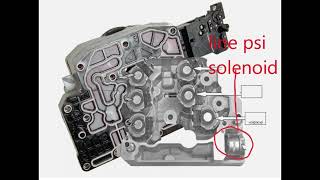
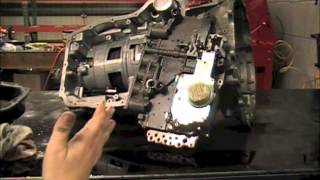
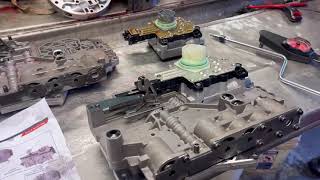
- Replace Sensor/Solenoid Pack: If the sensor reading is confirmed to be faulty, the next step is to replace the component. This involves draining the fluid, dropping the transmission pan, and removing the valve body to access the solenoid pack where the sensor is located. 🎬 See this walkthrough on replacing the solenoid block and pack.
- Perform Quick Learn: After replacing the solenoid pack or valve body, a 'Quick Learn' procedure must be performed with a compatible scan tool to calibrate the new components.
Parts You'll Likely Need
- Transmission Solenoid Pack (with Line Pressure Sensor)
(OEM #68376695AB)— The original line pressure sensor is the most common failure point. Replacing the entire solenoid pack, which includes the sensor, is the most reliable long-term repair. For 2010-2018 models, the pack has a gray electrical connector. Part number 68376695AB supersedes the earlier 68376695AA and 52120000AA.
Trusted brands: Mopar
OEM price range: $350-$450
Aftermarket price range: $200-$350 - Transmission Line Pressure Sensor (Transducer)
(OEM #5078336AC)— If you choose to replace only the sensor, this is the direct cause of the code. However, reliability can be a concern with non-OEM sensors, and the labor to get to it is the same as replacing the whole pack.
Trusted brands: Mopar, Rostra
OEM price range: $80-$150
Aftermarket price range: $50-$100 - Transmission Filter Kit and ATF+4 Fluid — These are required for the repair, as the transmission pan must be removed and the fluid drained to access the sensor and solenoid pack. Always use Mopar-licensed ATF+4 fluid.
Trusted brands: Mopar
OEM price range: $70-$120
Aftermarket price range: $40-$80
Related Codes That Often Appear With This One
- P0869 — Indicates 'Transmission Fluid Pressure High'. This code is often triggered alongside P0933 because the faulty sensor reports an erroneously high pressure reading to the computer.
- P0935 — Indicates 'Hydraulic Pressure Sensor Circuit High'. This points to a specific electrical fault (high voltage, >= 4.75V) in the sensor's circuit, often appearing with P0933 when the sensor fails electrically.
- P0868 — Indicates 'Transmission Fluid Pressure Low'. This can occur if the sensor fails in a way that it reports a pressure reading that is too low compared to what is desired by the TCM, or if there is an actual hydraulic leak internally.
Technical Service Bulletins (TSBs) & Recalls
- NHTSA ID: 10055835 / FCA TSB: 21-018-14 (Recall 14V-432): While not directly for P0933, this TSB addresses inadequate welds on the front track bar bracket on some 2013-2014 models. A loose track bar can cause severe handling issues ('Death Wobble') that might occur concurrently with other vehicle faults, complicating diagnosis.
Mechanic-Grade Diagnostic Values
- Line Pressure Sensor Signal Voltage — expected: 0.35V to 4.75V. Failure: Voltage below 0.35V (sets P0934) or at or above 4.75V (sets P0935). A reading stuck at a high value that doesn't correspond to pressure is also a failure.
- Pressure Control Solenoid (PCS) Duty Cycle at Idle — expected: ~20-25%. Failure: A duty cycle that is maxed out (e.g., 38%) while actual pressure remains too high indicates the system is trying to lower pressure but cannot, pointing to a mechanical or sensor issue.
- Line Pressure Solenoid Resistance — expected: ~4.0 - 4.3 Ohms. Failure: An open circuit (infinite resistance) or a reading significantly outside this range indicates a bad solenoid coil.
- Line Pressure Solenoid Max Current Draw — expected: ~1.0 Amp. Failure: Inability to draw close to 1 amp when commanded indicates a problem in the solenoid or the control circuit.
Scan Tool Commands That Help
- wiTECH, Snap-on, Autel, or equivalent professional scanner: Quick Learn / Transmission Relearn — This is mandatory after replacing the transmission solenoid pack or valve body. It resets and calibrates the clutch volume indexes (CVIs) and shift adapts. Failure to perform this step can lead to poor shifting and premature transmission wear.
- wiTECH or equivalent: Program Torque Converter Solenoid PI Curve — Required when the Torque Converter Clutch (TCC) solenoid, valve body, or the entire transmission assembly is replaced. The new component has a unique pressure/inductance curve that must be programmed into the PCM.
Wiring & Ground Locations
- Solenoid/TRS Assembly Connector (C107) — The main round electrical connector on the driver's side of the 68RFE transmission case.. This is the primary interface for all transmission electronics. Corrosion, moisture, or spread pins in this connector are a common cause of P0933 and other transmission codes. Pin 12 is the Pressure Control Solenoid Control circuit.
- PCM Connector C4, Pin T38 — At the Powertrain Control Module (PCM), which is integrated with the TCM on these models.. This is the specific pin for the Line Pressure Sensor Signal circuit. It can be used to test for continuity or shorts between the sensor and the control module.
- PCM Connector C2, Pin T160 — At the Powertrain Control Module (PCM).. This is the specific pin for the Sensor Ground circuit shared by several transmission sensors. An open or high resistance on this ground wire can cause skewed readings and high voltage codes like P0935.
Real Owner Repair Stories
- Turbo Diesel Register user 'jmorse' (2015 Ram 2500, 44,000 miles) — Check Engine Light with codes P0933, P0869, and P0935. Erratic shifting.
❌ Tried (didn't work) Replacing transmission filters and fluid.
✅ What actually fixed it The line pressure reading was stuck at 252 psi on a cold start. Replacing only the line pressure sensor resolved all codes and symptoms. - YouTube channel 'OCD AUTO' (2013 Ram with 68RFE) — P0933 - Line Pressure Performance. Actual line pressure was consistently higher than desired.
❌ Tried (didn't work) The truck had a newly replaced transmission, but the code appeared immediately.
✅ What actually fixed it The new transmission was installed with a cheap, 'clone' aftermarket line pressure sensor. The sensor was providing inaccurate readings. Replacing the faulty new sensor with a quality aftermarket (Weller) sensor fixed the problem.
When the Usual Fixes Don't Work
- While replacing the solenoid pack/sensor is the most common fix, it is not a guaranteed solution. A Reddit user with a 2018 Ram reported that the P0933 code persisted even after replacing the valve body, sensor, and solenoid pack with performance aftermarket parts. This type of scenario strongly suggests the root cause is not the component itself, but rather a problem in the wiring harness between the transmission and the PCM, such as an intermittent short, open, or high resistance that is difficult to trace.
OEM Part Supersession History
52120000AA, 68376695AA→68376695AB— Updated Mopar part for the solenoid pack assembly.
Heads up: This part (gray connector) is for 2010-2018 68RFE models. It is NOT compatible with 2019+ trucks, which require a different design.
Model Year Variations Within This Range
- 2010: For the 2010 model year, the Transmission Control Module (TCM) was integrated into the Powertrain Control Module (PCM) as a single unit.
- 2011-2018: Starting in 2011, the Overdrive (OD) solenoid was removed from the 68RFE valve body. This means a valve body from a 2011+ truck cannot be installed in a 2010- truck without swapping the old solenoid module onto the new valve body, otherwise a P0760 code will be set.
- 2012+: The torque converter was upgraded in 2012 to handle increased engine torque ratings.
Diagnostic Flowchart
Other Known Issues on This Vehicle
Issues unrelated to this code that are worth knowing about as an owner of this generation:
- EGR Cooler Clogging/Failure 🔴 High — Common, especially on trucks with high idle times or frequent short trips. Soot builds up and either clogs the cooler, causing flow codes, or leads to thermal stress and internal cracks.
- Variable Geometry Turbo (VGT) Actuator Failure / 'Stuck Turbo Syndrome' 🔴 High — Very common across the entire 6.7L Cummins generation. Soot and carbon buildup cause the turbo vanes to stick, leading to actuator strain and failure. Symptoms include loss of power, poor exhaust brake performance, and codes like P00AF or U010C.
- Front-End 'Death Wobble' 🔴 High — A well-known issue on solid front axle Ram trucks. Caused by worn track bar bushings, ball joints, steering dampers, or other steering components, leading to violent, uncontrolled oscillation of the front wheels after hitting a bump. (Ref: While not a specific recall for 'death wobble,' related recalls like 14V-432 (inadequate track bar bracket welds) address components that can cause it.)
- Diesel Particulate Filter (DPF) Clogging 🟠 Medium — More common on pre-2013 models that did not use DEF, but can still occur on later models, especially with excessive idling or city driving that prevents passive regeneration.
- Radiator End Tank Seepage/Leak 🟠 Medium — The plastic end tanks crimped to the aluminum core are a known weak point. Over time and many heat cycles, especially when towing, the seams can begin to seep coolant, leading to slow coolant loss and potential overheating under load.
Used vs. New Parts: Buying Guide for This Vehicle
When a used part is the smart pick: For this specific P0933 code, using a used electronic part like a sensor or solenoid pack is strongly discouraged. The only scenario where used might be considered is for a complete transmission assembly from a low-mileage, verified-running donor vehicle if a catastrophic failure is confirmed, but that is not typical for this code.
Donor-vehicle mileage cap: roughly under 75000 miles for the part to have meaningful remaining life.
What to inspect on the donor part:
- Verify donor vehicle mileage.
- Check transmission fluid on the dipstick; it should be reddish and not smell burnt.
- Inspect the main electrical connector (C107) for any signs of corrosion, bent pins, or harness damage.
OEM-only on this vehicle (don't cheap out):
- Transmission Solenoid Pack
- Line Pressure Sensor (Transducer)
Aftermarket brands forum-validated for this vehicle:
- Sonnax (For valve body upgrades and problem-solving components)
- Revmax (For performance-oriented solenoid packs)
Brands owners have reported issues with on this vehicle:
- Unbranded 'clone' or 'white-box' sensors and solenoid packs, particularly from online marketplaces. These are frequently reported to be defective out of the box or have a very short service life.
Real Owner Stories
Aggregated from forums and TSBs cited above. Mileages and costs reflect what owners reported in those sources.
2015 Ram 2500 with 68RFE — 44000 miles
Symptoms: Check Engine Light came on with codes P0933, P0869, and P0935. A scan tool confirmed the transmission pressure was stuck at 252 psi in park on a cold start.
What fixed it: The hydraulic pressure sensor was replaced, which resolved all codes and transmission issues.
Source hint: Turbo Diesel Register
2018 Ram
Symptoms: A persistent P0933 code remained even after the valve body, sensor, and solenoid pack were replaced with aftermarket parts.
What fixed it: The issue was not resolved by replacing parts, suggesting a more elusive problem like damaged wiring in the main harness or a potential issue with the non-OEM replacement parts.
Source hint: Reddit r/Cummins
Related OBD-II Codes
Frequently Asked Questions
My scan tool shows the transmission line pressure is stuck at 252 psi on my Ram 3500, even on a cold start. What does this mean?
When replacing the hydraulic pressure sensor for code P0933, is it okay to use a cheaper aftermarket part?
After replacing the transmission solenoid pack to fix P0933, is there any special procedure I need to follow?
Besides the sensor itself, what's another common cause for P0933 on these trucks?
I have a 2015 Ram 2500, not a 3500. Is the information about the P0933 sensor failure still relevant to my truck?
Is there a recall related to the P0933 code on my 2014 Ram?
Helpful Videos
We Have This Part in Stock


The information in this article is provided for general reference and educational purposes only. Vehicle specifications, procedures, and part compatibility can vary by production date, trim level, and region. Always consult your vehicle's factory service manual and verify part numbers before purchasing or performing repairs. Safety-critical components such as airbags, seat belts, and braking systems should be installed by a qualified professional.
- Ram 3500:
- 🎬 Helpful Videos
- 🛍️ Shop This Part
- What's Unique About the 2010-2018 Ram 3500
- Symptoms You May Notice
- Most Likely Causes
- Rare But Worth Checking
- Diagnosis Steps
- Parts You'll Likely Need
- Related Codes That Often Appear With This One
- Technical Service Bulletins (TSBs) & Recalls
- Mechanic-Grade Diagnostic Values
- Scan Tool Commands That Help
- Wiring & Ground Locations
- Real Owner Repair Stories
- When the Usual Fixes Don't Work
- OEM Part Supersession History
- Model Year Variations Within This Range
- Diagnostic Flowchart
- Other Known Issues on This Vehicle
- Used vs. New Parts: Buying Guide for This Vehicle
- Real Owner Stories
- 2015 Ram 2500 with 68RFE — 44000 miles
- 2018 Ram
- Related OBD-II Codes
- Frequently Asked Questions
- 🎟️ Get 5% Off