

P0847 on 2014-2021 Mazda CX-5: Transmission Pressure Switch Causes and Fixes
On a 2014-2021 Mazda CX-5, code P0847 is most often caused by a known issue with the transmission's oil pressure switches. The official fix, per Mazda TSBs, often starts with a TCM software update and may require replacing two internal oil pressure switches if the problem persists. This issue is common across multiple Mazda models using the SKYACTIV 6-speed automatic transmission.
- P0847 on a Mazda CX-5 is a very specific, well-documented issue.
- The problem is almost always related to internal transmission oil pressure switches, as outlined in Mazda TSB #05-002-23.
- The official repair starts with a TCM software update at a dealership. If that doesn't work, the switches themselves need to be replaced.
- This is not typically a DIY job due to the need for special tools, software, and working inside the transmission.
- Do not immediately assume the entire transmission needs replacement; the fix is usually much less expensive.
What's Unique About the 2014-2021 Mazda CX-5

This is a well-documented issue on Mazda vehicles with the SKYACTIV 6-speed automatic transmission (model FW6A-EL). Mazda has released multiple Technical Service Bulletins (TSBs) over the years addressing this exact code, along with a cluster of related codes. The root cause is identified as contamination within the transmission fluid that causes one or more internal pressure switches to stick. The official repair procedure has evolved, starting with software updates to make the TCM less sensitive to erratic signals and progressing to the replacement of the switches themselves. In some cases, dealers have quoted owners for a full transmission replacement, which is often unnecessary.
Generation note: This issue affects both the first generation (KE, 2014-2016) and the second generation (KF, 2017-2021) of the Mazda CX-5, as both use the SKYACTIV-Drive 6-speed automatic transmission. The TSBs cover vehicles across this entire year range and beyond, including models up to 2019.
Symptoms You May Notice
- Check Engine Light illuminated
- Automatic Transaxle (AT) warning light on
- Harsh or erratic shifting
- Vehicle entering 'limp mode' (stuck in a single gear)
- Delayed gear engagement
- Multiple other warning lights may appear simultaneously, such as for Smart City Brake Support (SCBS), Smart Brake System (SBS), and traction control (TSC).
- Replacing the entire valve body when only the pressure switches are faulty.
- Replacing the entire transmission when the issue is isolated to the switches or software.
Most Likely Causes

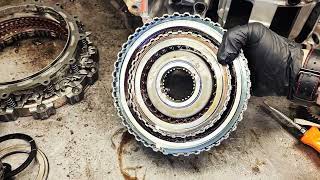
- Sticking Internal Oil Pressure Switch 🔴 High Probability Mazda TSBs explicitly state this is the primary cause, resulting from contamination in the transmission's hydraulic passages that causes the switch to stick. This is a known weak point in the FW6A-EL transmission family. 🎬 Watch: A detailed overview of the Skyactiv Drive transmission internals.
How to confirm: This is typically confirmed at a dealership. If a TCM reprogram does not resolve the code, the next step per the TSB is to replace the switches. A technician can also test the switch circuit, but replacement is the standard fix.
Typical fix: Replace both oil pressure switches (A and B) located on the valve body inside the transmission. This requires draining the fluid, removing the transmission oil pan, and then removing the switches from the valve body.
Est. part cost: $100-$200 for the pair of switches - Outdated Transmission Control Module (TCM) Software 🟡 Medium Probability Mazda's initial and ongoing fix for certain VIN ranges was to release updated software logic that is less sensitive to minor fluctuations from the pressure switches.
How to confirm: A Mazda dealership or a qualified shop with a J2534 pass-thru device can check the current software calibration against the latest version specified in the TSBs. A Reddit user confirmed this fixed their 2015 CX-5 for a cost of $170 for the diagnosis and reprogram.
Typical fix: Reprogram the TCM to the latest calibration file. This is often the first step in the official repair procedure, depending on the vehicle's VIN and service history.
Est. part cost: $0 (software only) - Low or Contaminated Transmission Fluid ⚪ Low Probability While the TSB points to switch contamination, severely degraded or low fluid can cause a host of pressure-related issues, including this one. The SKYACTIV transmission is sensitive to fluid condition and type.
How to confirm: Check the transmission fluid level and condition. Note that on the CX-5, this is a complex procedure as the dipstick is under the airbox and must be checked at a specific temperature (40-110°C). Burnt or debris-filled fluid indicates a problem. One owner sent a fluid sample to Blackstone Labs for analysis to confirm contamination before proceeding with repairs.
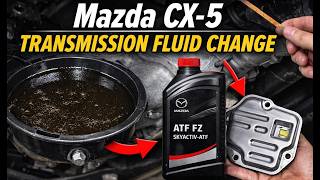
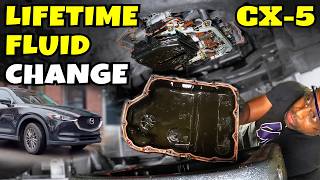
Typical fix: Perform a transmission fluid drain and fill, or a full flush if significant contamination is found. Use only Mazda-specific FZ automatic transmission fluid. 🎬 See this step-by-step guide for fluid and filter replacement. A transmission flush was part of a successful dealer repair for one owner.
Est. part cost: $100-$250 for fluid
Rare But Worth Checking
- Wiring Harness or Connector Issue: A damaged wire or poor connection between the pressure switch and the TCM can mimic a faulty sensor. The TSB repair procedure involves disconnecting and reconnecting these connectors, which can sometimes resolve a poor connection.
- Faulty Transmission Control Module (TCM): It is rare for the TCM itself to fail, but it's a possibility if all other causes have been ruled out. This is an expensive last resort.
- Weak or Failing Battery: On modern Mazdas, a weak battery can cause a cascade of seemingly unrelated warning lights and error codes, including transmission-related ones. If multiple, unrelated system warnings appear at once, checking the battery health is a wise first step.
Diagnosis Steps

- Verify the Check Engine Light and AT warning lights are on.
- Scan the TCM for stored codes. Confirm if P0847 is present, along with any other related codes like P0842, P0872, P0877, or P0780.
- Check for applicable TSBs (e.g., 05-002-23, 05-003-20) based on the vehicle's VIN.
- If recommended by the TSB for your VIN, the first step is to have a dealer or qualified shop update the TCM software to the latest version.
- If the code returns after the software update (or if the TSB directs it), the next step is to inspect the transmission fluid. A check for level and condition can indicate larger problems.
- If fluid is okay, proceed with the TSB recommendation to replace the internal oil pressure switches (A and B). This involves draining fluid, removing the pan, and carefully detaching the switches from the valve body.
- While the transmission pan is off, inspect the wiring and connectors for the pressure switches for any visible damage.
- It is also recommended to replace the transmission oil filter (strainer) while the pan is off, especially if contamination is suspected.
- After reassembly and refilling with the correct fluid (Mazda FZ), clear the codes and perform the transmission's 'Initial Learning' procedure using a compatible scan tool like the Mazda M-MDS.
- Road test the vehicle for 3-5 miles to confirm the repair and ensure smooth shifting.
Parts You'll Likely Need

- Transmission Oil Pressure Switch Kit (A & B)
(OEM #FZ01-21-2C0)— This is the most common hardware failure identified by Mazda's own TSBs for code P0847. Both are replaced as a set.
Trusted brands: Mazda (OEM)
OEM price range: $100-$200
Aftermarket price range: $70-$150 - Mazda FZ Automatic Transmission Fluid
(OEM #0000-FZ-113E-01)— Required to refill the transmission after replacing the internal switches. Using the correct fluid is critical for SKYACTIV transmissions. A drain and fill requires approximately 4 quarts.
Trusted brands: Mazda (OEM)
OEM price range: $20-$30 per quart - Transmission Oil Pan Gasket — Must be replaced anytime the transmission oil pan is removed to prevent leaks. Some procedures may call for sealant instead of a pre-formed gasket.
Trusted brands: Mazda (OEM)
OEM price range: $30-$50
Aftermarket price range: $15-$30 - Transmission Oil Filter (Strainer)
(OEM #FZ01-21-500)— Recommended to be replaced when the oil pan is removed, especially since contamination is the root cause of the switch failure.
Trusted brands: Mazda (OEM)
OEM price range: $40-$60
Aftermarket price range: $20-$40
Related Codes That Often Appear With This One
- P0842 — Relates to the other oil pressure switch ('B') sticking on. Both are often replaced together per the TSB.
- P0872 — Another code for Oil Pressure Switch 'A' sticking on, part of the same known issue.
- P0877 — Another code for Oil Pressure Switch 'B' sticking on, part of the same known issue.
- P0780 — A general 'Gear Shifting Malfunction' code that is frequently triggered alongside the specific pressure switch codes.
- P1738 — An 'Automatic Transaxle Internal Malfunction' code that is also listed in the TSBs related to this issue. Diagnostic procedures often begin by checking if this code is also present.
Technical Service Bulletins (TSBs) & Recalls

- 05-002-23: CHECK ENGINE LIGHT AND A/T WARNING LIGHT ON WITH ONE OR MORE OF THESE DTCS (P0842, P0847, P0872, P0877, P0780, P1738) STORED IN TCM MEMORY.
- 05-003-20: An earlier version of the TSB covering models up to 2019.
- 05-002/15: An even earlier TSB which provides detailed part numbers and repair flowcharts.
Platform-Specific Known Issues
- Mazda has issued multiple TSBs (including #05-002-15, #05-003-20, and #05-002-23) for this code on SKY
Mechanic-Grade Diagnostic Values
- ATF Temperature for Diagnostic Trigger — expected: 20°C (68°F) or more. Failure: The TCM will not run the self-test for this DTC below this temperature.
- ATF Temperature for On-Board Diagnostic Test (Post-Repair) — expected: 55°C (131°F) or more. Failure: The post-repair verification test requires the fluid to be at this minimum temperature.
- ATF Temperature for Heat-Soak Failure — expected: Above 110°C (230°F). Failure: At this temperature, typically after a long highway drive, the sensor's internal membrane may expand and cause intermittent faults that disappear upon cooling.
- Oil Pressure Switch Fitting Bolt Torque — expected: 9—10 N·m (80—88 in·lbf). Failure: Incorrect torque can lead to leaks or damage.
- Transmission Temperature Custom PID (for Torque/FORScan) — expected: PID: 1674, Equation: (A*256+B)*5/72-18. Failure: This allows live monitoring of transmission temperature on scan tools that support custom PIDs, which is critical for diagnosing heat-related failures.
Scan Tool Commands That Help
- Mazda M-MDS (or equivalent J2534 device): Initial Learning — This procedure is required after replacing the oil pressure switches or reprogramming the TCM. It allows the TCM to learn the hydraulic response characteristics of the new components.
- FORScan: Live Data Monitoring (PIDs) — A powerful tool for DIY or independent shops to monitor hundreds of Mazda-specific PIDs, including transmission temperature and gear commanded, to help diagnose the fault. It can also be used for module programming and resets.
- No Tool Required: Manual Initial Learning Mode / Transmission Adaptive Learning Reset — Can be used to force the TCM to relearn shift points and clutch engagement pressures without a scan tool. It involves a complex sequence of shifting, key cycles, and holding the shifter in manual positions while the engine idle raises and lowers. This can sometimes resolve shift quality issues after a repair or battery disconnect.
Wiring & Ground Locations
- Main Transmission Ground — A ground strap from the negative battery terminal is bolted to a bracket on top of the transmission housing.. A poor ground connection at this point can cause a variety of electrical issues in the transmission, including erratic sensor readings that could potentially trigger a P0847 code.
- Oil Pressure Switch Connector — Inside the transmission, on the valve body. It is a two-pin connector.. One source identifies the wires for the pressure switch as being red and white. Knowing the wire colors can aid in circuit testing if the pan is removed.
Real Owner Repair Stories
- Reddit user on r/mazda (2015 Mazda CX-5 Touring FWD, ~100,000 miles) — Check Engine Light and AT light on, vehicle in limp mode, codes P0780 & P0847.
✅ What actually fixed it The dealer performed a TCM reprogram per the TSB. The total cost was $170 for the diagnosis and reprogram. The owner also opted for a $270 transmission flush at the same time. The reprogram alone resolved the codes and limp mode. - Reddit user on r/CX5 (2020 Mazda CX-5) — On startup, CEL (P0847) appeared simultaneously with AT Transmission Malfunction, Smart Brake System Malfunction, Front Radar Malfunction, and Camera system malfunction.
✅ What actually fixed it The user did not post a final fix, but the immediate community response was that this cascade of unrelated warnings is a classic symptom of a weak or failing battery, which should be the first diagnostic step before addressing the transmission code. - Mazdas247 forum user (2018 Mazda CX-5 AWD, 16,000 miles) — Check Engine Light with code P0847. No noticeable shifting issues prior to light.
✅ What actually fixed it The final fix was a point of contention. The technician found severely burned transmission fluid and recommended a full transmission replacement. Mazda corporate, however, only authorized a warranty replacement of the pressure sensor. This story highlights that even with low mileage, severe fluid degradation can occur, and the manufacturer-approved fix may be a 'band-aid' against a technician's advice.
OEM Part Supersession History
fza1212c0→FZ01-21-2C0— Part number update/revision.N/A - Note on Parts→N/A— TSBs indicate two separate switches are to be replaced, not a single kit.
Heads up: While often sold together, there are two distinct parts: Switch A is Part No. FZ01-21-2C0 and Switch B is Part No. FZ01-21-2J0. Ordering only one part number may result in an incomplete repair.
Model Year Variations Within This Range
- 2013-2016: Early TSBs (e.g., 05-002/15) for this generation provided a flowchart: for certain VINs and software versions, a TCM reprogram was the sole required fix. For other VINs, or if the code returned, part replacement was necessary. This shows the fix evolved from software-only to a combined software/hardware approach.
- 2017-2021: Later TSBs (e.g., 05-003/20) continued to provide updated TCM software calibrations, indicating Mazda's ongoing effort to refine the diagnostic logic. However, the primary hardware fix—replacing both pressure switches—remains the definitive repair if software updates do not resolve the issue.
Helpful Videos

Used OEM Parts in Stock


New Aftermarket Parts Available


The information in this article is provided for general reference and educational purposes only. Vehicle specifications, procedures, and part compatibility can vary by production date, trim level, and region. Always consult your vehicle's factory service manual and verify part numbers before purchasing or performing repairs. Safety-critical components such as airbags, seat belts, and braking systems should be installed by a qualified professional.
- Mazda CX-5:
- 🎬 Helpful Videos
- 🛍️ Shop This Part
- What's Unique About the 2014-2021 Mazda CX-5
- Symptoms You May Notice
- Most Likely Causes
- Rare But Worth Checking
- Diagnosis Steps
- Parts You'll Likely Need
- Related Codes That Often Appear With This One
- Technical Service Bulletins (TSBs) & Recalls
- Platform-Specific Known Issues
- Mechanic-Grade Diagnostic Values
- Scan Tool Commands That Help
- Wiring & Ground Locations
- Real Owner Repair Stories
- OEM Part Supersession History
- Model Year Variations Within This Range
- 🎟️ Get 5% Off