

P0841 on 2012-2018 Ford Focus: DPS6 Transmission Faults and Fixes
On a 2012-2018 Ford Focus, code P0841 almost never means a bad pressure sensor. It's a strong indicator of a failing Transmission Control Module (TCM) in the problematic DPS6 PowerShift transmission. The fix is typically replacing the TCM, which has been subject to multiple warranty extensions by Ford.
- P0841 on a 2012-2018 Focus is a serious code that strongly suggests a failing Transmission Control Module (TCM).
- This is a well-known, widespread problem with the DPS6 PowerShift transmission; you are not alone.
- Do not drive the vehicle, as it can lose power or stop moving unexpectedly.
- The fix requires replacing and programming a new TCM, which is a job for a professional shop with the correct Ford diagnostic tools.
- Before paying for a repair, check with a Ford dealer if your vehicle's VIN is covered by the TCM extended warranty (Customer Satisfaction Program 14M02).
What's Unique About the 2012-2018 Ford Focus

The 2012-2018 Ford Focus uses the DPS6 'PowerShift' transmission, which is not a traditional automatic. It's a dry-clutch, dual-clutch automated manual transmission known for widespread issues like shuddering, slipping, and premature failure. Unlike in many other vehicles where P0841 might suggest a simple sensor swap or fluid issue, on this platform, the code is a very common symptom of an internal electronic failure within the Transmission Control Module (TCM). The TCM's failure disrupts its ability to correctly interpret sensor data and control the clutch actuators. The issue has been the subject of numerous Technical Service Bulletins (TSBs), warranty extensions (like Customer Satisfaction Program 14M02), and class-action lawsuits.
Symptoms You May Notice
- Check Engine Light or Transmission Warning Light is on
- Harsh, erratic, or delayed shifting
- Transmission shuddering or jerking, especially at low speeds
- Intermittent loss of power or acceleration
- Transmission intermittently disengages or goes into neutral while driving
- Vehicle may not start intermittently
- PRNDL indicator on the dash may flash
- "Hill Start Assist Not Available" message may appear
- Replacing the transmission fluid pressure sensor. On the DPS6, there isn't a traditional, easily replaceable pressure sensor that causes this issue. The fault lies within the control system, specifically the TCM.
- Assuming low or dirty transmission fluid is the cause. While fluid issues can cause P0841 on other cars, the DPS6 is a 'dry-clutch' system and the code is almost always electronic in nature. A Reddit user noted that a fluid change would be useless for this specific issue.
Most Likely Causes

- Faulty Transmission Control Module (TCM) 🔴 High Probability The TCM for the DPS6 transmission is a known high-failure item, as documented in Ford's own Technical Service Bulletins (e.g., TSB 15-0121) and extended warranty programs (14M02). The module is prone to internal electronic failures, such as bad solder joints or circuit board issues, that disrupt communication and control of the transmission.
How to confirm: Diagnosis with a high-level scan tool is required. Technicians will look for P0841 along with other codes like U0100, U0101, U1013, or P0606, which are strong indicators of TCM failure as noted in TSB 15-0121. A Reddit user with a 2012 Focus reported codes P0702, P0785, and P287A, which were all related to their TCM failure.
Typical fix: Replace the Transmission Control Module. The new module must be programmed to the vehicle using Ford's specific diagnostic software (IDS) or a capable aftermarket tool like FORScan. After installation, a series of adaptive learning steps must be performed to complete the activation.
Rare But Worth Checking
- Wiring Harness or Connector Issue: While the TCM is the most likely culprit, it's still possible for the wiring between the TCM and the transmission's internal components to become damaged or corroded. A thorough visual inspection and continuity check of the harness, especially checking for good grounds under the airbox, should be performed before condemning the TCM.
- Internal Transmission Failure (Clutch Forks/Actuators): In some cases, the code could be triggered by a mechanical failure within the transmission itself, such as a failing clutch actuator motor or a seized clutch fork, which are also known weak points of the DPS6. Dust and debris can cause the forks to bind, leading to erratic behavior that the TCM may misinterpret. Swapping the 'A' and 'B' clutch actuators is a common diagnostic step to see if the fault code changes, which would indicate a bad actuator rather than a bad TCM.
Diagnosis Steps

- Verify the complaint and check for any drivability symptoms like shuddering, slipping, or no-start.
- Scan for Diagnostic Trouble Codes (DTCs) with a professional-grade scan tool. Note P0841 and any other accompanying codes (e.g., P0606, U0100, P0902).
- Consult Ford Technical Service Bulletin (TSB) 15-0121. This TSB directly addresses the symptoms and codes associated with TCM failure on this vehicle.
- Check vehicle eligibility for Ford's Customer Satisfaction Program 14M02, which extended the warranty on the TCM to 10 years or 150,000 miles for these exact symptoms.
- Inspect the wiring harness and connectors to the transmission for any visible damage, corrosion, or loose connections. Pay special attention to the ground points located under the air filter box.
- If actuator-related codes are present, consider swapping the upper and lower clutch actuators (Actuator A and B) to see if the fault follows the actuator. If it does, the actuator is faulty; if not, the problem is more likely the TCM or wiring.
- Based on the presence of P0841 and other related codes like U0100/P0606, the most probable cause is a faulty TCM.
- If the TCM is confirmed as the fault, replace it.
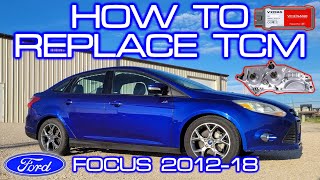
- After replacement, the new TCM must be programmed to the vehicle using Ford's Integrated Diagnostic System (IDS) software or a capable aftermarket tool like FORScan, followed by performing the clutch adaptive learning procedures. 🎬 Watch: How to replace and program the TCM using IDS
Parts You'll Likely Need
- Transmission Control Module (TCM)
(OEM #AE8Z-7Z369-F)— This is the primary cause of code P0841 and a wide range of other transmission problems on the 2012-2018 Ford Focus due to a high rate of internal failure.
Trusted brands: Motorcraft (Genuine Ford), Dorman (Remanufactured)
OEM price range: $400-$700
Aftermarket price range: $250-$450
Related Codes That Often Appear With This One
- P0606 — This code means 'ECM/PCM Processor Fault' and is specifically mentioned in Ford's TSB 15-0121 as a code that can be set by a failing TCM.
- U0100 — This code indicates 'Lost Communication With ECM/PCM 'A'' and points to the communication breakdown caused by the internal failure of the TCM.
- P0902 — This code relates to 'Clutch Actuator 'A' Circuit Low' and is another common fault pointing to the electromechanical control system of the DPS6 transmission.
- P287A — This code means 'Clutch 'B' Stuck Engaged' and is often seen with TCM failures, as reported by owners in forums.
Technical Service Bulletins (TSBs) & Recalls
- TSB 15-0121: Addresses intermittent loss of engagement, no-start, or loss of power, pointing directly to TCM failure and providing the diagnostic path (checking for codes like U0100, P0606) and replacement procedure.
- TSB 16-0129: A later TSB related to DPS6 transmission issues, often referenced in conjunction with warranty extensions.
- TSB 13-4-5: Details the service procedure for reprogramming the PCM/TCM and performing the 'Transmission Adaptive Learning' routines using IDS.
Platform-Specific Known Issues
- The DPS6 PowerShift transmission in the 2012-2018 Focus is the subject of numerous complaints, warranty extensions, and class-action lawsuits due to its poor reliability.
- Ford extended the warranty on the TCM under Customer Satisfaction Program 14M02 to 10 years or 150,000 miles. Owners should check with a Ford dealer to see if their vehicle is covered.
- Ford also issued Customer Satisfaction Program 19N08, extending the warranty on the clutch assembly itself to 7 years or 100,000 miles for shudder issues.
Mechanic-Grade Diagnostic Values
- TCM Ground Circuit Resistance — expected: Less than 5.0 ohms, with readings as low as 0.5 ohms achievable after thorough cleaning.. Failure: Initial readings can be as high as 2.6 ohms or more on a faulty vehicle, indicating a poor ground connection that can cause TCM communication and performance issues.
- Clutch Travel (A and B) after Adaptive Learn — expected: Typical travel ranges will be 9-14mm.. Failure: Readings outside this range, or severe variation from one routine to the next, can indicate a problem with the clutch, actuators, or the TCM's ability to control them.
Scan Tool Commands That Help
- Ford IDS (Integrated Diagnostic System): TCM Adaptive Learning — This is a required procedure after replacing the TCM or performing internal transmission service. It contains multiple sub-routines: 'Transmission Range Sensor Adaptive Learning', 'Shift Drum Adaptive Learning', and 'Clutch Adaptive Learning'.
- FORScan: TCM Module Firmware Update — Used to program a new or used TCM with the correct firmware for the vehicle. This is a critical step if installing a module from another vehicle.
- FORScan: Clutch Adaptive Learning — Similar to the IDS function, this is used after a TCM replacement or to address shifting issues. It resets and relearns the clutch engagement points. Some users perform this manually by resetting adaptations and then driving the vehicle to allow it to relearn over time.
Wiring & Ground Locations

- Main TCM Grounds — Located on the chassis under the air filter box/battery tray assembly.. These are the primary ground points for the TCM. Corrosion or looseness here is a common, often-overlooked cause of codes and symptoms identical to a failed TCM. Cleaning these grounds is a critical first diagnostic step before replacing the module.
- C1750A — One of the main electrical connectors on the Transmission Control Module (TCM).. Diagnostic procedures include checking for ground circuit resistance at pins 3, 4, 5, and 6 of this connector. A reading greater than 5 ohms indicates a wiring issue that must be repaired.
- C175B — A main connector at the Powertrain Control Module (PCM).. While the fault is usually at the TCM, this connector is part of the overall communication network. Wiring diagrams for C175B are necessary for tracing any potential communication circuit faults (like U-codes) between the PCM and TCM.
Real Owner Repair Stories
- Mechanics Stack Exchange User (2012 Ford Focus) — Not specified, but performing diagnostic grounding checks on the DPS6 transmission.
✅ What actually fixed it The user measured an initial ground resistance of 2.6 ohms from the battery negative cable to the transmission actuator. After cleaning the main body ground and two ground points under the airbox (grinding off paint, cleaning terminals), the resistance dropped to 0.5 ohms. This confirms a common failure point and a successful repair of the ground circuit. - Reddit User /r/FordFocus (2014 Ford Focus, 155k miles) — Implied TCM failure.
✅ What actually fixed it The user successfully sourced a used TCM from a 2011 Fiesta at a junkyard to install into their 2014 Focus. The story highlights the common practice of using salvaged parts and the subsequent need for reprogramming (flashing) the module to make it compatible with the new vehicle, which they planned to do with FORScan or by renting Ford's software.
OEM Part Supersession History
AE8Z-7Z369-A, AE8Z-7Z369-B, AE8Z-7Z369-C, AE8Z-7Z369-D, AE8Z-7Z369-E, BV6Z-7Z369-A→AE8Z-7Z369-F— Revisions to improve reliability and address the high failure rate of the original components. Later versions, and remanufactured units from brands like Dorman, often feature improved internal connections (e.g., soldered pins instead of press-fit) for better durability against heat and vibration.
Model Year Variations Within This Range
- 2012-2014 vs 2015-2018: The transmission calibration and internal hardware are different between these two groups. The difference can be physically identified by the thickness of the shims on the input shaft speed sensors. Early models (2012-14) use thicker shims (~3.2-3.5mm), while later models (2015-18) use thinner shims (~1.5-2.0mm). Installing a transmission from the wrong year group will require loading the corresponding calibration into the TCM for it to function correctly.
Diagnostic Flowchart
Other Known Issues on This Vehicle
Issues unrelated to this code that are worth knowing about as an owner of this generation:
- Faulty Canister Purge Valve 🟠 Medium — Very common across 2012-2018 models. Can cause stalling after refueling, rough idle, and difficulty starting. (Ref: Recall 18S32 (NHTSA 18V-735) was issued for this problem, as it could lead to a vacuum in the fuel tank, causing it to deform.)
- Power Steering Failure 🔴 High — Common on 2012-2014 models. The electronic power steering rack can fail suddenly, causing a complete loss of power assist while driving. (Ref: While many complaints were filed with the NHTSA, a widespread recall was not issued for all affected years, though some investigations took place.)
- Worn Rear Engine Mount 🟠 Medium — The lower rear engine mount (or 'torque strut mount') is known to wear out prematurely, causing excessive engine vibration and noise in the cabin, especially at idle and during acceleration.
- Cracked Clutch Assembly (1.0L Manual) 🔴 High — Affects 2016-2018 models with the 1.0L engine and manual transmission. The clutch can fracture, leading to transmission damage and fluid leaks. (Ref: Recall 19S16 (NHTSA 19V-278) was issued to address this.)
Used vs. New Parts: Buying Guide for This Vehicle
When a used part is the smart pick: A used TCM from a junkyard is a viable, cost-effective option ONLY if you have a plan for programming. The data from your original (failed) TCM can be 'cloned' to the used unit by a specialized service, making it plug-and-play. Alternatively, a tool like FORScan can be used to program the used module to your vehicle, but this is a more advanced procedure.
Donor-vehicle mileage cap: roughly under 80000 miles for the part to have meaningful remaining life.
What to inspect on the donor part:
- Ask for the donor vehicle's VIN to check for accident history.
- Inspect connectors for corrosion, bent pins, or signs of oil leakage from inside the module.
- Be wary of units that are freshly spray-painted silver; this is often done to hide the age and condition of a salvaged part.
- Ensure the plastic connector locking tabs are intact and not broken.
OEM-only on this vehicle (don't cheap out):
- Dual-Clutch Assembly: Due to the extremely high labor cost of a transmission-out job, using a new, updated OEM clutch pack is highly recommended to ensure longevity and avoid a repeat failure.
Aftermarket brands forum-validated for this vehicle:
- Motorcraft (New OEM): The most reliable but also most expensive option.
- Dorman (Remanufactured): A common aftermarket alternative that claims to have upgraded internal connections (soldered pins) to be more durable than the original. Comes with a warranty, but quality can be inconsistent, according to forum discussions.
Brands owners have reported issues with on this vehicle:
- Unbranded, no-name 'rebuilt' or 'refurbished' modules from online marketplaces (eBay, Amazon). These are often just used parts that have been cleaned and spray-painted, without any actual internal repairs, and are likely to fail quickly.
Real Owner Stories
Aggregated from forums and TSBs cited above. Mileages and costs reflect what owners reported in those sources.
2013 Ford Focus Titanium — 1200 miles
Symptoms: Recurring P0732 (incorrect gear ratio) and P0841 (transmission fluid pressure sensor) codes.
What fixed it: After replacing the mechatronic unit, the technician used a specialized 307675 tool to perform a full factory-level reset, which permanently cleared the codes.
Cost: $52
Source hint: AliExpress (Article/Case Study)
2012 Ford Focus
Symptoms: A flashing transmission light and hesitation while driving.
What fixed it: Forum commenters immediately identified the symptoms as a classic Transmission Control Module (TCM) failure and recommended the owner check for coverage under Ford's extended warranty program.
Source hint: Reddit r/FordFocus thread titled '2012 Ford Focus TRANSMISSION MALFUNCTION, how bad is it?'
2012 Ford Focus
Symptoms: Check Engine Light with codes P0702, P0785, and P287A stored.
What fixed it: The owner confirmed the issue was a failed Transmission Control Module (TCM) and pursued a replacement under the extended warranty program.
Source hint: Reddit r/FordFocus thread about a TCM issue and dealership warranty experience
Related OBD-II Codes
Frequently Asked Questions
Is my 2012-2018 Focus covered by a warranty for this P0841 transmission issue?
My mechanic mentioned TSB 15-0121. What does that mean for my car?
My Focus is shuddering. Is that related to the P0841 code or is it the clutch?
Can I use a cheaper, used TCM from a junkyard to fix my Focus?
What other common problems should I be aware of on my 2012-2018 Focus?
Why does the technician want to swap the clutch actuators to diagnose a P0841 code?
Helpful Videos
We Have This Part in Stock



The information in this article is provided for general reference and educational purposes only. Vehicle specifications, procedures, and part compatibility can vary by production date, trim level, and region. Always consult your vehicle's factory service manual and verify part numbers before purchasing or performing repairs. Safety-critical components such as airbags, seat belts, and braking systems should be installed by a qualified professional.
- Ford Focus:
- 🎬 Helpful Videos
- 🛍️ Shop This Part
- What's Unique About the 2012-2018 Ford Focus
- Symptoms You May Notice
- Most Likely Causes
- Rare But Worth Checking
- Diagnosis Steps
- Parts You'll Likely Need
- Related Codes That Often Appear With This One
- Technical Service Bulletins (TSBs) & Recalls
- Platform-Specific Known Issues
- Mechanic-Grade Diagnostic Values
- Scan Tool Commands That Help
- Wiring & Ground Locations
- Real Owner Repair Stories
- OEM Part Supersession History
- Model Year Variations Within This Range
- Diagnostic Flowchart
- Other Known Issues on This Vehicle
- Used vs. New Parts: Buying Guide for This Vehicle
- Real Owner Stories
- 2013 Ford Focus Titanium — 1200 miles
- 2012 Ford Focus
- 2012 Ford Focus
- Related OBD-II Codes
- Frequently Asked Questions
- 🎟️ Get 5% Off