

P0771 on 2012-2013 Mazda MAZDA3: Shift Solenoid 'E' Causes and Fixes
P0771 on a 2012-2013 Mazda3 indicates a 'Shift Solenoid E Stuck Off' error. While this can be a faulty solenoid in the FS5A-EL transmission, a known Mazda Technical Service Bulletin (TSB) points to a required Transmission Control Module (TCM) software update as a very common fix, especially if other transmission codes are present.
- Before buying any parts for a P0771 code on a 2012-2013 Mazda3, check if other transmission codes are also present.
- If multiple codes exist, the most likely solution is a TCM software update from a Mazda dealer, as specified in a Technical Service Bulletin.
- If P0771 is the only code, start diagnosis with the cheapest and easiest steps: check the transmission fluid level and condition.
- Do not automatically assume the solenoid is bad; the problem is frequently in the control system (software or TCM hardware) on this specific car.
- This is not a beginner-friendly DIY repair due to the complexity of transmission diagnostics and the potential need for dealer-specific programming tools.
What's Unique About the 2012-2013 Mazda MAZDA3
For the second-generation Mazda3 (and its platform-mate, the Mazda 5), this code is frequently not a mechanical failure of the solenoid itself. Mazda issued Technical Service Bulletins (TSBs) for the 2012-2013 models indicating that P0771, often appearing with a cluster of other transmission codes, can be resolved by reprogramming the Transmission Control Module (TCM) with updated software. Owners often find that a trip to the dealer for this software update is the correct and final fix, rather than unnecessarily replacing internal transmission parts.
Diagnostic Flowchart
Tap your situation to follow the diagnostic path that matches what you're seeing on this vehicle.
Symptoms You May Notice
- Check Engine Light and/or AT (Automatic Transmission) warning light illuminated
- Harsh, jerky, or delayed gear shifts, sometimes slamming hard into reverse.
- Transmission failing to shift into a specific gear, particularly 4th gear.
- Transmission slipping between gears.
- Vehicle enters 'limp mode,' often stuck in a single gear (typically 3rd).
- Reduced fuel efficiency.
- Engine may stall when coming to a stop while in gear.
- Immediately replacing the shift solenoid without checking for TSBs or testing the wiring. The actual problem on this car is often the TCM software.
- Replacing the entire transmission when only a solenoid, TCM reflash, or TCM replacement is needed.
Most Likely Causes
- Transmission Control Module (TCM) Software Glitch 🔴 High Probability Mazda released TSBs #05-003-14-2898 and #05-003-14-2898A specifically for this issue on 2012-2013 models, where P0771 appears with other codes due to a software logic error.
How to confirm: Check for the presence of multiple transmission DTCs alongside P0771 (e.g., P0751, P0756, etc.). A Mazda dealer can verify if the TSB applies to your VIN and if the TCM software is outdated.
Typical fix: Reprogramming the TCM with the latest manufacturer software, often referred to as a 'reflash'.
Est. part cost: $0 - Low or Dirty Transmission Fluid 🟡 Medium Probability Fluid is the lifeblood of the transmission. If it's low, it can't create the pressure needed to operate solenoids. If it's dirty or burnt, debris can cause solenoids to stick or clog passages.
How to confirm: Check the transmission fluid level and condition via the dipstick. The fluid should be at the correct level, pinkish-red, and not smell burnt.
Typical fix: Perform a transmission fluid drain-and-fill using fluid that meets Mazda's specifications (e.g., Mazda ATF M-V). Replace the filter at the same time.
Est. part cost: $50-$150 - Failed Shift Solenoid 'E' 🟡 Medium Probability The solenoid is an electro-mechanical part that can fail over time from heat and wear. It is located within the valve body inside the transmission pan.
How to confirm: After dropping the transmission pan, test the solenoid's resistance with a multimeter. For the FS5A-EL, the resistance for solenoid 'E' should be between 10.9 and 26.2 ohms. A professional can also use a scan tool to command the solenoid on/off.
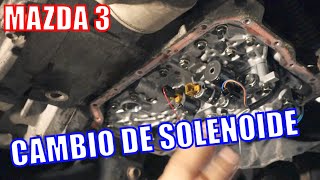
Typical fix: Replace the faulty shift solenoid. This requires removing the transmission pan and valve body components. 🎬 Watch: Step-by-step guide on how to change a transmission solenoid. The OEM part number is FN21-21-1F1.
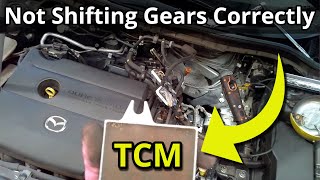
Est. part cost: $40-$100 - Faulty Transmission Control Module (TCM) ⚪ Low Probability Beyond software, the TCM itself is a known failure point. Its location mounted directly on the transmission casing can lead to overheating and eventual failure of internal components. This can cause a host of transmission codes, including P0771.
How to confirm: This is typically diagnosed by exclusion. If the fluid, wiring, and solenoid all test good, and a reflash doesn't solve the issue (or isn't applicable), the TCM hardware is the likely culprit. Companies like UpFix offer repair services.
Typical fix: Replace or repair the TCM. A replacement often requires programming to the vehicle, though some vendors sell pre-programmed units.
Est. part cost: $400-$800
Rare But Worth Checking
- Wiring Harness or Connector Damage: The wiring between the TCM and the transmission can become frayed, corroded, or damaged, interrupting the signal to the solenoid. Rodent damage to the soy-based wire insulation is also a known issue. This is worth checking before replacing expensive components.
- Clogged Valve Body Passages: Debris from old fluid can clog the small hydraulic passages within the transmission valve body, preventing the solenoid from functioning even if it's electrically sound.
- Incompatible Aftermarket Solenoid: Some owners have reported on forums that after replacing a solenoid with an aftermarket part, the code returned, suggesting potential incompatibility. The issue was only resolved by using a genuine OEM part from the dealer.
Diagnosis Steps
- Check the transmission fluid level and condition. Top off or change if necessary.
- Use an OBD-II scanner to check for P0771 and any other stored codes. Document all of them.
- If multiple transmission codes from the TSB list are present, contact a Mazda dealer to inquire about TSB #05-003-14-2898A and a potential TCM re-flash. This is the most likely fix.
- If P0771 is the only code, inspect the wiring harness leading to the transmission for any visible damage, corrosion, or loose connections.
- If wiring is okay, the next step is to test the solenoid itself. This requires draining the fluid and removing the transmission pan.
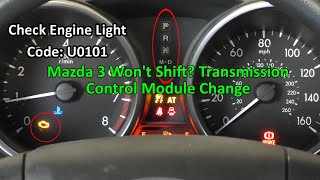
- Locate Shift Solenoid 'E' on the valve body. Measure its resistance with a multimeter between terminal F of its connector and ground. 🎬 Watch: How to test solenoid resistance and replace the TCM. It should be between 10.9 and 26.2 ohms. An out-of-spec reading or an open circuit indicates a bad solenoid.
- If the solenoid tests good and a reflash is not applicable or did not work, the final suspect is a hardware failure in the Transmission Control Module (TCM).
Parts You'll Likely Need
- Transmission Control Module (TCM) Reprogramming — A software update is the official Mazda fix for this code when it appears with other transmission DTCs, as per TSB #05-003-14-2898A.
OEM price range: $150-$300
Aftermarket price range: N/A - Automatic Transmission Shift Solenoid 'E'
(OEM #FN21-21-1F1)— If the solenoid itself has failed electrically (bad resistance reading) or is mechanically stuck, it will need to be replaced.
Trusted brands: Mazda Genuine, Rostra, ATP
OEM price range: $70-$120
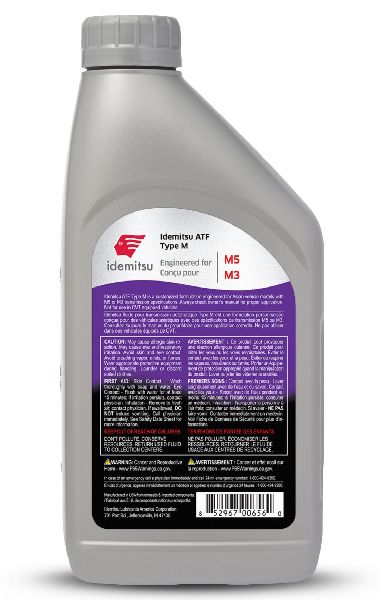
Aftermarket price range: $40-$80 - Mazda M-V (Type M5) Automatic Transmission Fluid
(OEM #0000-77-112E-01)— Any repair that involves dropping the pan requires draining and refilling the fluid. Using the correct OEM-spec fluid is critical for transmission health.
Trusted brands: Mazda Genuine
OEM price range: $15-$25 per quart
Aftermarket price range: $10-$18 per quart - Transmission Control Module (TCM) Repair/Replacement — If a software reflash doesn't work and the solenoid/wiring are good, the TCM hardware has likely failed due to heat and age.
Trusted brands: Mazda Genuine (Replacement), UpFix (Repair Service), Circuit Board Medics (Repair Service)
OEM price range: $800-$1500
Aftermarket price range: $300-$500 (for repair service)
Related Codes That Often Appear With This One
- P0746, P0751, P0756, P0761, P0766, etc. — Mazda TSB #05-003-14-2898A lists P0771 as part of a large group of codes that can be set simultaneously due to a TCM software issue. The presence of these other codes strongly points to the TSB as the solution.
- P0700 — This is a generic code indicating that the Transmission Control Module (TCM) has requested the Check Engine Light to be turned on. It will almost always be present with any specific transmission code like P0771.
- U0101, U0100 — These codes indicate a loss of communication with the TCM. If you see these along with P0771, it points strongly toward a wiring issue or a complete hardware failure of the TCM itself, rather than a software glitch or a bad solenoid.
Technical Service Bulletins (TSBs) & Recalls
- 05-003-14-2898A: Lists P0771:00 among other DTCs that are corrected by a new TCM program for 2012-2013 Mazda3 and other models.
- 05-003-14-2898: An earlier version of the same TSB, also correcting the TCM software issue.
Platform-Specific Known Issues
- A known issue documented by Mazda in TSB #05-003-14-2898A involves the setting of P0771 and other codes due to a software logic error in the TCM, which is corrected by a dealer-installed software update.
- The physical placement of the TCM on top of the transmission housing is a design flaw that makes it prone to failure from excessive heat over the life of the vehicle.
Mechanic-Grade Diagnostic Values
- Shift Solenoid 'E' Resistance — expected: 10.9 - 26.2 ohms at 68°F (20°C). Failure: A reading outside this range, or infinite resistance (open circuit), indicates a faulty solenoid.
- Shift Solenoid 'E' On-Vehicle Auditory Test — expected: An audible click or operating sound from the solenoid.. Failure: No sound when voltage is applied indicates a stuck or failed solenoid.
- Solenoid Current Draw (General) — expected: 0.5 - 2.0 Amps when commanded ON. Failure: No current draw indicates an open circuit; excessive draw indicates a short.
Scan Tool Commands That Help
- FORScan: TCM - Reset all default adaptations — After replacing the TCM or other major transmission components to force the module to relearn shift points and clutch pressures from its baseline.
- Mazda IDS (Dealer Tool): Active Test - Shift Solenoid Command — To manually command a specific solenoid on and off while monitoring circuit voltage or listening for an audible click, confirming the TCM driver and solenoid are capable of functioning.
- FORScan: PID: TFT (Transmission Fluid Temperature) — To monitor the transmission fluid temperature in real-time. This is required for an accurate fluid level check, which must be performed within a specific temperature range (typically 113-131°F or 45-55°C).
Wiring & Ground Locations
- TCM Location (FS5A-EL) — Mounted on top of the transmission housing, underneath the battery and battery tray.. This location subjects the TCM to significant heat and vibration, leading to a high rate of hardware failure, including cracked solder joints internally.
- Solenoid 'E' Test Point — At the main transmission harness connector, test between terminal 'F' and a known good ground.. This allows for testing the solenoid's resistance without dropping the transmission pan, helping to quickly determine if the fault is internal to the transmission.
- TCM Ground Wires — Multiple black wires in the main TCM harness connector located in the engine bay near the battery.. A poor ground connection to the TCM can cause a wide range of erratic behavior and fault codes, including solenoid performance issues. Verifying ground continuity is a key step before condemning the module.
Real Owner Repair Stories
- Reddit user in r/mazda3 (2008 Mazda 3 2.3L (similar platform/issue)) — AT light on, hard shifting, hard kick into reverse, code P0753 (Solenoid A).
❌ Tried (didn't work) Replacing the TCM with a remanufactured unit., Replacing the specific shift solenoid., Flushing the transmission fluid.
✅ What actually fixed it The user had to replace the remanufactured TCM two more times before getting a good unit that solved the problem. A different user in the same thread had their issue resolved by a transmission shop that found and repaired a wiring issue. - Reddit user in r/MechanicAdvice (2006-2011 Mazda 3) — Check Engine light, AT light, and traction control light all on; transmission issues.
❌ Tried (didn't work) Searching for used parts at junkyards., Getting a quote from the dealer ($1500-$2000).
✅ What actually fixed it Used a mail-in repair service from 'UPFIX' to have the original TCM repaired for about $300. The repaired module was plug-and-play and fixed the issues. - YouTube video by user 'd luu' (2011 Mazda 3 2.0L) — Check Engine, AT, and traction control lights on; limp mode; codes including U0101 (Lost communication with TCM).
❌ Tried (didn't work) A refurbished TCM bought online worked for two years before failing again.
✅ What actually fixed it The owner took their original failed TCM, opened it, and re-flowed (re-soldered) specific solder joints on the circuit board that are known to crack from heat. This DIY board-level repair fixed the original module.
OEM Part Supersession History
fn01211f1→FN21-21-1F1— Revision/update by manufacturer.LFJE-18-9E1A, LFJE-18-9E1B, LFJE-18-9E1C→LFJE-18-9E1D (for 2.0L Engine)— Updated hardware/software revision.
Heads up: The latest version 'D' is the correct service replacement for the earlier versions.L5F8-18-9E1A, L5F8-18-9E1B, L5F8-18-9E1C→L5F8-18-9E1D (for 2.5L Engine)— Updated hardware/software revision.
Heads up: The latest version 'D' is the correct service replacement for the earlier versions.
Model Year Variations Within This Range
- 2012-2013: The P0771 code and associated TSB apply to the non-Skyactiv models equipped with the 2.0L MZR or 2.5L MZR engine and the 5-speed FS5A-EL automatic transmission. Models with the 2.0L Skyactiv-G engine use a different 6-speed transmission and a different TCM, which is sometimes integrated with the PCM. It is critical to identify which powertrain the vehicle has before ordering parts like the TCM.
Helpful Videos

Used OEM Parts in Stock

New Aftermarket Parts Available




The information in this article is provided for general reference and educational purposes only. Vehicle specifications, procedures, and part compatibility can vary by production date, trim level, and region. Always consult your vehicle's factory service manual and verify part numbers before purchasing or performing repairs. Safety-critical components such as airbags, seat belts, and braking systems should be installed by a qualified professional.
- Mazda MAZDA3:
- 🎬 Helpful Videos
- 🛍️ Shop This Part
- What's Unique About the 2012-2013 Mazda MAZDA3
- Diagnostic Flowchart
- Symptoms You May Notice
- Most Likely Causes
- Rare But Worth Checking
- Diagnosis Steps
- Parts You'll Likely Need
- Related Codes That Often Appear With This One
- Technical Service Bulletins (TSBs) & Recalls
- Platform-Specific Known Issues
- Mechanic-Grade Diagnostic Values
- Scan Tool Commands That Help
- Wiring & Ground Locations
- Real Owner Repair Stories
- OEM Part Supersession History
- Model Year Variations Within This Range
- 🎟️ Get 5% Off