

P0752 on 2012-2013 Mazda MAZDA3: Shift Solenoid 'A' Stuck On Causes and Fixes
On a 2012-2013 Mazda3, P0752 often points to a faulty Transmission Control Module (TCM) or a bad shift solenoid/valve body. A failing TCM is a known issue for this generation, often due to its mounting location on the hot transmission case causing internal failure. Expect to pay $300-$600 for a remanufactured and pre-programmed TCM, or over $1,500 for a valve body replacement at a shop. A dealership TCM replacement can cost between $1500 and $2000.
- P0752 on a 2012-2013 Mazda3 is a serious code indicating a shifting problem, often caused by a component being stuck.
- The most likely culprit is not always the solenoid itself, but the Transmission Control Module (TCM) failing due to a poor mounting location that exposes it to excessive heat.
- Before approving an expensive valve body or transmission replacement, ensure the TCM has been properly diagnosed as it is a common, less expensive failure point.
- Checking transmission fluid level and condition is a critical first step in diagnosis.
- Driving with this code can lead to being stranded or causing more severe transmission damage, so prompt diagnosis is recommended.
What's Unique About the 2012-2013 Mazda MAZDA3
For the second-generation Mazda3 (2010-2013), this code is frequently linked to a design flaw where the Transmission Control Module (TCM) is mounted directly on top of the hot automatic transmission case. Over time, this constant heat exposure can cause the TCM's internal circuits and solder joints to fail, leading to various shift solenoid codes, including P0752. While the solenoid or valve body can be the cause, a faulty TCM is a very common point of failure on this specific platform and should be considered a primary suspect. This is a well-documented issue in owner forums and repair communities.
Diagnostic Flowchart
Tap your situation to follow the diagnostic path that matches what you're seeing on this vehicle.
Symptoms You May Notice
- Check Engine Light and/or AT (Automatic Transmission) warning light is on
- Harsh, delayed, or erratic shifting
- Transmission slipping between gears
- Vehicle gets stuck in a single gear (limp mode), often 3rd gear
- Failure to shift into or out of certain gears
- Poor acceleration and increased fuel consumption
- Transmission overheating
- A hard 'kick' or clunk when shifting from Park to Reverse or Drive
- Replacing the entire transmission when the fault is a less expensive, externally-mounted TCM.
- Replacing a shift solenoid when the root cause is a failing TCM sending incorrect signals.
- Assuming the transmission is failing mechanically when the issue is electronic (TCM or solenoid).
Most Likely Causes
- Faulty Transmission Control Module (TCM) 🔴 High Probability The TCM is mounted directly to the transmission case, where it is exposed to excessive heat. This is a well-documented failure point for this generation of Mazda3, causing internal solder joints and components to fail. Many owners on forums like Reddit have confirmed this is the root cause after experiencing shifting issues.
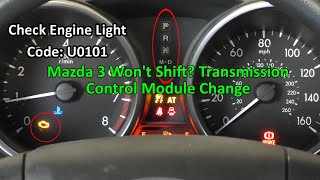
How to confirm: A professional will test for communication errors with the TCM using a high-end scan tool. Codes like U0100 or U0101 (Lost Communication with TCM) are strong indicators. The module itself can also be sent to a specialist like UpFix for bench testing. A mechanic can also back-probe the wiring at the TCM connector to check for correct voltage signals to the solenoid; an absence of voltage when expected points to a bad TCM.
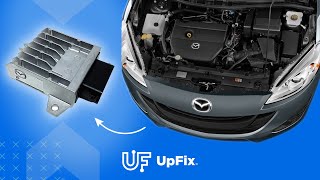
Typical fix: Replace the faulty TCM with a remanufactured, pre-programmed unit. It is highly recommended to relocate the new module away from the transmission case to prevent a repeat failure, though this is a custom job. 🎬 See how to repair and relocate your TCM to prevent heat damage Remanufacturing services like UpFix or Circuit Board Medics are common solutions.
Est. part cost: $300-$600 for a remanufactured and programmed TCM. - Failed Shift Solenoid 'A' or Valve Body 🔴 High Probability The manufacturer issued Technical Service Bulletins (TSBs) for 'AUTOMATIC TRANSAXLE INTERNAL MALFUNCTION' that include code P0752, pointing to a known pattern of internal component failure, sometimes caused by contamination in the fluid passages. [Bulletin #05-003-14-2898A, 30] TSB 05-003/14 specifically mentions replacing the valve body for certain DTCs.
How to confirm: A mechanic can test the solenoid's resistance with a multimeter to see if it's within the manufacturer's specification. A scan tool can also be used to command the solenoid on and off to check its response. If the solenoid tests good, the issue may be a blockage or failure within the valve body itself, as noted in Mazda TSBs.
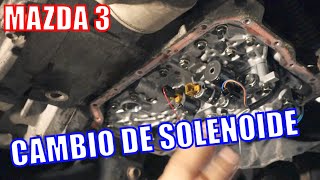
Typical fix: The failing shift solenoid is replaced. Solenoids are located inside the transmission oil pan, attached to the valve body. 🎬 Watch: How to access and replace a shift solenoid In some cases, particularly if passages are blocked or there are multiple solenoid codes, the entire valve body assembly must be replaced.
Est. part cost: $50-$150 for a single solenoid, $800-$1300 for a valve body assembly. - Low or Dirty Transmission Fluid 🟡 Medium Probability Contaminated fluid can obstruct the mechanical function of the solenoid or block passages in the valve body, which is a direct cause of this code.
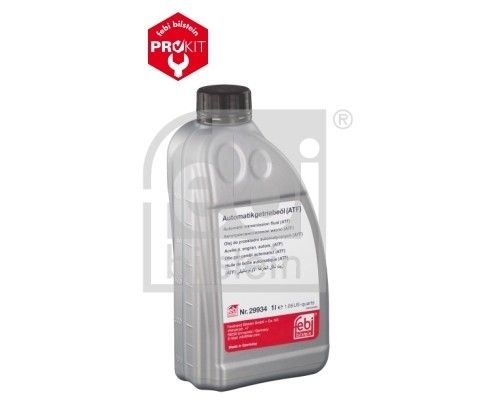
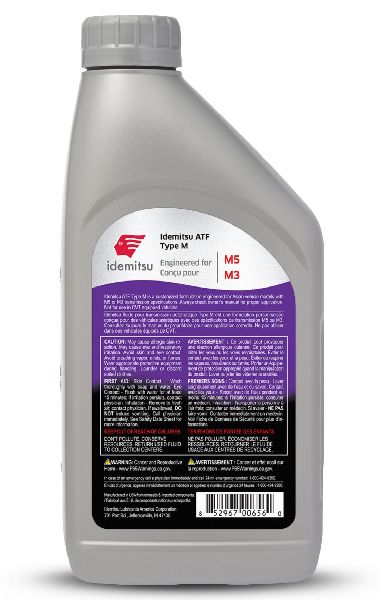
How to confirm: Check the transmission fluid level and condition via the dipstick (if equipped) or service plug. Fluid should be at the correct level, pink/red in color, and not smell burnt. Dark, dirty, or debris-filled fluid indicates a problem. The correct fluid type is Mazda ATF M-V for the 5-speed and ATF FZ for the 6-speed Skyactiv.
Typical fix: Perform a transmission fluid drain and fill. If the fluid is very dirty, a clogged transmission filter may also need to be replaced.
Est. part cost: $50-$150 for fluid and a filter. - Wiring or Connector Issue ⚪ Low Probability
How to confirm: Visually inspect the wiring harness and connectors going to the transmission and TCM for any signs of damage, corrosion, or loose connections. A multimeter can be used to check for continuity and proper voltage at the solenoid connector. The main transmission connector is located under the airbox.
Typical fix: Repair or replace the damaged section of the wiring harness or the faulty connector.
Est. part cost: $10-$100 depending on the extent of the damage.
Rare But Worth Checking
- Faulty Powertrain Control Module (PCM): This is rare. The TCM is the more likely control unit to fail for transmission-specific codes. A failing PCM usually presents with multiple, unrelated error codes.
Diagnosis Steps
- Check the transmission fluid level and condition. Top off or replace if low or dirty.
- Use an OBD-II scanner to check for other transmission-related or communication (U-prefix) codes.
- Inspect the wiring harness and connectors between the PCM, TCM, and the transmission case for visible damage or corrosion. Pay close attention to the main connector under the airbox.
- If possible, clear the codes and test drive to see if the code returns immediately.
- If a capable scan tool is available, command Shift Solenoid 'A' on and off to test its function electronically.
- If the TCM is suspected, check for communication errors (U-codes). Inspect the TCM (mounted on the transmission) for signs of heat damage or corrosion.
- If wiring and the TCM seem okay, drop the transmission pan to access the valve body.
- Test the resistance of Shift Solenoid 'A' with a multimeter and compare it to the manufacturer's specifications. If the reading is out of range, the solenoid is bad.
- If the solenoid tests bad, replace it. If it tests good, the issue may be a clogged passage in the valve body or an internal valve body failure, as suggested by TSBs.
Parts You'll Likely Need
- Transmission Control Module (TCM)
(OEM #LFJE-18-9E1x (for 2.0L non-Skyactiv), L5F8-18-9E1x (for 2.5L). The 'x' can be various letters like A, B, C, D, etc., representing revisions.)— This is a very common failure point on 2010-2014 Mazda3s due to heat exposure from its mounting location on the transmission.
Trusted brands: UpFix (remanufacturing service), Module Experts (remanufacturing service), Circuit Board Medics (remanufacturing service), Dorman (remanufactured part #609-070 or #609-071)
OEM price range: $1000+
Aftermarket price range: $300-$600 (remanufactured)
Related Codes That Often Appear With This One
- U0101 / U0100 — These codes indicate a loss of communication with the TCM. Their presence strongly suggests the TCM itself is the root cause of the P0752 code.
- P0751 — This code indicates 'Shift Solenoid A Performance/Stuck Off'. It's the opposite of P0752 and can be caused by the same failing components (TCM, solenoid, wiring).
- P0753 — This code indicates an electrical fault in the Shift Solenoid 'A' circuit. A Reddit thread on a 2010-2012 Mazda3 with this code was ultimately solved by replacing the TCM.
- P0842, P0847, P0872, P0877 — These are oil pressure switch codes that are often listed alongside solenoid codes in Mazda TSBs, pointing to internal hydraulic circuit or valve body issues.
Technical Service Bulletins (TSBs) & Recalls
- 05-003-14-2898A: Lists P0752 among many other DTCs related to 'AUTOMATIC TRANSAXLE INTERNAL MALFUNCTION'.
- 05-003/14 (supersedes 05-005/13): Recommends replacing the valve body with a new programmed unit to correct issues that trigger codes like P0780, P1738, and others.
- 05-002/15 (supersedes 05-003/14): Discusses oil pressure switch failures due to contamination for Skyactiv 6AT models, which can cause similar symptoms and codes.
Platform-Specific Known Issues
- Owner Experience: Intermittent to Permanent Limp Mode: A common story for 2012-2013 Mazda3 owners begins with intermittent AT and Check Engine lights, especially in hot weather or after the car has been running for a while. Initially, the car might get stuck in 3rd gear but return to normal after cooling down. Over time, the problem becomes permanent. One owner on Reddit with a P0753 code (solenoid A electrical) drove with this intermittent issue for months before it became constant. They ultimately diagnosed it as a bad TCM, not a mechanical transmission failure as the previous owner suspected, and fixed it by replacing the module.
Mechanic-Grade Diagnostic Values
- Shift Solenoid 'A' Resistance (for 5-speed FS5A-EL transmission) — expected: 1.0 - 4.2 Ohms. Failure: A reading outside this range indicates a failed solenoid coil.
- TCM CAN Bus Resistance — expected: 120 Ohms. Failure: No resistance or a significantly different reading suggests a wiring issue in the CAN bus circuit between the TCM and the OBD-II port, not a faulty TCM.
- TCM Power Pin Voltage — expected: Battery Voltage (B+). Failure: Voltage below B+ with the ignition on indicates a power supply issue to the module.
- TCM Ground Pin Voltage — expected: Below 1.0 V. Failure: Voltage significantly above 1.0V indicates a bad ground connection, which can cause erratic module behavior.
Scan Tool Commands That Help
- Professional OBD-II Scanner (e.g., FORScan, Mazda IDS): TCM Output Test / Solenoid Command — To electronically command Shift Solenoid 'A' on and off while monitoring its response. This helps isolate whether the fault is with the solenoid itself or the TCM's control over it.
- Professional OBD-II Scanner (e.g., FORScan, Mazda IDS): Reset Adaptive Values / Initial Learning Mode — After replacing the TCM or performing major transmission service, this function is used to clear old learned shift patterns and force the TCM to relearn optimal shift points.
Wiring & Ground Locations
- TCM Connector (Power) — On the main wiring harness connector that plugs into the TCM, located under the battery tray.. Pins I and O are the power supply pins. Verifying battery voltage here is a critical first step to ensure the module is powered correctly.
- TCM Connector (Ground) — On the main wiring harness connector that plugs into the TCM.. Pin X is the main ground for the TCM. A poor connection here can cause a host of communication and solenoid control issues, including P0752.
- TCM Connector (CAN Bus) — On the main wiring harness connector that plugs into the TCM.. Pin B (CAN-Hi) and Pin E (CAN-Lo) are for communication. Testing resistance across these pins verifies the integrity of the communication bus wiring.
- G07 — A ground point located on the top rear of the engine.. This is a key ground point for the transmission wiring harness. Corrosion or a loose connection here can affect the entire transmission electrical system.
- Transmission Case Grounds — Multiple ground wires are attached directly to the transmission case/bell housing.. These provide the primary ground path for sensors and solenoids within the transmission. Ensuring these are clean and tight is crucial for proper electrical operation.
OEM Part Supersession History
LFJE-18-9E1A→LFJE-18-9E1B, LFJE-18-9E1C, LFJE-18-9E1D, etc. up to H— Internal revisions and software updates by the manufacturer.
Heads up: For the 2.0L non-Skyactiv engine, part numbers in the LFJE-18-9E1x series are generally interchangeable. The final letter (A, B, C, D, etc.) denotes a revision, but they are compatible.
Model Year Variations Within This Range
- 2012-2013: The 2.0L non-Skyactiv engine uses a 5-speed automatic (FS5A-EL), while the 2.0L Skyactiv engine uses a 6-speed automatic (FW6A-EL). While the TCM failure mode is similar due to its location, the solenoids and internal components are different. The Shift Solenoid 'A' resistance for the 5-speed is 1.0-4.2 Ohms; the spec for the 6-speed may differ.
Helpful Videos

Used OEM Parts in Stock

New Aftermarket Parts Available




The information in this article is provided for general reference and educational purposes only. Vehicle specifications, procedures, and part compatibility can vary by production date, trim level, and region. Always consult your vehicle's factory service manual and verify part numbers before purchasing or performing repairs. Safety-critical components such as airbags, seat belts, and braking systems should be installed by a qualified professional.
- Mazda MAZDA3:
- 🎬 Helpful Videos
- 🛍️ Shop This Part
- What's Unique About the 2012-2013 Mazda MAZDA3
- Diagnostic Flowchart
- Symptoms You May Notice
- Most Likely Causes
- Rare But Worth Checking
- Diagnosis Steps
- Parts You'll Likely Need
- Related Codes That Often Appear With This One
- Technical Service Bulletins (TSBs) & Recalls
- Platform-Specific Known Issues
- Mechanic-Grade Diagnostic Values
- Scan Tool Commands That Help
- Wiring & Ground Locations
- OEM Part Supersession History
- Model Year Variations Within This Range
- 🎟️ Get 5% Off