

P0751 on 2006-2010 Hummer H3: Shift Solenoid 'A' Causes and Fixes
On a 2006-2010 Hummer H3, code P0751 is most often caused by a failed 1-2 Shift Solenoid 'A' inside the 4L60-E transmission. The fix involves dropping the transmission pan and replacing the solenoid, which costs about $25-$50 for the part. It is highly recommended to replace both the 'A' and 'B' solenoids at the same time.
- P0751 on your H3 points directly to an issue with the 1-2 shift solenoid ('A') in your 4L60-E transmission.
- The most likely cause is a failed solenoid, which is a common and relatively inexpensive part to replace.
- Always start by checking the transmission fluid level and condition; low or dirty fluid can cause this code.
- When replacing the failed solenoid, it is best practice to also replace the 2-3 shift solenoid ('B') and the transmission filter at the same time.
- This issue is almost always fixable without needing a complete transmission rebuild or replacement.
What's Unique About the 2006-2010 Hummer H3
The 2006-2010 Hummer H3 is equipped with the General Motors 4L60-E automatic transmission, a unit used in millions of GM trucks and SUVs. While generally robust, a known weak point with age and mileage is the failure of the shift solenoids. For this P0751 code, the issue is almost always mechanical or electrical failure of the 1-2 shift solenoid ('A') itself, rather than a more complex internal transmission problem. Conveniently, the 1-2 ('A') and 2-3 ('B') shift solenoids are identical, interchangeable parts on the 4L60-E, and it is best practice to replace them in pairs.
Symptoms You May Notice
- Check Engine Light is on
- Harsh, delayed, or failed shifts, particularly between 1st and 2nd gear
- Transmission is stuck in one gear (limp mode), often 3rd gear
- Transmission slipping
- Reduced fuel economy
- Transmission overheating
- Engine may stall
- Replacing the entire transmission when only a simple, inexpensive solenoid has failed.
- Blaming the solenoid immediately when the root cause is old, dirty transmission fluid that is causing it to stick. A fluid and filter change should be the first step if the fluid condition is poor.
Most Likely Causes
- Failed 1-2 Shift Solenoid 'A' 🔴 High Probability The shift solenoids in the 4L60-E are a common failure item as they age, either from the internal coil burning out or the mechanical plunger sticking due to contamination or wear.
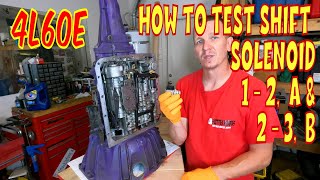
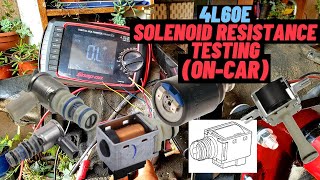
How to confirm: After dropping the transmission pan, test the solenoid's resistance with a multimeter; it should typically be within 20-30 ohms. You can also apply a 12V source to see if the solenoid 'clicks'. An out-of-spec reading or no click indicates failure. A reading of 26 ohms is considered good for this part. 🎬 Watch: How to test shift solenoids A and B.
Typical fix: Replace the 1-2 shift solenoid. It is highly recommended to also replace the 2-3 shift solenoid ('B') at the same time, as they are the same age and part. Many owners perform this repair at home.
Est. part cost: $25-$50 - Low or Contaminated Transmission Fluid 🟡 Medium Probability Over time, fluid can become contaminated with clutch material and metal shavings, which can clog the small passages and inlet screens in the solenoid and valve body, causing it to stick. Neglecting fluid service intervals is a common contributor.
How to confirm: Check the transmission fluid dipstick. The fluid should be at the correct level, pink/red in color, and not smell burnt. Dark, brown, or gritty fluid indicates a problem and potential for internal damage.
Typical fix: Perform a transmission fluid and filter change. If the fluid is heavily contaminated, this may be a temporary fix as the new solenoid can become clogged again. In some cases, a complete fluid flush may be needed to clear passages.
Est. part cost: $50-$100 for fluid and a new filter - Damaged Wiring or Connector ⚪ Low Probability The internal transmission wiring harness lives in a harsh environment of heat and vibration, which can cause wires to become brittle or connector pins to lose contact over time. The external connector can also be a point of failure due to corrosion or backed-out terminals.
How to confirm: Visually inspect the wiring harness leading to the shift solenoid for any signs of breaks, chafing, or corrosion on the connector pins once the transmission pan is removed. Also inspect the main 16-way transmission connector on the outside of the case.
Typical fix: Repair the damaged section of wire or replace the internal transmission wiring harness. If the external connector is the issue, terminals may need to be repaired or reseated.
Est. part cost: $40-$80 for a new harness
Rare But Worth Checking
- Sticking Valve in the Valve Body: If replacing the solenoid and changing the fluid doesn't resolve the issue, debris may have scored or blocked a channel within the transmission valve body, preventing proper hydraulic pressure. This usually requires professional service to clean, repair, or replace the valve body.
- Faulty Powertrain/Transmission Control Module (PCM/TCM): This is very uncommon. The module that controls the transmission can fail, but this should only be considered after all other possibilities (solenoid, fluid, wiring) have been thoroughly ruled out. Often, other communication codes (U-codes) will be present if the TCM is failing.
Diagnosis Steps
- Check the transmission fluid level and condition. If it is low, top it off. If it is dark, burnt, or contains debris, a fluid and filter change is the first step.
- Use an OBD-II scanner to check for other pending or stored transmission codes, especially P0756 or any U-codes.
- If possible, use a bi-directional scanner to command the Shift Solenoid 'A' on and off while listening for an audible click from the transmission pan area. Monitor solenoid voltage and status in the live data stream.
- If the solenoid does not click or the problem persists, safely raise the vehicle, drain the transmission fluid, and remove the transmission pan.
- Visually inspect the fluid in the pan and the pan magnet for excessive metal shavings (a fine metallic paste is normal, but large chunks are not), which would indicate a more serious internal failure.
- Locate Shift Solenoid 'A' on the valve body. Inspect its connector and wiring for damage.
- Disconnect the solenoid and test its resistance with a multimeter. A typical reading for a 4L60-E solenoid is 20-30 ohms. An open circuit (infinite resistance) or short (zero resistance) means the solenoid is bad.
- If the solenoid tests good electrically, the issue may be mechanical (sticking plunger) or a blockage in the valve body itself.
Parts You'll Likely Need
- 1-2 Shift Solenoid (Solenoid 'A')
(OEM #24230298)— This is the most common part to fail, causing the P0751 code on the 4L60-E transmission. Note that the original part number 24227747 is often listed for the TCC solenoid, not the shift solenoid. 24230298 is the correct number for the A/B shift solenoids.
Trusted brands: ACDelco, Delphi, Dorman
OEM price range: $30-$50
Aftermarket price range: $20-$40 - Automatic Transmission Filter Kit (with Gasket)
(OEM #24236931)— The transmission pan must be removed to access the solenoid, so replacing the fluid and filter is a required part of the job. 🎬 Watch: Full walkthrough for replacing all 4L60E solenoids and the filter.
Trusted brands: ACDelco, Wix, ATP
OEM price range: $25-$40
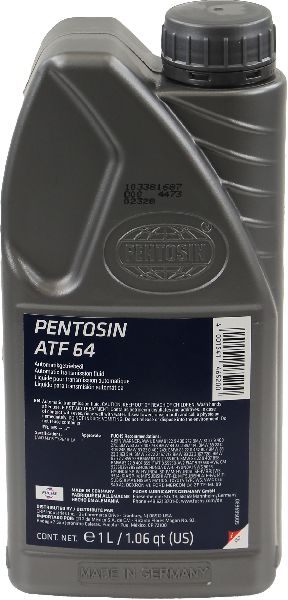
Aftermarket price range: $15-$30 - DEXRON VI Automatic Transmission Fluid — The correct type of fluid is required to refill the transmission after dropping the pan. A pan drop typically requires 5-6 quarts.
Trusted brands: ACDelco, Valvoline, Castrol
OEM price range: $8-$12 per quart
Aftermarket price range: $7-$10 per quart
Related Codes That Often Appear With This One
- P0756 — This code is for Shift Solenoid 'B' (2-3 shift). Since the solenoids are the same part, live in the same conditions, and are often replaced in pairs, it's common for them to fail around the same time.
- P0750 — This is a general electrical fault code for Shift Solenoid 'A'. P0751 is a more specific code indicating a performance or 'stuck off' condition. A user on HummerForums.com reported both codes appearing simultaneously after experiencing shifting issues.
Technical Service Bulletins (TSBs) & Recalls
- TSB 08-07-30-021H: This bulletin addresses a loss of high-speed GMLAN communications which can cause various issues, including the transmission not shifting. While not directly for P0751, it points to potential wiring issues at the 16-way transmission connector that could be a root cause if wiring is suspected.
Mechanic-Grade Diagnostic Values
- 1-2 Shift Solenoid 'A' Coil Resistance — expected: 20-30 Ohms. Failure: A reading of infinite Ohms (open circuit) or near-zero Ohms (short circuit) indicates a failed solenoid. Some technicians prefer a tighter range of 20-25 Ohms.
- Voltage Supply at Solenoid Connector — expected: ~12 Volts (Battery Voltage). Failure: With the ignition on and engine off, 0V at the power pin (Pin E) indicates a wiring issue or a blown TCM/TRANS fuse.
- Scan Tool Live Data: Solenoid 'A' Status — expected: Should toggle 'On' in 1st gear and 'Off' in 2nd gear.. Failure: The status being stuck 'Off' or showing a delayed toggle when a shift is commanded by the TCM confirms the fault.
- Scan Tool Live Data: Transmission Fluid Pressure Response — expected: A rise of 40-60 PSI when Solenoid 'A' is commanded to activate.. Failure: No pressure change when the solenoid is activated points to a stuck solenoid valve or a hydraulic blockage in the valve body.
Scan Tool Commands That Help
- Tech2 / GDS2 / Advanced Bidirectional Scanner: Solenoid Activation Test / Output Control — This command allows a technician to manually cycle Shift Solenoid 'A' on and off while the vehicle is stationary. A functional solenoid will produce an audible 'click' from the transmission pan. This test can quickly confirm if the solenoid is electrically and mechanically capable of moving, separating a bad solenoid from a wiring or TCM driver issue.
- Advanced Bidirectional Scanner: Solenoid Circuit Flow Test / Pressure Test — If a solenoid passes the activation test but shifting problems persist, this function can help diagnose a clogged valve body. It measures fluid flow through the solenoid's passages; reduced flow indicates a blockage that requires cleaning.
Wiring & Ground Locations
- Main Transmission Connector (C7) — A round, 20-way connector on the passenger side of the transmission case. It is a pass-through connector for all internal electronics.. This is the primary point for testing the transmission's electrical system from outside the vehicle. Corrosion or backed-out pins here can cause P0751.
- Pin A (1-2 Shift Solenoid Control) — Pin 'A' on the main transmission connector. The wire is typically Light Green.. This is the specific wire the TCM grounds to activate the 1-2 shift solenoid. A continuity test from this pin to the TCM can rule out a broken wire.
- Pin E (Solenoid Power Supply) — Pin 'E' on the main transmission connector. The wire is typically Pink.. This pin supplies 12V+ power to all shift solenoids. A voltage test here confirms the solenoids are receiving power from the ignition circuit.
- G102 / G103 / G104 — On the engine block on the lower left (driver's) side.. These are primary engine and transmission-related grounds. A loose or corroded ground here can cause erratic voltage and unpredictable behavior from the TCM and transmission solenoids.
Real Owner Repair Stories
- HummerForums.com user 'Chrmer3' (2009 Hummer H2 (6L80 transmission, but symptoms and diagnostic path are relevant)) — Heard a weird noise, then experienced a delayed and hard jump into gear. Check Engine Light came on with codes P0750 and P0751.
❌ Tried (didn't work) A transmission fluid and filter change was performed, which seemed to smooth out shifts temporarily, but the hard shifting problem returned shortly after.
✅ What actually fixed it The vehicle ultimately required a transmission replacement, indicating the solenoid code was a symptom of a larger, catastrophic internal failure rather than a simple solenoid issue.
When the Usual Fixes Don't Work
- In one documented case on a Hummer forum, a fluid and filter change did not resolve the P0751 code, and the symptoms of harsh shifting quickly returned. This ultimately led to a full transmission replacement, serving as a reminder that while the solenoid is the most common cause, the code can sometimes be an indicator of a more severe internal failure that has generated enough debris to cause the solenoid to malfunction.
OEM Part Supersession History
10478131, 24047681, 24236521→24230298— Part consolidation and design updates by GM over the long production life of the 4L60-E family.
Heads up: The part number 24230298 is the correct and current part for both the 1-2 ('A') and 2-3 ('B') shift solenoids in the 2006-2010 Hummer H3 4L60-E. Using older part numbers may result in receiving outdated stock.
Model Year Variations Within This Range
- 2008-2010: Hummer H3 models equipped with the 5.3L V8 engine may use the stronger 4L70-E transmission instead of the 4L60-E found with the I5 engine. The 4L70-E features a five-pinion planetary carrier for increased torque capacity. However, for the purposes of diagnosing and fixing a P0751 code, the procedure is identical as they share the same valve body design and use the same 1-2 shift solenoid (PN 24230298).
Diagnostic Flowchart
Used vs. New Parts: Buying Guide for This Vehicle
When a used part is the smart pick: A complete, low-mileage used valve body assembly from a junkyard can be a smart choice. It often costs less than two new OEM solenoids and replaces all solenoids and the internal harness at once, mitigating multiple potential failure points.
Donor-vehicle mileage cap: roughly under 80000 miles for the part to have meaningful remaining life.
What to inspect on the donor part:
- Ask to see the fluid from the donor transmission; it should be reddish-pink, not dark brown or black.
- Inspect the pan magnet from the donor; a fine metallic paste is normal, but large metal shavings or chunks indicate a severe internal failure.
- Visually check the solenoid inlet screens for blockage or debris.
- Ensure the main electrical connector pins on the donor harness are straight and free of corrosion.
OEM-only on this vehicle (don't cheap out):
- Shift Solenoids
Aftermarket brands forum-validated for this vehicle:
- ACDelco (OEM)
- Delphi (often the OE manufacturer)
- Rostra
Brands owners have reported issues with on this vehicle:
- Unbranded, generic 'kits' from online marketplaces are frequently cited on forums as having high premature failure rates.
Real Owner Stories
Aggregated from forums and TSBs cited above. Mileages and costs reflect what owners reported in those sources.
2009 Hummer H2
Symptoms: Experienced a hard jump into gear, which triggered the Check Engine Light for codes P0750 and P0751.
What fixed it: An initial attempt to fix the issue with a transmission fluid and filter change was unsuccessful. The problem was ultimately resolved by replacing the entire transmission.
Source hint: HummerForums.com - Thread 'P0751' (Feb 2020)
Related OBD-II Codes
Frequently Asked Questions
I'm replacing the 1-2 shift solenoid ('A') for code P0751 on my H3. Should I replace anything else at the same time?
What resistance reading should I expect when testing the shift solenoid on my Hummer H3's 4L60-E transmission?
Could my P0751 code be caused by something as simple as old transmission fluid?
Does TSB 08-07-30-021H specifically address the P0751 code?
Are there any recommended aftermarket solenoid brands for my H3, or should I stick to OEM?
My dealer quoted a full transmission replacement for a P0751. Is that always necessary?
Helpful Videos

Used OEM Parts in Stock

New Aftermarket Parts Available


The information in this article is provided for general reference and educational purposes only. Vehicle specifications, procedures, and part compatibility can vary by production date, trim level, and region. Always consult your vehicle's factory service manual and verify part numbers before purchasing or performing repairs. Safety-critical components such as airbags, seat belts, and braking systems should be installed by a qualified professional.
- Hummer H3:
- 🎬 Helpful Videos
- 🛍️ Shop This Part
- What's Unique About the 2006-2010 Hummer H3
- Symptoms You May Notice
- Most Likely Causes
- Rare But Worth Checking
- Diagnosis Steps
- Parts You'll Likely Need
- Related Codes That Often Appear With This One
- Technical Service Bulletins (TSBs) & Recalls
- Mechanic-Grade Diagnostic Values
- Scan Tool Commands That Help
- Wiring & Ground Locations
- Real Owner Repair Stories
- When the Usual Fixes Don't Work
- OEM Part Supersession History
- Model Year Variations Within This Range
- Diagnostic Flowchart
- Used vs. New Parts: Buying Guide for This Vehicle
- Real Owner Stories
- 2009 Hummer H2
- Related OBD-II Codes
- Frequently Asked Questions
- 🎟️ Get 5% Off