

P0740 on 2011-2018 Dodge Durango: TCC Solenoid and Torque Converter Guide
P0740 on a Dodge Durango usually points to a faulty Torque Converter Clutch (TCC) solenoid or, more commonly, a failed torque converter. The code is set when the computer commands the torque converter to lock and detects excessive slippage (over 100 RPM). Diagnosis involves checking fluid, testing the solenoid circuit, and if those are good, preparing for a torque converter replacement, which is a major repair.
- P0740 on a 2011-2018 Durango indicates a problem with the Torque Converter Clutch (TCC) circuit.
- The most likely cause is a failed TCC solenoid, which is a moderately difficult DIY repair.
- If the solenoid is not the problem, a failed torque converter is the next most likely cause, which is a major and expensive repair.
- Always check the transmission fluid level and condition first, as low or dirty fluid can cause this code.
- Due to the complexity and potential for significant transmission damage, professional diagnosis and repair are strongly recommended.
What's Unique About the 2011-2018 Dodge DURANGO
The 2011-2018 Durango uses different transmissions depending on the model year and engine. Early V8 models (2011-2013) use a Chrysler 65RFE 6-speed, while 2014 and newer models use a more advanced ZF-designed 8-speed automatic (845RE for V6, 8HP70 for V8). While P0740 applies to all, the diagnostic path is critical. For both transmission types, owner experiences and technician reports strongly suggest that while the code points to a 'circuit malfunction', the root cause is often a mechanical failure of the torque converter itself, especially if no other electrical codes are present. This is a crucial distinction that can save money on misdiagnosing a bad solenoid.
Diagnostic Flowchart
Tap your situation to follow the diagnostic path that matches what you're seeing on this vehicle.
Symptoms You May Notice
- Check Engine Light is on
- Transmission slipping or jerking, especially during shifts
- Vehicle stalling when coming to a stop
- Shuddering or vibration at highway speeds (40-60 mph)
- Reduced fuel economy
- Engine RPM is higher than usual at cruising speeds
- Transmission feels like it won't shift into the final gear or overdrive
- Replacing the TCC solenoid when the torque converter is the actual point of failure. Many forum users and even mechanics have shared experiences of spending money on a solenoid replacement only for the P0740 code to return.
- Replacing the entire transmission when only the torque converter was needed. A thorough diagnosis to pinpoint the failure is crucial.
Most Likely Causes
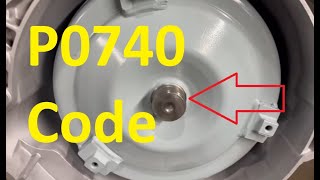
- Failed Torque Converter 🔴 High Probability The internal clutch lining of the torque converter can wear out, preventing it from locking up under command. This is a widely reported failure on both the 65RFE and the ZF 8-speed transmissions used in these Durangos and their platform mates. A Dodge TSB for the similar 62TE transmission explicitly states to replace the torque converter if the TCC solenoid is okay, a diagnostic logic that often applies here as well. 🎬 See why you should avoid replacing the solenoid first.
How to confirm: This is diagnosed by ruling out other causes and observing high TCC slip RPM on a scan tool during commanded lock-up. A large amount of fine, dark clutch material or metal shavings in the transmission pan is a strong indicator of internal torque converter or transmission failure.
Typical fix: Replace the torque converter. This is a major job that requires removing the transmission.
Est. part cost: $450-$1500 - Faulty Torque Converter Clutch (TCC) Solenoid 🟡 Medium Probability The solenoid is an electro-mechanical part that can fail electrically (open/short circuit) or mechanically (sticking). While it's a common part to check, many owners report replacing it only to find the P0740 code returns, indicating the torque converter was the real issue.
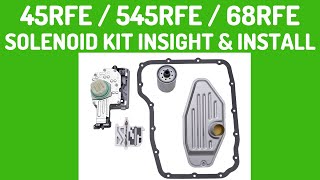
How to confirm: A mechanic can use a scan tool to command the solenoid on and off. The solenoid's electrical resistance can also be tested with a multimeter after dropping the transmission pan. For the 65RFE, the TCC solenoid is part of the main solenoid block. 🎬 Watch: Step-by-step guide to replacing the RFE solenoid block.
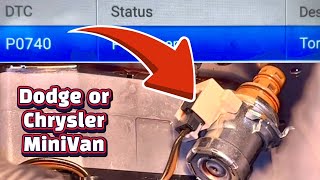
Typical fix: Replace the TCC solenoid or the entire solenoid pack. This is located inside the transmission oil pan on the valve body.
Est. part cost: $95-$350 - Low or Contaminated Transmission Fluid 🟡 Medium Probability Low fluid levels can prevent proper hydraulic pressure for lock-up, while burnt or debris-filled fluid can cause solenoids to stick or clog passages in the valve body.
How to confirm: Check the transmission fluid level and condition. On these Durangos, there is no dipstick, so this must be done by a professional at a specific fluid temperature via a check plug on the transmission pan. For the 8-speed, the temperature must be between 30°C (86°F) and 50°C (122°F). For the 6-speed, the check is done at a higher temperature of 70-80°C (158-176°F).
Typical fix: Perform a transmission fluid and filter service. If the fluid is very dark or smells burnt, it often indicates a deeper mechanical problem.
Est. part cost: $100-$350 (for fluid and filter/pan) - Damaged Wiring or Connectors ⚪ Low Probability
How to confirm: Visually inspect the transmission wiring harness for any signs of corrosion, fraying, or loose connections from the TCM to the transmission case. Check for circuit continuity with a multimeter.
Typical fix: Repair or replace the damaged section of the wiring harness or the connector.
Est. part cost: $20-$200
Rare But Worth Checking
- Faulty Transmission Control Module (TCM) or Powertrain Control Module (PCM): This is rare, but a failing control module can send erroneous codes. This should only be considered after all other mechanical and electrical causes have been eliminated.
- Internal Valve Body Issue: The valve body contains the TCC control valve, which can stick in its bore due to debris or wear, preventing proper hydraulic function even if the solenoid is working correctly. This often requires valve body repair or replacement.
Diagnosis Steps
- Scan the vehicle's computer for P0740 and any other codes. Note that P0700 is often present as well.
- Check the transmission fluid level and condition. This requires a specific procedure and tools as there is no dipstick. The correct temperature for checking is critical: 30-50°C (86-122°F) for the 8-speed and 70-80°C (158-176°F) for the 6-speed.
- Inspect the transmission wiring harness and connectors for any visible damage, corrosion, or loose pins.
- Using an advanced scan tool, monitor the live data for 'TCC Slip Speed' while driving at a steady highway speed. When lock-up is commanded, slip should be near 0 RPM. If it's over 100 RPM, it confirms a mechanical slip.
- If the circuit appears to be the issue, drop the transmission pan to access the solenoid(s).
- Test the TCC solenoid's resistance with a multimeter and check the internal wiring for continuity.
- If the solenoid and wiring test good, the issue is very likely the torque converter itself, which is a common failure point for this code.
- Inspect the valve body for sticking valves, particularly the Torque Converter Clutch Control Valve.
- If all else fails, the Transmission Control Module (TCM) may be at fault, though this is uncommon.
Parts You'll Likely Need
- Torque Converter
(OEM #52109336AA (For 845RE V6), check VIN for 8HP70 V8)— If the solenoid is not the cause, a worn-out internal clutch in the torque converter is the most likely culprit.
Trusted brands: Mopar, Transtar, Pro-King, ZF
OEM price range: $750-$1500
Aftermarket price range: $450-$900 - Transmission Solenoid Pack (65RFE)
(OEM #68002342AF (Supersedes older numbers))— For 2011-2013 V8 models, the TCC solenoid is part of this block. It's the primary electrical component to check for this code.
Trusted brands: Mopar
OEM price range: $300-$400
Aftermarket price range: $150-$250 - TCC Lock-Up Solenoid (8-Speed)
(OEM #52108314AB)— For 2014+ models with the 8-speed, this individual solenoid can be tested and replaced. However, failure is less common than the torque converter itself.
Trusted brands: Mopar, ZF
OEM price range: $95-$150
Aftermarket price range: $50-$100 - Transmission Filter and Pan Gasket Kit — Required for any repair that involves dropping the transmission pan. For 8-speed models, the filter is integrated into the plastic pan itself, which must be replaced as a unit.
Trusted brands: Mopar, ATP, Crown Automotive
OEM price range: $150-$330 (for integrated pan/filter)
Aftermarket price range: $80-$180 (for integrated pan/filter)
Related Codes That Often Appear With This One
- P0700 — P0700 is a generic code that means the Transmission Control Module (TCM) has stored a fault code. It almost always appears alongside a more specific transmission code like P0740 to signal the driver via the Check Engine Light.
Technical Service Bulletins (TSBs) & Recalls
- While no specific TSB for the Durango and P0740 was found, the diagnostic logic from TSBs for other Chrysler vehicles with similar transmissions (like the 62TE) consistently points to a failed torque converter if the solenoid circuit checks out. This logic is widely applied by technicians to the Durango as well.
Platform-Specific Known Issues
- For the 65RFE (2011-2013 V8), the TCC solenoid is integrated into the main solenoid block (Mopar P/N 68002342AF), which is replaced as a single unit.
- For the 845RE/8HP70 (2014-2018), the TCC solenoid is often available individually (Mopar P/N 52108314AB).
- Models from 2014-2018 with the 8-speed ZF transmission have a plastic oil pan with an integrated, non-serviceable filter. A filter change requires replacing the entire pan assembly.
Mechanic-Grade Diagnostic Values
- TCC Solenoid Resistance (8-speed ZF 845RE/8HP70) — expected: 5.0 Ohms at 20°C (68°F). Failure: A reading significantly higher or lower than 5.0 Ohms, or an open/infinite reading, indicates a failed solenoid coil.
- TCC Solenoid Resistance (6-speed 65RFE) — expected: The TCC solenoid is part of the larger solenoid block. The pressure control solenoid should read ~4.9 Ohms, while other shift solenoids in the block are ~1.3 Ohms. A dynamic test using an oscilloscope to observe the current ramp is more effective.. Failure: Resistance readings outside of spec, or a current waveform that lacks the characteristic 'hump' indicating mechanical pintle movement, points to a failure.
- TCC Slip Speed (Live Scan Tool Data) — expected: Near 0 RPM when TCC is commanded to lock at steady cruising speed.. Failure: A slip of more than 100 RPM for 10 seconds or more when lock-up is commanded will set the P0740 code.
- Fluid Level Check Temperature (8-speed ZF 845RE/8HP70) — expected: Fluid must be between 30°C (86°F) and 50°C (122°F) to get an accurate reading from the fill plug.. Failure: Checking outside this temperature range will result in an incorrect fluid level (either over or under-filled), causing shifting problems.
- Fluid Level Check Temperature (6-speed 65RFE) — expected: Fluid must be at normal operating temperature, between 70°C (158°F) and 80°C (176°F), for an accurate reading with a service dipstick.. Failure: Checking at a lower temperature using the 'HOT' marks will result in an under-filled transmission.
Scan Tool Commands That Help
- wiTECH (or equivalent advanced scanner): TCC System Test — This bidirectional test commands the TCC solenoid on to check for an immediate stall. If the vehicle stalls, it confirms the solenoid and clutch are capable of engaging, but may be stuck on. If it does not stall, it points toward a slipping clutch or hydraulic issue.
- wiTECH (or equivalent advanced scanner): Transmission Quick Learn / Drive Learn Procedure — After replacing the valve body, solenoid pack, or torque converter, a quick learn procedure is necessary to reset the clutch volume index (CVI) and other adaptive values. For the 65RFE, specific drive cycles involving 4-3 kickdowns and steady acceleration are required to relearn shift volumes.
Wiring & Ground Locations
- Transmission Control Module (TCM) - for 65RFE — For 2011-2013 models with the 6/5-speed transmissions, the TCM is located under the dash on the transmission hump, accessible by removing the side panels of the center console.. This is the location of the control module that sends the signal to the TCC solenoid. Any wiring checks for the TCC circuit will originate or terminate at this module's connectors.
- Transmission Control Module (TCM) - for 8-Speed — For 2014+ models with the 8-speed ZF transmission, the TCM is integrated into the mechatronics unit (valve body) inside the transmission oil pan.. There is no external TCM. All wiring for the TCC solenoid runs from the main transmission harness connector directly into the valve body assembly.
- Chassis Grounds — Multiple ground straps connect the engine/transmission assembly to the vehicle's chassis and body. One key ground runs from the alternator area to the frame.. A poor or broken ground connection can cause erratic voltage and unpredictable behavior in transmission solenoids, potentially leading to a P0740 code even if the solenoid itself is good.
Real Owner Repair Stories
- Reddit user in r/MechanicAdvice (Unknown year, likely post-2011) — P0740 code, failing inspection. Car drives fine, no metal shavings in fluid.
❌ Tried (didn't work) Flushed transmission fluid and replaced filter.
✅ What actually fixed it The code returned immediately after the fluid service. The shop's next step was to replace the TCC lockup solenoid, which is the common next step before condemning the torque converter itself.
OEM Part Supersession History
68002342A(A through F)→68002342AG— Progressive updates to the solenoid block for the 45RFE/545RFE/65RFE transmissions to improve reliability and performance.
Heads up: The latest part number, 68002342AG, replaces all previous versions (AA, AB, AC, AD, AE, AF) and should be used for replacement.
Model Year Variations Within This Range
- 2011-2013: These models primarily use the 5-speed (V6) or 6-speed 65RFE (V8) transmission. The TCC solenoid is part of a large solenoid block (68002342AG) on the valve body. The TCM is a separate module located inside the cabin.
- 2014-2018: These models use the 8-speed ZF 845RE (V6) or 8HP70 (V8) transmission. The TCC solenoid is an individual component on the mechatronics unit. The TCM is integrated into the mechatronics unit inside the transmission. The fluid check procedure and temperature are different from the earlier 6-speed.
- 2018: For 2018, models received the second-generation ZF 8-speed automatic, which included software and potential hardware updates. The gear shifter was also changed from a rotary dial to a T-grip handle.
Helpful Videos


Used OEM Parts in Stock


New Aftermarket Parts Available


The information in this article is provided for general reference and educational purposes only. Vehicle specifications, procedures, and part compatibility can vary by production date, trim level, and region. Always consult your vehicle's factory service manual and verify part numbers before purchasing or performing repairs. Safety-critical components such as airbags, seat belts, and braking systems should be installed by a qualified professional.
- Dodge DURANGO:
- 🎬 Helpful Videos
- 🛍️ Shop This Part
- What's Unique About the 2011-2018 Dodge DURANGO
- Diagnostic Flowchart
- Symptoms You May Notice
- Most Likely Causes
- Rare But Worth Checking
- Diagnosis Steps
- Parts You'll Likely Need
- Related Codes That Often Appear With This One
- Technical Service Bulletins (TSBs) & Recalls
- Platform-Specific Known Issues
- Mechanic-Grade Diagnostic Values
- Scan Tool Commands That Help
- Wiring & Ground Locations
- Real Owner Repair Stories
- OEM Part Supersession History
- Model Year Variations Within This Range
- 🎟️ Get 5% Off