

P0731 on 2020-2023 Ford TRANSIT: Incorrect Gear 1 Ratio Causes and Fixes
On a 2020-2023 Ford Transit, P0731 is almost always caused by a known internal transmission issue with the CDF clutch drum in the 10R80 10-speed automatic. This is not a DIY fix and typically requires transmission overhaul or replacement. The failure is due to a design flaw that was later corrected by Ford with an updated part.
- P0731 on a 2020-2023 Transit is a serious code indicating a likely internal transmission failure.
- The cause is almost certainly a well-known design flaw in the 10R80 transmission's CDF clutch drum, which is covered by multiple Ford TSBs.
- This is not a DIY-friendly repair. It requires transmission removal and disassembly by a professional.
- The correct fix involves replacing the original CDF drum with an updated part from Ford that permanently solves the issue.
- Do not continue to drive the vehicle, as this can lead to catastrophic transmission failure.
What's Unique About the 2020-2023 Ford TRANSIT
The 2020-2023 Ford Transit uses the 10R80 10-speed automatic transmission, which is known to have a specific, widespread design flaw. A bushing inside the 'CDF' clutch drum assembly has a tendency to walk, or move axially, out of its bore. This movement uncovers hydraulic fluid passages, causing a critical loss of pressure to the C, D, or F clutch packs. This leads to slipping, harsh shifts, and a variety of gear ratio codes, with P0731 being one of the most common. Ford has issued multiple Technical Service Bulletins (TSBs) acknowledging this exact problem, and later introduced a redesigned CDF drum with a machined retaining lip to prevent the bushing from moving.
Diagnostic Flowchart
Tap your situation to follow the diagnostic path that matches what you're seeing on this vehicle.
Symptoms You May Notice
- Check Engine Light is on
- Harsh or delayed shifting, especially into first gear, or on the 1-2 and 3-4 upshifts
- Vehicle hesitates or has poor acceleration from a stop
- Transmission slipping (engine RPMs increase but speed does not)
- Clunking or banging noises during shifts
- Transmission may enter "limp mode," limiting available gears
- Delayed engagement when shifting from Park to Drive
- Replacing only the input or output speed sensors. While a sensor can fail, it's rarely the root cause for this code on this specific vehicle; the issue is almost always mechanical/hydraulic.
- Performing only a fluid change. If the CDF drum has failed, a fluid change will not solve the problem, though it may be performed as part of the larger repair.
- Replacing only the valve body. While debris can affect the valve body, the root cause is often the disintegrating CDF drum, and replacing only the valve body will not be a permanent fix.
Most Likely Causes
- Failed CDF Clutch Drum Assembly 🔴 High Probability A bushing in the original factory CDF drum is known to walk out of its bore, uncovering fluid passages and causing a pressure loss to the C, D, or F clutches. This is a well-documented design flaw in the 10R80 transmission 🎬 Learn more about common 10R80 transmission failures and problems affecting a wide range of Ford vehicles.
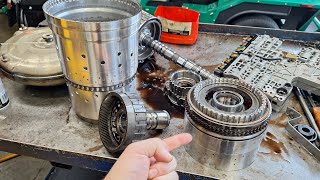
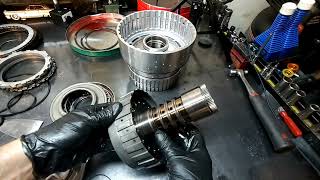
How to confirm: This requires transmission disassembly to physically inspect the CDF drum 🎬 Watch: Full teardown showing the CDF drum bushing failure and its internal bushing. A technician will see the bushing has physically moved, exposing an oil passage that should be covered.
Typical fix: Replace the original CDF drum with the updated, redesigned part that has a machined lip or 'wall' to prevent the bushing from moving. This repair requires a partial or complete transmission rebuild, including new seals and gaskets.
Est. part cost: $200-$500 for the updated drum assembly - Low or Contaminated Transmission Fluid 🟡 Medium Probability While less common than the CDF drum failure, low fluid can cause a lack of hydraulic pressure needed to engage clutches. Contaminated fluid (often with clutch material from the slipping caused by the CDF drum issue) can cause the valve body or solenoids to stick.
How to confirm: Check the transmission fluid level and condition. The 10R80 transmission does not have a traditional dipstick, so this must be done by a technician from under the vehicle, at a specific temperature.
Typical fix: Perform a transmission fluid drain and fill, or a full fluid exchange with the correct Motorcraft ULV (Ultra-Low Viscosity) fluid. Fix any leaks found. This is often done as part of the CDF drum replacement.
Est. part cost: $150-$300 for fluid and filter - Valve Body or Solenoid Failure ⚪ Low Probability The 10R80 valve body can suffer from internal cross-leaks or solenoid failures, though this is less frequent than the CDF drum issue. Debris from a failing CDF drum can also contaminate the valve body, causing secondary issues. One owner of a related vehicle reported a valve body failure at just 11,000 miles.
How to confirm: A technician can perform a pressure test and command solenoids using a high-level scan tool to check for proper operation. Physical inspection may reveal debris in the valve body passages.
Typical fix: Replacement of the faulty solenoid or the entire valve body assembly, followed by an adaptive learning reset.
Est. part cost: $400-$1200
Rare But Worth Checking
- Faulty Transmission Control Module (TCM): A software glitch or internal TCM failure can sometimes trigger false codes. This should only be considered after all mechanical and hydraulic possibilities have been ruled out.
- Incorrect Aftermarket Transmission Filter: In some cases on related Ford transmissions, an aftermarket transmission filter that is dimensionally incorrect (too long) can press against the bottom of the pan, restricting fluid flow and causing a no-move condition with a P0731 code immediately after a fluid service. Using an OEM filter resolved the issue.
Diagnosis Steps
- Verify the transmission fluid level and condition. This must be done by a qualified technician as there is no dipstick.
- Use a professional scan tool to check for P0731 and any other related transmission codes. Note the freeze-frame data.
- Review the known Technical Service Bulletins (TSBs) for this vehicle, specifically TSB 24-2254, which directly addresses this code and the CDF drum failure.
- Perform a road test to observe shift quality and attempt to replicate the symptoms, paying close attention to shifts from a stop and the 3-4 shift.
- If the CDF drum failure is suspected based on the TSBs and symptoms, the next step is to remove and disassemble the transmission for internal inspection.
- Inspect the CDF clutch drum for a migrated bushing and the clutch packs for signs of excessive wear or heat damage ('blued' steel plates).
- Inspect the valve body for scoring or metallic debris.
Parts You'll Likely Need
- CDF Clutch Drum Assembly (Updated Design)
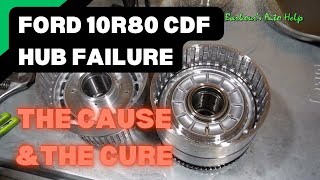
(OEM #JL3Z-7H351-B (supersedes HL3Z-7H351-A and JL3Z-7H351-A))— This is the primary point of failure. The updated Ford part has a machined lip to prevent the internal bushing from walking out, providing a permanent fix. 🎬 See the difference between the old and updated CDF hub
Trusted brands: Motorcraft
OEM price range: $200-$500
Aftermarket price range: $150-$300 - Transmission Overhaul Kit — Required for reassembling the transmission after replacing the CDF drum. Includes new seals, gaskets, and often clutch plates that may have been damaged by slipping.
Trusted brands: Motorcraft
OEM price range: $400-$800
Aftermarket price range: $250-$500 - Motorcraft MERCON ULV Automatic Transmission Fluid
(OEM #XT-12-QULV)— This is the specific fluid required for the 10R80 transmission. Using any other fluid type can cause damage.
Trusted brands: Motorcraft
OEM price range: $10-$15 per quart
Related Codes That Often Appear With This One
- P0729 — Incorrect Gear 6 Ratio. This and other gear ratio codes (P0732, P0733, etc.) are often stored together with P0731 because the underlying CDF drum failure affects multiple clutch packs and gears. [TSB 24-2254]
- P0751 — Shift Solenoid 'A' Performance/Stuck Off. Solenoid codes can accompany the gear ratio codes as the TCM attempts to compensate for the hydraulic pressure loss or flags the components it believes are responsible. [TSB 24-2254]
Technical Service Bulletins (TSBs) & Recalls
- TSB 24-2254: Mentions P0731 in a list of codes caused by axial movement of the CDF clutch cylinder. It provides service procedures to verify the leak and replace the drum.
- TSB 26-2046: Also lists P0731 among DTCs related to the same internal transmission issue.
- TSB 21-2377: Lists P0731 as a possible DTC for harsh/delayed shift concerns related to the CDF drum issue.
Platform-Specific Known Issues
- A widespread issue exists with the 10R80 transmission's CDF clutch drum, where a bushing can move axially, uncovering hydraulic fluid ports. [TSB 24-2254, 1]
- This failure is documented in Ford Technical Service Bulletins TSB 24-2254, TSB 26-2046, and TSB 21-2377, which list P0731 as a primary diagnostic trouble code for this condition.
- Ford released a redesigned CDF drum with a retaining lip on the bushing to permanently fix the problem on later models and for service repairs.
- Owner discussions on forums and Reddit are filled with accounts of this specific failure, with many occurring just outside the powertrain warranty period.
Mechanic-Grade Diagnostic Values
- Shift Solenoids (A-F) Resistance — expected: 5.0 - 5.4 Ohms at 20°C (68°F). Failure: A reading outside this range indicates a faulty solenoid coil.
- Transmission Fluid Temperature (TFT) Sensor Resistance — expected: Varies with temperature. Example: 37k-16k Ohms at 69°F-104°F, or 2.7k-1.5k Ohms at 195°F-230°F.. Failure: Resistance that doesn't correlate with the temperature chart indicates a bad sensor.
- Line Pressure Control (LPC) Solenoid Current — expected: Inversely proportional. Low/no current (~50 mA) commands full line pressure. High current (~850 mA) commands low pressure.. Failure: Pressure not responding correctly to commanded current.
- Torque Converter Clutch (TCC) Solenoid Current — expected: Directly proportional. Low/no current (~50 mA) commands low pressure. High current (~850 mA) commands high pressure/full lockup.. Failure: Pressure not responding correctly to commanded current.
Hidden / Shadow Codes Worth Checking
- P163E: Transmission Control Module Programming Error. This code can set after replacing the main control valve body. (see via This may occur if the 12-digit solenoid body ID is entered instead of the required 13-digit solenoid body strategy number during the programming procedure with a Ford IDS scan tool.)
- P1700: Transmission System Failure (Indeterminate). A generic Ford-specific code indicating a non-specific failure has occurred within the transmission system. (see via Visible with professional scan tools like Ford IDS.)
Scan Tool Commands That Help
- Ford IDS (Integrated Diagnostic Software) or FORScan: Transmission Characterization / Solenoid Strategy Download — This is a mandatory procedure after replacing the transmission valve body or individual solenoids. It requires entering the 13-digit strategy number from the new part to ensure the TCM uses the correct control logic. Failure to perform this step can result in poor shifting or new trouble codes like P163E.
- Ford IDS (Integrated Diagnostic Software): Clear All Adaptive Tables — This function should be used after any major transmission repair, such as replacing the CDF drum or valve body. It erases the TCM's learned shift patterns, allowing it to relearn with the new components.
- Ford IDS (Integrated Diagnostic Software): Adaptive Learning Drive Cycle — After clearing the adaptive tables, a specific drive cycle must be performed to allow the TCM to relearn shift pressures and timing. This involves a series of gentle accelerations through the gears, stops, and shifts between Drive, Neutral, and Reverse.
Wiring & Ground Locations
- TCM Power (Constant) — At the interior fuse panel located under the steering wheel, behind the knee bolster. The connection is at fuse position #3 (5 amp, typically for USB power).. Loss of constant power can cause the TCM to lose its memory (adaptive learn values), potentially leading to harsh shifting and communication faults.
- TCM Power (Ignition) — At the interior fuse panel under the steering wheel. The connection is at fuse position #16 (5 amp, typically for the rain sensor).. Loss of ignition power will prevent the TCM from operating, leading to a no-shift condition and multiple communication codes.
- High Current Battery Junction Box — Under the driver's seat, near the battery.. This box contains master fuses for multiple vehicle systems. A failure here (documented in SSM 50110) can cause a no-start or loss of communication with the PCM and other modules, which could be misdiagnosed as a primary TCM failure.
- Transmission Control Module (TCM) — The 10R80 transmission uses an externally mounted control module, located on the transmission case itself.. Its location exposes it to heat and vibration. All wiring and connectors going to the module should be inspected for damage or corrosion as a primary step in diagnosing electrical faults.
Real Owner Repair Stories
- Reddit user joemahoney76 on r/f150 (Ford F-150 with 10R80 (2,000 miles out of warranty)) — Harsh shifting that had been present for about a year without getting worse.
❌ Tried (didn't work) Continued driving with the symptoms for a year.
✅ What actually fixed it The dealership diagnosed a failed CDF drum. The total repair cost was quoted at $4300, and Ford offered to contribute $1680 as a goodwill gesture since the vehicle was just out of warranty. The fix is the replacement of the CDF drum. - Reddit user finefinethatsfine on r/f150 (Ford F-150 with 10R80, failure at 73,000 miles) — Unspecified symptoms leading to transmission failure.
❌ Tried (didn't work) Seeking warranty or goodwill assistance from Ford, which was denied.
✅ What actually fixed it A transmission rebuild was performed. The user noted that the rebuild kit included the updated CDF drum, which they considered an admission of fault by Ford. - Mustang6G.com forum user (2021 Ford Mustang with 10R80, failure at 11,000 miles) — Unspecified symptoms leading to diagnosis.
✅ What actually fixed it The valve body was replaced under warranty due to sticking solenoids. The user noted that even after the repair, they still experienced harsh 4-5 shifts, suggesting other issues might persist.
OEM Part Supersession History
HL3Z-7H351-A, JL3Z-7H351-A→JL3Z-7H351-B— The original design allowed an internal bushing to move ('walk') out of its bore, causing a hydraulic pressure leak. The updated JL3Z-7H351-B part features a machined retaining lip that physically prevents the bushing from moving.
Model Year Variations Within This Range
- 2020 - Mid-2022: Vehicles built on or before August 15, 2022, were likely assembled with the original, failure-prone CDF clutch drum. This is documented in Ford's TSB 24-2254.
- Late 2022 - 2023: Vehicles built after August 15, 2022, are expected to have the updated CDF clutch drum (part JL3Z-7H351-B) installed from the factory, significantly reducing the likelihood of this specific failure.
Helpful Videos

Used OEM Parts in Stock

New Aftermarket Parts Available


The information in this article is provided for general reference and educational purposes only. Vehicle specifications, procedures, and part compatibility can vary by production date, trim level, and region. Always consult your vehicle's factory service manual and verify part numbers before purchasing or performing repairs. Safety-critical components such as airbags, seat belts, and braking systems should be installed by a qualified professional.
- Ford TRANSIT:
- 🎬 Helpful Videos
- 🛍️ Shop This Part
- What's Unique About the 2020-2023 Ford TRANSIT
- Diagnostic Flowchart
- Symptoms You May Notice
- Most Likely Causes
- Rare But Worth Checking
- Diagnosis Steps
- Parts You'll Likely Need
- Related Codes That Often Appear With This One
- Technical Service Bulletins (TSBs) & Recalls
- Platform-Specific Known Issues
- Mechanic-Grade Diagnostic Values
- Hidden / Shadow Codes Worth Checking
- Scan Tool Commands That Help
- Wiring & Ground Locations
- Real Owner Repair Stories
- OEM Part Supersession History
- Model Year Variations Within This Range
- 🎟️ Get 5% Off