

P0707 on 2005-2010 Pontiac G6: Transmission Range Sensor Circuit Low Causes and Fixes
On a 2005-2010 Pontiac G6, code P0707 almost always points to a faulty Transmission Range Sensor (also called a neutral safety switch) or its wiring. This part tells the car what gear it's in. Expect to pay around $70-$120 for a quality replacement part (like ACDelco D2263C / GM Part #24229422) and 1-1.5 hours of labor for the fix.
- P0707 on a Pontiac G6 is most likely a failed Transmission Range Sensor (TRS) located on the outside of the transmission.
- Before replacing the sensor, always inspect the wiring and connector for corrosion or damage, as this is also a common point of failure.
- Check if your vehicle has any open safety recalls for the shift cable or Body Control Module (BCM), as these can cause identical symptoms.
- This repair requires careful alignment of the new sensor to ensure the vehicle will only start in Park or Neutral. Professional installation is recommended for safety.
What's Unique About the 2005-2010 Pontiac G6
The Pontiac G6 primarily used a 4-speed automatic transmission (4T45-E) where this sensor is an external switch mounted on the transmission case, making it a common and accessible repair. However, it's crucial to be aware of several safety recalls on this platform that can cause similar symptoms. Recalls for a faulty shift cable and a problematic Body Control Module (BCM) can also lead to no-start conditions or an inability to shift out of Park, so these should be ruled out. The BCM recall (NHTSA 14V-252) specifically mentions that voltage fluctuations can prevent the shifter from moving out of PARK, directly mimicking a P0707 symptom.
Symptoms You May Notice
- Check Engine Light is on
- Engine will not crank or start
- Engine only starts in Neutral, but not in Park
- Harsh or delayed gear engagement
- Transmission may be stuck in a single gear (limp mode)
- Gear indicator on the dashboard is incorrect or does not display
- Inability to shift the lever out of Park
- Replacing the starter motor when a no-start condition is actually caused by the faulty neutral safety switch function of the TRS.
- Replacing the transmission itself when the issue is an inexpensive external sensor or wiring problem.
- Mistaking the symptoms for a bad BCM, when it is actually the TRS. The symptoms can be very similar, including the inability to shift from Park.
Most Likely Causes
- Failed Transmission Range Sensor (TRS) 🔴 High Probability The sensor is exposed to the elements on the side of the transmission, making it susceptible to failure from moisture, road salt, and vibration over time. Internal corrosion from water intrusion is a common failure mode for this part across many GM vehicles.
How to confirm: With the key on, engine off, connect a multimeter to the sensor's signal wire. The voltage should change predictably as you move the shifter through each gear. A reading that is consistently low (typically below 0.5V) or does not change indicates a failed sensor. A scan tool can also show the gear position data the TCM is receiving, which will not match the physical shifter position if the sensor is bad.
Typical fix: Replace the Transmission Range Sensor. The new sensor must be properly aligned. The ACDelco part is D2263C, which corresponds to GM part #24229422.
Est. part cost: $70-$120 - Damaged Wiring or Corroded Connector 🟡 Medium Probability The wiring harness leading to the sensor is located under the vehicle and can be damaged by road debris, heat, or corrosion, especially in regions that use road salt. The connector pins are a frequent point of failure due to moisture buildup.
How to confirm: Visually inspect the entire wiring harness from the sensor to the TCM for any signs of chafing, breaks, or melted sections. Unplug the connector and check for green or white corrosion on the pins. A user on a G6 forum noted their P0707 was fixed by cleaning the corroded pins in the harness connector as a first step.
Typical fix: Clean the connector terminals with an electrical contact cleaner and apply dielectric grease to prevent future corrosion. If the wiring is damaged, repair the broken section or replace the connector pigtail.
Est. part cost: $10-$40 - Misadjusted Sensor or Shift Linkage ⚪ Low Probability This is most common after a recent repair. The sensor's position is adjustable and critical. Also, a recall for the shift cable clip (NHTSA 09V-073) on 2009 models highlights potential linkage issues. If the clip fails, the shifter position may not match the actual gear, causing a range sensor code.
How to confirm: Verify that the gear indicated on the dash matches the gear the transmission is actually in. Check for excessive play in the shift cable and linkage. The sensor requires a special alignment tool (J41545 for the 4-speed auto) for correct installation.
Typical fix: Loosen the sensor mounting bolts and adjust its position until the engine only starts in Park and Neutral. Tighten to specification. Address any underlying shift cable issues, including checking for recall compliance.
Est. part cost: $0
Rare But Worth Checking
- Faulty Transmission Control Module (TCM) or Powertrain Control Module (PCM): This is rare. Before condemning the module, all other possibilities (sensor, wiring, adjustment) must be exhaustively ruled out. A recall (NHTSA 14V-252) for BCM issues on the G6 makes module-level problems a remote possibility, as faulty BCM connections can cause a wide array of electrical issues that mimic component failure.
Diagnosis Steps
- Scan for all diagnostic trouble codes. Note any other transmission or communication codes, especially P0705 or P0706.
- Check for open recalls. Verify recalls 14V-252 (BCM), 12V-460 (Shift Cable), and 09V-073 (Shift Cable Clip) have been addressed, as their symptoms overlap with P0707.
- Check the transmission fluid level and condition. Burnt or dirty fluid can indicate larger internal problems.
- Perform a thorough visual inspection of the Transmission Range Sensor, its connector, and the wiring harness. Look for corrosion, loose pins, or physical damage.
- Verify shift linkage and cable integrity. Ensure the cable is not stretched, broken, or disconnected.
- Using a scan tool with live data, observe the TRS voltage/position as you move the shifter. Compare the displayed gear to the actual shifter position. The voltage should be steady and change with each gear.
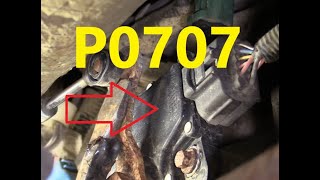
- If a scan tool is unavailable, use a multimeter to back-probe the signal wire at the sensor's connector. The voltage should change consistently for each gear position. A constant low voltage (under 0.5V) points to a bad sensor or a short to ground. 🎬 Watch: A quick guide to diagnosing and fixing P0707 codes.
- If the sensor and wiring test good, the issue may be a misadjustment of the sensor or, in rare cases, a fault within the Transmission Control Module.
Parts You'll Likely Need
- Transmission Range Sensor / Neutral Safety Switch
(OEM #GM: 24229422 / ACDelco: D2263C)— This is the most common component to fail, causing the P0707 code.
Trusted brands: ACDelco, Dorman, Standard Motor Products
OEM price range: $90-$150
Aftermarket price range: $60-$100
Related Codes That Often Appear With This One
- P0705 — P0705 indicates a general malfunction in the TRS circuit, while P0707 specifically points to a 'low input' signal. They often appear together if the signal is erratic.
- P0706 — This code indicates a 'range/performance' issue, often meaning the signal is irrational (e.g., between gears). It can be triggered by a misadjusted or failing sensor along with P0707.
Technical Service Bulletins (TSBs) & Recalls
- NHTSA 14V252000 (GM Recall 13036/14252) - BCM Connection Resistance
- NHTSA 12V460000 (GM Recall 12106) - Transmission Shift Cable Fracture
- NHTSA 09V073000 (GM Recall 09041) - Shift Cable Adjustment Clip
Platform-Specific Known Issues
- Recall NHTSA 14V-252 / GM 13036: Increased resistance in a Body Control Module (BCM) connection can cause voltage fluctuations that may prevent shifting out of Park or cause other electrical issues, mimicking a TRS failure.
- Recall NHTSA 12V-460 / GM 12106: On 2007-2010 models with the 4-speed automatic, the tabs on the transmission shift cable end may fracture, preventing proper gear selection and potentially causing a mismatch between the shifter and the transmission's actual gear.
- Recall NHTSA 09V-073 / GM 09041: On 2009 models, the transmission shift cable adjustment clip may not be fully engaged, causing a mismatch between the gear shifter's position and the actual transmission gear, which can trigger a range sensor code.
Mechanic-Grade Diagnostic Values
- Transmission Range Sensor (TRS) 'A' Circuit Voltage — expected: A distinct, steady voltage for each gear position that changes as the shifter is moved.. Failure: A voltage signal that is consistently below 0.5V, or a signal that is absent or does not change when moving the shifter.
- TRS Ground Circuit Resistance — expected: Less than 0.1V (100mV) drop.. Failure: A voltage reading higher than 0.1V indicates excessive resistance in the ground circuit, often at the G105 ground stud.
- TRS Signal Inputs to PCM/TCM — expected: The PCM/TCM receives a combination of signals from four separate circuits: Signal A, Signal B, Signal C, and Signal P. The combination of high/low states on these circuits determines the gear position.. Failure: An illogical combination of signals or a low signal on one of the circuits when it should be high.
Scan Tool Commands That Help
- Tech2 / GDS2 or equivalent advanced scanner: Live Data PID Monitoring (e.g., 'Trans Range Switch A/B/C/P State', 'TFP Switch') — This is the primary scan tool function for this code. It allows the technician to see the gear position status (Park, Reverse, Neutral, Drive, etc.) as the TCM is interpreting it in real-time. Comparing the scan tool data to the physical shifter position is the fastest way to confirm a fault in the TRS circuit.
Wiring & Ground Locations
- G105 — On a transmission-to-engine mounting stud, located on the left (driver's) side rear of the engine compartment, often below the upper coolant hose.. This is a critical ground point shared by the Transmission Range Sensor (PNP Switch), the Transmission Control Module (TCM), and the Engine Control Module (ECM). Wires at this stud are known to corrode and break, causing a loss of ground and leading to a P0707 code and a no-start condition.
- G106 — For the 3.5L engine, this ground is on the front of the engine at a transmission stud, near the TRS/PNP switch.. This is another major transmission-related ground point. If G105 appears intact, G106 should also be inspected for corrosion or damage.
- TRS Connector — On the external Transmission Range Sensor, which is bolted to the side of the 4T45-E transmission case, typically below the master cylinder and visible from the top of the engine bay.. This connector is the primary point for testing voltage and is highly susceptible to corrosion from moisture and road salt, which can cause the low circuit input.
Real Owner Repair Stories
- YouTube Channel 'Rainman Rays Repairs' (2007 Pontiac G6 3.5L) — No crank, no start condition. Horn was also inoperative (though likely unrelated). Wiggling a specific wire harness would sometimes allow the car to start.
❌ Tried (didn't work) Initial diagnosis was confusing due to intermittent nature.
✅ What actually fixed it The ground wires at the G105 ground stud on the transmission were corroded and broken inside the insulation, right at the ring terminal. The fix was to cut back the bad wiring, strip fresh wire, and crimp on a new ring terminal to re-establish a solid ground connection for the TCM and TRS.
Model Year Variations Within This Range
- 2007-2010: Later model year G6s, especially those with the 3.6L V6 engine, could be equipped with a 6-speed automatic transmission (6T40/6T45/6T70). On these transmissions, the range sensor is an Internal Mode Switch (IMS) located on the valve body inside the transmission. A P0707 on a 6-speed model is a significantly different and more labor-intensive repair, requiring removal of the transmission oil pan and valve body service, unlike the external sensor on the 4-speed 4T45-E.
Diagnostic Flowchart
Other Known Issues on This Vehicle
Issues unrelated to this code that are worth knowing about as an owner of this generation:
- Sudden Loss of Electric Power Steering (EPS) 🔴 High — Very common across all model years, subject to multiple recalls. (Ref: NHTSA 14V153000 (GM Recall 14116))
- Clunking Noise from Intermediate Steering Shaft 🟠 Medium — Widespread issue, often noticeable during low-speed turns. (Ref: GM TSB 06-02-35-009G)
- Leaking Sunroof Drains 🟠 Medium — Common problem leading to wet floorboards, particularly in the rear passenger area. Often caused by disconnected or clogged drain tubes.
- Faulty Body Control Module (BCM) Connection 🔴 High — Common enough to warrant a major recall; causes numerous electrical problems including brake light failure and inability to shift from park. (Ref: NHTSA 14V252000 (GM Recall 13036))
- Prematurely Worn Wheel Hub Bearings 🟠 Medium — A frequently reported issue causing a loud humming or 'helicopter' noise that changes with speed and turning.
Used vs. New Parts: Buying Guide for This Vehicle
When a used part is the smart pick: A used Transmission Range Sensor is generally not recommended due to its exposure to heat, moisture, and vibration leading to wear. However, it could be a viable option if a new OEM part is unavailable or cost-prohibitive, but only from a low-mileage donor vehicle that shows no signs of corrosion.
Donor-vehicle mileage cap: roughly under 80000 miles for the part to have meaningful remaining life.
What to inspect on the donor part:
- Inspect the electrical connector pins for any green or white powder (corrosion).
- Ensure the plastic housing is free of cracks or heat damage.
- Verify the metal shift lever arm is not bent, rusted, or excessively worn.
- Confirm it comes from a vehicle in a dry, salt-free climate if possible.
OEM-only on this vehicle (don't cheap out):
- While not strictly 'OEM-only', forum consensus and professional experience strongly favor using the ACDelco Professional or GM Genuine part for critical electronic sensors like the TRS to ensure reliability and avoid repeat repairs.
Aftermarket brands forum-validated for this vehicle:
- ACDelco (Professional or GM Genuine)
Brands owners have reported issues with on this vehicle:
- Dorman: This brand has a widely documented mixed reputation. While some of their products are well-regarded, their electronic sensors and complex assemblies are frequently cited by professionals as having higher failure rates than OEM. For a critical safety part like a neutral safety switch, many techs would rather install a used OEM part than a new Dorman part.
Real Owner Stories
Aggregated from forums and TSBs cited above. Mileages and costs reflect what owners reported in those sources.
Pontiac G6
Symptoms: Car wouldn't start, threw P0707.
What fixed it: Replaced the range sensor on the side of the trans and it fired right up.
Source hint: g6ownersclub.com
2008 Pontiac G6
Symptoms: P0707 code and inability to start.
What fixed it: The fix was a new transmission range sensor.
Source hint: pontiacforum.com
Pontiac G6
Symptoms: P0707 code was present.
What fixed it: Fixed by cleaning the corroded pins in the harness connector as a first step.
Source hint: G6 forum user cited in Common Causes
Related OBD-II Codes
Frequently Asked Questions
My 2009 Pontiac G6 won't shift out of Park and has a Check Engine Light. Could this be a recall issue?
My G6 won't crank or start. Is it definitely the starter?
I need to replace the Transmission Range Sensor on my G6. What is the correct part number?
My mechanic mentioned adjusting the sensor. Is that a valid fix for P0707?
Before I buy a new $100 sensor, is there a cheaper fix I should try first?
Do any of the shift cable recalls apply to my 2007 Pontiac G6?
Helpful Videos
We Have This Part in Stock




The information in this article is provided for general reference and educational purposes only. Vehicle specifications, procedures, and part compatibility can vary by production date, trim level, and region. Always consult your vehicle's factory service manual and verify part numbers before purchasing or performing repairs. Safety-critical components such as airbags, seat belts, and braking systems should be installed by a qualified professional.
- Pontiac G6:
- 🎬 Helpful Videos
- 🛍️ Shop This Part
- What's Unique About the 2005-2010 Pontiac G6
- Symptoms You May Notice
- Most Likely Causes
- Rare But Worth Checking
- Diagnosis Steps
- Parts You'll Likely Need
- Related Codes That Often Appear With This One
- Technical Service Bulletins (TSBs) & Recalls
- Platform-Specific Known Issues
- Mechanic-Grade Diagnostic Values
- Scan Tool Commands That Help
- Wiring & Ground Locations
- Real Owner Repair Stories
- Model Year Variations Within This Range
- Diagnostic Flowchart
- Other Known Issues on This Vehicle
- Used vs. New Parts: Buying Guide for This Vehicle
- Real Owner Stories
- Pontiac G6
- 2008 Pontiac G6
- Pontiac G6
- Related OBD-II Codes
- Frequently Asked Questions
- 🎟️ Get 5% Off