

P0700 on 2004-2010 BMW 5-Series: Transmission Malfunction Causes and Fixes
P0700 is a general code indicating a transmission fault. On a 2004-2010 BMW 5-Series (E60), this often points to a faulty crankshaft position sensor, low system voltage from a bad battery/alternator, or internal transmission issues like a failing mechatronic unit. A full diagnosis with a BMW-specific scanner is required to find the underlying problem.
- P0700 is a general alert from your transmission; the real, specific fault code is stored in the Transmission Control Module (TCM) and requires a BMW-specific scanner to be read.
- Before suspecting a major transmission failure, check for common E60 electrical issues: test the battery, check the alternator for proper voltage and oil contamination, and diagnose the crankshaft position sensor.
- A 'Transmission Malfunction' warning on the dashboard is serious. The car may enter a 'limp mode' with limited functionality, and driving should be avoided to prevent further damage.
- Known weak points on the ZF automatic transmission in these cars include the mechatronic sealing sleeve, which can leak, and the solenoids within the valve body.
What's Unique About the 2004-2010 BMW 5-Series
The E60-generation 5-Series is highly sensitive to electrical issues. A P0700 code on this car is frequently a symptom of another problem, not necessarily a primary transmission failure. A failing battery, a bad alternator (often contaminated by a common oil filter housing leak), or a faulty crankshaft position sensor can all disrupt communication with the transmission module, triggering a P0700 code and a 'Transmission Malfunction' warning. Owners often chase expensive transmission parts when the root cause is electrical or sensor-related. The ZF 6HP automatic transmission used in most models is also known for specific failure points like a leaking mechatronic sealing sleeve that can cause these symptoms.
Symptoms You May Notice
- Check Engine Light is on.
- 'Transmission Malfunction' or 'Transmission Fault' message on the iDrive display.
- Vehicle enters 'limp mode' (fail-safe mode), often stuck in 3rd gear.
- Harsh or delayed shifting.
- Inability to shift out of Park.
- Poor acceleration or sluggish performance.
- Decreased fuel economy.
- Engine takes a long time to crank before starting, or fails to start.
- Engine stalls or runs poorly.
- Replacing the entire transmission when the fault is a less expensive external component like the crankshaft position sensor or a wiring issue.
- Replacing the TCM when the actual problem is a leaking mechatronic sleeve or a bad ground connection.
- Mistaking air conditioning condensation dripping near the transmission for a mechatronic sleeve leak.
Most Likely Causes
- Faulty Crankshaft Position Sensor (CPS) 🔴 High Probability The TCM relies on the engine speed signal from the CPS to control shifting. A failing sensor provides an erratic or no signal, causing the TCM to register a fault and trigger a P0700, often with a 'Transmission Malfunction' message, even though the fault is with an engine sensor.
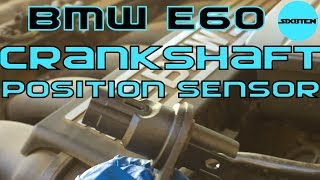
How to confirm: Scan for codes that accompany P0700, specifically P0335 (Crankshaft Position Sensor 'A' Circuit Malfunction) or BMW-specific code 2A94. The engine may also crank for a long time before starting, run rough, or stall. The sensor is located on the driver's side of the engine block, underneath the starter, making it very difficult to see and access.
Typical fix: Replace the crankshaft position sensor and its o-ring. 🎬 Watch: Step-by-step guide to replacing the crankshaft position sensor. Access is typically from underneath the vehicle and may require removing splash shields and an aluminum support plate. Due to the tight space, a ratchet with a swivel and E-Torx socket is often necessary.
Est. part cost: $50-$150 - Low System Voltage (Battery/Alternator) 🟡 Medium Probability The E60's complex electronic modules, including the TCM, are very sensitive to voltage. A weak battery or failing alternator can cause communication errors and trigger numerous faults, including P0700. A common E60 issue is an oil filter housing gasket leak, which drips oil directly onto the alternator, causing it to fail prematurely.
How to confirm: Test the battery and charging system. A healthy battery should be above 12.4V at rest. With the engine running, alternator output should be between 13.5V and 14.5V. Visually inspect the alternator and serpentine belt for oil contamination. Check for a loose battery cable connection in the trunk, which was subject to a recall.
Typical fix: Replace the battery and register it to the vehicle using a scan tool. If the alternator is faulty, it must be replaced. The source of any oil leak (usually the oil filter housing gasket) must also be fixed to prevent repeat failure. 🎬 Watch: How to replace the oil filter housing gasket.
Est. part cost: $200-$500 for a battery, $400-$800 for an alternator. - Mechatronic Sealing Sleeve (Connector Sleeve) Leak 🟡 Medium Probability The plastic sealing sleeve where the wiring harness connects to the transmission's mechatronic unit is a well-known failure point on the ZF 6HP automatic transmissions used in these cars. It leaks fluid, which can travel up the wiring harness via capillary action and damage the TCM or cause connection issues at the plug, leading to faults.
How to confirm: Visually inspect the area where the wiring harness enters the transmission for ATF (red or brownish fluid) leaks. This requires safely lifting the vehicle. Sometimes, what appears to be a leak is actually condensation from the rear A/C, so confirm the fluid type. If the connector is damp with ATF, the sleeve has failed.
Typical fix: Replace the mechatronic sealing sleeve, bridge seal, and other related seals (often sold as a kit). This also requires draining the transmission pan, replacing the pan/filter assembly, and refilling with the correct ZF-spec fluid to the proper level, which is a temperature-dependent procedure.
Est. part cost: $20-$50 for the seal kit. - Failing Mechatronic Unit (Valve Body / Solenoids) ⚪ Low Probability The mechatronic unit, which is the electro-hydraulic brain of the transmission, can fail. Solenoids can wear out or get clogged with debris from old fluid, leading to harsh shifting, shift flares, or failure to engage gears.
How to confirm: This is a diagnosis of exclusion after ruling out external electrical and sensor issues. A BMW-specific scan tool will show specific solenoid or pressure control faults (e.g., P0750 for a shift solenoid). A specialist may perform pressure tests or recommend a fluid/filter change as a first step.
Typical fix: Replace the faulty solenoids or rebuild/replace the entire mechatronic/valve body unit. This is a complex and expensive repair, but can be done DIY. 🎬 See this DIY walkthrough for servicing the mechatronic unit.
Est. part cost: $300-$800 for a solenoid kit, $1000+ for a rebuilt mechatronic unit.
Rare But Worth Checking
- Faulty Transmission Control Module (TCM): While the TCM can fail internally, it's more common for the issue to be with its power supply, ground connection, or sensor inputs. Fluid intrusion from a leaking mechatronic sleeve is a common cause of TCM failure. A full diagnosis should be performed before condemning the TCM.
- Low or Degraded Transmission Fluid: BMW marketed the fluid as 'lifetime,' but it degrades over time. Low or dirty fluid can cause shifting problems, overheating, and solenoid issues, leading to faults. A fluid and filter service is often a good first step on a high-mileage vehicle experiencing transmission issues.
Diagnosis Steps
- Scan for all codes in both the Engine Control Module (ECM) and Transmission Control Module (TCM) using a BMW-capable scanner. Do not use a generic reader that only shows P0700.
- Analyze the specific codes stored in the TCM. These will point to the actual problem (e.g., sensor, solenoid, communication).
- If a Crankshaft Position Sensor code (P0335 or 2A94) is present, diagnose that system first. Check for long crank times.
- Test the battery and charging system. Ensure voltage is stable and within specification (13.5-14.5V when running). Check for recalls related to the battery cable connection.
- Inspect the alternator for oil contamination from a leaking oil filter housing gasket, a very common E60 issue.
- Safely raise the vehicle and inspect the transmission for leaks, paying close attention to the mechatronic sealing sleeve where the wiring harness connects. Check if the fluid is ATF and not just water.
- Check the transmission fluid level and condition, if possible. Note that these transmissions do not have a traditional dipstick and require a specific procedure at a target temperature.
- If no external issues are found, diagnosis will shift to internal transmission components like solenoids and the valve body, which is best left to a professional.
Parts You'll Likely Need
- Crankshaft Position Sensor
(OEM #13627525015)— A very common failure point that sends a critical engine speed signal to the TCM.
Trusted brands: Bosch, VDO, Continental
OEM price range: $75-$150
Aftermarket price range: $40-$90 - Mechatronic Sealing Sleeve Kit
(OEM #24152333907 (Kit))— A known leak point on ZF 6HP transmissions that can cause fluid loss and electrical
Related Codes That Often Appear With This One
- P0335 — This code for the Crankshaft Position Sensor is a very common root cause for the TCM setting a P0700 fault.
- P1727 — This BMW-specific code indicates a communication fault between the engine and transmission control modules, often pointing to an electrical or sensor issue like the CPS.
- P07xx — Other P07xx codes (e.g., P0706 for Range Sensor, P0962 for a solenoid) are the specific faults stored in the TCM that cause the P0700 to be set in the ECM.
Technical Service Bulletins (TSBs) & Recalls
- NHTSA Recall 12V-122000: A recall was issued for a potentially loose insulated bulkhead connector for the positive battery cable in the trunk, which can cause electrical resistance and overheating, leading to various electrical faults.
- NHTSA Recall 12V-061000: A recall was issued for increased resistance at taillight electrical contacts, which while not directly related to the transmission, highlights the platform's sensitivity to electrical ground and connection issues.
- SI B 24 03 09: A service bulletin related to updating transmission software to address shifting complaints. While not a direct fix for P0700, it's a step dealers may take when diagnosing harsh shifting.
Platform-Specific Known Issues
- A leaking oil filter housing gasket is a very common issue on many BMW engines of this era. The leaking oil drips directly onto the alternator, causing it to fail and leading to low voltage conditions that trigger transmission faults.
Mechanic-Grade Diagnostic Values
- Crankshaft Position Sensor (Hall Effect type) signal voltage — expected: Approximately 5V with ignition on, engine off, and no metal near the sensor tip. Should drop to near 0V when a metal object is brought close to the tip.. Failure: Voltage does not switch between ~5V and ~0V, or is stuck at one value. If you see 12V, you are testing the wrong wire.
- Crankshaft Position Sensor (Hall Effect type) supply voltage — expected: Approximately 12V on the power supply wire with ignition on.. Failure: No voltage indicates a wiring or power supply issue from the DME.
Hidden / Shadow Codes Worth Checking
- 5088: Sensor, gearbox selector switch (L1-L4). This is a very common BMW-specific code stored in the EGS (transmission module) that points to a fault with the position sensors inside the mechatronic unit. It often triggers when the transmission is hot. (see via A BMW-specific scanner like ISTA, INPA, or a high-end professional scan tool is required.)
- A830: Fault in GWS (Gear Selector Switch) when returning from manual gate. This code is stored in the GWS module itself on LCI models with the electronic 'joystick' shifter. (see via BMW-specific diagnostic software (ISTA/INPA).)
- 5117: GWS (Gear Selector Switch) faulty. This is another code pointing to an issue with the LCI electronic shifter module. (see via BMW-specific diagnostic software (ISTA/INPA).)
- CF30: A fault code related to the Gear Selector Switch (GWS), indicating an inability to shift. (see via BMW-specific diagnostic software.)
Scan Tool Commands That Help
- ISTA: Service Functions > Powertrain > Transmission control > Adjustment > Display and reset adaptation values — This function should be used after replacing major transmission components like the mechatronic unit or solenoids, or after a fluid service, to force the transmission to relearn shift points and clutch pressures. Note: Experts advise against resetting adaptations on a high-mileage transmission without a specific reason, as it won't fix mechanical wear.
- ISTA/INPA: Clear Fault Memory — After any repair, all fault codes in all modules should be cleared. For some procedures, like SMG adaptations, codes must be cleared twice to ensure the system resets properly.
Wiring & Ground Locations
- Engine Ground Strap — A braided metal strap connecting the engine block to the vehicle's chassis. On the E60 535i (N54), it is located on the passenger side, connecting the engine mount area to the frame, and is notoriously difficult to access. On other models like the 3-series with the same engine, it's on the more accessible driver's side.. This strap is the primary ground path for the engine and all its electronics, including the starter and alternator. Over time, it corrodes and breaks, causing high resistance. This can lead to slow cranking, no-start conditions, and a host of bizarre electrical faults across various modules, including the TCM, due to unstable voltage and poor grounding. A bad ground can mimic a failing battery or alternator.
Real Owner Repair Stories
- Bimmerfest forum user (2007 BMW 525i) — Communication error with EGS (Transmission Control Module), dealership diagnosed faulty mechatronics.
❌ Tried (didn't work) Clearing codes after cleaning a small amount of oil from the mechatronic connector.
✅ What actually fixed it The owner sourced a complete used transmission. The fix required swapping the EGS (the black plastic computer part) from the original, faulty mechatronic unit onto the valve body of the donor transmission. The EGS is VIN-coded to the car and must be transferred for a used part to work. - YouTube user 'SA Diagnostic's' (2004 BMW X5 4.4 (E53, but uses same ZF6HP transmission and principles)) — Car goes into failsafe mode when hot, won't start until it cools down, PRNDL display disappears. Code 5088 (Sensor gearbox selector switch) present.
❌ Tried (didn't work) Forum suggestions to replace the shifter assembly.
✅ What actually fixed it The problem was diagnosed as a heat-related failure of the selector switch position sensor, which is integrated into the mechatronic unit. Replacing the faulty component on the mechatronic unit (the slide piece/position sensor board) resolved the issue. - YouTube user 'Unprofessional Ivan' (BMW E60 with 6HP19 transmission) — Infamous 5088 L1-L4 error, no gear selection recognized on the dashboard.
❌ Tried (didn't work) Initial diagnosis pointed towards entire mechatronic failure.
✅ What actually fixed it The root cause was a faulty circuit board for the Hall effect sensors that detect gear position. The fix involved removing the mechatronic unit, drilling out the rivets holding the black plastic EGS computer, and replacing only the small internal circuit board with a new one (costing around $10). This is a permanent fix for the 5088 code when caused by this specific board failure.
OEM Part Supersession History
24347519357→24347588725— Updated design for the mechatronic connector sealing sleeve to improve sealing and prevent leaks.
Heads up: The newer part number 24347588725 is the correct replacement for all E60 models with the ZF 6HP transmission.
Model Year Variations Within This Range
- 2008-2010 (LCI models): The Life Cycle Impulse (LCI) facelift introduced a 'shift-by-wire' electronic joystick (GWS) instead of the pre-LCI mechanical shifter. This new shifter is a complex electronic module prone to its own unique failures, such as internal wiring degradation, which can cause transmission faults and codes.
- 2004-2007 (Pre-LCI): Pre-LCI models used a traditional mechanical gear selector with a physical link to the transmission. While less complex electronically, they can still have issues with the selector mechanism itself.
- Post-2007 (LCI): LCI models received updated engines (e.g., N52K) and transmission software that addressed some earlier reliability issues. They also introduced features like regenerative braking. These changes can affect diagnosis, as software and hardware revisions were made.
Diagnostic Flowchart
Other Known Issues on This Vehicle
Issues unrelated to this code that are worth knowing about as an owner of this generation:
- Electric Water Pump & Thermostat Failure 🔴 High — Commonly fails between 60,000-90,000 miles, often without warning.
- Oil Filter Housing Gasket (OFHG) Leak 🔴 High — Extremely common. The gasket hardens and leaks oil, often onto the alternator and serpentine belt, which can cause belt failure and major engine damage.
- Valve Cover & Gasket Leak 🟠 Medium — Very common. The plastic cover can crack/warp and the gasket hardens, causing oil leaks onto the exhaust manifold (fire risk) or into spark plug wells (misfires).
- N54 High-Pressure Fuel Pump (HPFP) Failure 🔴 High — A notorious issue on the 535i models with the N54 engine. Symptoms include long cranks, stuttering, and sudden loss of power. Subject to an extended warranty/recall. (Ref: BMW Extended Warranty (10 years/120,000 miles))
- N54 Turbocharger Wastegate Rattle 🔴 High — Common on the twin-turbo N54 engine (535i). Caused by wear in the wastegate actuator rod/bushings, leading to a rattling noise on deceleration and eventual loss of boost.
- N52 Hydraulic Valve Lifter (HVA) Ticking 🟡 Low — Common on earlier N52 engines (pre-2009), causing a ticking noise, especially on cold starts. Generally considered an annoyance rather than a critical failure.
- iDrive System Malfunctions 🟠 Medium — Early E60 models can experience failures of the CCC (Car Communication Computer), leading to a blank screen and loss of control over infotainment, climate, and vehicle settings.
Used vs. New Parts: Buying Guide for This Vehicle
When a used part is the smart pick: A used transmission assembly or mechatronic/valve body can be a cost-effective choice, BUT it is critical to swap your original EGS (the black plastic computer module) onto the used part, as the EGS is VIN-locked to your car. A used Gear Selector Switch (GWS) for LCI models is also a good option, provided you inspect the internal wiring for degradation before purchase.
Donor-vehicle mileage cap: roughly under 120000 miles for the part to have meaningful remaining life.
What to inspect on the donor part:
- For a mechatronic/transmission, ask for service history if available. Lower mileage is always better.
- For a GWS (LCI shifter), demand clear photos of the wires under the shifter boot. If the insulation is cracked or flaking, do not buy it.
- Check the part number on the donor component and verify compatibility using a VIN decoder or parts catalog like RealOEM; shifters for Sport Automatic Transmission (SAT) are different.
- Buy from a reputable dismantler who offers a short warranty period (e.g., 30-90 days) to protect against DOA parts.
OEM-only on this vehicle (don't cheap out):
- Mechatronic Sealing Sleeve and Bridge Seal: These are inexpensive but absolutely critical seals. The cost savings of an aftermarket part are not worth the risk of a leak, which requires repeating a very labor-intensive job. Use OEM ZF or Genuine BMW parts.
- Transmission Fluid: Use only the specified fluid, such as ZF Lifeguard 6. Using a generic 'universal' fluid is a common cause of shifting problems.
Aftermarket brands forum-validated for this vehicle:
- Bosch / VDO / Continental: These are often the Original Equipment Manufacturers (OEM) for sensors like the Crankshaft Position Sensor. Buying these brands is equivalent to getting a Genuine BMW part without the dealership markup.
- ZF: As the manufacturer of the 6HP transmission, any parts from ZF, like the pan/filter, seals, or solenoids, are considered OEM quality.
Brands owners have reported issues with on this vehicle:
- Unbranded or 'white box' electronic sensors from online marketplaces. These frequently have high failure rates and can cause diagnostic headaches.
Real Owner Stories
Aggregated from forums and TSBs cited above. Mileages and costs reflect what owners reported in those sources.
2004-2010 BMW 5-Series
Symptoms: The engine takes a long time to crank before starting and the 'Transmission Malfunction' message appeared on the screen.
What fixed it: Replacement of the Crankshaft Position Sensor (CPS) and its o-ring, located underneath the starter on the driver's side of the engine block.
Source hint: YouTube video 's-g8G8-3jGk' showing CPS failure symptoms and location
BMW E60 5-Series
Symptoms: Transmission fluid was leaking from the area where the wiring harness connects to the transmission; the owner was concerned about fluid entering the connector and causing limp mode.
What fixed it: Replaced the mechatronic sealing sleeve, bridge seal, and transmission pan/filter assembly, followed by a refill with ZF-spec fluid.
Source hint: 5series.net thread 'sealing-sleeve-mechatronic-unit-replacement-tips-113308'
BMW E60 5-Series
Symptoms: The 'Transmission Fault' message appeared suddenly, leading to concerns about the reliability of the ZF 6HP transmission.
What fixed it: Diagnosis of the electrical system and potential sensor issues, as owners noted the platform's sensitivity to voltage and sensor signals.
Source hint: Reddit r/e60 thread 'Transmission fault msg appeared how worried'
Related OBD-II Codes
Frequently Asked Questions
Why does my iDrive display 'Transmission Malfunction' when the problem might be an engine sensor?
Is there a recall for the electrical issues causing my P0700 code?
Can an oil leak from my engine cause this transmission code?
What is the 'sealing sleeve' and why is it mentioned for my ZF 6HP transmission?
My car is stuck in 3rd gear and won't shift; is this part of the P0700 fault?
Does BMW have a software update for harsh shifting issues?
Helpful Videos

Used OEM Parts in Stock
New Aftermarket Parts Available


The information in this article is provided for general reference and educational purposes only. Vehicle specifications, procedures, and part compatibility can vary by production date, trim level, and region. Always consult your vehicle's factory service manual and verify part numbers before purchasing or performing repairs. Safety-critical components such as airbags, seat belts, and braking systems should be installed by a qualified professional.
- BMW 5-Series:
- 🎬 Helpful Videos
- 🛍️ Shop This Part
- What's Unique About the 2004-2010 BMW 5-Series
- Symptoms You May Notice
- Most Likely Causes
- Rare But Worth Checking
- Diagnosis Steps
- Parts You'll Likely Need
- Related Codes That Often Appear With This One
- Technical Service Bulletins (TSBs) & Recalls
- Platform-Specific Known Issues
- Mechanic-Grade Diagnostic Values
- Hidden / Shadow Codes Worth Checking
- Scan Tool Commands That Help
- Wiring & Ground Locations
- Real Owner Repair Stories
- OEM Part Supersession History
- Model Year Variations Within This Range
- Diagnostic Flowchart
- Other Known Issues on This Vehicle
- Used vs. New Parts: Buying Guide for This Vehicle
- Real Owner Stories
- 2004-2010 BMW 5-Series
- BMW E60 5-Series
- BMW E60 5-Series
- Related OBD-II Codes
- Frequently Asked Questions
- 🎟️ Get 5% Off